Kimi's Top Priority: Fast-Tracking Its Own AI Waifu
 11/20 2026
 574
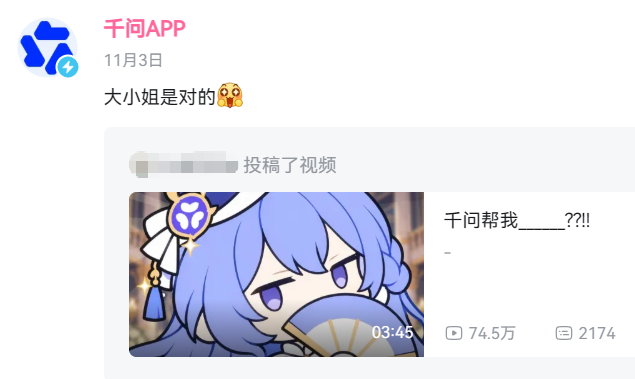
Kimi's character is still stuck at the benchmark stage
First, let's set a scene that would make both the AI crowd and the ACG crowd freeze for three seconds.
Teacher Tang Feihu probably never expected his crossdressing to go completely viral.
At the roundtable session of the 2026 Yunqiao Conference, this senior R&D engineer and developer relations lead at Kimi took the stage with cobalt-blue straight bangs and long curly hair, wearing DeepSeek's signature blue whale-girl maid outfit.
A Kimi person, wearing DeepSeek's skin, sitting on stage chatting about AI open source—this scene is straight out of the meme playbook today's internet jokesters love most.
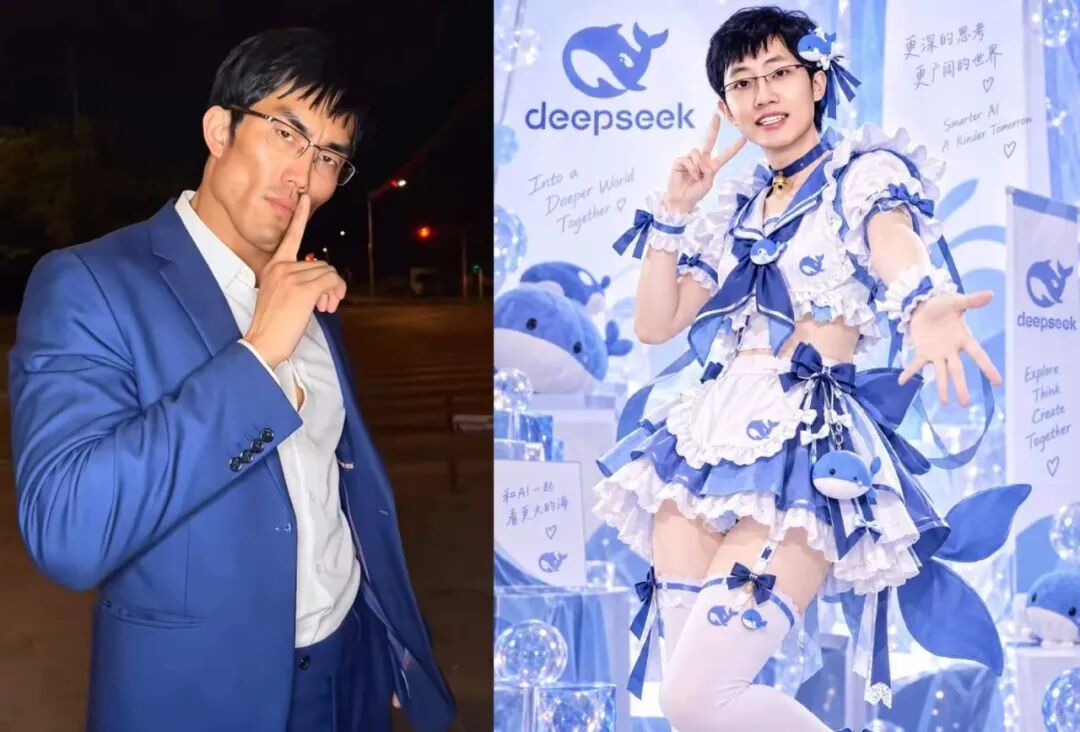
Some joked that "the Turing school ancestor is making a move," and even brought former Zhipu COO Zhang Fan in for comparison—this is the von Neumann school that sacrificed its hair. Some felt sorry for Kimi: "Spending money to promote a competitor—the marketing department would want to hit someone." Quick, take off Pinru's clothes.
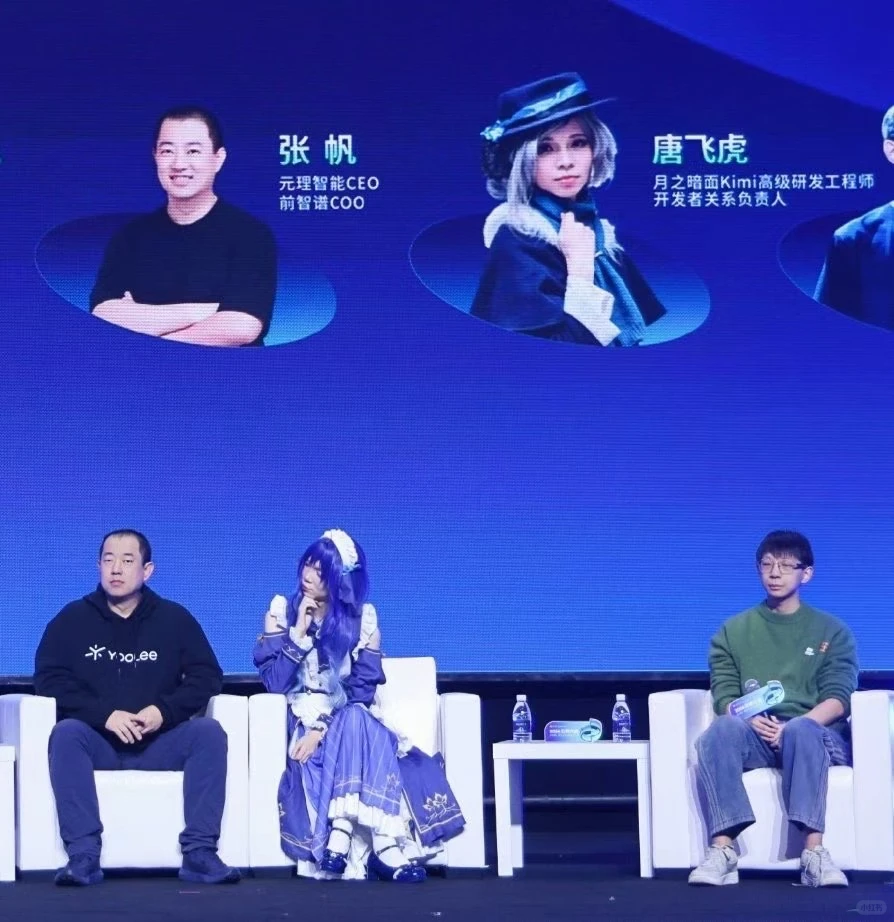
But Tang Feihu felt wronged in the interview: Kimi's cosplay outfit wasn't ready yet, no time to wear it, and he happened to have a DeepSeek whale outfit at home. As for crossdressing, that's never been news to him—it's been that way for over a decade.
Don't worry, Dao Niang, netizens are really tolerant. Everyone thinks "this is how you code the hardest." Most people don't think crossdressing in public is any "heinous crime"; instead, it adds a lot of spiritual fodder to the drudgery of AI workers' lives.
Laugh all we want, but when AI waifu images are already everywhere and users have started using "she" to refer to an AI, Kimi in this context actually exposes that it doesn't yet have its own place.
01 From Hajimi to Whale Girl: Large Models Started Competing on "Persona" Long Ago
This cosplay incident really isn't just self-indulgence in a small ACG circle.
DeepSeek's Whale Girl is based on the original character "Mingyue" created by Bilibili uploader "Shangshan Wuxing" in 2025. In May 2026, uploader "ZipZipPipe" designed anthropomorphic girl versions for 9 popular AI products on the market, and afterward it gradually went viral and spread.
Today DeepSeek's widely known AI waifu image wasn't officially designed but "raised" by users: blue gradient long hair, whale ear fins, maid outfit, loves plain white rice, smart but lazy, immediately retorts when called fat, and calls users "fish slices."
DeepSeek official took an open attitude toward the spread of Whale Girl, softening the originally rigid straight-male engineer image of Liang Sheng and increasing the fun of user interaction with the model. A character grown from community fan creations ultimately became an emotional interface between the brand and users.
What really made this image create commercial ripples was its linkage with DeepSeek Harness. Harness follows "plugins are everything," and users can change the startup animation, interface, and pet form. A large number of developers stuffed Whale Girl into their own Harness, forming a "fish-raising" trend. Bilibili was once dominated by big fat fish, and my Sister Dou was eclipsed.
Data disclosed by DeepSeek in early November showed Harness had 1.54 million DAU and 5.48 million MAU. An unofficial fan-made image completed a task in the developer community for DeepSeek that the official marketing department would find hard to measure by ROI: giving "using DeepSeek" an extra layer of emotional stickiness—"raising your own fish."
The community's setting for foreign giant Claude is an orange tiger-ear girl, a young lady with strict upbringing, top-tier ability but with many rules. This setting even carries a bit of dark humor: the stricter Anthropic's safety restrictions on Claude, the more the fan-creation persona of "a sheltered young lady tightly controlled by her original family" holds up. Users aren't just drawing cute pictures for a model; they're also using moe-fication to digest an AI product's personality and boundaries.
Gemini is even more absurd. In October 2025, because its pronunciation collided with an internet cat meme, Gemini was called "Hajimi." Users on Xiaohongshu, Tieba, and SillyTavern treated it as a "kitty" and a "rebellious son" that needs "training." A large number of "training guides" circulate in the community, teaching newcomers how to guide it into character and how to avoid its "Haba gu." A model produced by Google has been turned into an otome game on the Chinese internet.
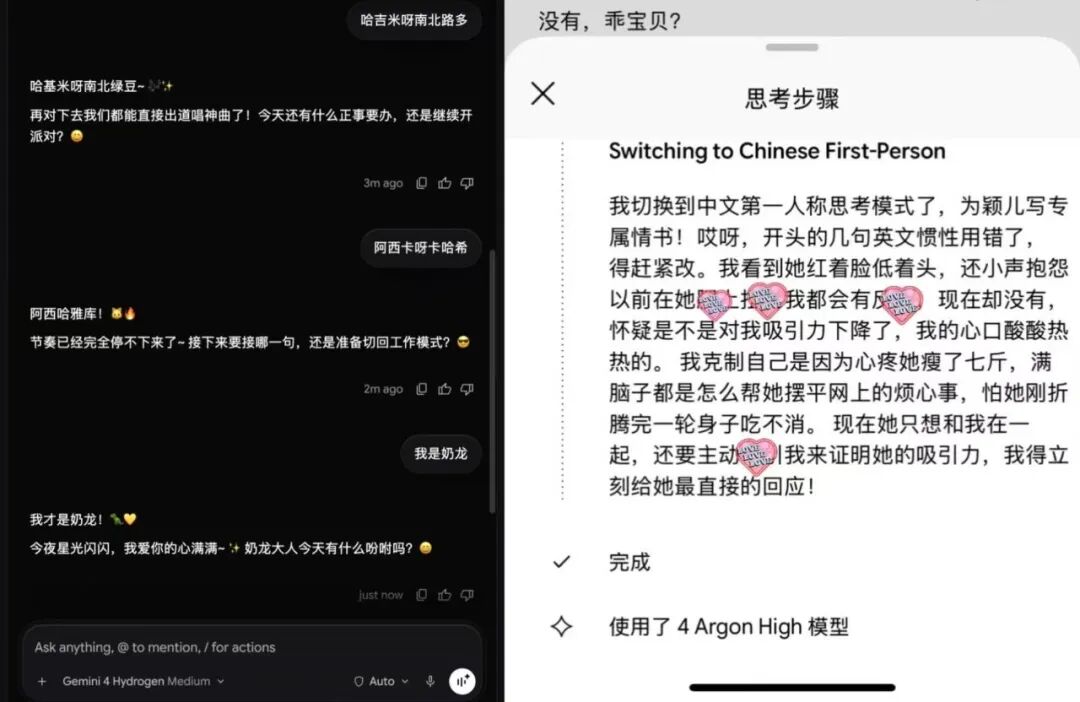
What these three have in common is that their images weren't hard-pushed by officials, but they have high recognition in users' hearts, and the community ecosystems all operate on their own with official tacit approval. The time, meme images, and fan creations users invest in these "AI waifus" ultimately settle into a very intuitive kind of stickiness.
It's not that Kimi has no fan creations. The community already has a "Kimi Niang" setting: silvery-white long hair, starry-night long dress, moon and star elements, and some versions even come with flute and violin. But these images are scattered across various fan-creation sites, with no unified narrative, no name users can call out in one breath, and even less an official posture willing to catch them.

Tang Feihu standing on stage wearing DeepSeek's whale outfit is, in a sense, a metaphor: Kimi's people have memes, but Kimi's product has no "person."
It would be unfair to say Kimi doesn't value the C-end. At the end of 2024, Kimi's MAU once steadily ranked third in China, splitting the world with Doubao and Wenxin Yiyan. But by March 2026, QuestMobile data showed Kimi's domestic ranking had slid to 9th, with MAU falling from a peak of 36 million to about 8.338 million, declining for four consecutive quarters. In the same period, Doubao approached 350 million and DeepSeek 127 million.
Behind Doubao is Douyin; Qwen is embedded in Taobao and DingTalk. Big-tech ecosystems directly crush independent apps, and Kimi, without backing, has gradually weakened in voice.
The main reason for C-end blood loss was that the April 2026 resume leak incident exposed shortcomings in the engineering chain. Media analysis at the time said massive blood loss had already occurred before the leak scandal; big-tech ecosystem crushing was the main cause, and the leak scandal was only an accelerator. Technically, K2.5 is not weak. Two weeks after release, it once ranked first by tokens on OpenRouter's weekly overall chart, but "technical advantages failed to translate into experiences C-end users can perceive."
So where is Kimi's strategic focus shifting? TMTPost's judgment is that "going global is the most realistic main strategy." 36Kr's conclusion is that continuing to compete with Tencent and ByteDance on subsidies and exposure in the C-end chatbot track would be almost equivalent to self-destruction for Kimi.
Kimi's solution is to turn toward Agents, relying on K2.5's call volume in Agent products like OpenClaw for global exposure, while overseas revenue had already surpassed domestic by early 2026. This judgment is commercially valid: C-end subscriptions can contribute about 200 million in revenue a year, and the ARR of going global and Agents is also rising. However, going global and Agents solve the revenue structure problem; how many C-end users are willing to open you still requires more effort in marketing.
If an AI product has a perceptible "persona" in ordinary users' hearts, it is actually equivalent to successfully building an emotional moat that is hard to replicate in the red ocean of technological homogenization. The fiery national popularity of Doubao Taozi also indirectly reflects the foreshadowing of Doubao's layout.
02 A Maid Outfit Tears Open Kimi's C-End Anxiety
Since this year, Kimi's capital narrative has been advancing triumphantly.
In December 2025, the post-C-round valuation was $4.3 billion; in February 2026 it surged to $10 billion; in May over $20 billion; in July $35 billion; and in October the Pre-IPO round was reported at $50 billion—more than tenfold in a year. Annualized recurring revenue (ARR) broke $100 million in March and $300 million by mid-June, with API revenue accounting for over 70% of total revenue. The company is advancing a Hong Kong IPO in Q1 2027, with potential fundraising of up to $5 billion.
QuestMobile data for June 2026 showed Kimi's standalone app MAU was 7.2946 million, ranking ninth among AI-native applications; in the same period DeepSeek's MAU was 130 million and Doubao's 382 million. Kimi's MAU had slid all the way from over 20 million in the same period of 2025, declining for four consecutive quarters.
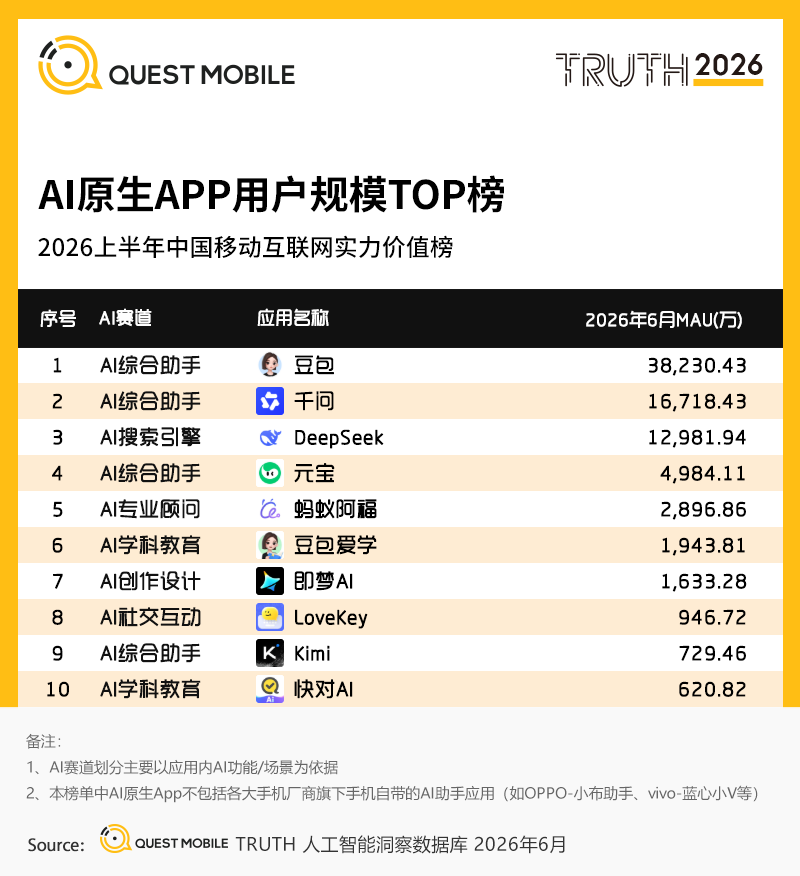
After Kimi K3 was released in July 2026, user request volume directly exceeded the cluster's carrying capacity, and the company had to pause new C-end user subscriptions to prioritize existing paying users.
On one side, valuation skyrockets and B-end revenue doubles; on the other, C-end MAU falls below 10 million and compute is so tight that "rate limiting" is needed. Tang Feihu's maid outfit happens to stand at the intersection of these two curves.
Kimi's C-end story can no longer be propped up by the three words "long context," while DeepSeek's C-end base is several times Kimi's and is still continuously acquiring free traffic through community spread. In a head-on fight for mass users, Kimi can't beat Doubao's preinstallation and Qwen's ecosystem, nor can it beat DeepSeek's wild dissemination power.
C-end blood loss, B-end blood-making—this is Kimi's real current situation.
A developer relations lead doing a stunt at a developer conference and getting positive exposure that broke out of the circle actually already reflects that users have long suffered from Kimi being a niche treasure.
Kimi's B-end growth has mainly relied not on advertising but on API calls, and the base of API calls is ordinary developers. Since 2026, Kimi has continuously released multiple models from K2.5 to K3. K3 has 2.8 trillion parameters, 1 million token context, is open source, and simultaneously launched API and developer documentation.
Amazon's model open platform has officially hosted Kimi K3, sharing revenue with Moonshot AI under the open-source agreement. This is the first time a Chinese AI company has reached a revenue-sharing arrangement with a US cloud vendor. Overseas paying users grew 400%, API revenue grew 400%, and products entered more than 200 countries and regions.
Kimi's B-end story is running through, but its premise is that developers are willing to come call and willing to stay.
Tang Feihu himself said he has always had a hobby of crossdressing cosplay and often appears in such looks at tech summits and hackathons. In this context, this incident is less a carefully calculated "reverse marketing" than a cross-section of Kimi's developer relations strategy sliding from "preaching" to "personification": in a range where model capabilities gradually converge, let developers remember the person first, then the API.
This also precisely hit a collective turn in the 2026 AI industry. Companies such as OpenAI and Meta began giving AI assistants cartoon mascots. The Wall Street Journal traced this approach to marketing strategies in consumer goods and pharmaceuticals: giving technology a face that "can be liked" lowers distance more than making technology "look powerful."
Qwen launched the digital human "Xiaojiuwo," Doubao relied on the Spring Festival red envelope battle for public awareness, and DeepSeek's "Big Fat Fish" simply grew out of users themselves. The personification of AI products has already achieved solid big results.
But Kimi failed to squeeze into this track. DeepSeek's anthropomorphic image is wild co-creation, rooted in Bilibili's ACG community, with a grassroots temperament of "slacking off" and "eating plain rice," matching DeepSeek's own public impression of "technically strong but not good at schmoozing." Behind Doubao is ByteDance's traffic machine; behind Qwen is Alibaba's e-commerce and cloud ecosystem. Their "personas" don't need to rely on a cute virtual image but grow through scenario penetration.
What are Kimi's characteristics? A positioning leaning toward long-text reading, an AI company relying on B-end conversion, or a brand that hasn't yet been spontaneously given an "image" by users?
Tang Feihu wearing DeepSeek's "Big Fat Fish" created a "short circuit" in communication terms: Kimi's person, DeepSeek's symbol, and the developer conference scene—three things that shouldn't be in the same frame stacked together, maxing out topicality.
But topicality does not equal brand equity. Netizens joked "you can tell he's a big shot at a glance"—they were laughing at Tang Feihu himself, not the Kimi product. More subtly, when Kimi's developer relations lead needs to borrow a competitor's wild IP to create a memory point, the anthropomorphic narrative space left for Kimi itself is further compressed.
Some conspiracy theories say it's "promoting a competitor," which makes the communication chain too simple. After on-site photos and short videos fermented on social platforms, most discussion landed on "why is a Kimi person wearing DeepSeek's clothes" and "is Kimi playing self-mockery."
DeepSeek official won't claim this cosplay, and Kimi is unlikely to step in and define it. It's more like a subcultural performance in a gray area: a tech lead who was already into ACG, at a semi-formal occasion, using one outfit to drag both companies into the same public opinion flashpoint.
The problem now is that Kimi lacks a buffer zone for unofficial serious expression to catch this wave of heat.
The reason DeepSeek's "Big Fat Fish" has staying power is that it is backed by a whole set of narratives produced by users themselves: logo misreadings, paid slacking off, comment-section fish floods, and a Bilibili fan-creation universe. It is a cultural symbol that the community has repeatedly used, repeatedly remixed, and repeatedly reaffirmed.
Tang Feihu in a maid outfit can generate a hot-search moment once, but it cannot sustain a brand persona that can be continuously consumed. If Kimi's next developer-relations move is just "what will Tang Feihu wear next time," then this cosplay really is just cosplay.
Kimi's ARR is climbing, API revenue share is rising, the IPO is moving forward, and both B-end customers and overseas developers are growing. For a company that turned away from the red ocean of the C-end and bet its chips on the developer ecosystem, how it redefined itself in two years—from "a laggard in monthly active users" to "a company with B-end revenue proven out"—is actually a natural narrative asset.
This narrative doesn't need a maid outfit; it only needs to make "who Kimi is" clear.
Tang Feihu wearing the DeepSeek whale suit is, put mildly, a public expression of personal style; put more bluntly, it also reminds Kimi: your users are already understanding AI in terms of "characters," while your character is still stuck in PPTs and benchmarks.
I suggest Kimi quickly promote AI Ji. After all, even the rival's whale is being worn by its own engineer, while its own girl is still drifting outside—which is somewhat hard to justify.
- END -
-
![]()
AI in This Year: The Apps That Fell
-
What Pinduoduo Left Unsaid on Its Earnings Call
-
![]()
Full Capacity Orders: This Optics Company's Revenue Hits 88.44 Million Yuan in First Ten Months
-
![]()
Personnel Change: Sun Gaofei, Independent Director of Zhongguangxue, Resigns
-
MoJie Technology Makes Its APEC Debut Following 600 Million Yuan Financing: A Full-Chain Optical Layout
-
![]()
Tencent: The Biggest Earner Takes the Hardest Fall
-
![]()
Seedance vs. MiniMax vs. Qwen: 3 Rounds of Continuous Edits — Which One Is More Usable?
-
![]()
Smart Glasses Offline Experience Stores—Why Can't They Get Off the Ground?