Smart Glasses Offline Experience Stores—Why Can't They Get Off the Ground?
 11/20 2026
 561
For a new consumer electronics category, the greatest value of offline retail lies in letting the product step out of the spec sheets at launch events and land in real-life scenarios.
When it comes to the industry as a whole, most of what we discuss is public data on new products, shipments, and marketing revenue. But once we turn to offline channels, a different phenomenon emerges.
How many stores has the industry opened so far? What about single-store break-even? What share of shipments goes offline, and what does the market landscape look like? What are brands' offline store opening plans?
As things stand, these data questions are blind spots for the entire smart glasses industry. The reason accurate data is unavailable is that offline store openings are still at the early 1.0 stage. Smart glasses offline channels have yet to produce a mature, scalable, replicable model—a far cry from the channel evolution path the mobile phone industry once followed.
After several years of hype, with multiple institutions forecasting shipments in the millions to tens of millions, why is this new smart hardware force—smart glasses—still not seen everywhere offline?
Zhu Ming (pseudonym), who has worked in smart hardware for many years, believes the identity of smart glasses is itself split. It is a standard 3C digital product, and at the same time it is an optical product worn on the face. The two capabilities belong to two completely different channel systems and have never truly been connected.
The question is, why is it the way he describes?
01
Speed gap: online grows fast,
offline penetration is slow
Everyone knows that for smart glasses to truly reach the masses, offline channels are an unavoidable hurdle. At the Shenzhen Smart Glasses Industry Development Forum hosted by VRAR Planet on October 27, several roundtable guests also emphasized on site that offline experience is very important. After all, users can try the weight, clarity, and translation latency on the spot, feel the comfort of daily wear, and then judge which model suits their work, commuting, and lifestyle.

Many brands understand this. Their flagship stores simultaneously carry after-sales, experience, and sales functions, and also organize user salons and scenario experience classes from time to time, providing professional usage guidance and product education—themselves a channel for spreading brand momentum.
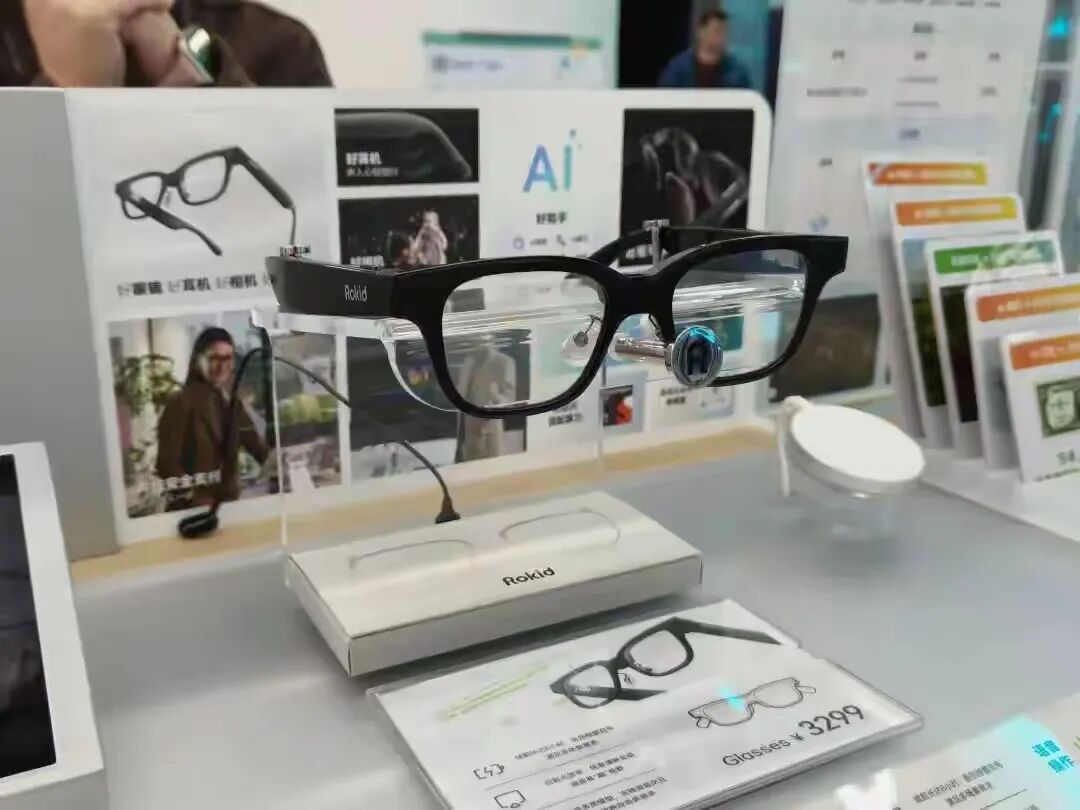
Manufacturers are indeed accelerating their layout. For example, Rokid founder Zhu Mingming once said that Rokid has opened 1,007 offline retail stores, including franchise stores; in nearly 40 of them, revenue related to smart glasses has exceeded half of the store's total revenue.

Alibaba, meanwhile, has tried partnering with traditional lens brand stores for distribution. RayNeo was previously reported to be continuously penetrating offline outlets through refined operations. Brands with their own hardware stores, such as iFlytek and Xiaomi, are in a position to gradually increase the display share of smart glasses in their existing channels.
In August, Sharge opened its first AI glasses flagship store, located in Wuhan MixC, the largest single shopping mall in the country. The store fully carries the display, experience, and sales functions of AI glasses products. Sharge founder Zhang Qianyin bluntly said he wants to be "the Pang Dong Lai of the AI glasses world."
Most recently, in November this year, INMO Tech's first global brand flagship store landed in the Nanjing West Road commercial area of Shanghai, where passersby can walk in and try on the full product line.

But so far, no channel model has proven it can be replicated quickly. A thousand-store scale sounds impressive, but spread across hundreds of cities nationwide, the number of outlets in each city is still sparse. Flagship stores offer a good experience but also cost a lot per store, so they can only land in a few core commercial districts. Cooperative distribution has a low threshold but is prone to problems such as unprofessional staff explanations and inadequate service, ultimately degenerating into displays that are just "there to look at."
Fast online growth and slow offline penetration have become a vivid portrait of the current smart glasses industry. The industry is now all talking about the "iPhone moment" of smart glasses, but behind the speed gap lies the channel contradiction unique to this category—and the most core difference between it and the mobile phone track.
02
Optical shops don't understand tech,
electronics stores can't do prescriptions
Years ago, mobile phone brands such as OV and Huawei relied on carrier outlets and township mom-and-pop stores to reach lower-tier markets, gradually penetrating urban chain stores, and only when the industry landscape stabilized and the market matured did leading brands gradually open high-end brand flagship stores. Looking back at the channel development history from feature phones to smartphones, mobile phones followed a bottom-up path.
Smart glasses follow exactly the opposite rhythm. Many brands first open experience stores and flagship stores in core commercial districts, then try to expand into lower-tier channels, and truly large-scale offline outlets have yet to appear. Open a map and search for smart glasses experience stores—what most cities can find are still traditional optical shops, and stores that are genuinely smart glasses stores or AI glasses stores can be counted on one hand.
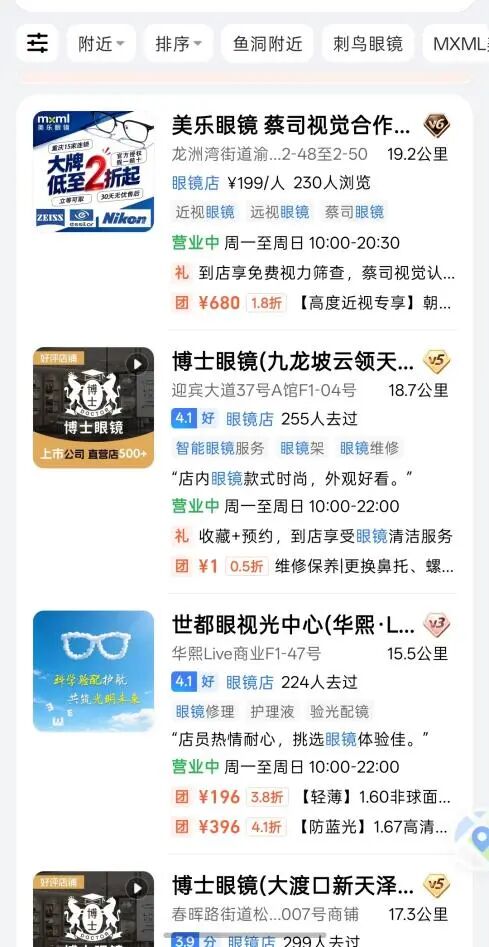
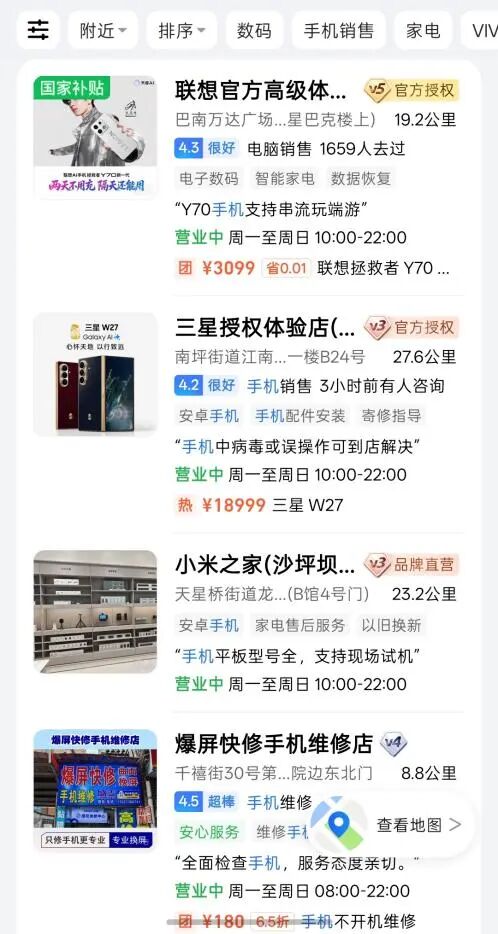
However, the core of the difficulty in expanding is the structural mismatch of channel capabilities: optical shops don't understand tech, and electronics stores can't do prescriptions.
Going back to the beginning, Zhu Ming (pseudonym), who has worked in smart hardware for many years, believes that from the perspective of industry development, the biggest bottleneck in current AI glasses offline sales is that single-store sales just can't be pushed up. The constraints are concentrated at both ends: on one end, traditional optical stores are not good at the sales logic of electronic consumer goods and don't know how to do feature demonstrations and scenario education; on the other end, AI glasses themselves have special attributes, possessing both consumer electronics and optometric service attributes, and their integration with traditional optometric stores remains at a very shallow level.
In Zhu Ming's view, the identity of smart glasses is itself split. It has a chip, a battery, can connect to the internet, and can run AI applications—it is a standard 3C digital product that requires someone to explain parameters such as computing power, battery life, features, and system updates; at the same time, it is an optical product worn on the face that requires optometry, prescription lenses, adjustment of frame curvature, and fitting for wearing comfort—inseparable from professional optometric services. The two capabilities belong to two completely different channel systems and have never truly been connected.
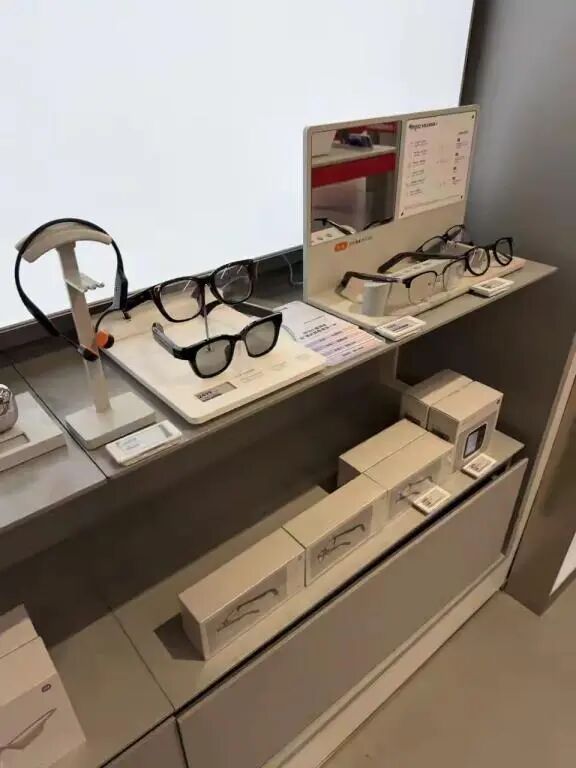
As a result, consumers' purchasing paths are often fragmented: they pick out a pair of smart glasses in an electronics store, pay, and then still have to find an optical shop for an eye exam and prescription lenses; or they try them on in an optical shop and decide to order, but after-sales warranty and system upgrades require going back to the brand.
With the process split in two, consumers find it troublesome, and channel partners feel awkward too—optical shop staff are good at explaining lens refractive indices but can't clearly explain AI models and latency parameters; electronics store salespeople can explain the specs clearly but can't do optometry or adjust frames, nor can they undertake prescription services.
Even brands with their own communications stores, such as Huawei and Xiaomi, can directly stock smart glasses in large stores, but walk into the store and you'll find that smart glasses are often just a very small category within the full-scenario product matrix, with limited display space, and staff mainly sell phones and the like.
Opening stores—for offline stores, this ultimately comes back to the business model itself: whether sales per square meter can meet standards, whether average order value can support operating costs, and whether after-sales value-added services can generate repeat purchases—these determine whether a channel format can survive. And the answers to these questions all point to the same premise: the offline channels for smart glasses cannot copy the mobile phone template, nor can they directly apply the logic of optical shops—they need to evolve a brand-new retail format.
03
Connecting the offline experience—
is there a template globally?
Looking at the global market, smart glasses offline channels have actually also split into two clearly distinct routes, and neither has been proven to be the ultimate answer.
The North American market follows a pure consumer electronics route. Large electronics chains like Best Buy are the main channel, where smart glasses are sold alongside headphones and watches; users can try on features and experience display effects on the spot, while prescriptions are handled separately through professional optometry centers.
The advantage is strong electronics sales capability and high user acceptance of new categories; the downside is also obvious—optometric services and the sales process are completely disconnected, and after buying glasses you still have to make another trip to an optometry center, creating an obvious experience gap and raising users' decision costs.
The Japanese and Korean markets chose the opposite: the mainstream path is deep cooperation with traditional optical chain brands, embedding smart glasses as a new lens category into the existing service system. Users can get an eye exam, choose frames, and get smart lenses fitted all in one go, and optometric services are very mature.
The shortcoming is equally prominent: sales staff in traditional optical shops have limited understanding of digital features and can't clearly explain AI functions and system iterations, tending to sell smart glasses as "premium lenses," so the product's tech attributes are not fully unleashed.
Both models have pros and cons, yet neither has seen explosive growth. The reason is simple: smart glasses themselves are still in a period of rapid iteration, and the product form has not fully taken shape. From early glasses with cameras to today's AI interaction, core functions keep changing, and the corresponding channel needs naturally keep changing too. With the product not even finalized, channels naturally cannot be solidified first.
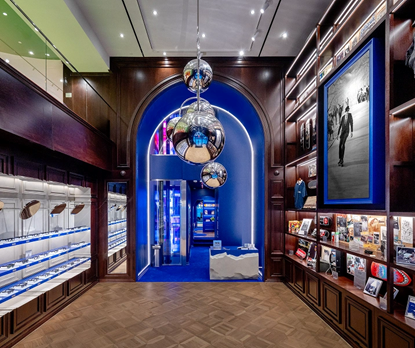
Interior of Meta's offline store Meta Lab, image source: Meta
From another angle, domestic channel exploration is actually richer. Brand-owned flagship stores, cooperation with traditional optical shops, electronics market distribution, and carrier channel deployment—almost every model that can be tried is being tried by someone. Different models correspond to different user groups and are also validating different business models. There is no standard answer in this process; it is closer to collective trial and error—whoever first gets a replicable single-store profitability model working will seize the initiative in the next round of expansion.
Interestingly, many channel partners are already attempting integration. Some traditional optical shops have set aside special digital experience areas and trained staff to explain smart features; some electronics markets have brought in resident optometrists to provide basic prescription services. Both sides are moving toward the middle, trying to make up for their own shortcomings.
Looking back, what exactly is different between smart glasses offline channels and mobile phones?
Mobile phones are standardized 3C products that work right out of the box; channels only need to solve two things—"selling goods" and "after-sales." Smart glasses are not like that: half digital product, half optometric service, they inherently require the superposition of two capabilities. That is why they cannot simply replicate the mobile phone channel path—it's not just about stocking goods in stores; behind it there must be a complete set of services: optometry, prescription lenses, adjustment, guidance, and after-sales.
The trade-in policy has added fuel to the industry, and online growth has proven that market demand truly exists. The coldness of offline channels is not because users are uninterested, but because the retail format suited to this category has not yet truly matured.
Back then, mobile phone channels took more than a decade to go from mom-and-pop stores to chain stores and then to brand flagship stores. The offline exploration of smart glasses has only just begun. As for what smart glasses stores will ultimately look like in the future, that is a question the entire industry must answer.
Text / R Xingren
-
![]()
Smart Glasses Offline Experience Stores—Why Can't They Get Off the Ground?
-
Making Money from AI Music Is Far Harder Than Cashing In on Short Dramas
-
![]()
Alibaba Cloud's AI-Driven Growth to Moderate Amid Computing Supply Constraints, but $100 Billion Revenue Target Remains Firm
-
Tencent WorkBuddy, ByteDance Doubao, and Alibaba Qwen's Digital Employee Battle: The Victory Lies in the "Foundation," Not the "Floors"
-
![]()
Apple's Unreleased AI Glasses: Chinese Manufacturers Have Already Broken into the Overseas Top 3
-
![]()
Why Are Smart Glasses Offline Experience Stores Struggling to Take Off?
-
![]()
Quarterly Report | 2026 Q3 China Smart Glasses Market Misses Expectations: Sales Growth Slows to 14.3%, Revenue Falls 4.3%; Full-Year Sales Growth Forecast Cut to Below 50%
-
[Focus] Demand for Deep-Ultraviolet Fluoride Optical Crystals Continues to Rise, with Broad Space for Domestic Substitution in China