AI in This Year: The Apps That Fell
 11/20 2026
 341
In September 2025, on the very day Sora shot to the top of the U.S. App Store, OpenAI's engineers were reposting screenshots on social platforms, as if the AI video era had truly arrived. Seven months later, the product vanished from users' phones: the app went dark, the website threw errors, and the API received termination notices.
This is no isolated case. Bubble Duck (Maopao Ya) racked up 6 million downloads across all platforms before shutting down; XEVA had 3 million users before it pulled the plug on its servers; ByteDance's Coze Enterprise Edition, which held a 19.3% market share and ranked first in the industry, was served notice of a full shutdown by the end of 2027. Tencent Yuanqi, Baidu Ladder AI, miHoYo's AnuNeko… the "death list" keeps growing.
But the flip side of this shutdown wave is not industry contraction. According to Sensor Tower, global downloads of generative AI mobile applications doubled year-on-year in 2025 to 3.8 billion, with in-app purchase revenue exceeding $5 billion—nearly three times that of 2024.
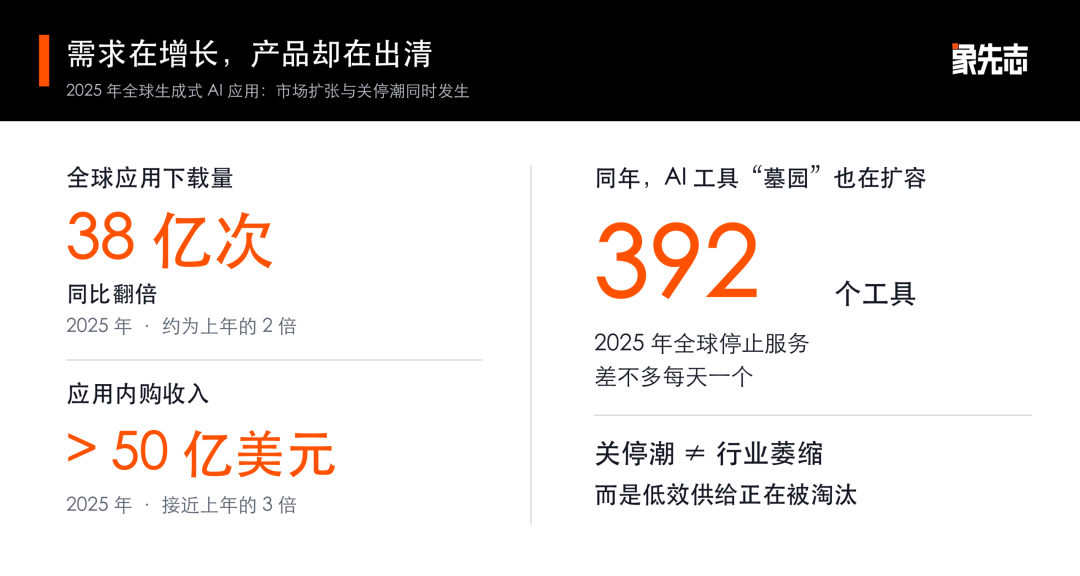
Demand for generative AI applications keeps growing even as products shut down
So why did these AI products die, and which AI app will be next?
01 The Graveyard Is Expanding, and the List Keeps Growing
The AI tool aggregation website Dang.ai runs an "AI Graveyard" directory dedicated to recording tools that have ceased service.
As of November 20, 2026, the directory had marked 1,895 discontinued tools in total. This figure records tool and service entries—covering both outright product shutdowns and exits through consolidation or rebranding—and cannot be taken directly as the number of companies that closed.
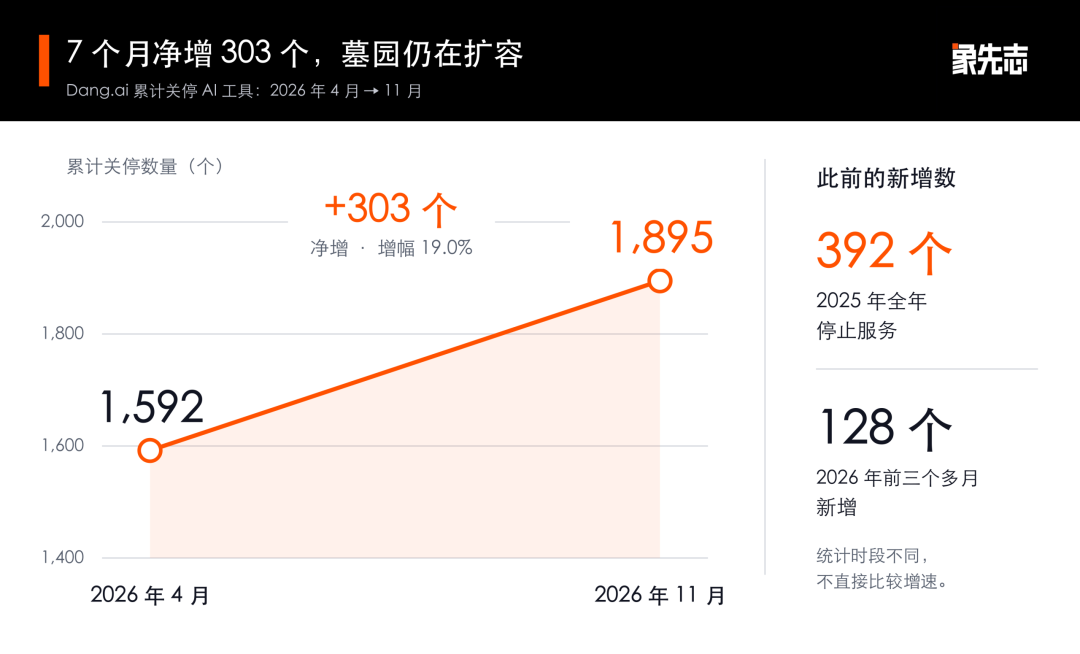
Cumulative shutdown counts compared with new additions across different periods
On the overseas tombstones are engraved a string of names once favored by many: mental health chatbot Woebot announced its shutdown in 2025 after raising over $100 million; AI search engine Phind had just wrapped up fundraising in December 2025 when it announced its shutdown on January 16, 2026, giving users only two weeks to export their data. Google shut down Pixel Studio's core image generation feature in June and took Project Mariner offline in May; Microsoft's Copilot GPT Builder disappeared three months after launch.
Scroll down to the Chinese entries and the picture is no less bleak. According to ZhiDongXi, at least 25 domestic AI applications were shut down, delisted, or left to languish without updates in 2025 alone. The 2026 clear-out continues: Tencent Yuanqi officially ceased service on November 9; QClaw announced it would shut down on December 24, roughly nine months after its March public beta; ByteDance took Doubao's self-built agent feature offline on July 15; Coze Enterprise Edition began its exit countdown on October 29; Baidu Ladder AI shut down on March 4, 2026—only about half a year from its renaming and launch to its merger into the parent company; NetEase Cloud Music's Miaoshi stopped service on July 14; and BSide: Olivia Lin, from miHoYo co-founder Cai Haoyu, was pulled from Steam less than a month and a half after launch.
The corpses of startups are even denser. StepFun's Bubble Duck surpassed 6 million downloads across all platforms before shutting down on November 5, 2025; Xiaoice's XEVA topped 3 million downloads and halted all services on the 30th of the same month; MiniMax's Wanwu Zhuizong was fully delisted less than three months after its public beta; Cai Haoyu's AnuNeko ran for less than a year before closing on July 29, 2026.
From conversational companionship to AI video, from agent platforms to productivity tools, almost every hot track has left behind a trail of shuttered silhouettes.
02 Why Did They Die?
When these AI applications fell, user demand was still there—but the rationale that had once justified independent charging had changed.
Independent AI search faced exactly this kind of competition. Back when general models couldn't yet access the internet, searching for users, organizing web pages, and generating answers could be turned into a business. By February 2025, ChatGPT had opened search to all users in covered regions without registration. Independent applications began competing against a product that already had a large user base and offered similar features for free. Developers still had to pay model invocation and customer acquisition costs—and model vendors had begun competing directly for application users.
Stronger, cheaper models would also end up in the hands of other developers. If a product mainly charges based on temporary feature differences, and users don't need to migrate large amounts of data or change workflows when switching services, such an advantage is easily eroded by the next update. Demand didn't disappear; users simply had a more convenient, cheaper place to go.
Another pressure comes from billing methods. A short Q&A and a task involving repeated reasoning and tool calls may consume vastly different amounts of computing power. A fixed monthly fee can stabilize revenue but cannot guarantee that each user's usage cost stays stable too. Cursor adjusted its billing in June 2025, changing frontier model usage in the Pro plan to a $20 credit converted at API prices. It explained that the cost of the most complex requests can be an order of magnitude higher than simple ones. Even if model unit prices fall, longer tasks and more calls may spend back the savings.
This makes the "attract users for free first, then slowly charge" playbook harder to sustain. Active users stay, and each use may generate new inference spending; limits hurt the experience, while price increases push some users toward free alternatives. Applications must make users clearly feel that paying this extra money solves problems general assistants cannot solve well. Without such differentiation, scale growth is hard to convert into revenue sufficient to cover additional invocations.
Products under big tech companies also have to compete for parent company resources. When OpenAI shut down Sora, it was shifting its business focus toward professional work and enterprise customers. CFO Sarah Friar explained to the Associated Press that sufficient computing power needed to be reserved for upcoming new models.
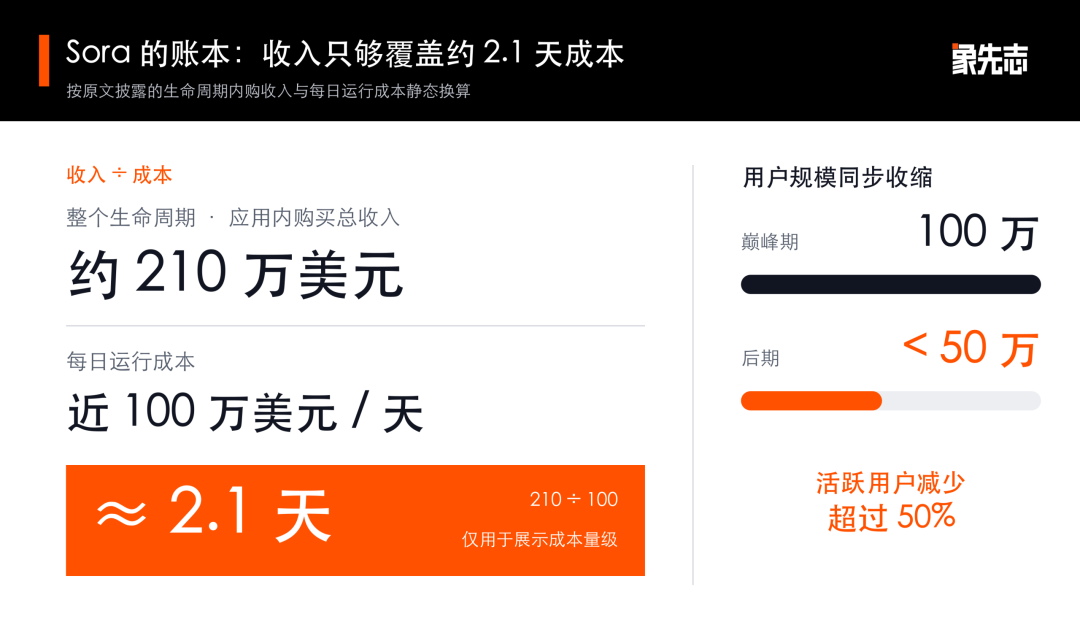
Static conversion between cumulative in-app purchase revenue and daily costs, and changes in user scale
Leading products still in operation have also begun adjusting their investment. On November 18, Tencent President Liu Chiping admitted that Yuanbao had not met initial expectations and that the company had significantly reduced investment, shifting focus from expanding user scale to improving capabilities. Tencent's capital expenditure in the quarter increased 527% year-on-year, while investment in Yuanbao decreased.
Qwen and Doubao also cut marketing spending. Alibaba disclosed in August that Qwen App's marketing expenses decreased in the quarter ended June 30; according to a June report by 36Kr, ByteDance also reduced Doubao's promotional ad spending due to expensive inference costs. After buying a user, there is still continuous inference spending afterward, and even leading products have begun to proactively slow expansion.
Product integration is another form of exit. Coze Enterprise Edition's shutdown announcement specifies phased sales suspension and service termination, while subsequent enterprise products and packages are still being planned. What changes here is the parent company's product arrangement. Placing it on the same list as startup closures after running out of funds obscures the different business choices of the two.
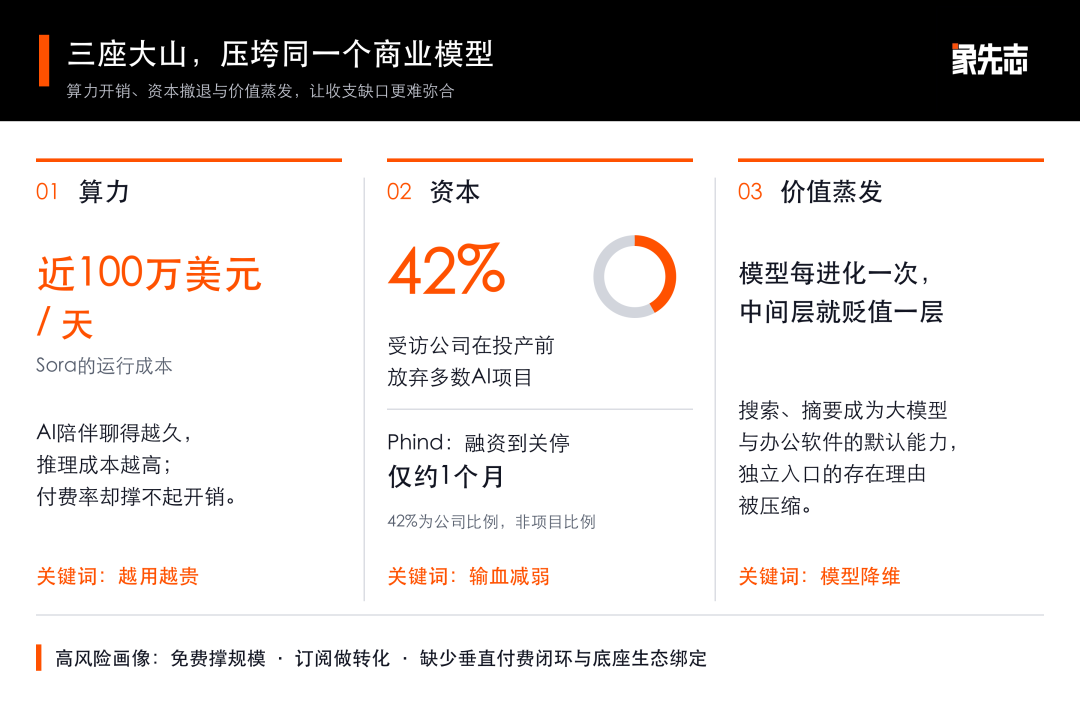
Computing power, capital, and model evolution jointly affect the living space of AI applications
03 What Did the Surviving AI Products Do Right?
The other side of the death list is a list of ways to live. Survivors have no unified formula, but they all avoid the same trap: treating "having AI" as the selling point.
Cursor took the first path. This company, founded by four MIT dropouts, disclosed in June 2025 that annual recurring revenue (ARR) exceeded $500 million; according to a March 2026 Bloomberg report citing people familiar with the matter, its annualized revenue had exceeded $2 billion in February. But its cleverness lies not in "using the best model" but in splitting its cost structure into two firewalls.
The first firewall is self-developed models. Cursor fine-tuned a self-developed reasoning model based on Kimi K2.5, pushing down the API cost per invocation. The second firewall is enterprise-level pricing. Its Pro version costs $20/month, Business version $40/month, and Enterprise contracts are custom-priced—enterprise customers have lower price sensitivity and value security, compliance, and team collaboration more, with average revenue per account 2-4 times that of the individual version and lower churn. By early 2026, enterprise revenue had accounted for 60% of total revenue.
But Cursor's survival does not mean it can rest easy. After Anthropic launched Claude Code, it reached $130 million in annualized revenue in just over a month after release, and exceeded $1 billion half a year later. When upstream vendors begin to value this market, the value of intermediaries will shrink rapidly—this is the life-or-death speed Cursor is facing.
DeepSeek took a completely different path. Its strongest moat, summarized by tech commentator Kevin Xu, is "zero external financing, no commercialization pressure." The quantitative fund High-Flyer behind founder Liang Wenfeng earned over $700 million in profit in 2024 with a 53% return, and this money was directly used to buy GPUs and hire people. DeepSeek does not need to be responsible to investors, only to technology.
This model of "using old money to feed new dreams" provides financial support for DeepSeek's continued investment in model research and development. Open source also expands the model's scope of use; developers can either call the official API or deploy the open weights themselves. DeepSeek's public V3/R1 inference efficiency calculation shows that if all tokens on a statistical day in February 2025 were charged at R1 prices, theoretical daily profit would be about $475,000, with a cost-profit ratio of 545%; the company also stated that actual revenue is significantly lower than this calculation.
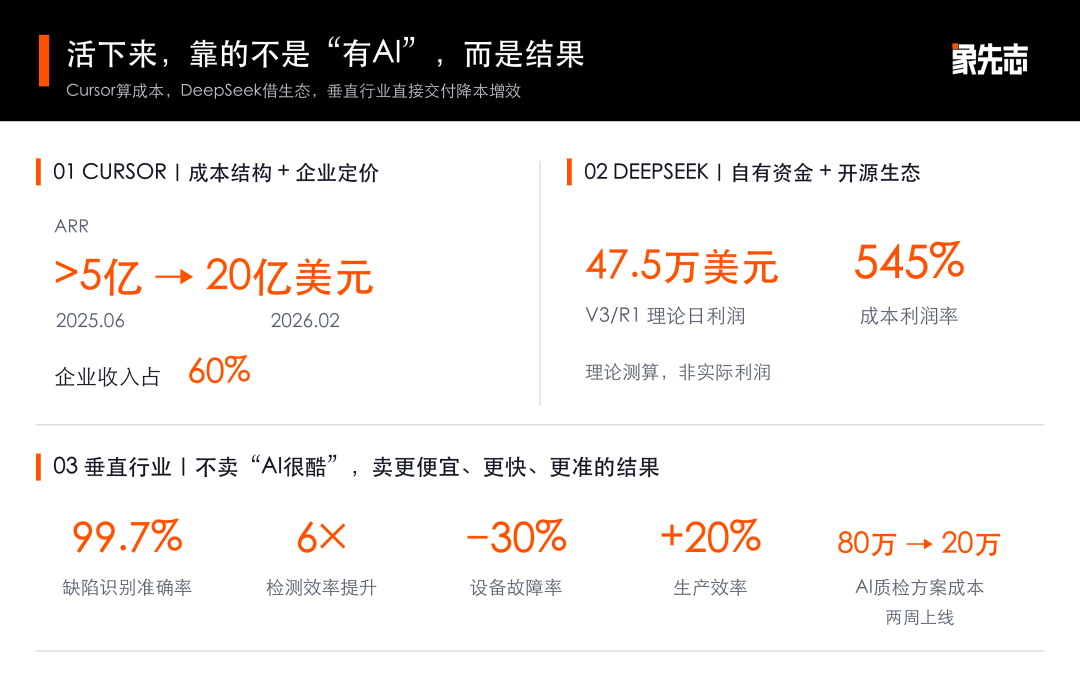
Comparison of revenue and business effects of Cursor, DeepSeek, and vertical industries
The third type that can survive is hidden in vertical industries, where big tech's range cannot reach. Industrial visual inspection is the most mature scenario for AI implementation in manufacturing in 2025. An automobile factory improved defect recognition accuracy to 99.7% and inspection efficiency by 6 times through AI visual inspection; a small connector factory had previously declined an AI inspection solution quoted at 800,000 yuan as too expensive, but in 2025 switched to a large-model fine-tuning solution, got it done for 200,000 yuan, and went live in two weeks. Predictive maintenance has also been proven—an automobile manufacturing enterprise reduced equipment failure rates by 30% and increased production efficiency by 20% after applying AI predictive maintenance; a power enterprise used AI technology for predictive maintenance of generator sets, reducing unplanned downtime losses by as much as 30%.
In the medical field, AI-assisted diagnosis systems have been approved by the FDA for market launch and can help family doctors monitor diabetic retinopathy in primary healthcare institutions without specialist guidance. In the legal field, scenarios such as contract review, case retrieval, and automatic document generation are seeing AI replace a large amount of repetitive work.
All these surviving products share one common feature: they do not sell "AI is cool," but sell "I can help you solve this problem, and cheaper/faster/more accurately than before." Customers pay for results, not for novelty.
04 Who Will Fall Next?
Judging by three dimensions—whether revenue can cover costs, whether the moat will be dissolved by model evolution, and whether capital can still provide blood transfusions—the most dangerous are independent AI search and general productivity tools, especially products that rely on free users for scale and subscription conversion for monetization.
The death list in this track is rapidly lengthening. Baidu's Ladder AI lived only half a year; Notion Mail shut down on September 22, 2026, with a lifecycle of about 17 months, and the official reason was brutal—"more than half of Notion Mail users can manage email without opening their inbox," as Agents directly ate the email client. Phind, as an AI search engine for programmers, died one month after finishing fundraising.
The domestic mirror risk falls on similar independent AI search apps—when Doubao, Yuanbao, and DeepSeek make internet search a default capability, the reason for independent entrances to exist will be further compressed. General AI tools without a paid closed loop in vertical scenarios and without binding to an underlying ecosystem will be the hardest-hit area of the next wave of concentrated deaths.
05 The First Half of AI Is Over
The first wave of AI was essentially a concept-driven bubble period: rushing to launch, burning money wildly, competing on user numbers, while few calculated invocation costs clearly. The shutdown wave is a signal of the bubble bursting.
As of November 2026, the Dang.ai directory has cumulatively marked 1,895 discontinued tools. In a 2025 survey of corporate figures in North America and Europe, S&P Global found that 42% of respondent companies abandoned most of their AI projects before production. These exits involve different products and businesses, but all require companies to reassess: how many resources should still be invested in the original projects.
Those who can survive the cycle are not the loudest, but those who calculate most clearly. Cursor calculated its cost structure clearly, DeepSeek calculated its ecosystem leverage clearly, and industrial inspection calculated its input-output ratio clearly.
The next domino to fall may already be in motion—and it could be right there in your phone: that AI search box you seldom open but that quietly consumes computing power every day.
Note: This article is compiled and organized from publicly available online information, with some sources cited from Zhidongxi, Huxiu, 36Kr, Jiemian News, TMTPost, IT Home, Caixin, Dang.ai, S&P Global Market Intelligence, and others. The content does not represent the views of the platform.
-
![]()
AI in This Year: The Apps That Fell
-
What Pinduoduo Left Unsaid on Its Earnings Call
-
![]()
Full Capacity Orders: This Optics Company's Revenue Hits 88.44 Million Yuan in First Ten Months
-
![]()
Personnel Change: Sun Gaofei, Independent Director of Zhongguangxue, Resigns
-
MoJie Technology Makes Its APEC Debut Following 600 Million Yuan Financing: A Full-Chain Optical Layout
-
![]()
Tencent: The Biggest Earner Takes the Hardest Fall
-
![]()
Seedance vs. MiniMax vs. Qwen: 3 Rounds of Continuous Edits — Which One Is More Usable?
-
![]()
Smart Glasses Offline Experience Stores—Why Can't They Get Off the Ground?