Material Large Models Enter the Factory: Can AI Really Design Formulations on Its Own?
 11/24 2026
 495
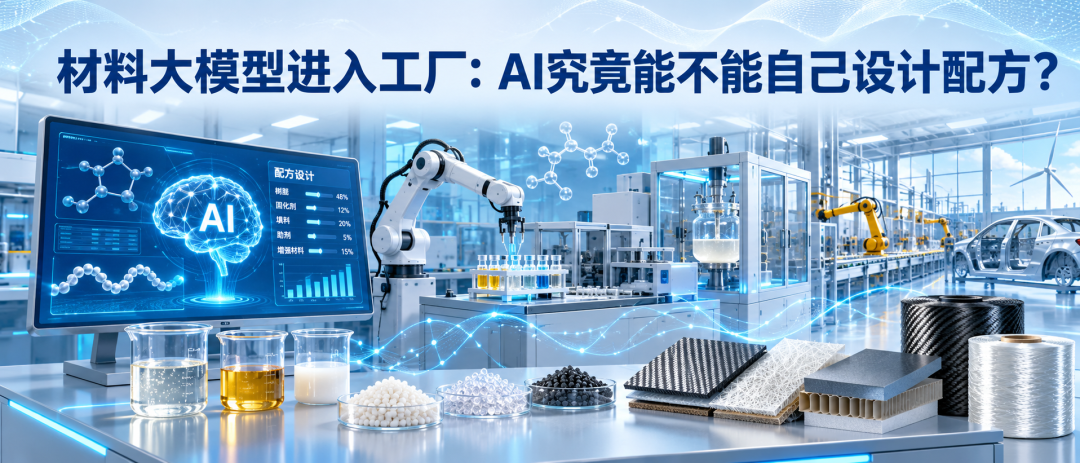
In the past, materials R&D often relied on engineers' experience: selecting raw materials, adjusting ratios, preparing samples, testing performance, and then tweaking the formulation based on the results. A new material might require dozens or even hundreds of experiments to go from the lab to application.
Now, this process is changing. Artificial intelligence can not only read papers, analyze patents, and organize experimental data, but also predict material performance, generate candidate molecular structures, and even reverse-engineer formulations and process parameters from target performance.
In 2026, practical cases combining specialized large models with intelligent R&D platforms have already emerged in China's polymer materials field, and some AI-designed new materials have completed laboratory validation and entered end-use applications.
So a more noteworthy question arises: If AI is told, "I need a resin with high strength, low viscosity, high temperature resistance, and low cost," can it select raw materials, calculate ratios, and ultimately deliver a formulation that can be directly produced?
The answer is: Under certain conditions, AI can already complete formulation design and optimization, but it is still far from fully autonomous and reliable development of industrial formulations, with multiple thresholds remaining in data, mechanisms, experimental validation, and engineering scale-up.
What is truly noteworthy is not whether AI can generate a set of formulations, but whether it can establish a complete closed loop from material design to experimental validation and then to production application.
1. What Exactly Is a Material Large Model? How Is It Different from Ordinary AI?
First, a concept needs to be clarified: A material large model is not simply applying a general-purpose large language model to the materials industry.
Ordinary large language models are good at understanding and generating text, but materials R&D involves complex relationships among chemical composition, molecular structure, microstructure, processing technology, and performance. Merely relying on a language model to read a few papers cannot accurately predict what performance will result when a certain resin is mixed with a curing agent. At present, AI applications in materials R&D are mainly composed of the following types of technologies working together.
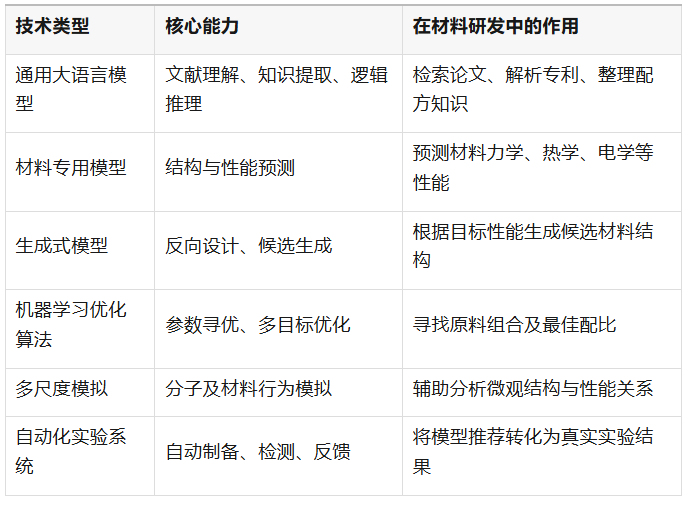
These technologies each have their own roles. For example, language models can extract the ratios and curing conditions of epoxy resins, curing agents, and accelerators from a large number of papers; materials-specific models can predict performance under different combinations; optimization algorithms can screen more promising schemes from a large number of candidate formulations; and automated experimental systems are responsible for validating results.
Therefore, a truly valuable materials AI system is not a chatbot that can answer materials questions, but an R&D platform that can connect materials knowledge, data, models, simulation, and experiments.
2. Can AI Already Design Materials? Let's Look at Several Real Advances
Over the past few years, some representative research and industrial cases have emerged in the global materials AI field. These cases show that AI has gradually advanced from assisting literature retrieval and performance prediction toward inverse material design and experimental closed loops.
1. Google DeepMind: AI Predicts Millions of New Materials at Once
In 2023, Google DeepMind published deep learning-based materials discovery research in Nature, introducing the GNoME model.
The research results of this model are very striking: approximately 2.2 million new crystal structure candidates were generated and evaluated; about 380,000 of them were predicted to be materials with relatively high stability; and researchers worldwide independently experimentally synthesized 736 of these structures in related work.
The significance of this research lies in the fact that AI can use existing crystal structure and stability data to further explore large-scale material spaces that are difficult to cover by traditional computational screening. In the past, researchers often needed to perform element substitution and structural adjustment around existing materials, and then determine their stability through computation. Now, AI can generate candidate structures in a larger space and then combine them with computational methods such as density functional theory (DFT) for screening.
However, it should be noted that 2.2 million is the number of candidate structures generated by the model, which does not mean that 2.2 million materials have been successfully prepared in the laboratory, and predicted stability does not equal guaranteed synthesizability. This precisely shows that AI can greatly expand the scope of materials search, but experimental validation remains irreplaceable.
2. Microsoft MatterGen: Moving from Predicting Materials to Inverse Designing Materials
In 2025, research related to MatterGen launched by Microsoft Research was published in Nature.
Unlike traditional models that mainly predict the performance of known materials, MatterGen adopts a diffusion generative model and can generate new inorganic material structures according to preset conditions. Researchers can set targets for the model, such as specific chemical composition, crystal symmetry, mechanical properties, electronic properties, and magnetic properties, and the model then generates candidate materials based on these constraints.
The research team also experimentally validated the generated materials, and the measured performance of one proof-of-concept sample differed from the target value by within 20%. This means that materials AI has begun to develop from answering "what performance does this material have" to answering "what new material can be designed to obtain this performance."
Of course, this achievement is mainly aimed at inorganic crystal materials and cannot be directly equated with the ability to autonomously design industrial resins, glass fiber sizing agents, or composite formulations. However, the technical logic behind it has inspirational significance for the entire materials industry: gradually shifting from finding optimal solutions among existing materials to actively generating new materials according to target performance.
3. New Progress in 2026: AI Begins to Participate in Materials Synthesis Scheme Design
In August 2026, Advanced Materials published a noteworthy study: Closed-Loop Solid-State Synthesis Planning for Materials Discovery With Large Language Models. The researchers extracted target materials, raw materials, and process parameters from 4,407 open-access solid-state synthesis papers to construct a structured synthesis formulation dataset. Subsequently, using large language models and retrieval-augmented generation (RAG) technology, they retrieved synthesis experience for similar materials and generated new candidate synthesis schemes. More importantly, the research did not stop at the model generation stage, but combined real experimental feedback to gradually adjust synthesis temperature and time, ultimately successfully preparing multiple oxyselenide solid-state electrolyte materials.
This work shows that AI can not only help researchers find material structures, but has also begun to participate in the design of actual material preparation paths. However, this study targets inorganic solid-state synthesis systems, and its methods cannot be directly copied to complex multi-component polymer formulations. Different material systems have obvious differences in reaction mechanisms, process variables, and performance evaluation methods.
3. AI Platforms Truly Oriented Toward Formulation R&D Have Already Emerged in China
If the preceding research mostly demonstrates AI's capabilities in materials discovery, then progress in China's polymer materials field is closer to the formulation problems that enterprise R&D personnel face daily.
One noteworthy example is the AI plus Polymers platform developed by Professor Lin Jiaping's team at East China University of Science and Technology. In 2026, the platform released version 3.0 and launched Chat AIPolym, a specialized large model in the polymer field. According to public information from East China University of Science and Technology, by the end of 2025, the platform had gathered about 7.6 million professional data records, carried more than 80 AI models and more than 10 polymer-specific algorithms, and covered functions such as material data retrieval, performance prediction, inverse structure design, formulation process optimization, and high-throughput screening.
Currently, the platform has covered more than 60 institutions and thousands of R&D personnel nationwide. As of the relevant report release, the platform had cumulatively discovered 12,700 potential new materials, of which 94 completed laboratory validation and 2 entered practical application. However, these data come from public introductions by the platform's R&D team and should be understood as phased results disclosed by the team, rather than all materials having achieved large-scale industrial production.
A more representative case is AI-designed conductive adhesive formulations. In a project cooperating with the Shanghai Plastics Research Institute, the research team faced a typical multi-component formulation optimization problem. The customer provided 40 conductive adhesive formulations, each containing nearly 20 substances, involving resins, curing agents, silver powder, and additives. AI was required to achieve multiple objectives while ensuring product performance: meeting mechanical strength requirements; controlling resistivity; meeting viscosity requirements; maintaining suitable thixotropic performance; and reducing the usage ratio of two high-cost raw materials as much as possible.
This is not simply finding the optimal addition amount of a certain raw material, but rather finding a balance among multiple raw materials and multiple performance indicators. According to public reports, the research team used multi-dimensional optimization algorithms and, after only three rounds of iteration, obtained a candidate formulation using 13 substances that met the performance requirements proposed by the project.
This case has several points worthy of attention from materials R&D personnel:
First, AI is not simply fine-tuning based on existing formulations, but can seek new raw material combinations in a larger candidate combination space.
Second, formulation optimization is not the maximization of a single performance, but simultaneously considers strength, resistivity, viscosity, thixotropy, and cost.
Third, AI does not work completely divorced from experimental data, but relies on existing formulations, specialized models, and optimization algorithms to jointly complete the design.
This is the true value of AI entering materials formulation R&D.
4. How Exactly Does AI Design a New Formulation?
For materials R&D personnel, what is most worth understanding is not the model names, but how AI derives candidate formulations from target performance.
Take an epoxy resin system that needs to balance high strength, low viscosity, and heat resistance as an example. Traditional R&D usually first determines the resin, curing agent, accelerator, and toughening agent based on experience, and then adjusts the ratios. With AI involvement, the R&D process can become the following steps.
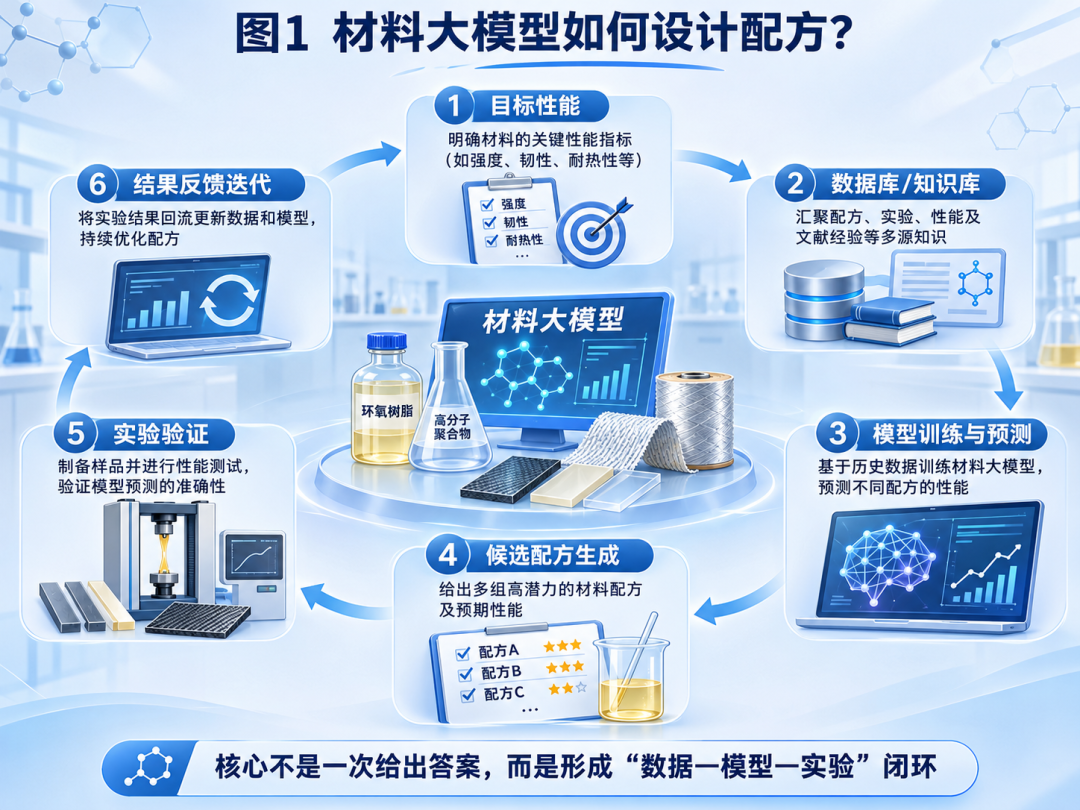
Step 1: Convert performance requirements into computable objectives. First, the model needs to be told what exactly is wanted. For example:
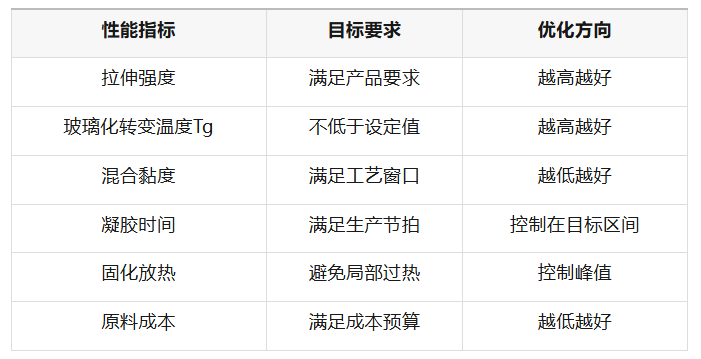
Here there is an important issue: Material performance indicators often constrain one another. For example, increasing crosslink density may help increase Tg, but may also cause a decrease in material toughness; adding a toughening agent may improve impact performance, but may affect modulus and heat resistance. What AI needs to handle is precisely these mutually constraining relationships. Therefore, formulation design is essentially a multi-objective optimization problem, rather than simply finding the formulation with the highest value for a certain performance.
Step 2: Establish a material formulation database. This is the most important foundation of the entire AI R&D system.
Without sufficiently accurate data, the model cannot truly understand the relationships among raw materials, processes, and performance. An effective materials database should not only store final formulations and test results, but also include raw material information (raw material name, grade, supplier; chemical composition and key physical properties; batch information; solid content, viscosity, activity, etc.), formulation information (addition ratio of each component; ratio relationships among raw materials; formulation version; raw material substitution records), process information (feeding order; stirring speed and time; mixing temperature; curing temperature and time; process equipment and key parameters), and testing information (mechanical properties such as tensile, flexural, and impact; thermal properties such as DSC, Tg, and TGA; viscosity and gel time; water absorption, acid resistance, and other environmental properties; test methods, sample status, and repeatability).
In particular, data from failed experiments should also be retained. If the database only stores successful formulations, the model may not be able to identify which raw material combinations will cause abnormal gelation, insufficient wetting, performance degradation, or curing defects. A truly valuable materials database should record both successful experience and failed experience.
Step 3: Train models to establish the relationship between formulations and performance
Once data has accumulated to a sufficient level, machine learning models can be used to establish the mapping relationship among formulations, processes, and performance. For example, the inputs might include epoxy resin ratio, curing agent ratio, accelerator ratio, toughening agent content, curing temperature, and curing time, while the outputs would be tensile strength, flexural modulus, Tg, viscosity, gel time, and cost.
The model learns the relationships among different variables from historical experimental data and then predicts the performance of new formulations. But there is a key issue here: model predictions do not equal actual test results. Therefore, in addition to predicted values, attention should also be paid to prediction uncertainty and to whether the current formulation falls outside the applicable range of the model's existing data. If the model has never seen a certain new curing agent system, it cannot simply be assumed that it still has reliable predictive capability for that system.
Step 4: Use optimization algorithms to automatically search for candidate formulations. This is the stage where AI truly creates value.
Traditional R&D personnel usually adjust a certain component based on experience and then conduct experiments. AI can use methods such as Bayesian optimization and active learning to search for candidate formulations that are more worthy of experimentation based on existing data. It can simultaneously consider which formulations are most likely to meet target performance, which formulations have the opportunity to further reduce cost, which experiments can help the model better understand unknown regions, and which raw material combinations have higher actual manufacturability.
For example, the system can recommend 10 candidate formulations and rank them by predicted performance, cost, and uncertainty. R&D personnel do not need to blindly put all 10 into experiments, but can prioritize combinations with higher information value and expected returns. The experimental results are then fed back to the model, and the model updates its predictions based on the new data and proposes the next round of schemes. This process is called active learning or sequential optimization.
Step 5: Experimental validation to form a closed loop.
Ultimately, the formulations recommended by AI must enter real experiments. Experimental results may deviate from predictions. At this point, the system needs to input the actual test data back into the model, analyze the causes of deviation, and adjust the next round of experimental schemes. The complete process can be summarized as: target performance setting → data input → model prediction → candidate formulation generation → experimental validation → result feedback → model update → next round of optimization. This is the key for materials AI to move from a software tool to an R&D system.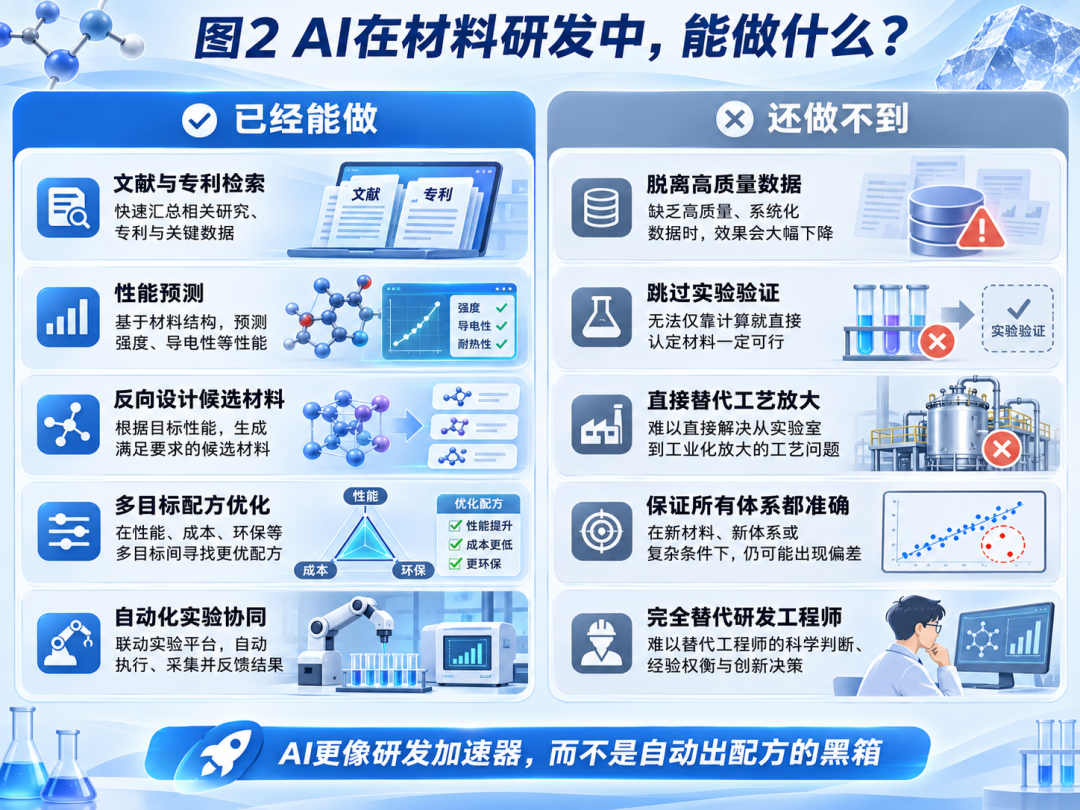
V. Where are the most valuable applications of AI in the composite materials industry?
Materials AI is not only used to discover entirely new materials. For a large number of already mature material systems, formulation optimization, raw material substitution, process window adjustment, and improvement of product performance stability may more easily generate practical value. Especially for the glass fiber, carbon fiber, resin, and composite materials industries, the following directions deserve key attention.
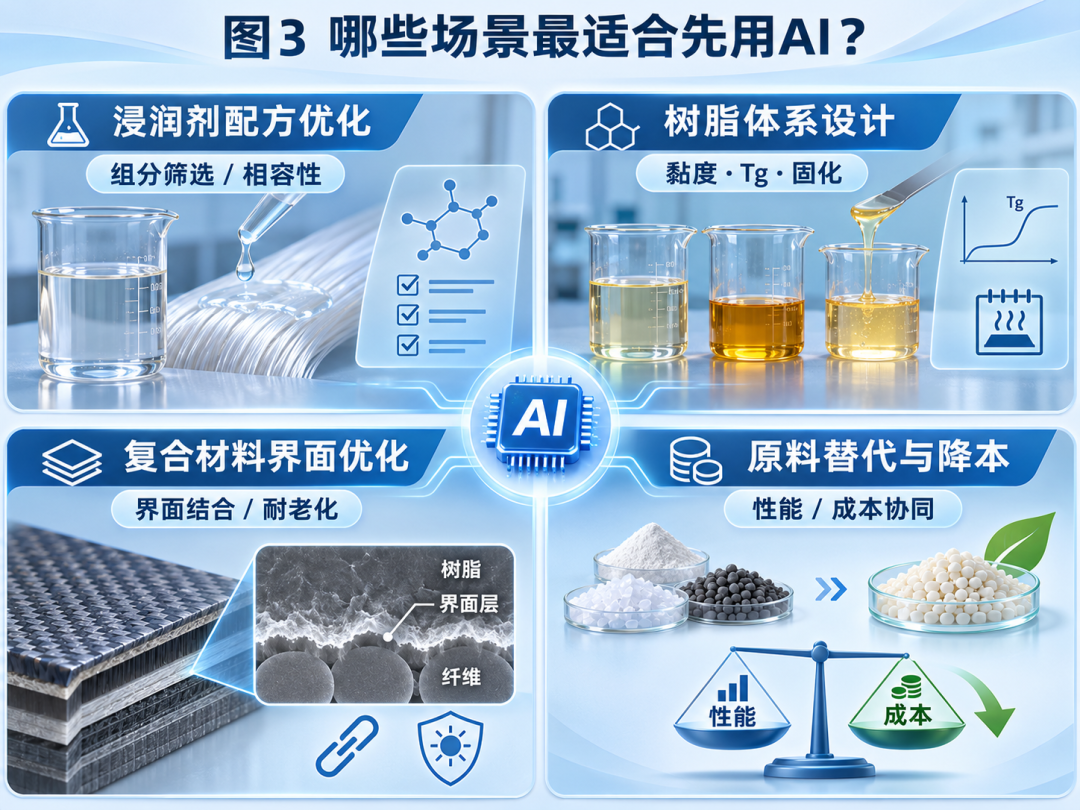
1. Sizing formulation optimization
Take continuous glass fiber sizing as an example. Its system may involve film formers, coupling agents, lubricants, antistatic agents, and other functional components. Complex interactions exist among different components. For example, the type and amount of coupling agent may affect the interfacial bonding between fiber and resin; the film former affects fiber bundling and protective ability; the lubricant affects fiber friction, fuzz, and processing performance.
AI can use the proportions of each component, system solid content, pH, viscosity, preparation process, etc. as input variables. It can then use combustible content, fiber bundling, fuzz, wet-out performance, resin compatibility, and mechanical properties of composites as output indicators. In this way, R&D personnel can use multi-objective optimization to find a more reasonable sizing formulation.
Particularly noteworthy is that one should not only optimize the test indicators of the sizing itself, but should also incorporate the performance of the final product into the model. This is because good fiber surface condition does not necessarily mean the final composite material performance is optimal.
2. Resin system formulation design
In resin systems such as epoxy, vinyl ester, and polyurethane, AI can participate in the formulation optimization of resins, curing agents, accelerators, toughening agents, and functional additives.
For example, in an epoxy-anhydride system, the following parameters can be incorporated into the model: the ratio of epoxy resin to anhydride; the type and amount of accelerator; resin system viscosity; gel time; curing exothermic peak; curing schedule; Tg and mechanical properties.
AI can find formulation combinations that meet the requirements for wetting, curing efficiency, and final mechanical properties. However, it must be noted that the curing reaction has obvious kinetic characteristics. The model cannot judge the final curing state based only on raw material ratios; it also needs to combine experimental data such as temperature, time, reactivity, and DSC.
3. Optimization of composite interface performance
The performance of fiber-reinforced composites depends not only on the fiber itself but is also affected by the interface between fiber and resin.
AI can combine fiber surface treatment, sizing composition, resin system, and composite process to establish the relationship between interface state and final product performance. For example, joint optimization can be carried out around interlaminar shear strength, flexural performance, water absorption, acid resistance, and long-term aging performance.
The difficulty of such problems lies in the fact that interfacial effects involve complex chemical bonding, wetting, diffusion, and microstructural changes. Building a model based solely on formulation data may not be enough; it also needs to be combined with surface characterization, interface testing, and material mechanism analysis.
4. Raw material substitution and cost reduction
This may be one of the application directions where material enterprises can most easily see economic value. When the supply of a certain imported raw material is unstable or its price rises, AI can screen domestic substitute raw materials based on existing formulation and performance data.
At the same time, by adjusting the proportions of other components, it can find substitution solutions that meet performance requirements. Such tasks usually have relatively clear objectives and existing formulations as a basis, making them suitable for machine learning and multi-objective optimization methods.
VI. Why can't AI completely replace materials R&D engineers now?
Although AI can already generate candidate formulations, there are still several unavoidable problems in going from the laboratory to the factory.
First, data quality determines model capability.
Material enterprises have accumulated a large amount of test reports, formulation records, and process data over the long term, but these data may be scattered across different systems and Excel spreadsheets. The same raw material may have different grades, suppliers, and batches; the same performance property may use different test methods. If not uniformly organized, the model may learn data under different conditions as the same type of data, ultimately leading to distorted predictions.
Second, material systems have complex nonlinear and coupling effects.
A certain additive may perform well when used alone, but when combined with another additive, compatibility may decrease or performance may reverse. Such complex effects cannot be fully explained by simple data fitting. Material mechanisms, chemical knowledge, and experimental verification are still very important.
Third, laboratory formulations are not equal to industrial formulations.
The fact that a few hundred grams of resin in the laboratory can be smoothly mixed and cured does not mean that the same performance will still be maintained when scaled up to tens of kilograms or even ton-level production. Equipment structure, heat transfer efficiency, shear conditions, mixing uniformity, and raw material batch variation may all affect the final result. Therefore, AI needs to be further combined with pilot-scale data and production data.
Fourth, models may produce erroneous predictions.
General large language models, in particular, may generate raw material combinations and process conditions that look reasonable but actually do not conform to chemical laws. Even with specialized models, problems such as insufficient training data coverage and unclear model applicability may occur. For material systems involving high pressure, flammability, corrosive media, and special chemicals, model recommendations should certainly not be directly used as the basis for production operations. Therefore, the application of materials AI must establish mechanisms for experimental verification, professional review, and safety management.
VII. How should materials R&D personnel truly make good use of AI?
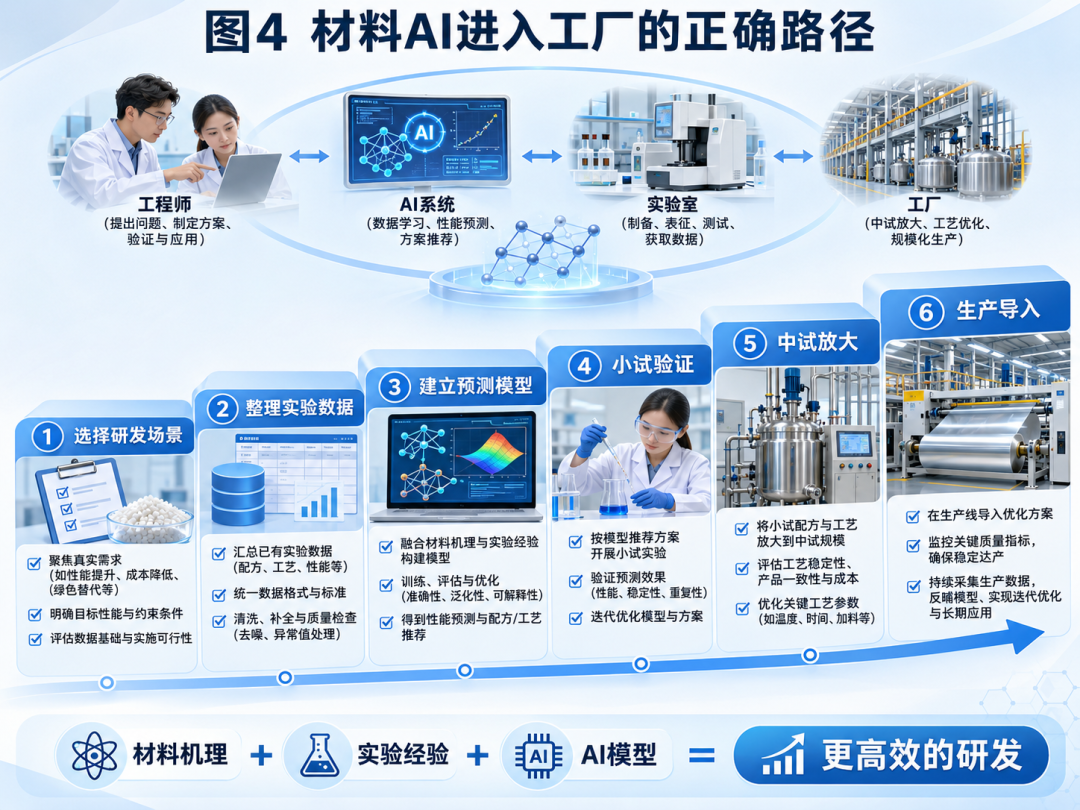
For enterprises, building a materials AI platform does not mean training their own large model from the very beginning. A more realistic path is to start from a specific R&D problem. It is recommended to proceed according to the following approach:
Step 1: Choose a clear R&D scenario. For example, cost reduction of a certain resin system, optimization of a certain type of sizing formulation, or the problem of mechanical performance fluctuation in a certain product. Do not try to make AI solve all materials R&D problems from the start.
Step 2: Organize existing experimental data. Associate formulations, raw materials, processes, and test results to form a traceable dataset. In particular, retain raw material batches, test conditions, and failed experiment data.
Step 3: Build a predictive model. First identify key influencing factors from existing data and establish a basic performance prediction model. After the model has certain predictive capability, introduce multi-objective optimization algorithms.
Step 4: Carry out small-scale experimental verification. Let AI recommend a small number of candidate formulations, have R&D personnel judge their reasonableness, and then conduct experiments. Continuously revise the model based on experimental results.
Step 5: Gradually extend to pilot and production. Only after repeated experiments, pilot scale-up, and production batch verification can it be determined whether the formulations recommended by AI truly have industrial application value.
A set of evaluation criteria also needs to be established here.
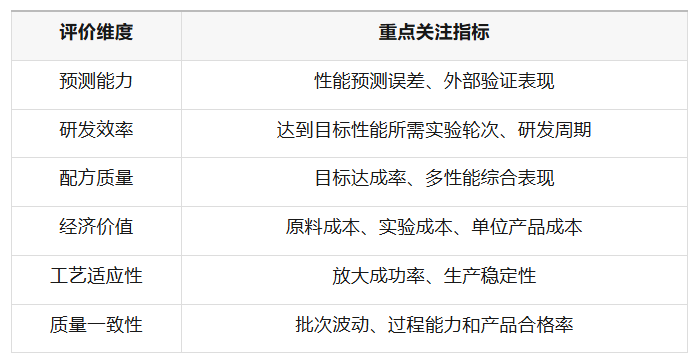
In particular, do not only look at how many formulation sets AI can generate or how high the model's R is. The truly valuable indicator is whether it can reduce ineffective experiments, improve the hit rate of target formulations, and ultimately stably achieve expected performance on the production line.
Conclusion: AI will not simply replace materials engineers, but it will change the way materials R&D works
From Google DeepMind's GNoME to Microsoft's MatterGen, and then to domestic professional R&D platforms such as AI plus Polymers, it can be seen that materials AI is undergoing an important transformation.
In the past, AI mainly helped researchers retrieve literature, analyze data, and predict performance. Now, it has begun to participate in material structure generation, formulation optimization, synthesis route design, and experimental scheme formulation. In the future, with the further integration of materials databases, specialized models, automated experimental equipment, and industrial digital systems, AI is likely to become an important part of the R&D system of materials factories.
But one point needs to be clear: AI can help us find formulations more worth trying, but it cannot prove that a formulation can be stably produced based on a single model prediction alone.
For materials R&D engineers, the truly important ability in the future may no longer be merely how many raw materials one is familiar with or how much formulation trial experience one has accumulated, but rather the ability to combine material mechanisms, process experience, experimental data, and AI models. R&D personnel need to be gradually freed from a large amount of repetitive trial and error and devote more energy to objective definition, mechanism analysis, experimental design, anomaly diagnosis, and engineering verification.
The future of materials R&D may not be AI replacing engineers, but engineers using AI to make work that previously required extensive trial and error more directional, evidence-based, and predictable. When AI truly enters the factory, the core competitiveness of material formulation R&D will also gradually move from experience accumulation to being driven collaboratively by data, mechanisms, and experiments.
If you follow trends in the materials industry, technological evolution, and industrial opportunities, you are welcome to follow "Materials Trend Compass".
Disclaimer: This article is only for industry exchange and trend discussion. The views involved do not represent the position of any institution and do not constitute securities, investment, or business decision advice. Readers are requested to refer to it rationally. The content in this article is organized based on public information and the author's understanding. Limited by cognitive level, information sources, and observation perspective, some views may contain deviations or deficiencies. Experts and readers in the industry are welcome to exchange and correct them.
Note: This article is an original article. If reprinting is needed, please indicate the source of the article.
-
![]()
Doubao Tests Shopping as a Primary Entry Point: Is AI Conversation Becoming the New Shelf?
-
![]()
Insta360 Q3 Financial Report: Revenue Surges to 3.9 Billion Yuan, Net Profit Plummets 93% to Just 17.43 Million Yuan
-
Global Investors Are Converging on AI Hardware
-
Is Charging Now Faster Than Refueling?
-
![]()
$10 Billion Entry: Who Is Pricing AI4S
-
![]()
Why Is ChatGPT Still Running Ads? | iAnalysys Insights
-
![]()
Anthropic's Trillion-Dollar Valuation
-
Optical Communications' "Fire and Ice": Amid NVIDIA Personnel Turmoil, Should We Panic or See the Big Picture Clearly?