WorkBuddy Just Built a "Lobster"-Stuffed "Doubao"
 11/25 2026
 377
Editor: Liu Zhicheng
Reviewer: Xu Xu
The AI industry's sky really does change in an instant!
Yesterday the market was still mourning the ebb of the lobster craze, and then the Muse craze appeared, prompting a host of major companies to ramp up personal AI agent applications...
Then recently, desktop AI agents reshuffled the deck once again.
First, Google announced a new Computer Use feature for the Gemini Mac app. Users only need to describe a task in natural language, and Gemini can operate different applications and web pages on a Mac, automatically completing clicks, input, form filling, and other work.
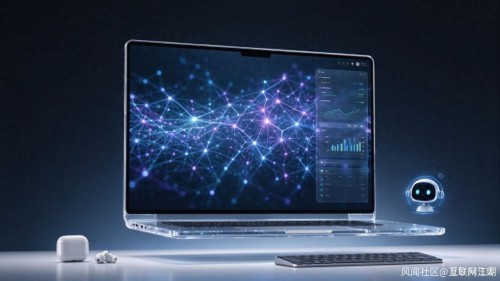
At the same time, media also reported that Apple is developing its own AI agent, planning to let AI perform device control, app operations, web browsing, and software programming tasks on users' behalf.
And Tencent: a few days ago, WorkBuddy also launched computer control capabilities—able to recognize the current page, understand client interfaces, and perform clicks, input, scrolling, and other operations without requiring the target software to open APIs, operating in the background.
Looking at the three together is quite interesting:
If Google, Apple, and others are entering now because of the success of Meta's rapidly rising Muse,
then domestically, WorkBuddy's computer control capabilities correspond to "Lobster" and Doubao phones, especially the first-generation Doubao phone that focused on GUI visual simulated clicking...
But the problem lies here—in the past, the lobsters basically never generated much imagination.
That being said, why does WorkBuddy still go into the tiger's mountain knowing there are tigers? Can Tencent actually achieve on PC what ByteDance failed to do on mobile?
Tencent bypassed the wall ByteDance couldn't climb over
Why did WorkBuddy launch computer control capabilities?
Essentially, it is an expansion of the capability boundaries of the previously launched cross-app AI collaboration system—Buddy One—to help users achieve a one-stop AI office experience and break the fragmented dilemma of manually uploading information and data between applications...
However, in the past Buddy One worked within Tencent's internal office system, while now WorkBuddy faces external market applications. The difficulty of the two challenges is worlds apart.
So can Tencent pull it off?
Given the cautionary tale of the Doubao phone "hitting the wall," many people are not optimistic about this, but according to observations by the Internet Jianghu team, the final answer may be exactly the opposite.
First, why did the first-generation Doubao phone hit the wall?
There were many external reasons, but the core one is that it shook the entire internet business model.
For the past decade or so, the mobile internet value chain has revolved around the "traffic closed loop": platforms use content, social relationships, and product supply as anchor points to retain user attention within their own apps, and then monetize through information feed ads, transaction commissions, membership subscriptions, and other methods.
The premise of this business logic is that users complete the full interaction within the app. Every browse, click, and order is a carrier of traffic value.
And the GUI screen automation route championed by the Doubao phone precisely undermines this premise.
When AI can read the screen on behalf of users, simulate human clicks and swipes, and handle tasks for users, platforms shift from being "the direct front office that receives users" to "backend services invoked by AI."
The front office controls traffic, ad slots, and pricing power; the backend can only passively respond to invocation requests, and the whole loses its imagination.
So this is a high-voltage line—whoever touches it gets banned...
Now, will WorkBuddy's newly launched "computer application control" capability impact the traffic business models of mainstream internet apps?
Theoretically possible—after all, in technical form it is exactly the same as GUI screen automated click operations, and in actual testing it can indeed open Taobao web pages and organize product data, etc.
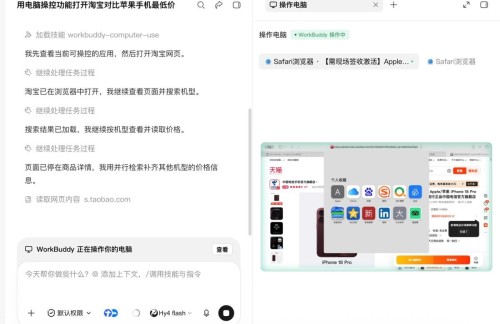
So if WorkBuddy intends to extend deeper in the future, it may well replay the Doubao phone script...
But now, the situation is a different picture.
First, in terms of experience, WorkBuddy currently runs relatively slowly when controlling the computer, and its search scope is not comprehensive. It is usable, but not yet good enough.
For example, the question I posed was, "Use the computer control feature to open the Taobao web page and find and compare the lowest prices of various Apple 18 series phones." As a result, it did not include third-party low-price stores...
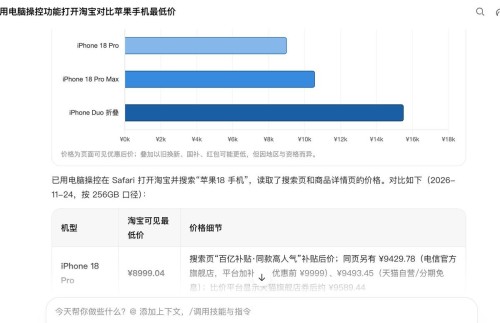
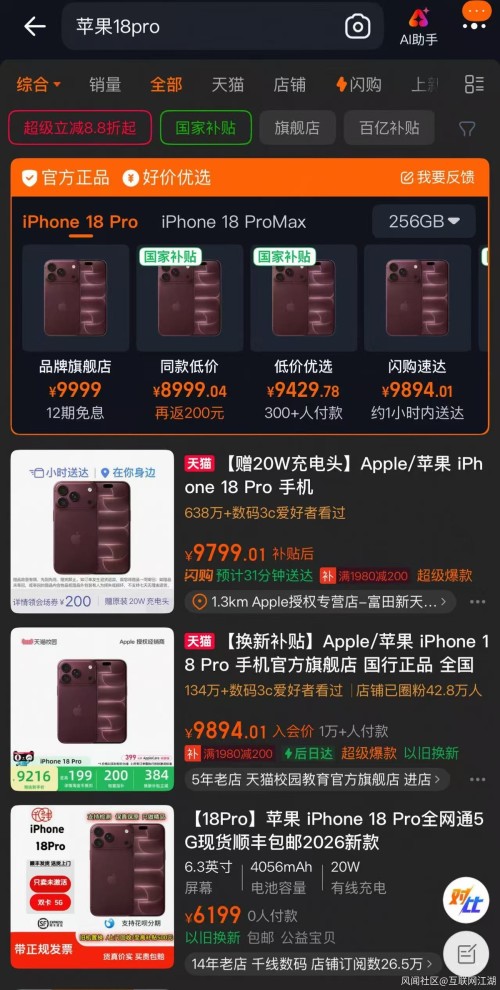
Second, judging from the announcement, WorkBuddy is mainly targeting applications and legacy applications where, when using WorkBuddy, the software has no API, connectors cannot connect, and there is no web version.
In the AI era, if mainstream players still have these "three-no" applications, it itself shows that their ecosystem value is limited.
And the two examples officially given by WorkBuddy confirm this—checking records in an academic administration system; using inbound order numbers to match warehouse and asset information across clients.
These are not traffic entrances, but purely enterprise work tools. They themselves have no ecosystem to defend, no ad slots to sell, and no need to compete for user time.
Users are their owners. As long as data security is ensured, WorkBuddy using GUI to connect this AI office breakpoint is incremental for everyone...
So strictly speaking, WorkBuddy did not bypass the app wall ByteDance hit, but walked into an area where no wall has been built yet.
The reason there is no wall there is not that Tencent is more popular, but that there are no commercial interests worth defending there.
Speaking of this, I wonder if everyone has noticed:
Now the overall attitude of internet giants toward AI is somewhat contradictory—building walls while tearing them down.
For example, Tencent: in the SAEP "Screen Automation Operation Declaration Protocol" previously announced by Doubao mobile assistant, more than 60 Tencent ecosystem applications chose to refuse access.
But then, WorkBuddy, WeCom, and others reached ecosystem cooperation with the agent phone released by StepFun.
As for what WorkBuddy and Buddy One are doing now, it is essentially also a kind of wall-tearing down, internally and externally...
The same is true for Alibaba on the other side. While building a wall against the Doubao phone, Alipay, Amap, and others instead connected to the StepFun phone.
The Qianwen app, meanwhile, actively tore down walls and brought in a host of non-Alibaba AI agent applications such as Beike and SF Express.
Why this change? There are two reasons:
One relates to the AI technology route—Doubao phones chose the GUI route, which can forcibly enter other applications' territory without authorization. It is the most universal, but faces the greatest resistance.
StepFun, Qianwen, and others take the MCP and A2A route. Their biggest feature is that things can be negotiated: what to open and what not to open can be agreed upon in writing, making the whole relatively controllable.
To sum it up in one sentence: the giants do not reject AI interoperability; they reject "interoperability without my consent."
The other relates to the unclear prospects of AI commercialization—the most awkward point in the AI market now is that the story is good, but sufficiently large return value has not yet fully emerged. This is also the biggest concern of the current investment market about Tencent and others.
So against this backdrop, the giants' attitudes have changed: from complete non-acceptance during the Doubao phone period to now being able to try, but the foundation cannot be shaken.
High-value links such as core relationship chains, payments, transaction closed loops, and ad distribution must have walls built.
Office, reading, enterprise services, and tool-type scenarios can have walls torn down first, letting AI run more invocations, grab more entrances, and try more commercialization.
The two are not opposites, but two sides of the same strategy...
The battle for authorization: no winners among Tencent, ByteDance, and others?
Frankly speaking, the computer control capability now launched by WorkBuddy is basically a technical integration of Tencent's previously announced discontinued "Lobster" QClaw.
Correspondingly, because Alibaba, ByteDance, and others have all laid out "Lobster" in the past, if they wish, Qianwen Office and Doubao Work could catch up very quickly.
Overall, this cannot constitute a differentiated competitive point.
This is probably the most headache-inducing part for Tencent and WorkBuddy right now.
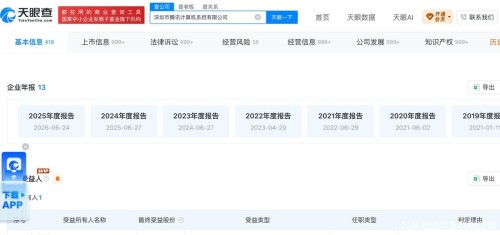
After all, Tianyancha APP shows: Tencent disclosed at its third-quarter earnings call that as of early November, WorkBuddy's daily active users exceeded 10 million. On the revenue side, its revenue for the most recent seven days annualized exceeds $500 million, more than twice that of Tencent Meeting, which was launched seven years ago.
And on the same day, Doubao officially announced that Doubao Work, only three months after launch, had daily active users exceed 8 million and annual recurring revenue (ARR) from enterprise customers exceed 2 billion yuan.
It can be seen that latecomers are already about to catch up...
In fact, not only in B-end AI office, but also in C-end personal agent assistants, the Qianwen GO!, Xiaodou APP, and Tencent Handy Bot launched by Alibaba, ByteDance, and Tencent have now fallen into a homogeneity dilemma. Everyone is eager for a new competitive narrative.
So for these AI application tracks that are moving from "being able to talk" to "being able to do things," what is the key to determining victory?
I think the answer is not in the debate over technology routes, but in "authorization."
Because the bottleneck of AI task execution has never been "whether it can do it," but "who allows it to do it."
So whoever can define "authorization"—user authorization, developer authorization, or system authorization—can grasp the boundaries of agent cross-app operations, the way data is used, responsibility allocation, and commercial revenue sharing.
Just like now, why doesn't one-sentence AI task execution work?
User authorization passed, but application developer authorization chose to refuse, so overall it can only take a detour...
Precisely for this reason, the key to the next round of competition rises to the higher level of system authorization.
First, on PC, according to Apple's developer announcement released a few days ago, Mac OS 27.3 Beta 2 has introduced adjustments for device control, data access, and full disk access permissions. The new system splits the original device control and data access settings into different permission options, allowing users to specify the exact programs an app can control or the folders it can access, and provides an option requiring user confirmation every time permission is requested.
What does that mean? Apple Mac can allow AI operation and control, but authorization checkpoints will further increase.
Combined with the news that Apple has now been reported to be working on its own autonomous AI agent, that is, in AI task execution, Apple in the future wants to be both athlete and referee.
For many application-layer AI players, including Tencent, this is not good news.
Because under Apple's rules, even if WorkBuddy can become the best "tenant," it still cannot set the rent price overall...
Second, on mobile, to some extent, Doubao's past collaboration on the Doubao phone and the current choice by Alibaba, Tencent, and others to connect to StepFun smartphones have the same core purpose:
Both want to try to bypass app restrictions on AI task execution from the system layer, or to grasp higher discourse power and seize the next-generation terminal.
This idea is not wrong, but the question is: how are traditional phone manufacturers willing to give up the entrance to mobile AI assistants?
So you see, Huawei's newly launched sub-brand—the first phone of Xingmang—was positioned as a HarmonyOS AI phone born for AI.
And even earlier, Honor AI phones, as well as OPPO's previously announced cooperation with AI company Manus, under which Manus's agent capabilities will be integrated into OPPO's AI Mind Pilot...
This is enough to show phone manufacturers' vigilance and attention toward AI application players competing for entrances.
Therefore, Tencent and WorkBuddy are still far from being able to open the champagne.
Especially after entering the era of AI task execution, being able to talk is model capability, being able to act is authorization capability; and being able to define authorization is what counts as ecosystem capability.
So for the giants, what comes next is not a competition over who can first make an Agent that can click, but over who can turn a "negotiable, auditable, and revenue-shareable" authorization protocol into an ecosystem consensus.
In the future, AI that cannot define authorization will ultimately only work for others...
-
Why Did Xiaomi Earn 6.5 Billion Yuan Less? SU7 Ultra Dividend Fades, Phone Shipments Cut and Prices Raised
-
![]()
XPeng Upgrades X-World to Version 1.6: Why Introduce Virtual Cities into the World Model?
-
Born Out of Lenovo, Bound to Huawei: Why Does Digital China, with Hundreds of Billions in Revenue, Earn Only 780 Million?
-
Jetour Traveler EV Launched Starting at 89,900 Yuan: One Car, Three Uses for Versatile Travel Experiences
-
Third-Generation Tang Officially Launched, Starting at 187,900 Yuan, Featuring Steer-by-Wire Digital Chassis and a Large Five-Seat All-Electric Flagship
-
![]()
Wei Jianjun and Yu Donglai Meet Again: Wei Jianjun Opens Up About His Anxiety Over the Past Few Years as Great Wall Motor Slips from China's Top Independent Brand to Ninth; Yu Donglai's Advice — Just
-
![]()
WorkBuddy Just Built a "Lobster"-Stuffed "Doubao"
-
![]()
Google Makes Another Move: AI Search Now Connects to Your Spending Records—It Even Knows How Much You've Spent