XPeng Upgrades X-World to Version 1.6: Why Introduce Virtual Cities into the World Model?
 11/25 2026
 484
On November 23, XPeng released version 1.6 of its world model, X-World, introducing the Virtual City capability and further enhancing scene control and real-time interaction performance.
This upgrade addresses a real problem in autonomous driving simulation. Generative world models can already produce continuous driving scenes based on vehicle actions, but for intelligent driving R&D, realistic-looking scenes alone are not enough.
If road structures and key traffic conditions cannot be reproduced consistently, it becomes difficult to make meaningful comparisons between test results from different model versions.
X-World 1.6 introduces real-world road scene constraints on top of the existing controllable generation capability, keeping the fixed environment as consistent as possible while allowing vehicles, pedestrians, and other traffic conditions to vary.
The goal is no longer simply to generate driving videos, but to make the generated environment genuinely usable for repeated testing and model training.
01 Why Do Generative World Models Still Need Real Scenes?
Traditional autonomous driving simulation generally relies on 3D modeling, road maps, and traffic participant models to build test environments. R&D personnel can set conditions such as road geometry, vehicle positions, driving trajectories, and traffic light states, enabling vehicles to complete tests in specified scenes.
The advantage of this approach is that parameters are explicit and scenes are controllable, making it suitable for validating vehicle dynamics, road geometry, and specific traffic rules.
However, real road environments contain a wealth of visual detail and dynamic variation. Building appearances, road facilities, lighting, and the behavior of traffic participants all require substantial modeling and maintenance work.
Generative world models offer an alternative approach.
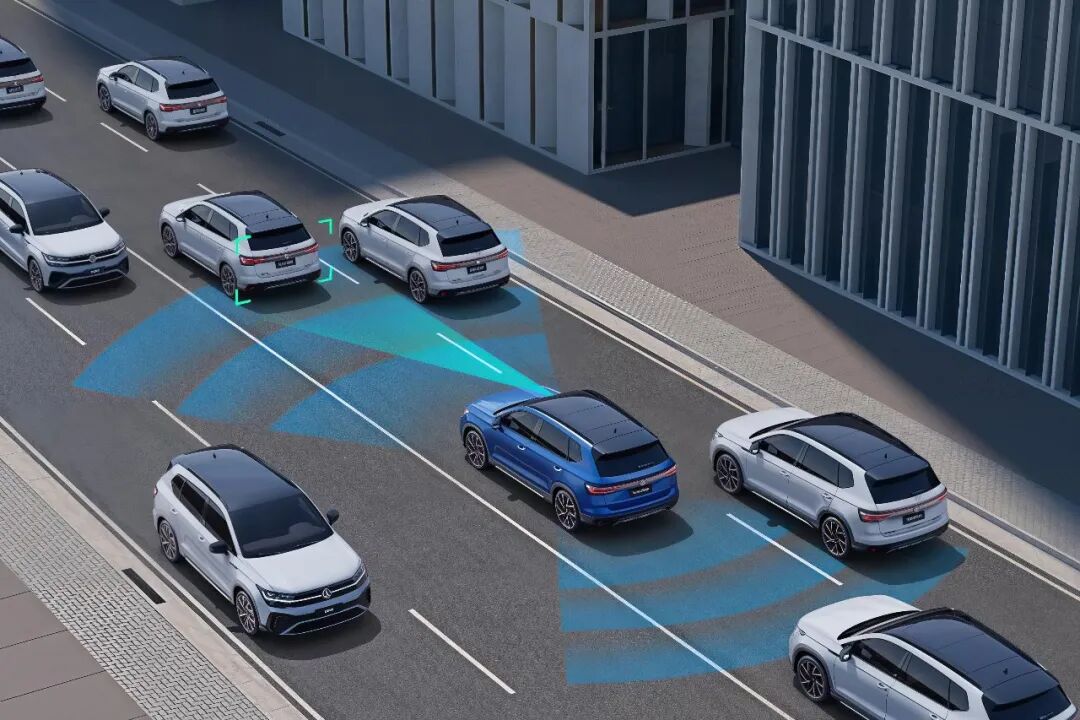
Image source: Internet
They use video generation technology to continuously produce future multi-view driving footage based on multi-camera historical frames, vehicle actions, and scene conditions.
The intelligent driving model can feed its own actions into the simulation environment and then continue making decisions based on the generated subsequent frames, forming a closed-loop interaction.
XPeng's previous X-World 1.0 already had this capability. It could control ego-vehicle motion, traffic participants, road geometry, and overall environment appearance, supporting closed-loop simulation, online reinforcement learning, and data generation.
X-World 1.6 is not about turning an uncontrollable model into a controllable one, but rather further solving the problem of stable reproduction of real scenes.
In this release, XPeng mentioned that R&D personnel had encountered situations such as: when repeatedly generating the same intersection under the Beijing Fourth Ring Road overpass, the positions of bridge piers changed;
when only wanting to adjust the weather, the positions of traffic lights and the timing of their turning green might also change;
when facing narrow roads in urban villages, relying entirely on model generation made it difficult to accurately reproduce road details from the real environment.
These phenomena essentially reflect unstable test conditions.
Suppose R&D personnel want to verify whether a new version of the intelligent driving model has solved a traffic problem at a certain intersection. Ideally, both versions should face the same road structure, initial positions, and traffic conditions.
If the bridge piers, road boundaries, or traffic light states all change in the second simulation, then differences in vehicle performance could stem from both model updates and scene changes. This creates confounding test variables.
It becomes difficult for R&D personnel to determine whether the improvement in model performance is because the policy itself has gotten better, or because the second generated scene is easier to pass.
Therefore, world models need to go beyond existing controllable generation capabilities and further possess the ability to constrain real locations. Fixed environments such as roads, buildings, and bridges should be kept as consistent as possible, while vehicles, pedestrians, and traffic conditions are adjusted according to testing needs.
This is precisely why X-World 1.6 introduces real scene references.
02 How Does X-World 1.6 Turn the Same Road into a Repeatable Testing Environment?
The core technology behind XPeng's upgrade this time is Absolute Static Scene Control.
Previously, X-World could already control ego-vehicle actions, traffic participants, and some road elements, but these conditions were not sufficient to fully describe a specific location.
For example, lane markings and road boundaries can be controlled through structured information, but they may not accurately express the bridge piers, guardrails, building facades, and other location-specific details at a certain intersection.
X-World 1.6 introduces reference information such as 3D Gaussians, point clouds, and real driving videos and images to provide spatial and appearance constraints of real scenes for the model.
3D Gaussian is a 3D scene representation and reconstruction technology that can describe real environments through a large number of Gaussian elements with attributes such as spatial position and color; point clouds use 3D spatial coordinates to record the spatial forms of roads and surrounding objects.
Real videos and images can provide visual references for specific locations.

Image source: XPeng
This information is not simply overlaid onto generated videos as background textures.
The model encodes reference scenes into features with spatial information, then combines them with the target video generation process, enabling the model to generate corresponding multi-camera frames based on target camera viewpoints and vehicle motion conditions.
Among these, real scene references mainly constrain buildings, roads, bridges, and other fixed environments, while vehicle actions and traffic conditions determine how subsequent scenes change.
The dynamic part is still handled by the DiT (Diffusion Transformer) generative model. Traffic participants such as vehicles and pedestrians, as well as vehicle motion, weather, and lighting changes, can all be generated under the constraints of scene references.
There is also a technical detail worth explaining here. Input paths such as point clouds, 3D Gaussians, and visual references each use independently trained models; it is not one model receiving all types of reference data simultaneously.
XPeng also demonstrated the ability to generate future videos from seven cameras from a single street view image, indicating that scene references do not necessarily all need to go through complete 3D reconstruction first.
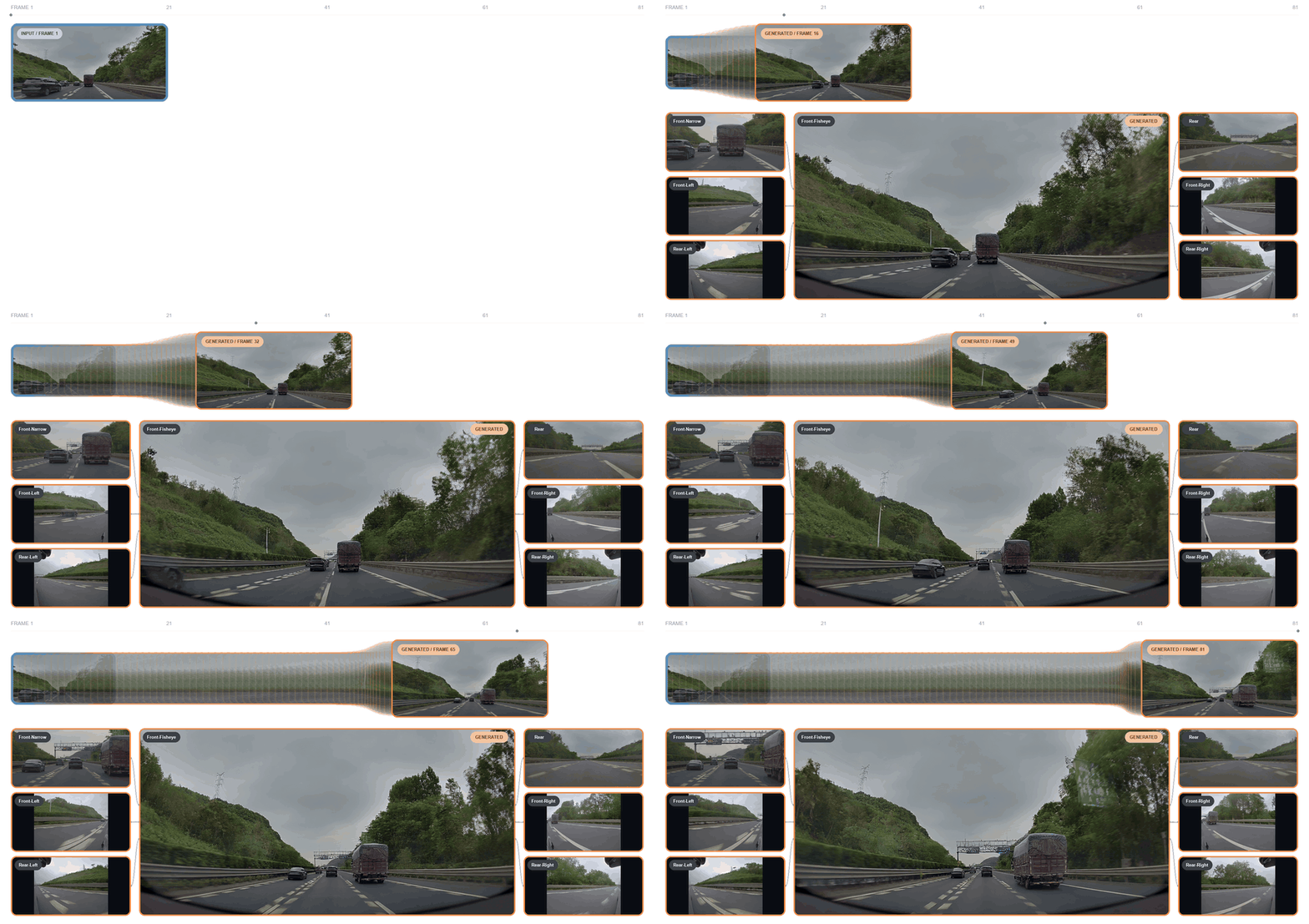 Image source: Internet
However, the generated multi-view frames still need to be evaluated for spatial consistency and dynamic reasonableness. On the basis of static scene constraints, XPeng further built Virtual City.
It is not simply about creating a complete 3D digital replica of an entire city, but rather continuously accumulating scene references from different locations and times through real driving videos uploaded by users, so that these environments can be called upon and regenerated in the cloud.
For example, a road may have undergone half a year of road occupation construction. Through data collected at different periods, the scene states before, during, and after construction can be separately preserved.
By calling the corresponding scene references, R&D personnel can make the intelligent driving model re-run road sections where problems previously occurred. This is clearly different from traditional video playback.
Video playback can only present the driving process that actually happened at the time, and cannot allow the vehicle to change its driving actions and continue exploring new outcomes.
Virtual City, on the other hand, can change the initial positions and motion states of surrounding vehicles, or adjust the ego vehicle's driving actions, while preserving the original road environment references, generating different subsequent scenes.
For example, at the same intersection, different versions of the intelligent driving model can be re-run, or the motion patterns of surrounding vehicles can be changed in the same road environment to observe how the vehicle would make decisions under different traffic conditions.
This is the more important value of virtual cities for intelligent driving R&D. It transforms one-time driving experiences on real roads into scene resources that can be repeatedly called upon, adjusted in conditions, and used for comparative testing.
For closed-loop evaluation, R&D personnel can re-call scenes where problems previously occurred, have the new version model perform regression testing, and check whether the original problems have been improved.
For On-policy RL (online policy reinforcement learning), the current policy needs to continuously interact with the environment, produce new driving outcomes, and then update the policy based on interaction feedback.
If different policies can interact multiple times under the same scene references and initial conditions, R&D personnel can more easily analyze the impact of policy changes and reduce interference from environmental differences on evaluation.
Two types of training need to be distinguished here. The world model itself can also be optimized through reinforcement learning for generation quality and action-following capability; the other is using the world model as a simulation environment for intelligent driving policies to undergo interactive training within it.
The training targets of the two are different and cannot be conflated.
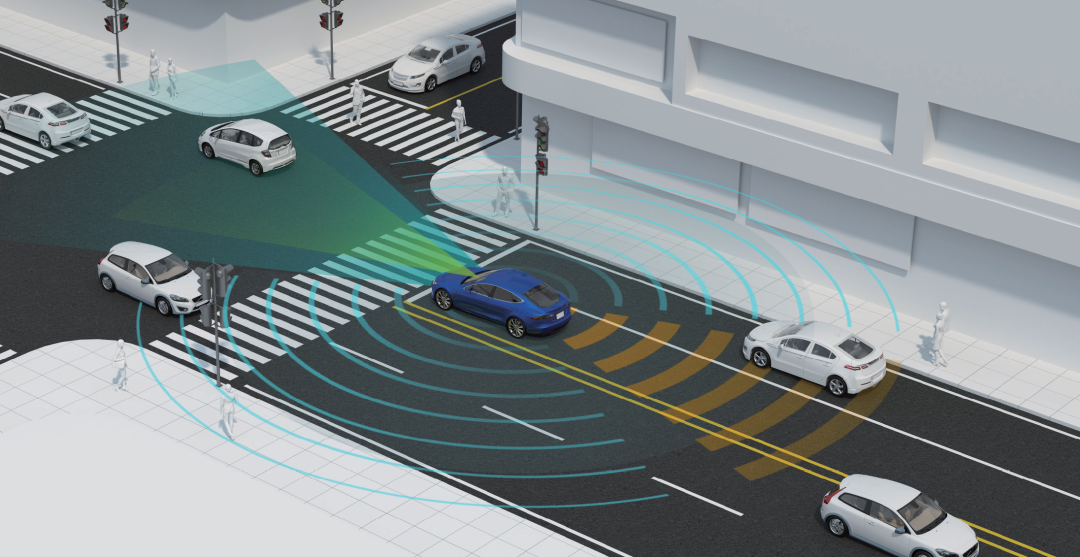 Image source: Internet
XPeng's technical report also clearly distinguishes the reinforcement learning optimization of the world model itself from downstream driving policy training. In addition to scene references, X-World 1.6 also improved the training process of the generative model.
Official data shows that compared with 1.0, the candidate driving record pool has been expanded to 4 times, the filtered training dataset has been expanded to 2 times, and the scene label system has been expanded to more than 150 categories.
At the same time, the team used post-training methods such as Connected Self Forcing to enable the model to more fully consider previously generated historical information during continuous generation, improving frame consistency and action-following performance in long-duration interactions.
This means the 1.6 upgrade is not just about adding real scene inputs, but also involves data filtering, scene control, long-sequence training, and model evaluation.
03 What Thresholds Does the World Model Still Need to Cross?
Once scenes can be reproduced, another issue to face is generation efficiency. In closed-loop simulation, the intelligent driving model outputs driving actions, the world model generates the next moment's multi-camera frames based on those actions, and then hands the results back to the intelligent driving model to continue making decisions.
This process needs to loop continuously. If each generation requires a long wait, the time consumed for a single test will increase.
For online reinforcement learning that requires extensive interaction, the inference throughput of the environment model will also affect training efficiency. Closed-loop evaluation and data production face similar issues; the slower the generation speed, the fewer simulation tasks can be completed per unit time.
XPeng disclosed that the team carried out systematic optimization from kernel scheduling, multi-card parallelism, and operator fusion to encoding and decoding, and reduced control latency to 426ms.
R&D personnel can directly drive the generated virtual vehicle through the steering wheel and pedals, observing how the environment responds to different driving actions.
It should be noted that the 426ms here is the control latency disclosed by XPeng officially, not the control response latency of a production intelligent driving system, nor can it be directly equated with single model inference time.
It mainly reflects the interactive experience when manually driving in the virtual environment. Real-time interaction also provides another testing method.
Image source: Internet
When the intelligent driving model drives by itself, the testing process is affected by the current policy, and vehicle actions generally concentrate on operating conditions that the existing policy can handle.
Human testers, on the other hand, can proactively create special operations such as sharp turns, hard braking, and traversal through narrow spaces, observing whether the generated environment can respond continuously, and checking whether the world model exhibits obvious scene drift, frame distortion, or action-following errors.
This is both testing the intelligent driving model and checking the generation quality of the world model itself.
From the results published in the technical report, X-World 1.6 reduced average final displacement error (FDE) by 20.9% relative to 1.0.
FDE here measures the distance between the endpoint of the generated trajectory and the endpoint of the corresponding real video reference trajectory. The smaller the error, the closer the endpoint of the generated trajectory is to the reference result.
In another target behavior reproduction evaluation, 1.6 performed better in 19% of cases, similarly in 77.4% of cases, and worse in 3.6% of cases.
Of course, the 96.4% improvement or similarity ratio refers to same-scene comparison results relative to 1.0, not the simulation success rate, nor does it mean that all road scenes can be accurately reproduced.
However, these data indicate that the new version has indeed delivered improvements in the scenarios evaluated in the paper—though this still does not warrant the conclusion that the simulation environment is already indistinguishable from real roads.
In fact, the technical report also disclosed several current limitations.
Although the model supports continuous multi-camera generation for over 30 seconds, prolonged occlusion and long-distance motion may still prevent previously observed scene content from being accurately recovered;
if control inputs are temporally discontinuous, the generation process may also exhibit frame discontinuities or behavioral inconsistencies. This shows that the spatiotemporal memory of the virtual city is not a complete replication of the real world.
It can preserve scene references within the coverage of existing data and generate new driving sequences on that basis, but missing reference data, scene reconstruction errors, and long-sequence generation drift will still limit simulation effectiveness.
04 Closing Remarks
From the broader perspective of simulation technology development, generative world models will not necessarily replace traditional simulation platforms entirely; the problems they solve are not entirely the same.
Traditional simulation offers clear modeling and control advantages in vehicle dynamics, collision detection, road parameters, and rule constraints; generative world models are better suited to handling complex visual environments, interactions among multiple traffic participants, and continuous scene changes.
The future is more likely to involve a division of labor and combination tailored to testing tasks, rather than one technology simply replacing another.
What is truly noteworthy about XPeng X-World 1.6 is that it has begun to integrate real road references, dynamic scene generation, temporal state backtracking, and real-time interaction.
In the past, generative world models mainly addressed the question of how to generate complex driving scenes;
now, whether scenes can be stably reproduced, whether test conditions can be independently adjusted, and whether different model versions can be repeatedly validated in the same environment are becoming key criteria for assessing the engineering value of world models.
Ultimately, what world models compete on is not just the ability to generate scenes, but whether the generated environment can become a trustworthy, controllable, and reusable tool for intelligent driving R&D.
#AutonomousDriving #WorldModel #XPengWorldModel
-
Why Did Xiaomi Earn 6.5 Billion Yuan Less? SU7 Ultra Dividend Fades, Phone Shipments Cut and Prices Raised
-
![]()
XPeng Upgrades X-World to Version 1.6: Why Introduce Virtual Cities into the World Model?
-
Born Out of Lenovo, Bound to Huawei: Why Does Digital China, with Hundreds of Billions in Revenue, Earn Only 780 Million?
-
Jetour Traveler EV Launched Starting at 89,900 Yuan: One Car, Three Uses for Versatile Travel Experiences
-
Third-Generation Tang Officially Launched, Starting at 187,900 Yuan, Featuring Steer-by-Wire Digital Chassis and a Large Five-Seat All-Electric Flagship
-
![]()
Wei Jianjun and Yu Donglai Meet Again: Wei Jianjun Opens Up About His Anxiety Over the Past Few Years as Great Wall Motor Slips from China's Top Independent Brand to Ninth; Yu Donglai's Advice — Just
-
![]()
WorkBuddy Just Built a "Lobster"-Stuffed "Doubao"
-
![]()
Google Makes Another Move: AI Search Now Connects to Your Spending Records—It Even Knows How Much You've Spent