Kling's Image Bet Isn't Just About Filling a Gap
 11/25 2026
 551
Most people first encountered Kling through its striking AI videos. As the earliest domestic company to deploy a DiT-based text-to-video model, Kling leveraged its first-mover advantage to show creators worldwide what Chinese AI imagery could do: the AI short film "Paper Phone" was completed in three days and racked up over 100 million views across the internet; an advertising piece appeared at the Cannes Lions; and tens of thousands of overseas creation platforms integrated its API—together forging a commercialization path as an independent model service provider.
But the pace of competition in this industry is far faster than anyone imagined. In May of this year, third-party compute consumption statistics showed that ByteDance's Seedance already accounted for more than 80% of daily compute consumption in the video track, while Kling held about 14%. The gap in compute and ecosystem in video is objectively clear. Just as the outside world was debating "whether Kling's first-mover advantage in video will be caught up," Kling officially launched the Kling Image 4.0 image model on November 17 to round out its image capabilities. Eight days earlier, ByteDance had just released Seedream 5.5—the two major players making their moves in the image track almost simultaneously.
It's easy for outsiders to read a simple narrative here: as competitive pressure in video mounts, Kling turning to images looks like a retreat. But step into the real workflows of film storyboard artists, e-commerce designers, and overseas advertising creators, and a different picture emerges. This heightened focus on images is not an abandonment of the video main line—it's about filling in the most upstream and critical link in AI imagery production. The question Kling now aims to answer has shifted from "can it generate stunning AI videos" to: how do you build a complete creation workbench spanning image storyboards, character assets, and finished videos—one that serves real commercial production?
Images Are Not a Second Track—They're the Upstream Foundation of Video Creation
Of all the pain points in AI video, character consistency, scene coherence, and storyboard controllability are the ones creators complain about most. Many video failures don't stem from the video generation model itself being inadequate—they stem from the reference images, character settings, and storyboard sketches in the early stage lacking a stable, controllable image foundation.
A creator at an overseas advertising studio once described their daily work like this: upon receiving a brief, first draw dozens of storyboards, finalize character appearances, clothing color schemes, and scene lighting, then feed the reference images into an image-to-video tool. Once the facial features, materials, or text layout of those reference images become unstable, the dozens of video assets that follow all go off track—requiring repeated generation attempts and adjustments, consuming large amounts of compute and time. This is also why more than 85% of commercial AI videos in the industry rely on the image-to-video pipeline: image quality directly determines the lower bound of the finished video.
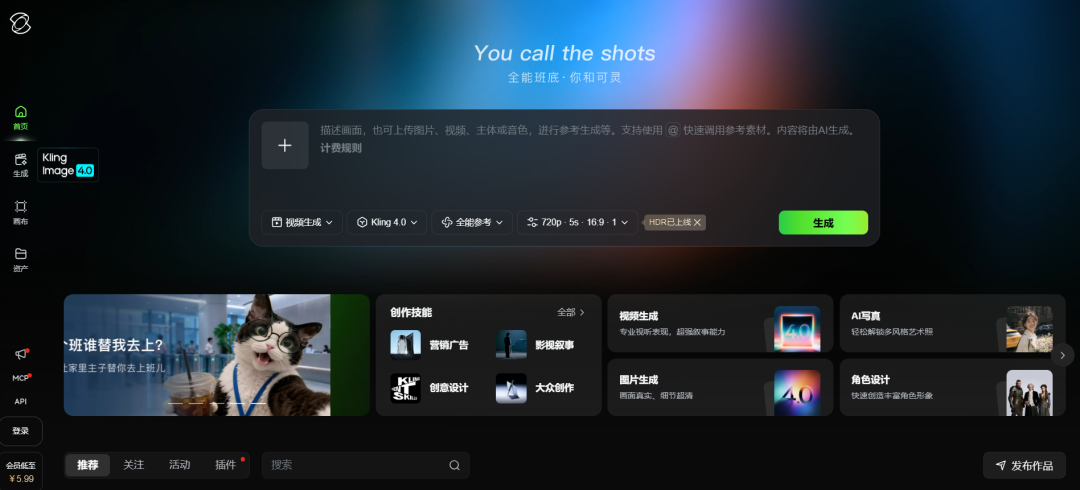
The design philosophy of Kling Image 4.0 is anchored precisely to this real production process. The new model adopts a unified understanding-and-generation architecture, natively supports 8K output, handles up to 2,000 characters and 15,000 tokens of long-text input within a single image, and also supports coherent image sets and batch generation of long images—adapting to the needs of e-commerce detail pages, posters, and complete sets of film storyboard materials. On the AA (Artificial Analysis) global ranking, this model ranks seventh worldwide and first among domestic models, entering the global top five in the e-commerce retail and UI/UX design segments—specifically addressing the old problems of blurry text, messy layout, and distorted materials in commercial scenarios.
For Kling, images and video are not two separate products but one system. The Kling 4.0 video model launched in October this year supports up to 10 reference images and multi-keyframe locking of character, scene, and prop features, achieving cross-shot consistency. When character three-view sheets, storyboard drafts, and brand materials produced by its own image model can flow seamlessly into the video pipeline, creators no longer need to export, upload, and align styles back and forth between different platforms; assets can accumulate in the same workbench. This is the core value of Kling's integrated "image + video" layout: it's not adding a separate image generation tool—it's installing a more stable upstream supply for the video engine.
From a cost perspective, this step also has pragmatic commercial logic. Video is widely recognized as a compute guzzler, with extremely high inference costs for high-resolution, long-duration video and expensive trial-and-error costs in commercial scenarios. Image inference costs are lower and iteration is faster, making it suitable for handling large numbers of small and medium-sized orders and standardized design needs—leaving teams room to continuously refine video large models.
Completing the Revenue Structure to Add Stability to a Fast-Growing Business
Kling's commercialization story is a rare model among domestic AI companies. Public data shows that Kling's full-year revenue in 2025 was approximately 1 billion yuan; in the first quarter of 2026, revenue exceeded 650 million yuan, with a year-on-year growth rate of over 300%; second-quarter revenue exceeded 850 million yuan, up more than 200% year-on-year and about 30.8% quarter-on-quarter, with total first-half revenue exceeding 1.5 billion yuan—already surpassing the full-year 2025 level.
Behind the high growth, the characteristics of the business structure are equally clear: overseas revenue accounts for nearly 80% of Kling's revenue, and API enterprise service revenue accounts for about 60%, surpassing personal subscriptions to become the largest revenue source; within API revenue, super-large customers contribute 80%, concentrated among overseas creation platforms, advertising, and film and television studios.
This model helped it scale quickly, avoid the crowded domestic consumer traffic market, and open up in the global creator market—but it also inherently carries structural risks: fluctuations in call volume from large overseas customers, platform policy changes, and shifts in the copyright environment could all directly affect revenue. For Kling, which is advancing independent capitalization, the capital market no longer pays only for "cool video demos"—it places more emphasis on revenue diversification, customer tiering, and scenario richness.
The image track happens to open up new customer segments. In scenarios such as e-commerce design, brand posters, game concepts, and UI design, many customers have no video needs at all—they only need high-quality image materials. These customers complement the overseas platform customers that previously relied mainly on video APIs, reducing dependence on a few top customers and making the customer base thicker.
At the same time, the image business can also activate existing users. Many creators already using Kling for video naturally have needs for accompanying posters, covers, and storyboards; completing the entire creative process within the same membership system will improve user retention and usage time. There is a crucial boundary here: a good image business is not simply "diverting video quotas"—it's about amplifying per-user value, enabling one creator to complete all work from creative sketches and visual finalization to finished output on one platform.
Comparing with ByteDance's model makes Kling's differentiated path clearer. ByteDance has a closed loop of models, creation tools, and short-video content platforms, where model-generated content can be distributed internally and share in content monetization revenue. Kling, by contrast, is more of a model supplier: customers call APIs to generate content and publish it on third-party platforms such as YouTube and Instagram, while Kling mainly earns call fees. In this model, making the creation pipeline complete is the optimal solution for enhancing its own irreplaceability—customers choose you not just because the video model scores high on benchmarks, but because the entire workbench can solve their full range of production problems.
AI Imagery Competition Is Moving from Benchmark Contests to Production Closed Loops
Over the past two years, a clear consensus has formed in the AI visual track: pure model parameters and leaderboard scores alone can hardly form a long-term moat. Whether in images or video, the capability gap among top players is rapidly converging; today's exclusive capability becomes an industry standard a few months later. 8K, long text, subject reference, and multi-turn editing are shifting from "highlight features" to baseline thresholds for commercial customers.
It is no accident that players in the track are collectively turning to full-pipeline workbenches. Runway, MiniMax Design, and Jimeng are all simultaneously building integrated products for images, video, editing, and asset management. Customer needs have changed: two years ago, everyone asked "can you generate an AI video"; now, advertising agencies, film and television teams, and e-commerce service providers care about whether character assets can be stably reused, whether complete sets of materials can be produced in batches, whether the tool can be embedded in their internal workflows, and whether post-production rework costs can be reduced.
Viewed against this larger backdrop, the release of Kling Image 4.0 is a step by Kling to keep pace with the industry inflection point. It has not stopped iterating its video models; just a month ago, the Kling 4.0 video model had fully launched, supporting up to 2-minute continuation shooting and combinations of multiple reference materials. Now, completing images means assembling single-point model capabilities into a production system for professional creators.
Of course, the image track itself is already a red ocean, with products such as Midjourney, DALL·E, Seedream, and QwenImage each having their own advantages—breaking through will not be easy. Kling's opportunity lies not in simply competing with established image players on generation quality, but in its inherent video DNA: the vast majority of image generation tools on the market consider only the image itself, while Kling's image model was designed from the outset to connect with the video pipeline, so image assets can directly serve as video anchors, keyframes, and reference materials. This "native image-to-video synergy" is its most unique differentiating label compared with other image models.
For professional creators, this is a tangible difference in experience. A film storyboard artist can complete a coherent set of long storyboard images in Kling and directly generate continuous shots based on those storyboards, with characters, lighting, and color tone remaining consistent—without repeatedly migrating materials and aligning styles across multiple tools. This kind of fluency is difficult to achieve with a combination of scattered tools.
Three Synergy Tests Kling Must Pass
Increasing the image bet is a smart layout, but to truly unleash synergy value, there are still three tests that require sustained answers.
The first is the depth of asset connectivity. It's not about putting image and video functions on the same page, but about whether character, prop, scene, and style assets are truly accumulated, reusable, and callable across modalities. If materials produced by images still easily break down after being imported into video, then the image business is merely an add-on feature and cannot form a synergy moat.
The second is the incremental quality of commercialization. Image API unit prices are generally lower than video, and whether it can bring new customers and new orders—rather than merely consuming existing member quotas and internally transferring original video demand—determines whether the image business can truly hedge the risk of customer concentration.
The third is continuously maintaining the stability of professional production. Commercial customers have extremely high requirements for fault tolerance; brand logos, poster text, product materials, and character images are not allowed to randomly go wrong. This requires sustained investment in models, annotation, and engineering to find a balance between creative freedom and controllability.
These challenges are also precisely the common issues of the entire AI imagery industry. Compute costs, copyright compliance, and uncertainty in overseas markets remain shackles that all model service providers must face over the long term.
Conclusion
It's easy for outsiders to simplify this image model release into a retreat in the track. But viewed from the three dimensions of creators' production workflows, business structure, and long-term industry trends, this is more like a proactive strategic deepening: Kling has not abandoned video, its fundamental base—it has chosen to move upstream in the creation pipeline, pushing AI imagery from "single-point cool demos" toward a stable, controllable production system capable of taking on commercial orders.
In the first half of AI imagery, the competition was about who could first produce stunning video effects; in the second half, the competition is about who can embed into the real creative industry and help creators reliably turn ideas into deliverable finished films. Leaderboard scores will iterate and parameters will be caught up, but a complete workflow connecting images, storyboards, characters, and video—along with the creator assets and industry know-how accumulated on the platform—are the more enduring moat.
For Kling, Kling Image 4.0 is not the endpoint, but a key piece of the full-pipeline creation platform. When the image foundation is solid enough, the potential of video will be further unleashed; when images and video form synergy, it will have the opportunity to step beyond its positioning as a mere API supplier and become the AI imagery infrastructure trusted by professional creators worldwide.
-
![]()
Why Can't Hongguo Swallow Bilibili?
-
![]()
The Day After Jensen Huang's Return: The Fed Pours Cold Water on the Rally
-
![]()
Global Online Action Camera Market Hits 5.65 Billion Yuan in Q3 2026
-
![]()
Hyundai-Kia Retail 11,000 Vehicles in China in October
-
![]()
Geely Galaxy Sold 98,896 Vehicles Domestically in October, With the Xingyuan Alone Accounting for Half
-
![]()
Kling's Image Bet Isn't Just About Filling a Gap
-
![]()
Foxconn Industrial Internet Shareholders Can Quietly Celebrate
-
![]()
Why Are AR Glasses Increasingly Paired with Interaction Rings: Filling a Gap, or a New False Need?