The Day After Jensen Huang's Return: The Fed Pours Cold Water on the Rally
 11/25 2026
 351
The capital market frenzy sparked by Jensen Huang's return to NVIDIA lasted less than 24 hours.
On November 23, US Eastern Time, Jensen Huang returned to NVIDIA as President and CEO, driving a substantial increase in the market value of the US tech sector. Yet just one day later, as the Fed signaled further tightening, market expectations for future interest rate trends shifted, and AI tech stocks pulled back across the board. NVIDIA fell 5.86% after surging 31.48% in the previous trading day, and the Philadelphia Semiconductor Index also dropped 7.88% after rising 14.03% in the previous session.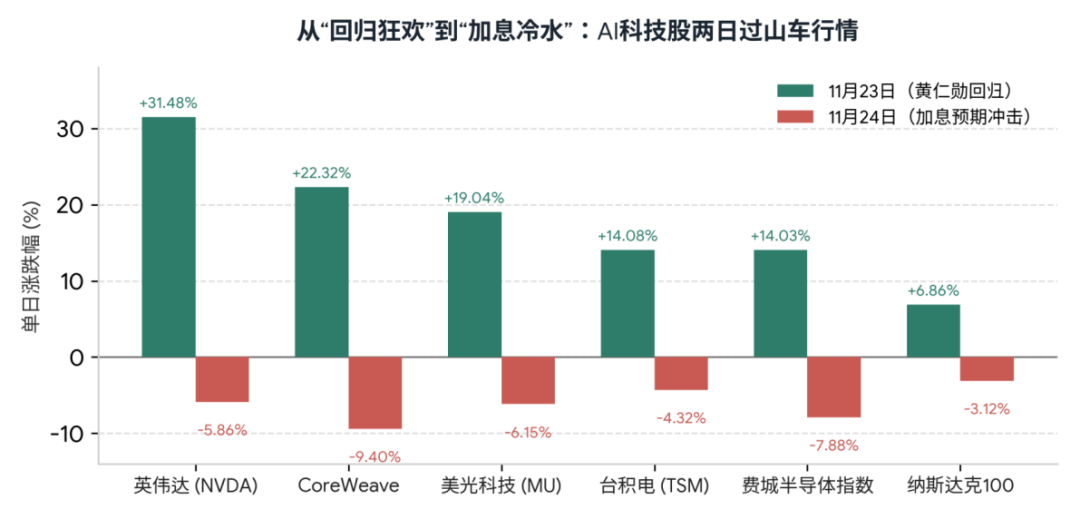
This rapid reversal in the capital market reflects another layer of investors' concerns about the AI industry: as financing costs rise and infrastructure investment continues to expand, can trillions of dollars of AI investment still deliver the expected commercial returns?
Just before this, Musk had warned that the AI industry could face a working capital gap of hundreds of billions of dollars in 2027, and that large-scale bankruptcies or mergers and acquisitions could even hit the data center sector in the future.
As analyzed in the previous AI Business article "Jensen Huang Is Back, but the Problems Remain," Jensen Huang's return can ease market concerns about NVIDIA's internal governance and product iteration, but it cannot solve the financing costs, power supply, and return on investment issues facing the AI infrastructure industry.
As rate hike expectations collide with continuously expanding AI investment, a test of compute economics is arriving.
1. The "Interest Rate Hike Paradox" of AI Infrastructure: Investment Expansion May Push Up Its Own Costs
Over the past few years, a relatively loose financing environment provided important support for tech companies to expand AI infrastructure investment. But as the scale of investment continues to grow, the impact of AI data center construction on the supply-demand relationship for real economy resources is also deepening.
AI data center construction is far more than just purchasing GPUs; it also involves power, energy, cooling, construction, and many other industries. Large tech companies concentrating on expanding capital expenditure has driven rapid growth in demand for transformers, high-voltage cables, gas turbines, liquid cooling equipment, copper and aluminum raw materials, and specialized construction workers. With supply unable to expand in sync, costs for related equipment, raw materials, and labor face upward pressure.
Federal Reserve Governor Lisa Cook recently also pointed out that the investment boom in artificial intelligence has become one of the sources of US inflationary pressure.
This puts the AI infrastructure industry in a noteworthy "interest rate hike paradox": AI investment expansion may intensify inflationary pressure in some areas, and persistent inflationary pressure may prompt the Fed to maintain high interest rates or even raise them further, which in turn pushes up the financing costs of AI infrastructure construction itself.
Although AI investment is not the only factor determining US inflation and monetary policy direction, as the scale of investment continues to expand, its impact on the supply-demand relationship for real economy resources can no longer be ignored.
AI infrastructure investment is facing a new cost pressure: on one side is continuously expanding construction demand, and on the other side are potentially persistently rising capital and resource costs.
2. Trillion-Dollar AI Investment: Compute Hasn't Made Money Yet, but Capital Is Already Being Consumed
Changes in the financing environment do not affect different types of AI infrastructure investors in the same way.
The four major tech giants Amazon, Alphabet, Microsoft, and Meta are expected to spend a combined total of more than $720 billion in capital expenditure in 2026, but with relatively stable business cash flow and strong financing capabilities, these companies have some risk buffer space. By contrast, emerging cloud service providers (Neocloud) that rely heavily on external financing face more direct funding pressure.
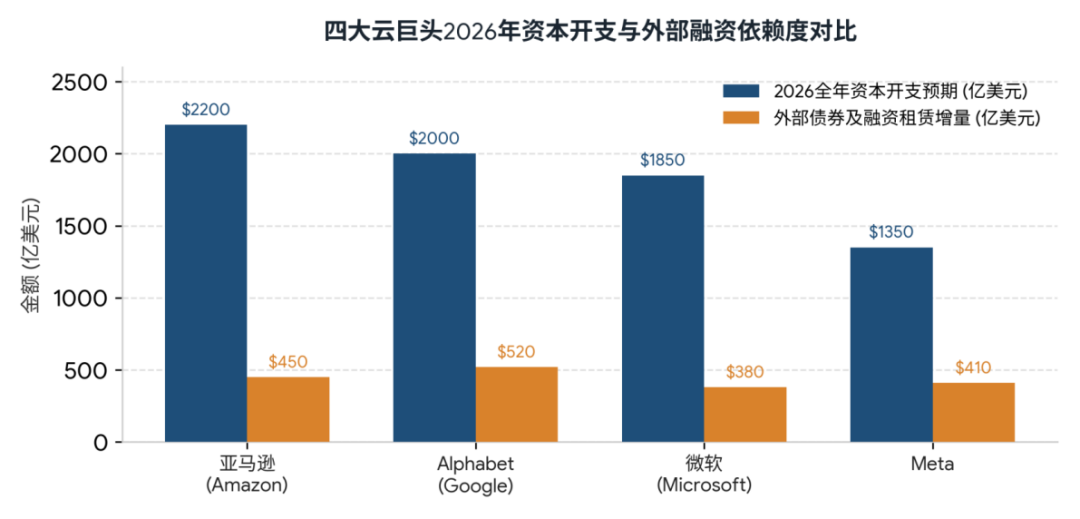
Recently, Musk warned on social platform X that the AI industry could face a working capital gap of hundreds of billions of dollars in 2027, and that more than 200 companies in the data center sector could face bankruptcy or acquisition in the future. Relevant estimates from Goldman Sachs show that global AI capital expenditure is approaching $1 trillion in 2026, and the cumulative related debt issuance has reached about $600 billion.
Behind these numbers is an easily overlooked problem: there is a clear time lag between AI infrastructure construction investment and the formation of commercial revenue.
From financing and procuring servers to completing power connection, liquid cooling commissioning, and cluster deployment, and then to formally providing commercial compute services, it often takes months or even more than a year. During this period, costs such as equipment procurement, site leasing, and financing have already occurred, but compute assets have not yet generated corresponding revenue.
If power connection or engineering construction is delayed, companies not only bear additional capital occupation costs but may also miss the originally planned revenue window.
At the same time, AI chips and computing systems iterate rapidly, and delayed production may also shorten the commercial operating cycle during which equipment remains competitive in the market. Even if a batch of GPUs is eventually deployed, it may face falling rental prices and asset value shrinkage because a new generation of products has come to market.
Therefore, AI infrastructure investment must consider not only how much capital construction requires, but also how much capital support is needed throughout the entire cycle from investment to revenue generation. The higher the financing cost and the longer the construction cycle, the greater the operating pressure companies bear.
3. A Typical Case: CoreWeave's $47 Billion Debt Test
As expectations of Fed rate hikes heat up, Neocloud companies that rely heavily on external financing are facing greater operating pressure. The recently disclosed financial report of globally representative compute service provider CoreWeave has already revealed the risks of this business model.
As of the end of the third quarter of 2026, CoreWeave's liabilities had reached nearly $47 billion, including more than $10 billion of debt maturing in 2027. Although single-quarter revenue increased 168% year over year, interest expense of $846 million was more than four times operating profit for the same period, and single-quarter net loss exceeded $700 million.
Capital market concerns have also been reflected in bond prices. In the second half of 2026, yields on some of CoreWeave's unsecured senior notes at one point exceeded 15%, and creditors also began to strengthen management of corporate cash flow through stricter loan terms.
To ease funding pressure, CoreWeave is improving cash flow by increasing the proportion of customer prepayments and relying on long-term compute procurement contract financing.
CoreWeave's situation reveals a real contradiction under the AI infrastructure boom: strong compute demand can bring rapid revenue growth, but it may not be enough to cover high financing and operating costs. Once interest rates rise further, debt refinancing pressure will intensify further.
For Neocloud companies expanding rapidly with high leverage, the real test may only just be beginning.
4. The Logic of Global Compute Competition Is Changing: From Scrambling for Resources to Improving Compute Output Efficiency
Changes in the financing environment are not limited to the North American market. Differences in the US dollar exchange rate, financing costs, and regional energy and industrial infrastructure conditions will also affect the pace and path of global AI infrastructure construction.
Europe and some emerging markets may face issues such as rising US-dollar-denominated GPU and server procurement costs and increased financing pressure. Some large intelligent computing center projects may adopt phased construction and on-demand expansion, placing greater emphasis on return on investment.
The two major AI infrastructure markets of North America and China face different resource constraints. In some parts of North America, grid expansion cycles are long and transformer and gas turbine supply is tight, making how to accelerate compute production and reduce full-lifecycle costs an important issue. China, meanwhile, needs to cope with capacity limits in high-end AI chips and advanced packaging, and improve compute efficiency through multi-chip software and hardware adaptation, super nodes, and system-level optimization.
Comparison dimension
North American AI infrastructure market
Chinese AI infrastructure market
Macro financing environment
The Fed has restarted tightening expectations, high-yield bond spreads have widened, financing costs for asset-heavy compute providers are generally in the double digits, and creditors are tightening capital controls.
In a low-interest-rate and loose-liquidity environment, policy-based financial tools support new infrastructure, and funding costs are significantly lower than overseas.
Physical delivery bottleneck
Public grid expansion approvals often take years, transformers and gas turbines are in severe shortage, and "chips without power" greatly lengthens the funding recovery gap.
Relying on ultra-high-voltage grids and the "East Data West Computing" project, power supply is abundant and infrastructure deployment is extremely fast, with almost no long grid connection gap.
Current core breakthrough
Giants are forced to build their own gas turbines or nuclear microgrids to bypass public grids; capital pressures companies to strictly control TCO (total cost of ownership over the full lifecycle).
Concentrated efforts to tackle capacity limits in high-end chips and advanced packaging, improving cluster compute efficiency through super node architecture, high-density liquid cooling, and system engineering optimization.
Although the constraints faced by each region differ, the industry is showing a common trend: compute scale is still important, and how to use limited capital, energy, and chip resources to obtain more effective compute is becoming the key to competition.
This change will also affect customer demand for AI servers and infrastructure procurement. In the past, customers focused more on GPU supply capacity, cluster construction scale, and hardware performance; in the future, how soon equipment can enter production after procurement, whether clusters can operate stably over the long term, and how many effective tokens can be generated per unit of capital and energy input will become more important evaluation indicators.
Final Thoughts
The continued evolution of large models and the large-scale application of AI Agents will still drive growth in global compute demand. However, growth in compute demand, growth in infrastructure investment, and growth in compute company profitability cannot simply be equated.
In the past few years, quickly obtaining capital, GPUs, and data center resources was an important means for companies to seize the market. In the future, whether companies can control financing costs, shorten production cycles, improve asset utilization, and generate stable operating cash flow will be key to sustainable development.
Jensen Huang's return can revive market confidence in NVIDIA, but every company ultimately has to figure out this economic account of the AI infrastructure industry for itself.
-
![]()
Why Can't Hongguo Swallow Bilibili?
-
![]()
The Day After Jensen Huang's Return: The Fed Pours Cold Water on the Rally
-
![]()
Global Online Action Camera Market Hits 5.65 Billion Yuan in Q3 2026
-
![]()
Hyundai-Kia Retail 11,000 Vehicles in China in October
-
![]()
Geely Galaxy Sold 98,896 Vehicles Domestically in October, With the Xingyuan Alone Accounting for Half
-
![]()
Kling's Image Bet Isn't Just About Filling a Gap
-
![]()
Foxconn Industrial Internet Shareholders Can Quietly Celebrate
-
![]()
Why Are AR Glasses Increasingly Paired with Interaction Rings: Filling a Gap, or a New False Need?