Short Dramas: Big Tech's Q3 Earnings Scapegoat or Lifeline?
 11/25 2026
 552
Short dramas have become a convenient catch-all excuse.
If you ran a word frequency count on the earnings call remarks of major tech companies in Q3 2026, "short dramas" would most likely land in the top three.
NetEase's William Ding claimed on the earnings call that short dramas are experiencing "explosive growth" and siphoning attention away from games. Tencent's management touted the WeChat short drama entry as a "breakthrough success" that "has begun to noticeably contribute advertising revenue." At Kuaishou, short dramas cut both ways—a "rare bright spot" in the earnings report and a "cost item" dragging down gross margin.
On the night of its earnings call, NetEase's US stock closed down more than 11%, and the next day its Hong Kong shares plunged more than 19% intraday before closing down 17.6%. Bilibili was the least cooperative with this narrative—when Chen Rui was asked about short drama erosion, he simply said no, and the next day its Hong Kong stock opened up more than 14%.
The same word plays completely opposite roles in different companies' narratives.
If short dramas are really that powerful, the companies making them should be raking it in, right?
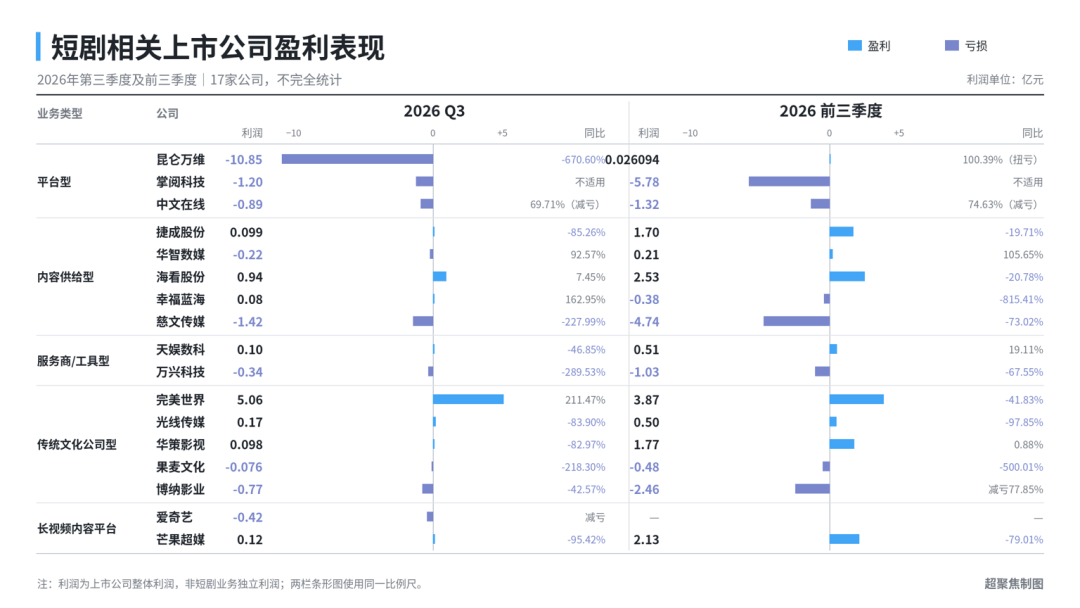
According to an incomplete tally by Super Focus of the profitability of listed companies with short drama businesses in the first three quarters, this quarter, apart from Perfect World's big profits and Kunlun Tech's heavy losses, almost all companies barely broke even.
According to DataEye's Ju Chacha statistics, the full-caliber short drama market size is expected to exceed 120 billion yuan in 2026, yet 98.7% of projects fail to recoup their investment within six months. With the recoupment benchmark set at 50 million views, the hit rate is less than 0.1%, and the ROI of small and medium-sized teams generally falls below 0.8. Among domestic short drama ad-buying companies, Juliang Engine accounts for about 73% share, Tencent Ads 17%, and Kuaishou 8%. Short drama companies compete to the death, and the ad-buying budgets they squeeze out ultimately flow to the platforms that own the traffic pools.
Tencent's "Green Bubble Short Dramas" did indeed drive advertising growth, but a UBS report also pointed out that the profit margin of this incremental advertising was diluted by short-term traffic acquisition costs and ecosystem investment. Short dramas bring platforms advertising revenue, but to keep users in the short drama scenario, platforms also have to keep paying traffic costs. They made money, but not so easily.
Games and long video had their user time taken away, advertising platforms captured the short drama ad-buying budgets, and they themselves also personally entered the short drama business, actively keeping users within their own traffic closed loops. The relationship between big tech and short dramas is far more complex than "having their time stolen by short dramas"—they are simultaneously victims, beneficiaries, and suppliers of short dramas.
Seen this way, short dramas are actually a besieged fortress: those inside want to get out, and those outside want to get in.
01 Short dramas have become the "universal scapegoat" in big tech earnings reports
Recently, due to excessive discussion, Hongguo Short Dramas launched an optional "time lock." Users can set a daily usage duration—equivalent to setting up "parental mode" for children or "anti-addiction" for one's parents. Now there's no need to worry about the whole family staying up late scrolling short dramas.
Ding Lei pointing the finger at short dramas makes logical sense—users only have so much fragmented time, and if they scroll Hongguo, they play one less round of Justice Online.
The earnings report shows NetEase's Q3 net revenue was 27.9 billion yuan, down 1.8% year-on-year, with gaming revenue of 22.9 billion yuan, down 1.7% year-on-year—the first negative turn since Q3 2024.
But NetEase's own earnings report also shows deferred revenue below expectations, lackluster performance of major summer products, and the next core new title Infinity Nikki not arriving until January 2027. Short drama diversion is an external variable, while the product gap is an internal rhythm—both happened at the same time, and picking only one to talk about is somewhat "picking the soft persimmon."
On Tencent's side, it's a mix of good and bad news. WeChat short dramas are indeed contributing advertising growth; without them, advertising growth would be even slower in a weak consumption environment. But UBS's research report flipped over the other side: the profit margin of incremental advertising brought by short dramas was "diluted by short-term traffic acquisition costs and ecosystem investment."
Short drama advertising has come in, but to nurture the short drama ecosystem, Tencent has to give content providers a bigger cut, and gross margin has actually thinned. Marketing services gross margin fell from 57% to 52%. Short dramas are both a source of incremental advertising revenue and a deduction from gross margin. When a business appears simultaneously in the "growth highlight" and "profit drag" columns, it is no longer a pure business—it has become a narrative tool.
Kuaishou's situation provides an observation window. In Q3, Kuaishou's DAU hit a historic high of 417.3 million, and MAU reached 818.5 million, also a new high. But in the same earnings report, average daily user time spent declined year-on-year, and average online marketing revenue per DAU fell from 48.3 yuan to 42.8 yuan. MAU up, time spent down, per-user advertising revenue down—the three indicators diverged in this direction for the first time.
Kuaishou itself admitted on the earnings call that a considerable portion of the audience attracted by short drama content are "low-frequency viewers" who "can get in but find it hard to stay." At the same time, the revenue-sharing costs of short drama advertising are eating into gross margin, and Daiwa Securities estimated that operating profit margin fell 17 percentage points year-on-year to -2.0%. Short dramas brought traffic, but the traffic brought in isn't very valuable, and the cost of acquiring it isn't low either.
iQIYI's Q3 membership service revenue was 3.97 billion yuan, down 6% year-on-year, back near the level of Q4 2020; Mango Supermedia's Q3 net profit attributable to shareholders was 11.55 million yuan, down more than 95% year-on-year. Although the DAU of its short drama channel is doubling, AI short drama advertising revenue is only a drop in the bucket of the overall business.
QuestMobile data lays out the structural shift clearly: in September 2026, total usage time of short drama videos increased by a net 13.329 billion hours, while total online video time during the same period fell by 1.38 billion hours. User attention is indeed migrating from traditional long video to short dramas.
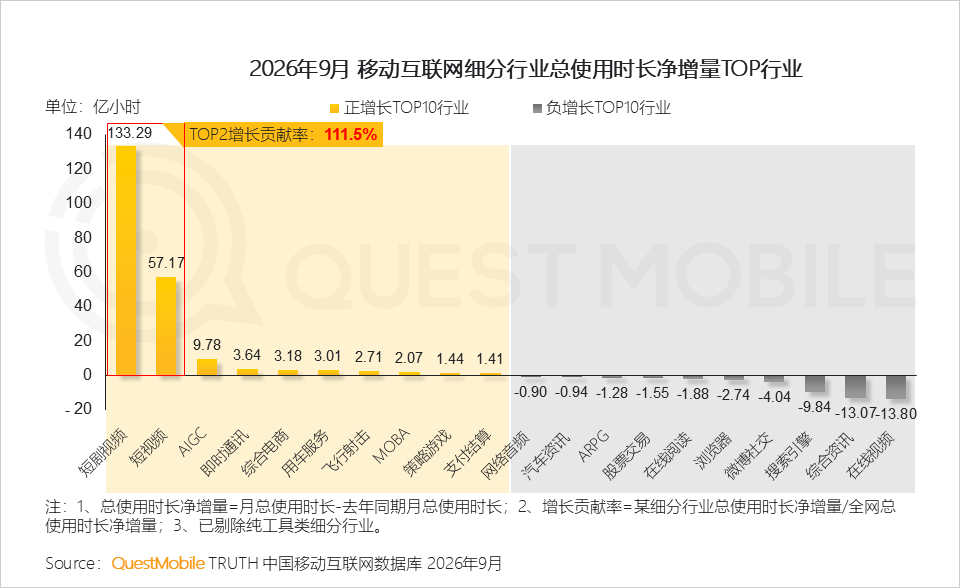
Attributing the weakness of long video to "short dramas stealing user time" is very smooth narratively, because it simplifies a competition about content supply efficiency into a war about content duration. But long video's problems did not begin on the day short dramas appeared.
Users' habit of watching shows at double speed, the loss of patience caused by padded series, and the blunting of willingness to pay caused by shrinking membership benefits—these structural ailments were already fermenting before short dramas rose.
Short dramas merely provided a cheaper, faster, more direct alternative, giving those marginal users who were already drifting away a reason to leave. Blaming the decline on short dramas is equivalent to rewriting a long-accumulating content efficiency problem as an impact from an external category.
Rather than saying short dramas are "stealing" long video's rice bowl, it's more accurate to say they are redefining "the table at which one eats." If you still don't submit to the short drama party now, when the time comes you won't get a share of the rolling wooden latiao, you won't be left any instant noodle soup, no one will call you for the 8 AM class, and you'll have to go to the bathroom alone after class.
The danger of the "short drama diversion" explanation is that it easily covers up things big tech doesn't really want to elaborate on: NetEase's product cycle gap, the squeeze on Tencent's profits from AI capital expenditure and ecosystem subsidies, Kuaishou's pressure on its e-commerce advertising foundation, and so on.
Short dramas are indeed a real variable in big tech's ecosystem, but they are also being used as a convenient "unified talking point."
02 Bringing in DAU, taking away ARPU
So what exactly do short dramas bring to big tech? If you look only at the "diverted time" layer, the conclusion seems to be that big tech is losing out across the board, but these observations clearly stop only at the level of "who stole whose time."
The significance of short dramas to internet giants needs to be broken down into three roles, and there is a difficult-to-reconcile contradiction among these three roles.
The first role is the traffic black hole. Short dramas, especially the free IAA model represented by Hongguo, are essentially a machine that devours users' fragmented time at extremely low cost.
Analysys Qianfan data shows that in October 2026, standalone short drama apps had average daily usage time per person of 113.04 minutes and average daily launches per person of 4.96 times. The market structure is highly concentrated: Hongguo Short Dramas had nearly 360 million MAU in October, Hippo Theater 42.6 million, Xifan about 22.8 million, and the remaining 43 apps all below one million.
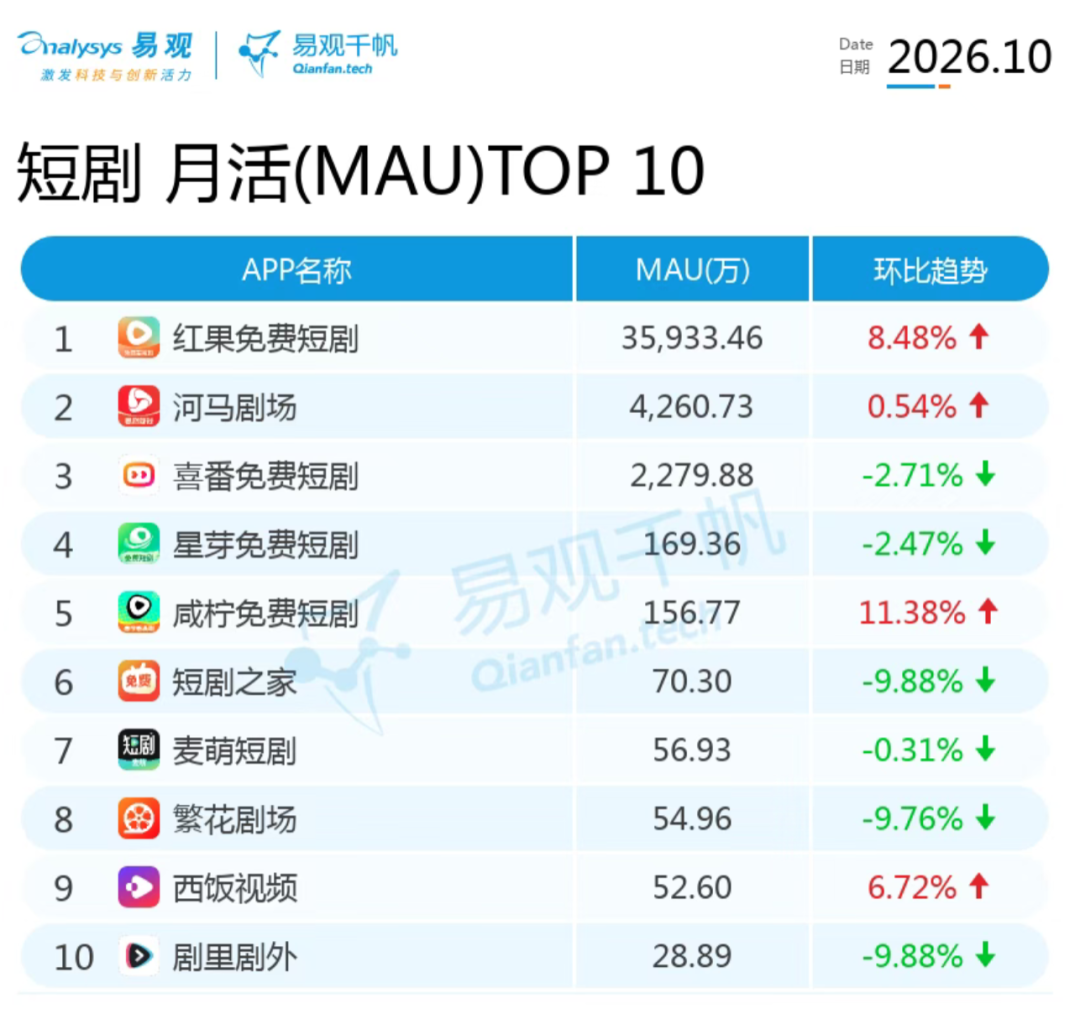
For any internet company that monetizes based on user time spent, the financial consequences of attention migration on this scale are immeasurable. NetEase's gaming revenue under pressure, Kuaishou's main app usage time being diluted, and long video's dual contraction in membership and advertising are all downstream manifestations of this black hole effect.
What it devours is not just big tech's existing time spent—it is simultaneously creating new advertising inventory and new consumption scenarios. The question is who gets the pricing power over this new inventory.
The second role is a cost item, not a profit item. This is the layer most easily covered up in Q3 reports by expressions like "short dramas contribute incremental revenue."
Tencent's short drama advertising revenue is rising, but UBS clearly pointed out that profit margin was diluted by traffic acquisition costs and ecosystem investment. Kuaishou's revenue-sharing costs for short drama advertising rose, directly dragging operating profit margin into negative territory.
According to Daiwa Securities research, for Kuaishou, "every additional yuan of short drama advertising revenue generates one yuan of revenue-sharing cost at the same time." This means that for platforms, the marginal profit margin of short drama advertising is far lower than that of traditional e-commerce advertising or brand advertising.
Hongguo's own moves in 2026 confirm the same logic: canceling large-scale guaranteed revenue sharing for producers and tightening the guaranteed amounts for AI scripts, with the core motivation being "to turn profits positive" and "the stage of subsidizing for scale is over." Even the biggest beneficiary of the short drama track is shifting from "burning money for DAU" to "calculating profit." Other big tech companies telling short dramas as an incremental growth story will probably find it hard to avoid this accounting as well.
The third role is a diluter of monetization efficiency. This is the most structural layer and the one most easily glossed over in earnings calls.
Kuaishou's data provides an observation window: MAU rose 12%, DAU grew almost zero, and advertising revenue per DAU fell more than 11%. What short dramas brought in were "low-frequency viewers" who contributed to the MAU number but did not contribute matching usage depth and advertising value.
Tencent's social networking revenue fell 1% year-on-year, and the number of paying value-added service subscriptions fell 5% year-on-year, indicating that the advertising growth brought by short dramas did not stop the contraction of long video's subscription base. In other words, short dramas may be the cure at the "quantity" level, but at the "quality" level they may be another kind of pressure.
When a platform's user time migrates from a 20-minute game round or a 45-minute episode to a 90-second short drama episode, the advertising density and willingness to pay that can be carried per unit of time will most likely decline. Short dramas create more "views," but the commercial value of each view is lower. When this migration reaches a certain scale, it will shift from an "incremental growth story" to a "structural headwind."
Stacking these three roles together reveals that short dramas are not a fabricated "scapegoat." Their diversion effect is real, quantifiable, and has left clear traces in the earnings reports of multiple companies.
But when big tech chooses to emphasize short dramas' "diversion" or "contribution" on earnings calls, it is often choosing the narrative framework most favorable to itself: NetEase attributing gaming decline to external attention competition is easier than explaining a product pipeline gap; Tencent defining short dramas as a "breakthrough success" in advertising is more pleasant to hear than elaborating on how ecosystem subsidies dilute gross margin; Kuaishou putting short dramas simultaneously in the "highlight" and "cost" drawers is more respectable than admitting that main app usage time was diluted and per-DAU advertising revenue declined.
Short dramas are a real variable, but when real variables are used as shields, what they often obscure are things harder to explain clearly in a 45-minute earnings call: product cycles, the return rhythm of capital expenditure, and a more basic question—when the unit of users' entertainment shatters from "hours" into "seconds," how big a recalculation does the internet business model that lives on time spent actually need?
This account cannot be blamed on short dramas, but they cannot avoid it either.
- END -
-
AI Steps on the Gas: A 167-Year-Old Cold Case Finally Hears an Echo
-
![]()
Short Dramas: Big Tech's Q3 Earnings Scapegoat or Lifeline?
-
![]()
Coating Material Selection: Four Critical Gates — Contrast, Absorption, Stress, and Process Window
-
![]()
Maishi Optoelectronics Completes IPO Coaching Acceptance Inspection, Securing 2 Billion Yuan in Financing This Year
-
Second Financing Round of the Year! Chengfeng Technology Secures Tens of Millions of Yuan in B+ Round
-
![]()
Why Can't Hongguo Swallow Bilibili?
-
![]()
The Day After Jensen Huang's Return: The Fed Pours Cold Water on the Rally
-
![]()
Global Online Action Camera Market Hits 5.65 Billion Yuan in Q3 2026