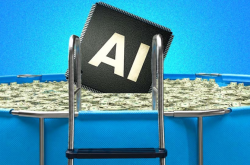
AI Hot Money Is Hitting a Turning Point
 11/26 2026
 339
The signals in the global AI market this week are fragmented. On one side, a16z continues to advance fundraising for a new $20 billion fund, and capital is still willing to bet on AI's long-term story; on the other side, billions of dollars in syndicated data center loans in Southeast Asia have collectively hit the brakes, and banks have begun recalculating the compliance risks brought by controls. Add to that the warning from hedge funds at an alternative assets conference in Singapore: the market is collectively underestimating the tail risks of AI.
Many people simply interpret this as "chip controls are good for domestic substitution," but that is only the surface narrative. The transmission chain of this round of the AI bubble is highly similar to the 2000 internet bubble, yet it hides a sharper variable — AI directly replaces labor, and its path of impact on consumption will be faster and more hidden than back then.
Computing power financing suddenly stops, and the arbitrage space has disappeared
Over the past two years, Southeast Asia has been a "computing power transit hub" for Chinese cloud vendors. ByteDance, Alibaba, and Tencent leased overseas high-end GPUs through data centers in Malaysia and Singapore, and banks and private credit extended billions of dollars in project loans around this stable demand. By exploiting regional regulatory gaps to bypass chip restrictions, data center operators obtained stable long-term contracts, and banks obtained certain cash flow.
After the new rules took effect, this arbitrage framework immediately became ineffective. Computing power clusters serving domestic cloud vendor tenants need to apply separately for U.S. licenses, and within the 90-day window, all banks are afraid to lend rashly. Bridge Data Centres' $6.6 billion financing, Digital Halo's $372 million loan, and GMI Cloud's $300 million project have successively been suspended or abandoned by institutions; DayOne Data Center directly postponed its U.S. IPO.
In a CNBC interview, a fund manager gave a restrained judgment: the fundamentals of domestic hyperscale cloud vendors are relatively weak, and revenue growth pressure persists, but controls will not make them stop AI investment; funds will shift from overseas chip procurement to domestic chips and local computing power infrastructure. This judgment itself is not wrong, but there is an easily overlooked cost: the efficiency of capital expenditure is declining.
In the past, money was used to buy mature GPUs and quickly form computing power for rent; going forward, money will have to be invested in chip tape-out, cluster adaptation, and software-hardware tuning, with longer return cycles and higher failure probabilities. Capital is no longer simply "buy computing power, earn rent," but has become a high-consumption, long-cycle hardcore R&D investment.
An interesting contrast is a16z. In a computing power infrastructure market where financing is frozen, it is still negotiating a new $20 billion fund. The institution has long spun off a dedicated $1.1 billion Machine Age fund to bet on hard infrastructure such as chips, power, data centers, and robots. This shows that capital is not leaving AI, but beginning to stratify: short-term credit funds are seeking safety, while long-term LPs such as sovereign wealth funds and endowments are still willing to bet on AI's endgame.
The AI track will not stall because of a single round of controls, but the logic of capital pricing has completely changed. The light-asset computing power leasing model relying on "binding domestic cloud tenants and building computer rooms in Southeast Asia" is basically over in terms of its dividend. Next, only computing power assets with diversified customer structures, clear compliance boundaries, and no dependence on a single restricted tenant can still obtain financing.
Back to the internet bubble: how the burst hurt consumption
Many people's memory of the 2000 internet bubble stops at the Nasdaq crash and a large number of internet companies going bankrupt. But its deepest chain reaction damage to the economy occurred on the consumption side.
During the bubble's expansion, high-paying Silicon Valley jobs and the equity wealth effect boosted household consumption confidence, and discretionary consumption, real estate, and automobiles continued to strengthen; after the bubble burst, the Nasdaq fell by as much as 78% over 21 months, a large number of tech companies laid off workers, equity wealth shrank sharply, and the University of Michigan Consumer Sentiment Index slid from a high of 112. With the disappearance of the stock market wealth effect compounded by spreading unemployment, households first cut non-essential spending, discretionary consumption came under pressure first, and the pull of consumption on GDP weakened significantly, Cheung Kong Graduate School of Business.
But the internet era had a buffer: the internet is essentially a tool, and the speed at which it created new jobs was enough to offset some of the jobs being replaced. Even after the bubble burst, the internet continued to spawn new professions and new business opportunities.
But this round of AI is different. The internet bubble back then was a bubble of business models; today's AI bubble is superimposed on the long-term pressure of labor substitution.
If there is no recession triggered by an AI investment pullback within a few years, we will usher in a recession driven by unemployment. The main force of AI substitution is white-collar workers, analysts, content creators, junior R&D staff and other groups that used to have high incomes and a high willingness to consume. And it is precisely this group that is the core payer for discretionary consumption, home decoration, real estate, and service consumption.
Here there is a negative feedback loop that many people overlook: companies, in order to reduce costs and improve efficiency, continue to increase AI investment and cut manpower; household income expectations weaken, and people voluntarily compress discretionary consumption; consumer demand contracts, corporate revenue comes under pressure, further increasing AI substitution and cutting staff. This is a spiral that was not so strong during the internet bubble period.
In the short term, large-scale unemployment may not break out immediately. But a pricing mismatch in risk has already appeared: what the market is trading now is entirely the AI growth dividend, and valuations have barely incorporated the tail scenario of "a declining share of labor income and long-term weakening of consumption."
Many investors assume by default that AI is an independent market and does not interfere with the consumer sector. History tells us that the endgame of tech bubbles is never confined within the tech sector. Capital expenditure contraction, spreading layoffs, and reversal of the wealth effect will ultimately spill over to the demand side.
Two divergences, and one realistic conclusion
Next, the market will inevitably show two clear layers of divergence.
The first layer is the divergence of AI capital: short-term debt funds dislike uncertainty, and financing for computing power and data centers continues to tighten; long-term equity funds are still willing to bet on hard assets such as underlying infrastructure, domestic chips, and robots, but their patience for commercialization will decline, and they will no longer accept projects that only tell stories without cash flow.
The second layer is the divergence of the macroeconomic chain: AI will continue to create new wealth, but wealth distribution will be extremely concentrated toward capital and technology owners, and labor income growth will not keep up with capital returns. Under this structure, overall consumption is unlikely to see a broad rally, but will instead be an extreme K-shape: high-end services and luxury goods will be more resilient, while mass discretionary consumption will remain under pressure.
There is a key boundary here: AI is not the bubble itself; the bubble is "a carnival of computing power capital that ignores returns and makes no distinctions." Just as the internet was not the bubble; the bubble was the valuation frenzy in 1999 when any domain name could go public.
Controls are merely a needle that pricks a local bubble, not the end of the AI industry. The end of the Southeast Asia computing power arbitrage model essentially pulls the AI competition back from "competing on computing power leasing" to "competing on chips, algorithms, and implementation scenarios."
From a longer cycle perspective, AI will ultimately raise society-wide productivity, and there is no doubt about that. But the productivity dividend does not equal an income dividend for everyone. The internet bubble took many years to translate technological dividends into the real economy; and because AI's impact on employment comes earlier, before the dividend is realized, we must first go through a round of adjustment in income expectations and consumer confidence.
For investors, do not simply treat AI as a permanent safe haven, and do not turn completely bearish on AI just because financing has stalled. The real risk is that the market has not yet priced in the scenario of "AI suppressing consumption."
When the growth rate of computing power capital expenditure slows and layoffs gradually spread, the pressure on the consumer sector is the gray rhino most easily underestimated in this round of the AI cycle.
-
![]()
Ban AI Glasses! German Consumer Association Formally Sues Meta
-
AI Hot Money Is Hitting a Turning Point
-
![]()
Buick's Firm Stance Against Building Range-Extender MPVs: What Exactly Is Buick Opposing?
-
Four Motors and 850 Horsepower—The BMW All-Electric M3's Specs Would Only Earn a Passing Grade in China
-
![]()
Waveguide Wafers: Flatter Isn't Always Better — The Engineering Judgment Behind the "Good-Enough Line"
-
![]()
From Chat Assistants to Proactive Agents: ByteDance and Tencent Take Opposite Sides Again
-
![]()
Breaking Down Xiaomi's Q3 Report: Higher Phone Prices, So Where Did the Profit Go?
-
Does Xiaomi Need to Make a Bold Bet?