Breaking Down Xiaomi's Q3 Report: Higher Phone Prices, So Where Did the Profit Go?
 11/26 2026
 487
Lu Weibing summed up the just-concluded third quarter in six words: "the hardest since I started working."
After reading Xiaomi's newly released Q3 report, two figures stuck with me. The average selling price of a phone was over four hundred yuan higher than in the same period last year. Yet across the entire phone business, gross profit fell by more than nine hundred million yuan.
Phones sold for more, so how did the business overall earn less? Start by counting how many fewer units shipped. Xiaomi's phone shipments this quarter fell by about 12.6 million units, while memory and other components continued to rise in price. The higher selling prices had to cover these gaps first.
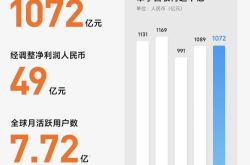
On November 24, Xiaomi released its Q3 2026 report. Group revenue came in at 107.240 billion yuan, with adjusted net profit of 4.884 billion yuan, down 56.8% year-on-year.
In the same quarter, over a hundred thousand vehicles were delivered, yet vehicle revenue fell nearly 20% year-on-year. In this report, I want to pursue two questions. What can make up for the phones not sold?
Once new cars reach buyers, how much money can they leave for Xiaomi?

After the Hundred-Billion Revenue Mark
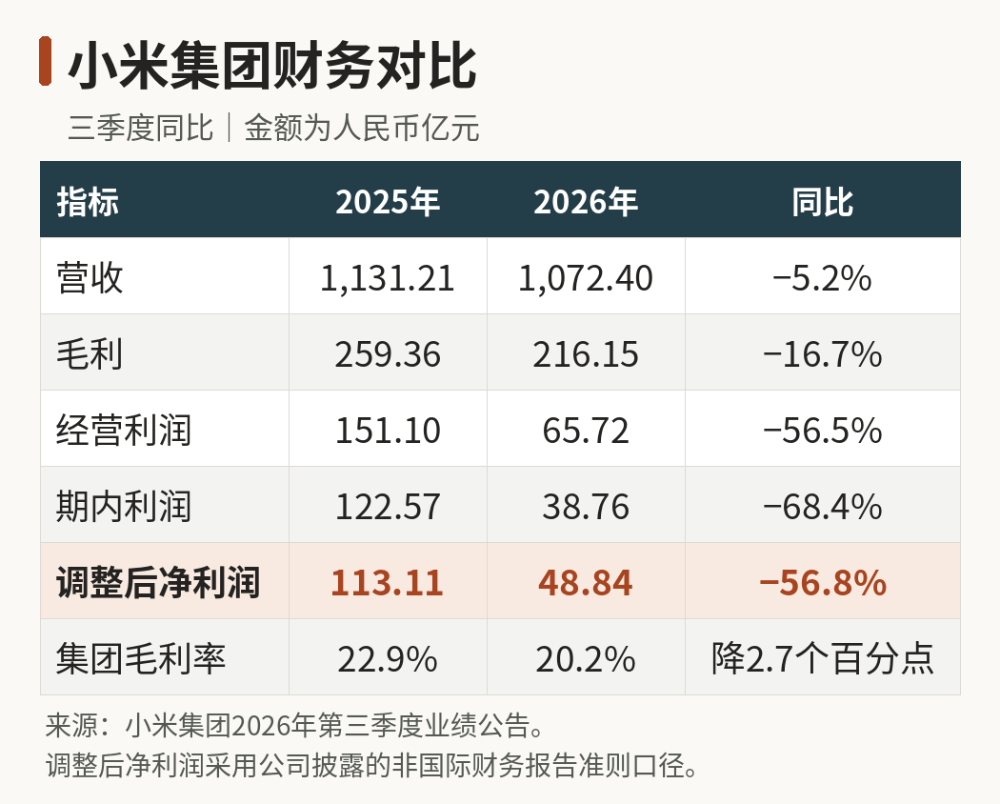
Revenue fell 5.2% year-on-year and gross profit fell 16.7%. For every hundred yuan of revenue, Xiaomi kept 2.7 yuan less in gross profit than in the same period last year. R&D, selling, and administrative expenses still had to be deducted from that gross profit.
Further down the income statement, gains from changes in the fair value of financial instruments decreased by about 1.8 billion yuan, and net finance costs increased by about 1.8 billion yuan. According to Xiaomi, the latter mainly stemmed from changes in the value of financial liabilities payable to fund investors.
Accounting items amplified the profit decline. Adjusted net profit still fell 56.8% year-on-year and 21.5% quarter-on-quarter. Over the first three quarters, revenue fell 7.4% year-on-year and adjusted net profit fell 47.7%.
Profit contraction has persisted for some time. We can also break down the revenue gap. The group had about 5.9 billion yuan less year-on-year, of which about 5.1 billion yuan came from the new energy vehicle, AI, and other innovative business segment.
This segment accounted for over 20% of revenue but contributed nearly 90% of the revenue decline. On the gross profit side, the innovative business segment was down about 2.8 billion yuan, accounting for roughly 65% of the group's gross profit reduction. From the revenue line to the gross profit line, this segment remains the heaviest drag.
Phones Priced Higher, Yet Gross Margin Fell
According to Omdia, global smartphone shipments in Q3 totaled 254.7 million units, down about 20% year-on-year—the lowest for the same period since 2013. Omdia noted that rising prices suppressed purchase demand, and channels grew more cautious.
Xiaomi's own disclosed shipments were 30.7 million units, down 29.1% year-on-year—a steeper decline than the global market. By Omdia's measure, Xiaomi's shipment share rose quarter-on-quarter for three consecutive quarters to 12.1%, still below the 13.6% recorded in the same period last year.
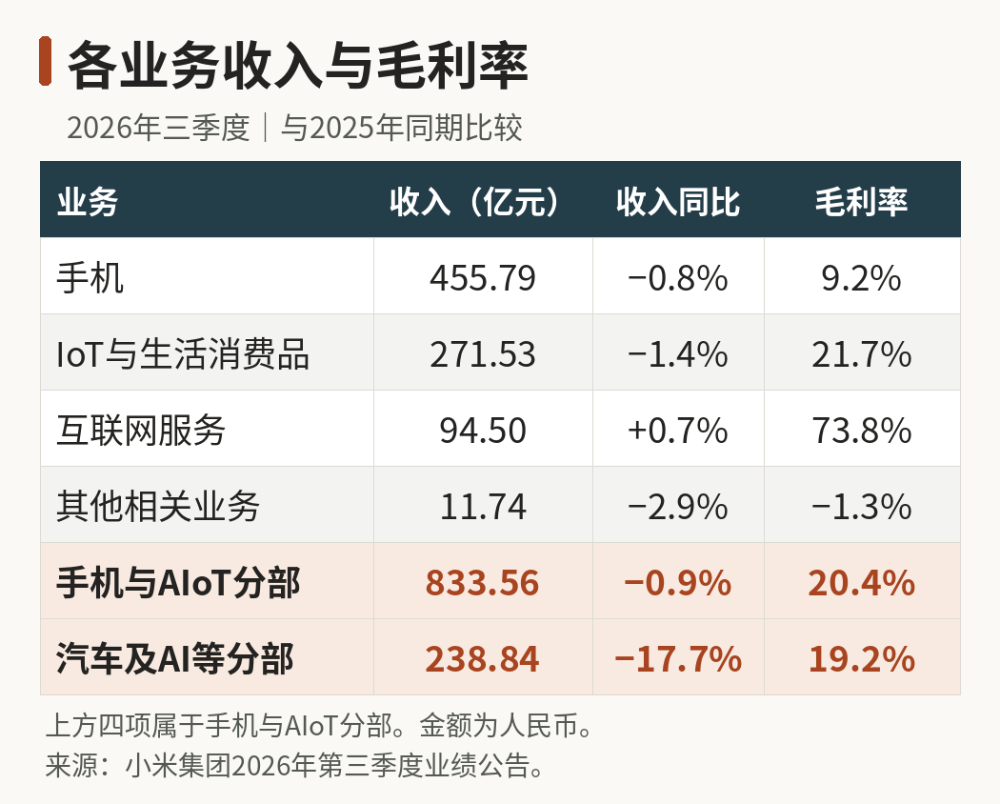
Xiaomi deliberately reduced low-end phone shipments, and the proportion of shipments going to mainland China also increased; together, these pushed the average selling price up to 1,486.1 yuan. With shipments down nearly 30%, phone revenue fell only 0.8%—the higher average price indeed propped up revenue.
Xiaomi is also testing higher price points. The foldable flagship launched in September starts at 10,999 yuan. The report cited third-party data showing that in Q3, Xiaomi's sales share in mainland China's 6,000-yuan-and-above price range rose to 4.4%, up 1.2 percentage points year-on-year.
With prices raised, gross margin still has to pass the cost test. Phone gross margin fell from 11.1% to 9.2%, which Xiaomi mainly attributed to rising prices of key components.
Dividing phone business gross profit by shipments for the same period gives a rough gross profit per unit that rose from 118 yuan to 136 yuan.
Each phone left about 18 yuan more in gross profit, but shipments fell by about 12.6 million units, so the phone business's gross profit still moved downward. How many low-priced phones to keep, what price to set for flagships—every market has to be calculated.
Home appliances and lifestyle consumer goods are also absorbing costs. Revenue from laptops, smart large home appliances, and overseas tablets grew, filling part of the gap, but the segment's overall revenue still fell 1.4%.
Adding component price increases and category mix changes, gross margin fell to 21.7%. Internet services, meanwhile, are a high-margin business in Xiaomi's hands. It brought in less than 10% of group revenue but contributed about one-third of gross profit.
Global monthly active users are still growing, and advertising revenue is also growing, but the pre-installation revenue contribution declined, and service gross margin dropped by more than three percentage points. A quarter of fewer phone sales may not show its impact on services within the same quarter.
Existing users are still using their phones, and ads are still being watched. When these users reach upgrade time, whether Xiaomi has suitable models on hand will determine how many people continue to use this business going forward.
A Hundred Thousand Cars Sold
Xiaomi delivered 100,975 vehicles in Q3, down 7.2% year-on-year and 3.1% quarter-on-quarter. Vehicle revenue was about 22.7 billion yuan, down 19.9% year-on-year.
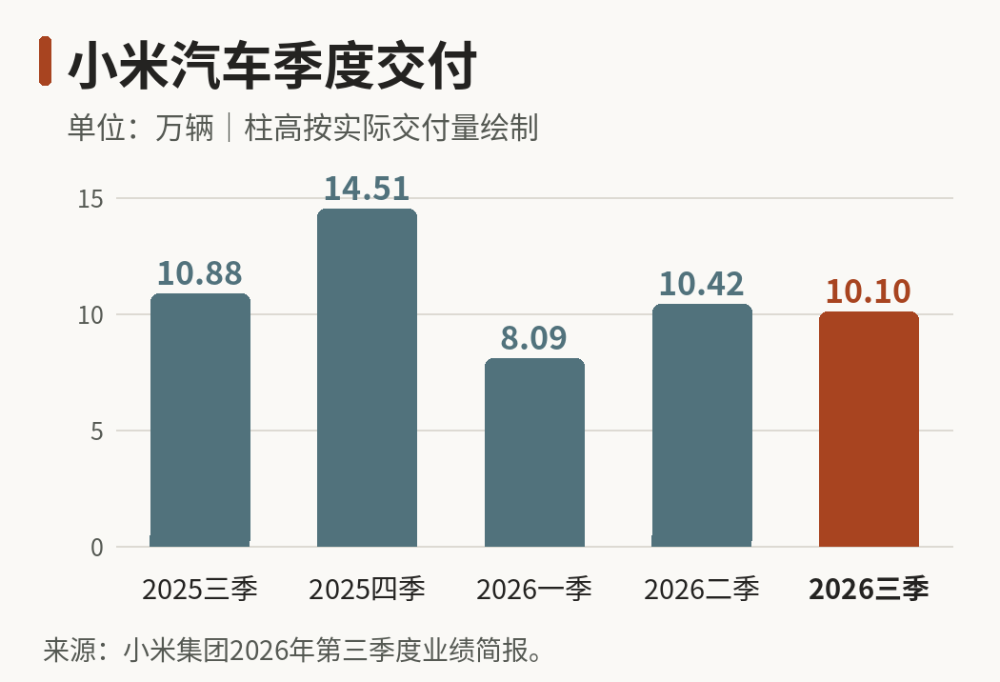
Revenue fell faster than deliveries. Xiaomi noted in its announcement that SU7 Ultra's contribution to deliveries decreased. Dividing vehicle revenue for the two periods by deliveries in the respective quarter gives a rough drop from about 260,000 yuan per vehicle to 225,000 yuan. This rough figure is useful for observing the relationship between quarterly revenue and deliveries. How much each model actually sold for still needs separate examination.
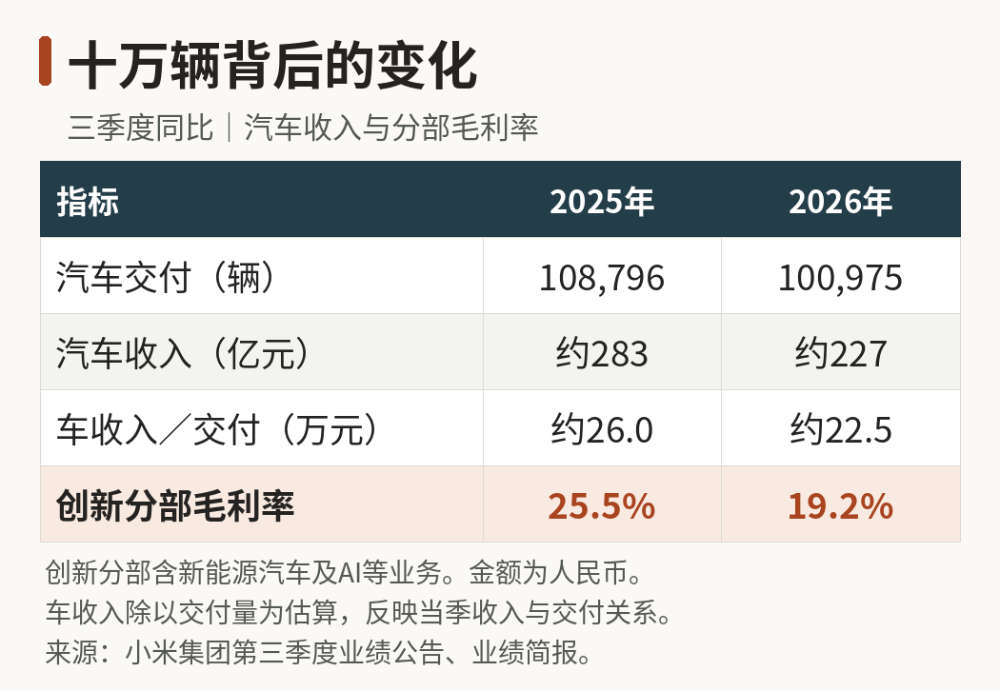
Changes in model mix, rising prices of key components, and increased AI business costs together dragged down the segment's gross margin. The segment's operating expenses also increased 18.6% year-on-year to about 8 billion yuan.
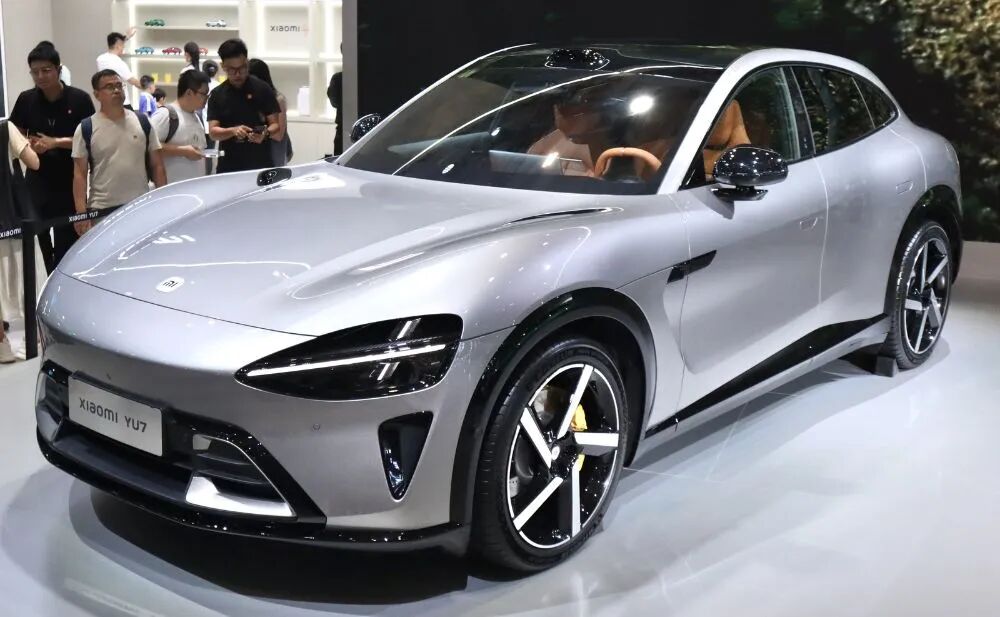
Squeezed at both ends, the entire innovative business segment posted an operating loss of about 3.4 billion yuan. The extended-range option brought Xiaomi new orders. The extended-range SUV launched in September comes in four configurations, starting at 209,900 yuan.
The company disclosed that from September 7 to October 7, locked orders exceeded 70,000 units, and actual deliveries of this series in Q3 exceeded 10,000 units.
Locked orders first show that people are willing to place orders. After the first batch of customers take delivery, whether daily sales can stabilize prices and orders will need a few more months to observe. By then, it will also be easier to judge how much gross profit the new deliveries brought to the segment. The car market also tests new models.
Data from the Passenger Car Association shows that in October, domestic passenger car retail fell 27.1% year-on-year, and new energy passenger car retail also fell 13.7%. Penetration rose to 67.5% because new energy vehicles took a larger share of a shrinking market.
Making both pure electric and extended-range vehicles, Xiaomi can appeal to families with different charging conditions. With more models, procurement, production scheduling, and after-sales also become more complex.
A hundred thousand vehicles is certainly worth watching, but which car the stores sell and which car the factories build determine what kind of account these hundred thousand vehicles ultimately become.
Where Did the R&D Money Go?
In the first three quarters, Xiaomi's R&D expenses were about 27.4 billion yuan, up 16.5% year-on-year. For Q3 alone, R&D expenses were about 9.2 billion yuan. The announcement mainly attributed this quarter's R&D increase to new energy vehicles and AI and other innovative businesses, especially AI investment.
XRING O3 has already been installed in the 18 Fold and Pad 9 Pro Max, and Xiaomi has also open-sourced the MiMo V2.6 series models. Taken together, these moves show Xiaomi intends to have the chips and models it develops used first on its own hardware.
By the end of September, the AIoT platform connected about 1.204 billion devices, excluding phones and tablets. By the same measure, users with at least five connected devices numbered 25.6 million, up 18.7% year-on-year.
These users already manage multiple devices on the same platform, and Xiaomi is well positioned to let them try cross-device features first. For example, someone in the car wants to turn on the home air conditioner in advance.
Using something occasionally and being willing to use it every day are two different things. Whether R&D can become business depends on whether these features can make users use one more device or still choose Xiaomi at the next upgrade.
Overseas expansion of cars tests execution even more. Xiaomi plans to enter the European market in 2027 and has signed memoranda of understanding with eight German auto dealer groups.
Brand awareness accumulated from phones is useful, but vehicle delivery, repair outlets, and spare parts supply still have to land in city after city. The pace of expansion must return to cash flow.
In Q2, operating activities were still a net inflow, but in Q3 they were a net outflow of 23.034 billion yuan. The company disclosed that the main adjustment item was an increase in inventory of about 25.4 billion yuan.
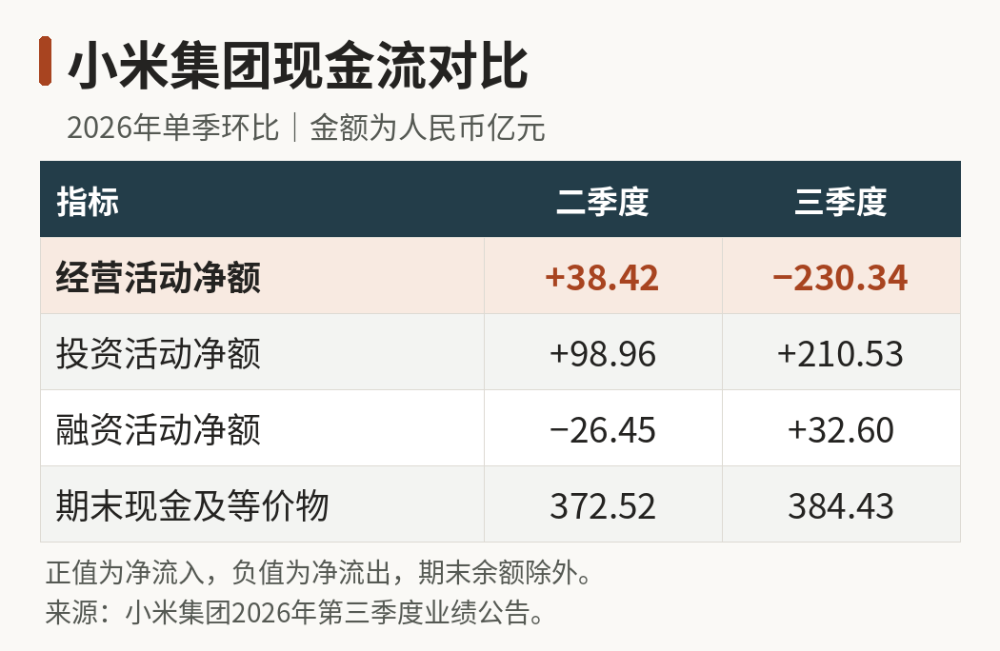
At the end of Q3, the cash and cash equivalents balance was nearly 1.2 billion yuan more than at the end of Q2. In the same period, investing activities had a net inflow of 21.053 billion yuan, mainly from a net decrease in time deposits and some short-term investment balances.
Stockpiling may be to stabilize supply or to support new product launches; the certain information given in the announcement is the increase in inventory. If goods sell slowly, payment collection still has to wait, and promotions may also eat into gross profit.
Next quarter, whether inventory falls and whether operating cash returns are best viewed together.
What to Watch Next Quarter
Xiaomi had several bright spots this quarter worth watching. Flagship phones propped up part of phone revenue, internet services still left relatively thick gross profit, and the new extended-range car also won first-sale orders.
The pressure is also specific: total gross profit in the phone business shrank, the innovative business segment lost money, and stockpiling tied up cash. My personal view is that Xiaomi now needs more than anything to adjust its pace according to actual sales.
Phone pricing depends on local demand, and car production scheduling must follow orders and deliveries. After R&D money is spent, it also depends on whether products can be mass-produced and whether users use them frequently.
In the next financial report, I will first check whether phone business gross profit has stabilized, then look at the innovative business segment's losses, inventory, and operating cash flow. Xiaomi can already roll out new products in many places.
With the market changing so fast, only by retaining profit after selling can there be room for expansion.
What do you think of Xiaomi's latest financial report? We look forward to your civil and rational comments in the message area.
Disclaimer: This article is only a financial hotspot analysis from a professional perspective. Data and materials are cited from public queries, company announcements, and Tonghuashun iFinD. The views are for reference only and do not constitute any investment or consumption advice.
#FinancialHotspots #InDepthInterpretation #BusinessFinance #InvestmentBankingCircle #ListedCompanies #PrimaryMarket #IPO #XiaomiFinancialReport #Xiaomi #XiaomiNetProfitDecline
Thank you for your patience in reading. Feel free to click "Wow".
-
Four Motors and 850 Horsepower—The BMW All-Electric M3's Specs Would Only Earn a Passing Grade in China
-
![]()
Waveguide Wafers: Flatter Isn't Always Better — The Engineering Judgment Behind the "Good-Enough Line"
-
![]()
From Chat Assistants to Proactive Agents: ByteDance and Tencent Take Opposite Sides Again
-
![]()
Breaking Down Xiaomi's Q3 Report: Higher Phone Prices, So Where Did the Profit Go?
-
Does Xiaomi Need to Make a Bold Bet?
-
![]()
Xiaomi Searches for a "New Rhythm"
-
After Running 11,307 AI Shopping Tests, I Found That the Profit Logic of Consumer Brands Has Changed
-
![]()
Amid Industry Headwinds, Xiaomi Builds Strength for the Long Haul