Quarterly Report | 2026 Q3 China Smart Glasses Market Misses Expectations: Sales Growth Slows to 14.3%, Revenue Falls 4.3%; Full-Year Sales Growth Forecast Cut to Below 50%
 11/20 2026
 500
This article runs approximately 3,000 words and contains a large amount of information. A detailed read is expected to take 15 minutes. Readers are advised to follow and bookmark it first, or to read selected sections.
Data Release
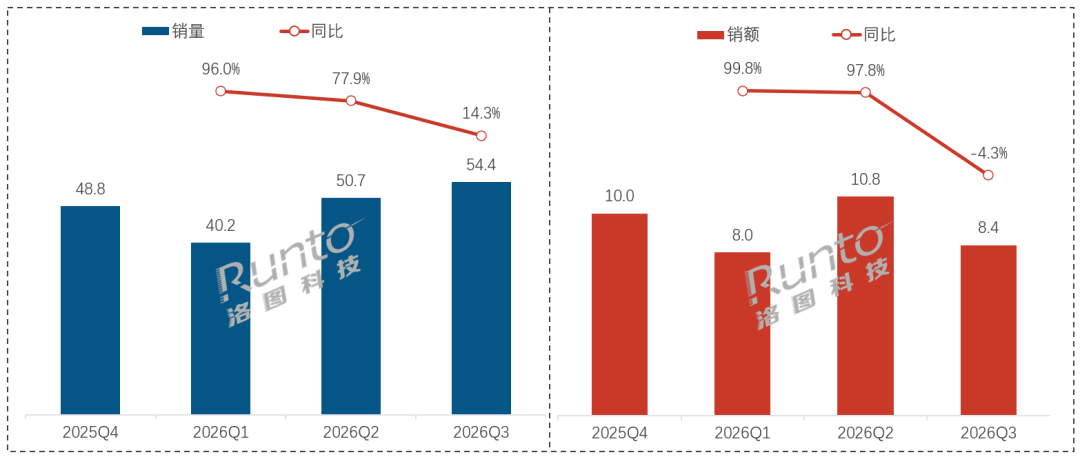
According to RUNTO data, in Q3 2026, China's smart glasses market recorded omnichannel retail volume of 544,000 units, up 14.3% year-on-year, and retail revenue of 840 million yuan, down 4.3% year-on-year.
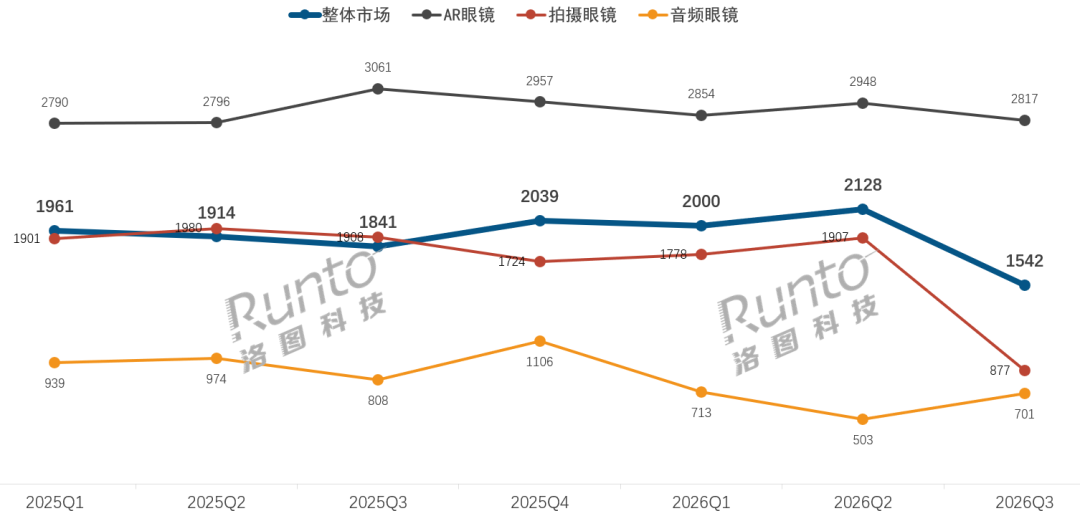
The average market price for the quarter was 1,542 yuan, down 16.2% year-on-year and down 27.5% quarter-on-quarter. Average prices for AR glasses, camera glasses, and audio glasses stood at 2,817 yuan, 877 yuan, and 701 yuan, respectively. Camera glasses, in particular, saw their average price fall off a cliff.
AR glasses' share of overall market sales rose from 20.6% in the same period last year to 35.8%, an increase of 15.3 percentage points, making it the only category to gain share. Within the monitoring scope of this sub-market, Thunderbird, Rokid, XREAL, Viture, INMO, and Qwen ranked in the top six by sales volume.
Within the monitoring scope of the screenless glasses market, Huawei, Xiaomi, Thunderbird, Qwen, and Qingye ranked in the top five by revenue. Qingye, meanwhile, led in sales volume with a 16.5% share.
China's smart glasses industry is currently at a critical stage of transition from a niche early-adopter category to mass-market adoption, and the interplay among cost competition, product iteration, and consumer awareness is becoming more pronounced.
The phrase "below expectations"—built from slowing sales growth, declining revenue, and sharply plunging average prices—has become the most intuitive portrait of China's smart glasses market in Q3 2026.
I. Overall Scale:
Broadly below expectations: sales growth slowing, revenue falling outright
According to the latest data released by RUNTO, in Q3 2026, China's smart glasses market recorded omnichannel retail volume of 544,000 units, up 14.3% year-on-year, and retail revenue of 840 million yuan, down 4.3% year-on-year. The average price was 1,542 yuan, down 16.2% year-on-year and down 27.5% quarter-on-quarter.
RUNTO's analysis attributes the divergence between volume and revenue this quarter mainly to two factors. On one hand, the year-on-year base was relatively high last year, with single-quarter retail volume in Q4 2025 already reaching 488,000 units. On the other hand, in Q3 this year, low-priced camera glasses from small and medium-sized brands expanded rapidly through emerging channels. Manufacturers shifted more promotional resources toward entry-level price segments, and the average market price of camera glasses plunged from 1,907 yuan in Q2 to 877 yuan, with both year-on-year and quarter-on-quarter declines exceeding 50%. This directly broke the value structure of the sub-category, ultimately producing a market defined by rising volume and falling revenue.
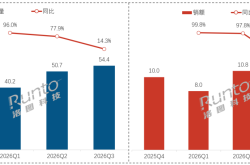
Looking at the first three quarters over a longer time span, year-on-year changes in market sales volume were +96.0% in Q1, +77.9% in Q2, and now +14.3% in Q3, with growth converging quarter by quarter. Although the total scale is still growing and the comparison base remains high, the track is still at such an early stage, yet growth has slowed markedly—which to some extent reflects that smart glasses are undergoing a process of category disenchantment. Core support such as product experience and application scenarios is still not fully mature, and the products themselves have not yet built sufficiently solid consumer value.
2025Q4–2026Q3 China Smart Glasses Omnichannel Market Scale
Data source: RUNTO omnichannel aggregated data; units: 10,000 units, 100 million yuan, %
In terms of absolute scale, Q3 retail volume of 544,000 units rose 7.3% quarter-on-quarter from Q2, the highest level in the past four quarters; retail revenue of 840 million yuan fell 22.3% quarter-on-quarter, close to Q1's 800 million yuan and remaining in the low range of the past four quarters.
II. Category Structure:
AR share rises to 35.8%; audio glasses shrink significantly to 17.5%
RUNTO divides smart glasses into three major categories: AR glasses with displays, audio glasses without displays, and camera glasses.
According to RUNTO data, in Q3, AR glasses' share of overall smart glasses market sales rose from 20.6% in the same period last year to 35.8%, an increase of 15.3 percentage points, making it the only category to gain share.
Screenless (display-free) products simultaneously ceded share. Camera glasses' sales share fell from 51.7% in the same period last year to 46.7%, down 5.0 percentage points, weakening their previously obvious advantage; audio glasses fell from 27.7% to 17.5%, down 10.2 percentage points, making them the tier that lost the most ground among the three product types.
Data shows that the category structure in Q3 displayed a clear "one rising, two falling" direction: AR glasses absorbed the industry's main increment, while camera and audio glasses contracted simultaneously.
The significance of this structural change lies in the fact that the market's source of increment is shifting from single-point functions centered on camera recording and listening/translation to category upgrading centered on display and interaction. In fact, screenless products are indeed facing direct impact from smart action cameras and AI earphones; and glasses products are still at the stage of "making users adapt to the device, rather than making the device adapt to people."
RUNTO analyst Liu Chuang concluded that the lesson screenless products need to learn next is to shift from "technology first" to "perception first," achieving "imperceptible presence, perceptible empowerment."
III. Price Structure:
Average prices of all categories fell year-on-year; camera glasses halved year-on-year and quarter-on-quarter
In terms of price trends, in Q3, the three major categories of China's smart glasses market showed the following changes:
First, the average market price of AR glasses was 2,817 yuan, down 8.0% year-on-year and down 4.5% quarter-on-quarter, with the decline significantly smaller than the overall market. Over the past seven quarters, the average price of AR glasses has consistently fluctuated between 2,790 yuan and 3,061 yuan, a highly stable price band.
Second, the average price of camera glasses halved. Its average price fell from 1,908 yuan in the same period last year to 877 yuan, down 54.0% year-on-year and also down 54.0% quarter-on-quarter, the tier with the most dramatic price decline among all categories. From Q4 2025 to Q2 2026, the average price of this category remained between 1,724 yuan and 1,908 yuan, and in Q3 it showed a cliff-like decline.
Third, audio glasses rebounded quarter-on-quarter from a low level. Its average price for the quarter was 701 yuan, down 13.2% year-on-year, but up 39.4% quarter-on-quarter from 503 yuan in Q2, still the lowest price band among all categories.
2025–2026Q3 China Smart Glasses Omnichannel Market Product Average Price
Data source: RUNTO omnichannel aggregated data; unit: yuan
IV. Brand Competition:
AR market presents "one superpower and one strong player"; screenless market shows obvious volume-revenue mismatch
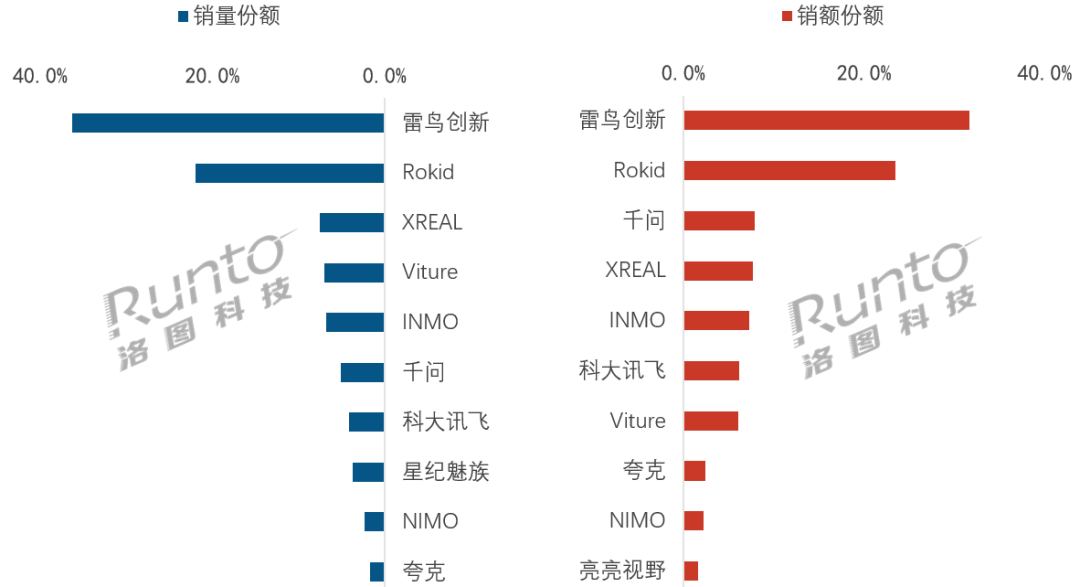
AR glasses market: According to RUNTO online data, within the monitoring scope, in Q3, the top five players in China's AR smart glasses online market accounted for 79.7% of sales volume share and 78.0% of revenue share. Market concentration belongs to the extremely high oligopoly type.
Thunderbird Innovation ranked first on both lists with a 36.3% sales volume share and a 31.7% revenue share, making it the absolute leader in the AR track. Rokid ranked second with a 22.0% sales volume share and a 23.4% revenue share. The two combined accounted for 58.3% of sales volume share and 55.1% of revenue share, forming the first tier of "one superpower and one strong player" and opening a gap of more than 14 percentage points over the third place.
It is worth noting that Rokid, Qwen, and iFlytek's revenue shares were approximately 1.4, 2.8, and 2.1 percentage points higher than their sales volume shares, respectively, indicating relatively higher product structure and price structure.
Star Era Meizu entered the top ten in the AR glasses field with a 3.7% sales volume share but did not enter the top ten in revenue share, an equally significant volume-revenue gap.
2026Q3 China AR Glasses Online Market Brand Sales Share
Data source: RUNTO online monitoring data; unit: %
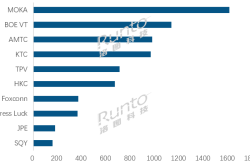
Screenless glasses market: The landscape is completely different. On the sales volume side, Qingye ranked first with a 16.5% share, followed closely by Huawei, Amoi, Xiaomi, and Thunderbird, with the top five combined accounting for 54.7%. On the revenue side, Huawei led by a wide margin with a 30.1% share, ranking in the top five together with Xiaomi, Thunderbird, Qwen, and Qingye, with a combined share of 66.7%.
Huawei is the most typical brand in terms of volume-revenue mismatch this quarter: a sales volume share of 14.8%, yet a revenue share as high as 30.1%, a difference of 15.3 percentage points. Qingye is the opposite, with a 16.5% sales volume share yielding only a 6.0% revenue share, a difference of 10.5 percentage points. The former corresponds to transactions in high price segments, while the latter corresponds to a low-price, volume-driven structure.
2026Q3 China Screenless Smart Glasses (Camera + Audio) Online Market Brand Sales Share
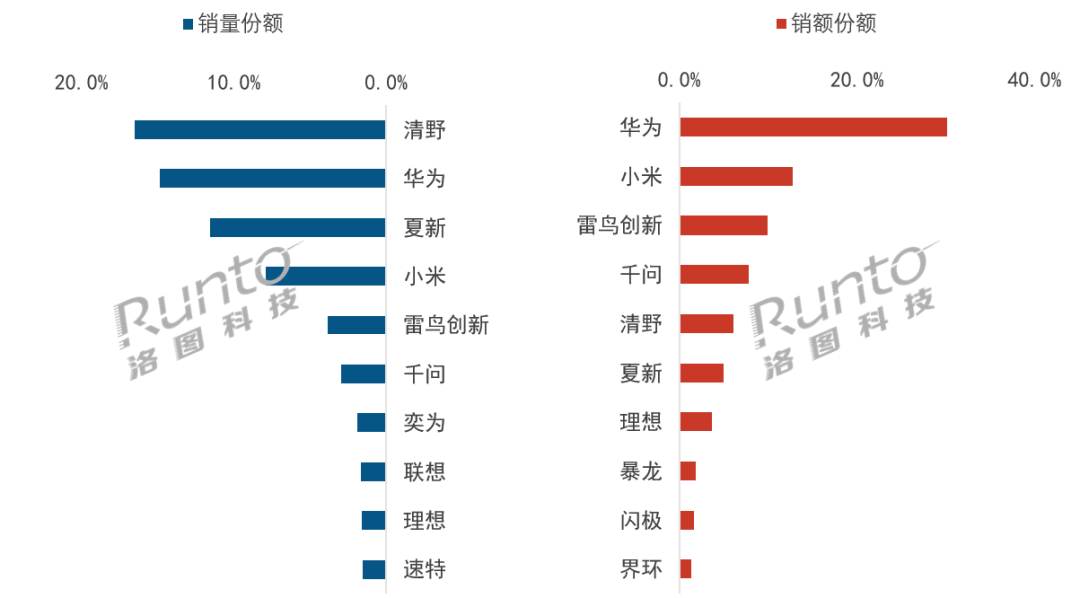
Data source: RUNTO online monitoring data; unit: %
Overall, the brand landscape of China's smart glasses market in Q3 presented a dual characteristic: "concentration on the AR side, dispersion on the screenless side."
V. Outlook Forecast:
Q4 to focus on new products and structural repair; full-year scale forecast lowered
Taking the first three quarters of 2026 together, China's smart glasses omnichannel market accumulated retail volume of 1.453 million units, up 50.4% year-on-year, and accumulated retail revenue of 2.72 billion yuan, up 49.1% year-on-year.
It cannot be denied that, looking at Q3, the growth momentum from "new customer expansion" has fallen significantly, and the industry's high-growth phase is giving way to structural competition.
Entering Q4, RUNTO will continue to focus on the following three aspects:
First, whether AR can take over as the main engine of revenue. In Q3, AR glasses already captured 35.8% of sales volume share and, with an average price of 2,817 yuan, became the only category to hold the price band above 2,000 yuan. Q4's share and price will jointly determine the quality of the full-year performance; if AR glasses' volume expansion is accompanied by price declines, the industry will remain on the track of "volume up, revenue down."
Second, the scale expansion in the low-price segment of screenless glasses needs to match value contribution. The average prices of camera and audio glasses have already fallen to 877 yuan and 701 yuan, respectively. This price band serves the functions of penetration and first-time purchase by new customers, but its contribution to revenue is limited. If the volume expansion of sub-1,000-yuan products continues at the cost of average prices, manufacturers will find it difficult to "sell expensive" even if they "sell a lot."
Third, brand stratification and channel stratification need to advance in tandem. The "one superpower and one strong player" pattern on the AR side is temporarily stable, with technology brands such as Qwen, Xiaomi, and Huawei mostly entering from the ecosystem and channel sides; the long-tail dispersed pattern on the screenless side mostly enters through low-price seeding on emerging e-commerce platforms, which will directly trigger mutual squeezing within the same price band and further compress the industry value of sub-categories.
In terms of market scale, RUNTO forecasts that in Q4 2026, with the concentrated launch of a new round of products and the arrival of year-end major promotion nodes, the scissors gap between sales volume and revenue in the smart glasses market is expected to converge. Full-year sales volume will land between 2.05 million and 2.15 million units, lower than the 2.58 million units forecast at the beginning of the year, with year-on-year growth correspondingly between 41.0% and 47.9%.
-
![]()
Apple's Unreleased AI Glasses: Chinese Manufacturers Have Already Broken into the Overseas Top 3
-
![]()
Why Are Smart Glasses Offline Experience Stores Struggling to Take Off?
-
![]()
Quarterly Report | 2026 Q3 China Smart Glasses Market Misses Expectations: Sales Growth Slows to 14.3%, Revenue Falls 4.3%; Full-Year Sales Growth Forecast Cut to Below 50%
-
[Focus] Demand for Deep-Ultraviolet Fluoride Optical Crystals Continues to Rise, with Broad Space for Domestic Substitution in China
-
![]()
AI Has Its Sights on Your Wallet | Juchao
-
![]()
LOTU Ranking | October 2026 Global TOP TV ODM Factory Shipments
-
![]()
Between Trade-offs: XPeng's High-Stakes Gamble
-
![]()
Alibaba: A Chinese Version of the "Google" Dream Shattered by the Chip Crisis?