Apple Builds AI Agents, OpenAI Makes Phones
 11/24 2026
 525
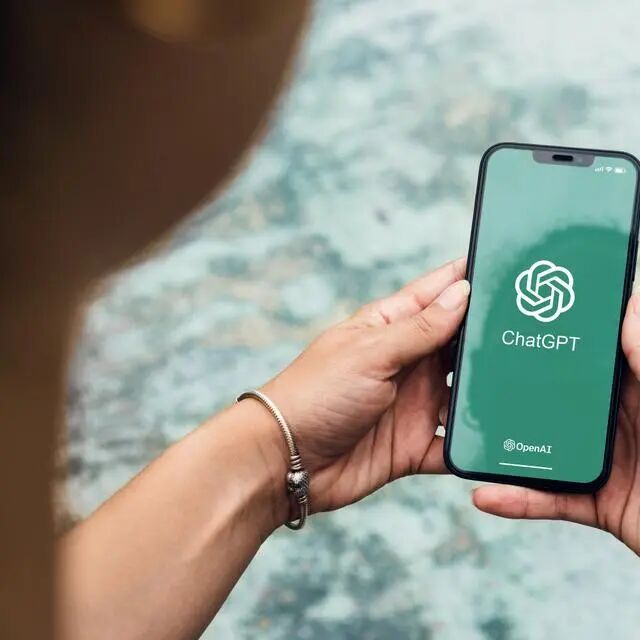

Each is encroaching on the other's turf.
Image source: Internet (contact us for removal if infringing). Partly AI-generated.
On November 20, two news stories caught the tech world's attention.
The first came from Apple. According to media reports, Apple is developing an AI agent that will eventually be able not only to write code and browse the web, but also to control applications and complete complex tasks on users' behalf.
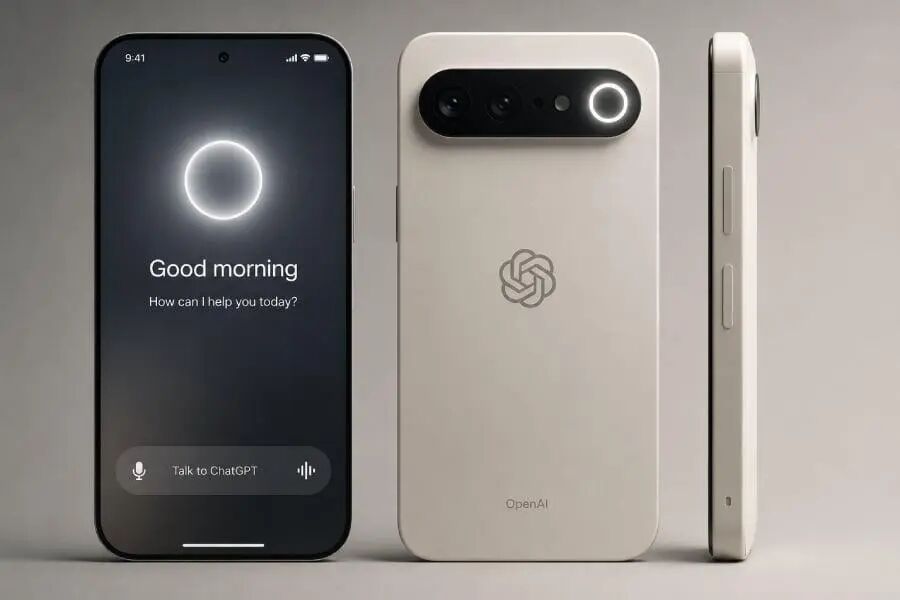
The second came from OpenAI. Supply chain sources say FIH Mobile, a Foxconn subsidiary, has won the full-device assembly contract for OpenAI's phone project—a sign that OpenAI may be moving from AI models into smartphone hardware.
Taken together, the two stories reveal a curious phenomenon:
Apple is getting AI out of the chat box, while OpenAI wants to get AI into the phone.
One is the world's best company at making hardware and operating systems, and it has begun researching how to let AI operate devices on users' behalf. The other is the world's most representative AI model company, and it has begun trying to get its hands on the physical device in users' pockets.
These may look like two opposite paths, but they point to the same goal: making AI no longer just answer questions, but truly complete tasks on users' behalf.
In the past, the AI industry competed over whose model was smarter. But once AI moves from chat to agents, the rules of competition change.
Because AI knowing how to do something does not mean it has permission to do it.
It can draft an email, but may not be able to open the mailbox directly. It can plan a shopping trip, but may not be able to complete an order across applications.
Thus a more practical question than model capability has emerged:
When AI truly begins to do things for people, who decides what it can operate?
Apple and OpenAI are giving two different answers.

Apple Wants to Seize Control of Devices
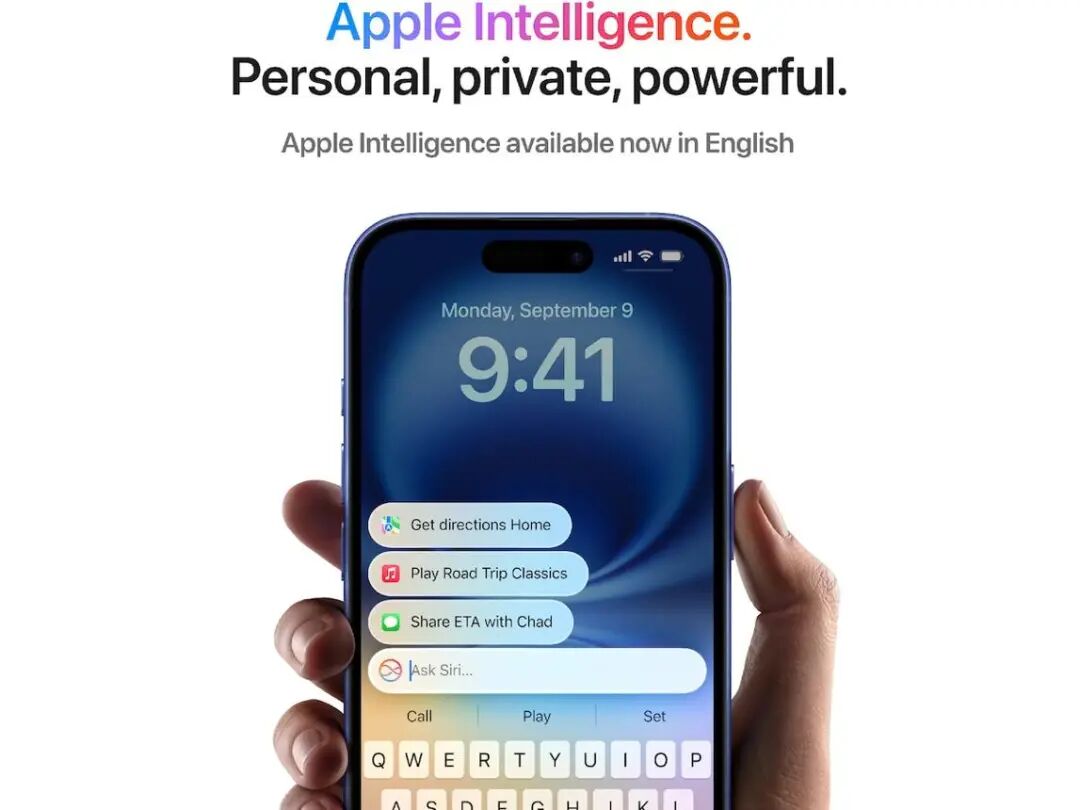
Apple's biggest advantage in developing agents is not that it has a leading AI model, but that it already controls the core entry point through which users interact with the digital world.
The iPhone connects users' communications, photos, calendars, and various applications. iOS governs the permission boundaries between apps. And the Mac, iPad, and Apple Watch further extend users' digital lives.
For model companies, obtaining such information requires user authorization, third-party interfaces, and platform cooperation.
Apple is different: these capabilities are built on its own hardware and operating system ecosystem.
That means Apple does not need to fight for the entry point anew; it needs to make the existing entry point smarter.
From the information disclosed by the media, the agent Apple is developing this time is no longer limited to the scope of a traditional voice assistant.
It needs the ability to browse the web, write code, control applications, and coordinate different tools to complete multi-step tasks.
This is precisely the biggest difference between an agent and traditional Siri.
In the past, Siri was essentially a voice interaction assistant. The user asked a question, it understood the intent, and then invoked preset functions.
But what an agent needs to do is understand the goal, break down tasks, invoke tools, handle various problems during execution, and ultimately deliver results.
For example, a user asks to organize the materials involved in today's meeting, form a report, and send it to the attendees.
A traditional assistant may help the user look up the calendar and open files. A true agent needs to read the meeting schedule, locate materials, extract information, generate a report, and send an email after obtaining authorization.
The former helps the user operate the phone; the latter completes the work on the user's behalf.
So the boundary between Apple's agent and Siri ultimately lies not in who is better at chatting, but in who can complete tasks autonomously.
However, Apple also faces a difficult problem.
Its closed ecosystem, once a competitive advantage, may become a new limitation in the agent era.
Because the greatest value of an agent lies precisely in cross-application execution.
Complex tasks often require invoking third-party software, internet services, and enterprise systems. If the agent can only act within Apple's own ecosystem, its capability boundary will ultimately still be determined by Apple itself.
Apple controls devices, but that does not mean it naturally controls services across the entire internet.
So the real problem Apple needs to solve is: how to give the agent sufficiently open execution capability while protecting privacy and security.

OpenAI Doesn't Want to Live Inside Someone Else's System
Compared with Apple, OpenAI's move is more counterintuitive.
Why would a company that already has ChatGPT and advanced model capabilities enter the smartphone industry?
From a business perspective, continuing to provide services through iOS, Android applications, and APIs is obviously more asset-light.
But the problem is that agents and traditional AI applications have completely different requirements.
In the past, ChatGPT only needed an application entry point: the user opened the app, entered a question, and the model generated an answer. The whole process could basically be completed within the app.
But when AI begins to execute tasks for users, it needs to read device information, invoke other applications, access cameras and microphones, and even run continuously in the background.
At this point, OpenAI will discover an awkward reality:
It has the brain of AI, but does not own the body through which AI acts.
No matter how smart ChatGPT is, it must run on an operating system provided by Apple or Google.
It can request permissions, but cannot decide how permissions are allocated. It can call third-party services through APIs, but cannot guarantee that all applications open their interfaces.
It can become the most important AI application on a phone, but may not be able to become the core entry point of the entire phone system.
This is the common dilemma of model companies: the stronger the model capability, the higher users' expectations for agents; but the more agents need cross-application execution, the more obvious the limitations of third-party operating systems become.
So OpenAI's most important purpose in making phones may not be to add a hardware business, but to fight for execution power in the AI era.
If it owns its own device, OpenAI will have the opportunity to redesign the way users interact with AI.
The interaction logic of traditional phones is: the user opens an application, looks for a function, enters information, and completes an operation.
The ideal interaction logic of an AI-native phone is: the user states a goal, AI understands the need, invokes the corresponding services, and automatically completes the task.
Applications do not become less important, but they may shift from interfaces users directly operate to service modules invoked by AI.
Whoever controls this scheduling layer will have the opportunity to redefine the phone entry point.
Earlier, relevant media reported that FIH Mobile had secured the assembly order for OpenAI's phone project, with the product possibly launching between late 2027 and 2028, and MediaTek was also rumored to be involved in related chip cooperation.
This information has not yet been officially confirmed by OpenAI, but the industrial logic behind it deserves attention.
Here is a key question:
Is OpenAI making phones by replicating Tesla's vertical integration logic, or is it admitting that pure API distribution cannot support the ambition of agents?
In fact, both are true, but the latter is more critical.
Tesla makes cars to integrate algorithms, vehicles, sensors, and software systems into a complete product loop.
OpenAI making phones similarly hopes to integrate models, chips, operating systems, and interaction methods.
But the core motivations of the two are not entirely the same.
The more direct reason OpenAI is entering the phone industry is: if AI is ultimately to become the next-generation human-computer interaction entry point, it cannot always be built on someone else's operating system.
APIs can let models connect to the world, but they do not necessarily let models control the world.
For a company that wants to become the core of the next-generation computing platform, this kind of control is obviously too important.

Competitive Resources Are Shifting from Model Capability to Execution Permissions
Putting Apple's and OpenAI's moves together reveals an important change taking place in the AI industry.
In the past, the core competition in the AI industry took place at the model layer.
Whoever had stronger computing power, better training data, and better foundation models was more likely to gain market advantage.
But after the emergence of agents, model capability is no longer the only condition for task completion.
For an agent to truly complete work, it needs to go through four stages as shown in the figure:
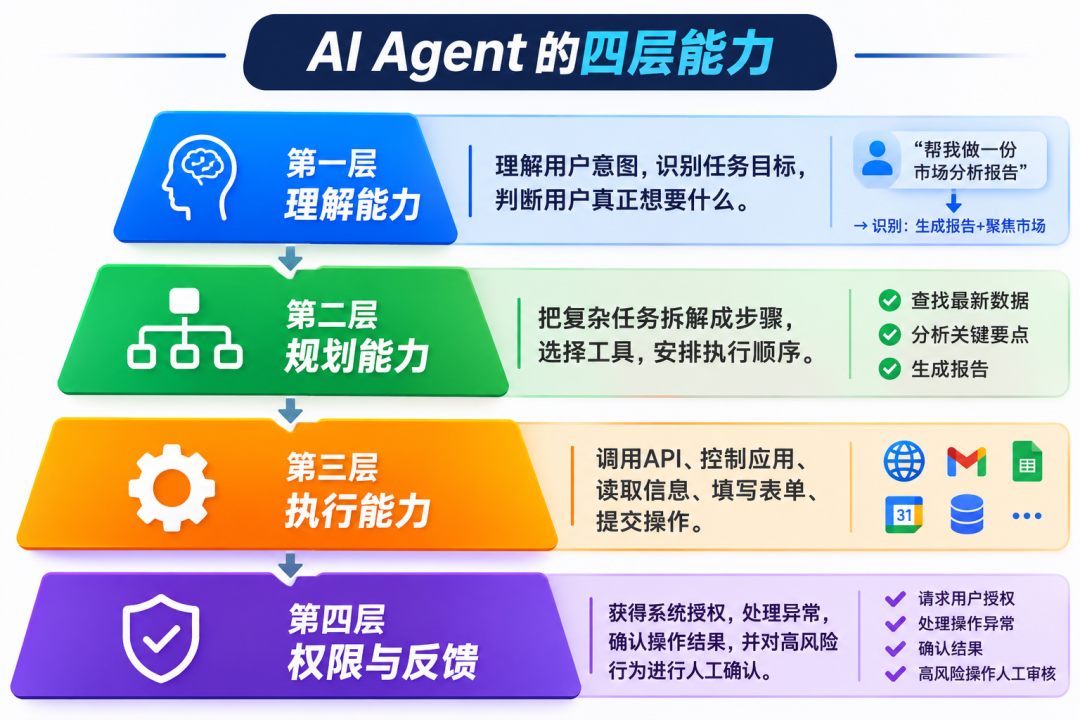
The first two stages rely more on models, while the latter two increasingly rely on operating systems, hardware, and application ecosystems.
This means the value chain of the AI industry is being redistributed.
In the past, model companies competed for the right to produce intelligence; now, platform companies compete for the right to execute intelligence.
Whoever can decide what agents can invoke, access, and operate can determine the capability boundary of agents.
And this is precisely the traditional advantage of platform companies such as Apple, Google, and Microsoft.
They not only control user entry points, but also control application distribution, system permissions, identity authentication, and payment systems.
By contrast, although OpenAI has strong model capabilities, it cannot naturally obtain control over other platforms.
Of course, what agents truly need is not unlimited permissions, but controllable, verifiable, and accountable permissions.
If AI can freely read user data, modify account information, or even complete transactions without confirmation, then the stronger the capability, the greater the risk.
Therefore, future competition among agents will depend not only on who opens more permissions, but also on who can establish a more reliable permission management system.
Apple can leverage its hardware and operating system advantages to embed privacy, security, and permission control into the agent architecture.
OpenAI needs to prove that it can not only let AI complete tasks, but also let users feel confident handing tasks to AI.
Models determine what agents can do; operating systems determine what agents are allowed to do.
This may be the most important competitive dividing line in the AI industry's future.

What Apple and OpenAI Are Fighting for Is the Right to Define the Next-Generation Operating System
If we extend the timeline, we will find that the competition between Apple and OpenAI is not just competition between two products.
They are in fact both answering one question:
When AI becomes the main way people interact with the digital world, will today's operating systems still maintain their original form?
Over the past few decades, computing platforms have gone through several important stages.
In the PC era, Windows controlled the desktop computing entry point, and users completed work through keyboards, mice, and software.
In the mobile internet era, Apple and Google controlled the application entry point through iOS and Android, and users entered different applications by clicking icons.
In the AI era, a new interaction method may emerge: users no longer actively look for applications, but directly state goals to agents, and AI is responsible for invoking various services.
This means the core value of operating systems may also change.
Future operating systems, in addition to managing hardware and running applications, will also need to manage agents, allocate execution permissions, and coordinate different applications and services.
Whoever can control this new scheduling layer will have the opportunity to become the foundational platform of the AI era.
From this perspective, the paths of Apple and OpenAI are very clear:
Apple extends from hardware and systems toward agents, while OpenAI extends from models and agents toward hardware.
Apple needs to make up for intelligence, and OpenAI needs to make up for control.
Of course, OpenAI making phones does not mean it will necessarily be able to replicate Apple.
Consumers will not give up iPhones or Android devices they have used for years simply because a phone has ChatGPT built in.
OpenAI also needs to solve issues such as hardware cost, battery life, application compatibility, privacy and security, and the developer ecosystem.
Especially the application ecosystem. If not enough third-party services are willing to integrate, then even if OpenAI has its own phone, it may just be putting ChatGPT into a new hardware device.
Conversely, Apple cannot take for granted that controlling iOS will automatically guarantee its dominance in the agent era.
If the most capable agents in the future come from model companies like OpenAI and Anthropic, while Apple's own agent can only handle a limited set of system operations, Apple risks being relegated to a mere hardware carrier—a platform on which others' agents run.
What ultimately determines the outcome, therefore, is not who releases an AI phone first, nor who launches an AI assistant capable of operating apps first.
It is who can build a sufficiently robust execution ecosystem.

In the AI era, the greatest fear for big tech is having no "body"
Looking back, Apple building agents and OpenAI building phones actually reveals a major shift in the AI industry: in the past, the primary goal of model companies was to make AI increasingly intelligent.
But today, intelligence alone is no longer enough.
Users will not feel that AI has changed their lives simply because it can write elegant code or generate a complete business plan.
The real transformation lies in its ability to enter users' workflows, invoke different applications, and accomplish tasks that previously required manual operation.
And execution authority is precisely a resource that model companies inherently lack.
It may reside with operating systems, with hardware manufacturers, or with platforms that host a large number of third-party services.
Competition in the AI industry, therefore, is no longer merely a contest among models, but a comprehensive contest among models, hardware, operating systems, and application ecosystems.
Apple is extending from hardware to models and agents, while OpenAI is extending from models to hardware and systems.
Both are attempting to reintegrate capabilities originally scattered across different companies into their own hands.
For Apple, the imperative is to make AI a new source of value for the iPhone; for OpenAI, the imperative is to give AI its own entry point.
Two seemingly opposite paths ultimately converge on the same war:
Who will define the operating system of the AI era?
This competition is far from settled.
Apple has an ecosystem, but needs to prove it can deliver sufficiently powerful agents; OpenAI has models, but needs to prove it can build a sufficiently complete device and service system.
But one thing is becoming increasingly clear: in the past, users opened their phones to find an application.
In the future, users may open their phones simply to tell AI what they want to do.
As applications gradually recede into the background and agents become the new interaction entry point, companies that truly master user needs, system permissions, and task scheduling capabilities will have the opportunity to redistribute the value of the entire mobile internet.
If leadership at the model layer cannot be converted into control at the execution layer, it may ultimately only provide fuel for others' entry points.
-
Your Car Could Earn Money on Ride-Hailing While You're at Work — Will Musk's Bold 7-Year-Old Promise Come True?
-
![]()
Jensen Huang's Departure Sparks AI Selloff, His Return Revives Sentiment—Yet Hidden Concerns Linger Beneath the Computing Power Frenzy
-
![]()
Lynk & Co Sells 18,032 Units Domestically in October, Lynk 20 Alone Accounts for 28%
-
![]()
Nissan Group's China Retail Sales Hit 18,500 in October, with Dongfeng Nissan Accounting for the Lion's Share
-
![]()
Insta360 Q3 Financial Report: Revenue Surges to 3.9 Billion Yuan, Net Profit Plummets 93% to Just 17.43 Million Yuan
-
![]()
[Tool Tip] WorkBuddy Auto-Claim Points: No Simulated Clicks — Let the Client Sign Itself in Three Steps
-
![]()
Apple Builds AI Agents, OpenAI Makes Phones
-
![]()
Gross Margin of 70%, Yet Still Short on Cash? The Second Half of AI Infrastructure: From Competing on Scale to Competing on Delivery