Chinese Manufacturers Sweep Top Five Global Rankings! Cellular IoT Module Market Grows 15% - What Changes Are Occurring?
 10/13 2026
 398
398
Source: IoT Analytics
Compiled by: IoT Intelligence
[In-Depth Analysis by IoT Intelligence]
Whether IoT applications are accelerating their deployment can often be observed intuitively through the communication module market.
Smart meters, POS terminals, network cameras, tracking devices, connected two-wheelers... these terminals, deployed across various scenarios, all rely on communication modules to access the network. Which types of modules are seeing faster shipment growth, which regions have stronger demand, and which manufacturers are continuously increasing their market share—these trends often reflect changes in terminal applications and project deployments.
Several noteworthy signals emerged from the cellular IoT module market in the first half of 2026.
On one hand, the phase-out of 2G and 3G networks, coupled with expanding demand for metering and tracking applications, has accelerated the adoption of Cat 1 bis, further elevating the global standing of Chinese manufacturers. On the other hand, rising costs and extended lead times for memory and other components have added pressure to procurement and project delivery.
Demand is surging, yet production capacity remains tight; shipments are climbing, but revenue growth may not keep pace. Evaluating this industry transformation requires looking beyond mere module shipment volumes.
According to IoT Analytics' *Global Cellular IoT Module and Chipset Market Tracker & Forecast Report*, global cellular IoT module shipments grew 15% year-on-year in H1 2026, with Cat 1 bis shipments surging approximately 34%. The top five global manufacturers by shipment volume were all from China. Meanwhile, the composite average selling price (ASP) of modules halted its four-quarter consecutive year-on-year decline, returning to growth.
Behind these figures, which applications are driving this growth? Do Chinese manufacturers' dominance in the top five imply full-scale leadership in overseas markets? How will price recoveries impact module manufacturers and end-user enterprises?
Below are key insights and observations from IoT Intelligence based on IoT Analytics' research.
[Latest Research by IoT Analytics]
Cat 1 bis shipments surge 34% year-on-year, sustained by demand for low-cost connectivity
Cellular IoT connections are migrating to next-generation low-power technologies, prompting adjustments in module shipment structures.
As mobile operators gradually shut down 2G and 3G networks, newly deployed IoT devices increasingly adopt newer, lower-power, and more cost-effective cellular technologies. Among these, LTE Cat 1 bis has emerged as a primary technology for meeting such demand.
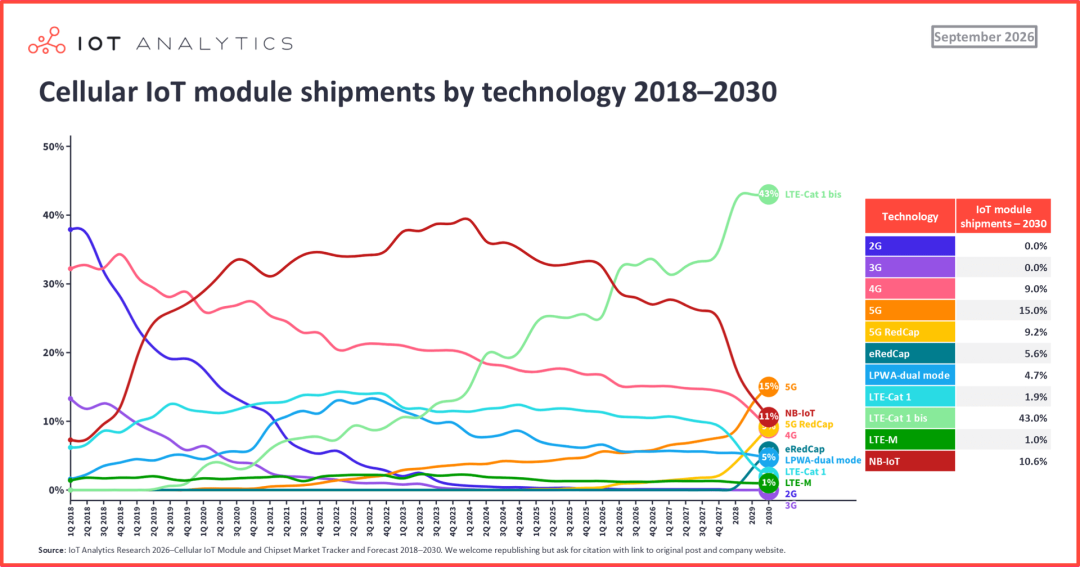
IoT Analytics data reveals that Cat 1 bis now represents the largest share of global cellular IoT module shipments and is the fastest-growing technology category. By 2030, it is projected to account for approximately 43% of total global cellular IoT module shipments. Applications such as tracking, POS terminals, cameras, and metering are key drivers of this growth.
Meanwhile, NB-IoT's shipment share has gradually declined from its Q1 2024 peak, while 2G and 3G's shares continue to shrink, nearing negligible levels.
5G adoption follows a distinct logic: 5G solutions remain focused on high-value applications. RedCap and eRedCap, supported by expanding terminal product portfolios and 5G standalone (SA) network coverage, are transitioning from product planning to mass shipments. By 2030, they are expected to collectively account for about 15% of cellular IoT module shipments.
This indicates that cellular IoT's technological evolution is not a uniform migration but is segmented by applications' varying demands for cost, power consumption, and speed, creating new niche markets.
Q2 accelerates significantly, with Cat 1 bis contributing ~76% of sequential growth
Global cellular IoT module shipments grew 15% year-on-year in H1 2026, with Q1 up 8.9% and Q2 accelerating to 20.9%.
Sequentially, Q2 shipments rose 15% from Q1, compared to just 3.7% in the same period last year.
1. Cat 1 bis drives Q2 growth
In Q2 alone, Cat 1 bis module shipments surged 45.3% quarter-on-quarter, accounting for ~76% of the total sequential shipment increase.
Module manufacturers report sustained growth in Cat 1 bis deployments across large-scale applications like network cameras, tracking, POS terminals, and smart metering. In discussions with IoT Analytics, one manufacturer highlighted network cameras and tracking devices as the two primary applications driving its Cat 1 bis shipment growth.
Cat 1 bis adoption is fueled by both the replacement of legacy device communication technologies and expanding application-specific demand. However, understanding Q2's strong growth also requires considering supply chain disruptions' impact on procurement rhythms.
2. Memory price hikes and extended lead times disrupt procurement
In Q2 2026, memory emerged as the most critical supply-side issue for modules, particularly for high-end products reliant on external DDR3 and other large-capacity storage, which were most severely affected.
According to one module manufacturer, the cost of a high-end DDR3 memory component surged roughly sevenfold from Q1. The company also noted pressure on resistors, capacitors, PCBs, and other components, but memory remained the key bottleneck for products with higher memory configurations.
Lead times are also lengthening, with delivery cycles for multiple module categories nearly doubling.
An executive from one manufacturer stated that LPWA and Cat 1 bis module lead times extended from ~12 weeks to 16 weeks, then further to ~22 weeks; products with higher memory configurations faced ~24-week lead times and rationing. To secure supply, the company began requiring customers to provide 12-month demand forecasts.
Another manufacturer reported that Cat 1 module lead times stretched from ~1.5 months to 3 months. The company has started stockpiling inventory and notifying customers in advance of extended lead times and impending price hikes.
Anticipation of longer lead times and price increases prompted some customers to place orders early or seek additional supply, intensifying Q2 procurement activity.
However, manufacturers' experiences with early procurement varied.
One module manufacturer stated that most orders—both existing and new—stemmed from normal business demand and gradual project ramp-ups, without widespread panic buying. While some customers attempted last-minute procurement increases, the company declined such requests.
Thus, Q2 growth was supported by both normal business demand and early procurement by some customers. Given differing customer structures and project timelines across manufacturers, market growth cannot be solely attributed to stockpiling.
3. China remains the largest market, while India emerges as the fastest-growing major market
Regionally, China remains the world's largest cellular IoT market, but overseas markets grew faster in Q2.
In Q2 2026, module shipments in markets outside China rose ~23.7% year-on-year, outpacing China's 19.6% growth.
India, though starting from a relatively small base, was the fastest-growing major regional market. Q2 cellular IoT module shipments in India nearly doubled year-on-year, with H1 cumulative shipments up ~54%.
Expanding demand for smart metering, POS terminals, tracking devices, and connected two-wheelers supported local market growth. In Q2, manufacturers launched Cat 1 bis modules for smart metering and distribution automation, as well as new products for connected two-wheelers, tailored to the Indian market.
Regional demand expansion is also prompting manufacturers to adjust their product portfolios. Growth opportunities in the global market increasingly hinge on aligning specific regions with specific use cases.
The current module market landscape has evolved through years of M&A, business realignments, and regulatory changes. IoT Analytics identified 18 key events since 2019 involving acquisitions, divestitures, spin-offs, and regulatory shifts, with automotive connectivity and cellular module businesses frequently changing hands. When assessing manufacturer rankings, these adjustments must be considered: supplier entity changes do not necessarily mean original products exit the market.
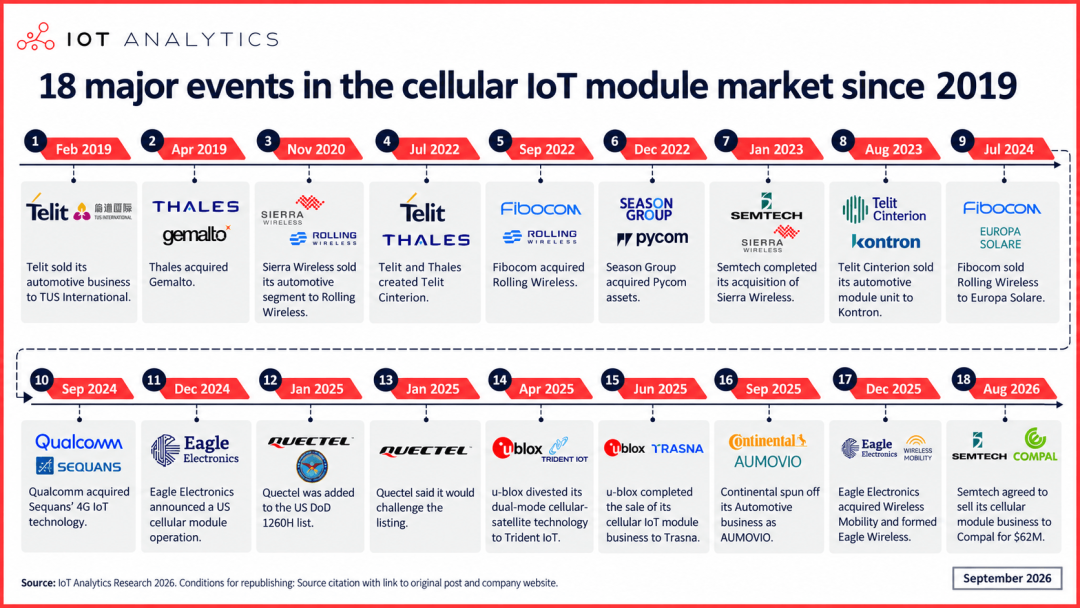
18 Key Events in the Cellular IoT Module Market Since 2019
Chinese manufacturers dominate top five global rankings, with overseas share gains concentrated among a few players
In H1 2026, the top five global cellular IoT module manufacturers by shipment volume were all Chinese:
1. Quectel
2. China Mobile
3. Lierda
4. Fibocom
5. Sunsea AIoT
Compared to IoT Analytics' July 2025 market analysis, Lierda entered the top five, displacing Telit Cinterion—the sole Western manufacturer previously ranked—which fell off the list.
Chinese manufacturers' growth is no longer confined to their domestic market. In 2018, Chinese cellular IoT module manufacturers accounted for ~35% of shipments in markets outside China; by H1 2026, this share rose to ~59%.
However, overseas share gains are concentrated among a few companies.
Quectel is the primary driver, with its share of non-China market shipments rising from ~13% in 2018 to ~38% in H1 2026, making it the largest cellular IoT module supplier outside China.
Fibocom also solidified its overseas presence, with its share increasing from <5% in 2018 to nearly 10% in H1 2026. Sunsea AIoT remains a major supplier in non-China markets.
In contrast, while China Mobile and Lierda rose rapidly in global rankings, their shipments remain China-centric. In H1 2026, China Mobile ranked second globally and Lierda third, but their shares in non-China markets remained small.
This indicates that while Chinese manufacturers' global standing has improved overall, not all firms have achieved equal overseas progress. Global rankings and overseas market performance must be evaluated separately.
The automotive market remains competitively balanced, with Chinese manufacturers rapidly gaining share. AUMOVIO and Rolling Wireless focus nearly exclusively on automotive embedded cellular connectivity. Kontron, WNC, and LG Innotek also have significant businesses in vehicle network access devices (NADs), telematics control units (TCUs), and related connectivity platforms.
However, Chinese manufacturers are quickly expanding their footprint.
In H1 2026, Chinese module manufacturers' shipments in automotive embedded cellular connectivity grew ~33% year-on-year, outpacing the segment's overall ~12% growth and boosting their market share from ~28% to 34%.
Current projections suggest Chinese manufacturers' share in this segment could rise further to ~39% by 2030.
Chinese manufacturers' leadership in overall shipments has not yet fully extended to specialized segments like automotive. Competitive dynamics vary by application and must be assessed individually.
H2 demand remains supported, but shipment and revenue growth may further diverge
IoT Analytics expects the cellular IoT module market to remain robust in H2 2026, though growth drivers will become more complex.
Rising component costs are filtering through to module prices.
In H1 2026, the composite ASP of cellular IoT modules rose ~2.5% year-on-year, halting four consecutive quarters of decline. Prices for modules across multiple technology categories also increased quarter-on-quarter.
However, rapid growth in low-cost Cat 1 bis module shipments, which account for an increasing share of total shipments, has suppressed ASP growth. Thus, the overall ASP change does not fully reflect actual price increases across module types.
Feedback from multiple manufacturers indicates that memory supply and cost pressures are likely to persist at high levels in H2, particularly for modules with higher memory configurations. IoT Analytics expects this pressure to further propagate to modules with lower memory requirements, such as Cat 1 bis and LTE-M.
Demand remains supported, but Q2's high growth rate may not sustain.
Customer project ramp-ups and communication technology migrations will continue to drive module demand. However, extended lead times and component rationing may limit manufacturers' ability to meet demand and fulfill deliveries.
Manufacturers' expectations for the second half vary. Some anticipate the overall market to remain flat quarter-on-quarter in Q3. Thus, even if quarterly growth normalizes after Q2's strong performance, the market is expected to stay robust in H2.
Technology migrations will continue to drive growth through 2027.
In the near term, Cat 1 bis is expected to lead module shipment growth, driven by 2G and 3G device replacements and expanding applications in metering, tracking, POS terminals, and cameras.
RedCap shipments remain small but are entering commercialization, with more module products reaching the market. China leads in RedCap development, thanks to its mature 5G SA infrastructure; some non-China markets may face slower adoption due to limited 5G SA coverage.
5G solutions will remain critical for high-value applications like fixed wireless access (FWA), automotive, and enterprise networks.
Overall, H1 2026 market growth was primarily volume-driven. In H2 and 2027, product pricing, component supply, RedCap commercialization, and supplier competition will increasingly shape market performance.
As product mixes and pricing evolve, revenue growth and shipment growth rates in the module market may diverge more significantly.
Final Thoughts
This research reveals that changes in the cellular IoT module market extend far beyond a simple "demand recovery."
Cat 1 bis adoption reflects strong demand for cost-effective connectivity solutions across numerous terminal applications. Chinese manufacturers' rising overseas shares indicate their competitive advantages are being tested in broader markets. Extended lead times and component price hikes remind the industry that translating demand into shipments depends on supply and delivery capabilities.
The IoT Intelligence thinks that there are three changes worthy of continuous attention in the next stage.
Firstly, the direction of technological upgrades will ultimately be determined by application demands.
The phase-out of 2G and 3G networks will drive equipment updates, but different terminals require varying connectivity capabilities. Cat 1 bis, RedCap, eRedCap, and 5G each have their application spaces.
For terminal enterprises, model selection must return to specific business requirements: what data is being transmitted, how fast a response is needed, what power supply method is used, how long the device is expected to operate, and whether the network in the deployment area supports the corresponding technology. Solutions that can support large-scale deployment must simultaneously meet application demands, network conditions, and total lifecycle cost requirements.
Secondly, after leading in global shipments, competition will further deepen into regional markets and segmented applications.
Chinese manufacturers ranking among the top five globally represents a significant change. However, overseas growth is mainly concentrated in a few enterprises, and competition in the automotive market remains relatively balanced, indicating differences in market performance among different manufacturers and application fields.
Module enterprises still need to continuously improve product adaptation, certification support, customer service, and supply guarantees to convert shipment scale into long-term cooperation. Entering a market is just the starting point; the ability to serve local customers over the long term determines whether market position can be solidified.
Finally, to assess growth quality, it is necessary to consider shipments, prices, and costs simultaneously.
Extended lead times and expectations of price increases may alter customer procurement rhythms; supply constraints may delay deliveries; and an increase in the proportion of low-priced products will affect overall revenue growth.
Therefore, growth in shipments cannot be directly equated with synchronous revenue growth, and a rebound in average selling prices does not necessarily mean improved profitability. Demand sources, product mix, cost changes, and delivery capabilities must be observed together.
For the IoT industry, the market value of modules ultimately manifests in terminal applications and project operations. In the next stage, it is not only worth noting which technology sells more or which manufacturer ranks higher but also whether these connectivity solutions can be smoothly deployed, operate stably, and continue to be delivered amid cost and supply changes.
Converting growing connectivity demands into sustainably implemented projects represents the longer-term value of this round of module market growth.
References:
IoT Analytics: "Cellular IoT module shipments grow 15% in H1 2026, led by 34% Cat 1 bis growth; ASPs rise after four quarters of decline amid higher memory costs"
-
![]()
Jensen Huang Backs Post-85 Twin Entrepreneurs: Leasing AI Computing Power, Company Valued at $97 Billion
-
![]()
Has Qualcomm Begun Paying Royalties to Huawei?
-
The Business Strategy of Autonomous Buses
-
AI Completes Mathematical Proofs in an Average of 3 Hours: Is Scientific Research Heading Towards an Era of Overload?
-
TechVantage Cloud Stock Tumbles Over 80% in a Day: Bridging the Gap Between 'Planning' and 'Delivery' in the Second Wave of Computing Power
-
![]()
AI Glasses: Starting to Take the Initiative
-
![]()
Chinese Manufacturers Sweep Top Five Global Rankings! Cellular IoT Module Market Grows 15% - What Changes Are Occurring?
-
![]()
Why Does the Mobile Hotspot Keep Disconnecting at Crucial Times?