The Privacy Filter Protects Your Privacy—But It's Quietly Stealing Your Eyesight
 11/12 2026
 351
Many people apply a privacy filter for a very simple reason: they don't want strangers catching a glimpse of their chat history on the subway, and in the office they don't want the person next to them seeing their pay slip.
Once applied, a side view shows nothing but a black patch—privacy is indeed protected.
But after using one for a while, you may notice that your eyes get sore more easily than before when looking at the screen. At night with the lights off, after scrolling on your phone for a while, you feel a swelling sensation. You assume it's because you've been tired lately, or because you've been on your phone too long.
The problem may not be your eyes—it may be that film.
The Fujian Provincial Consumer Rights Protection Commission, together with the Fujian Provincial Institute of Product Quality Inspection and Research, conducted an evaluation of eye-protection privacy filters, testing 12 best-selling products. The results found that eye-protection privacy filters cannot actually protect the eyes.
01
The Essence of Blue Light Protection
Is Dimming the Entire Screen
When selling privacy filters, the most common additional selling point is blue light protection and eye protection. This sounds very reasonable: blue light harms the eyes, the film blocks blue light, therefore it protects the eyes.
Actual measurements of the 12 samples showed blue light attenuation rates ranging from 34.51% to 66.09%. The higher the value, the more blue light is theoretically blocked.
The test also found that screen brightness transmittance of the same batch of samples ranged from 67.09% to 34.01%. The one that blocked the most blue light had a blue light attenuation rate of 66.09%, but only 34.01% of screen brightness could pass through. After applying the film, screen brightness was cut to about one-third.
This isn't precision targeting of harmful blue light—it's reducing all the light from the screen together. Normal light, blue light, and colors are all dimmed.
Experts from the Fujian Provincial Institute of Product Quality Inspection and Research also noted that the blue light protection of eye-protection privacy filters is essentially passive dimming. Not only can it not specifically block harmful blue light, but it may also force the eyes to over-adjust because the screen is too dark, thereby aggravating visual fatigue.
In fact, for a phone without a film, the effective radiance of blue light hazard is itself below 0.5W/(m·sr), while the upper limit for the no-risk category of blue light hazard is 100W/(m·sr). In other words, the blue light intensity of the phone screen itself is far below the level that would require a special film to block it.
Blocking blue light with a film has little practical significance in most daily scenarios.
02
Privacy Filters Make Your Eyes Work Overtime
The core function of a privacy filter is privacy, and it does achieve that. But its working principle is inherently at odds with comfortable viewing.
Privacy filters rely on a grating structure to limit the light emitted by the screen to a very narrow angle. From the side it's all black, and from the front the brightness is also reduced. Privacy filters with light transmittance dropping to 61% are not uncommon, while ordinary high-definition films usually have a light transmittance of about 92%. This is equivalent to putting a pair of dark sunglasses on the screen.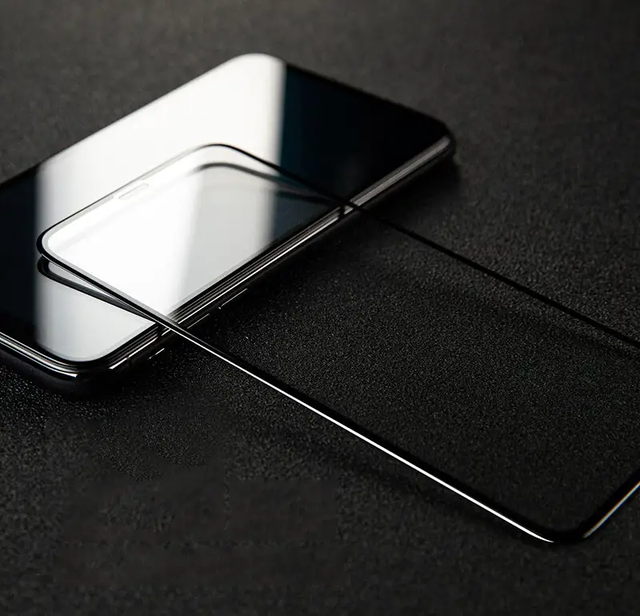 Image source: Internet
After the screen becomes darker, the eyes have to do two things: first, dilate the pupils to let more light in; second, the ciliary muscles must keep adjusting, straining to see the darkened image with reduced contrast.
They can hold up for a short time, but over time, soreness, dryness, and fatigue follow.
Claims circulating on social platforms that vision dropped from normal to 300 degrees after using a privacy filter for a few months—although individual differences are large and this cannot be directly treated as a universal conclusion—point to one undeniable fact: the darker the screen, the more tired the eyes.
03
Eye Protection and Privacy Don't Have to Be an Either-Or Choice
Privacy filters aren't something you can't use. If you really need a solo mode, they are effective in scenes with dense nearby gazes such as commuting and office work.
But the problem is, don't buy a privacy filter for eye protection, and even more, don't expect it to replace scientific eye-use habits.
If you have applied a privacy filter, there are several ways to reduce the cost.
One is to choose a version with higher light transmittance—look for products with light transmittance above 85% and an anti-glare coating, and don't be tempted by a few yuan with free shipping.
Another is to turn on automatic brightness and True Tone, letting the phone adjust brightness according to ambient light for you, rather than manually pulling it to the brightest to fight that dimmed film.
Image source: Internet
In addition, don't scroll on your phone for a long time after turning off the lights. A dark environment plus a dark screen compounds the adjustment burden on the eyes.
Truly effective eye protection is not in that film.
You can remember the 20-20-20 rule: every 20 minutes looking at the screen, look up at something 6 meters away for 20 seconds. This method is more useful than any blue light protection film.
The blue light of the screen itself is far below the safety line. What you need is not to block the light, but to give your eyes a chance to rest from close-up focusing.
The privacy filter protects your privacy, and that's fine—but it cannot protect your eyesight.
#Phone privacy filter
-
![]()
What Is Astigmatism, Really? Why Tangential and Sagittal Foci "Go Their Separate Ways"
-
![]()
Gree Electric's Performance Weighed Down by Soaring Copper Prices: Will Dong Mingzhu Unveil a "Big Move" by Year-End?
-
![]()
AI R&D Doubles in Speed as Anthropic Redacts Most of a 100-Page Report
-
![]()
Crown New Materials to Inject RMB 228 Million into Zhejiang Optical Film Project
-
![]()
Gaize Technology Officially Announces Takeover of Entire Japanese Optical Powerhouse Plant: Can It Translate Into Production Capacity?
-
![]()
Baidu Begins Building Factories
-
Hong Kong Listed Company Huaxia Culture Technology Enters AI Sector with Mid-Term Profit Alert Exceeding HKD 900 Million
-
![]()
NXP Earnings: Net Income Hits $884 Million as Automotive Chip Growth Lags at 13%