Twists and Turns: Musk Can't Wait Any Longer, Tesla Suddenly Cuts Prices
 09/10 2026
 529
529
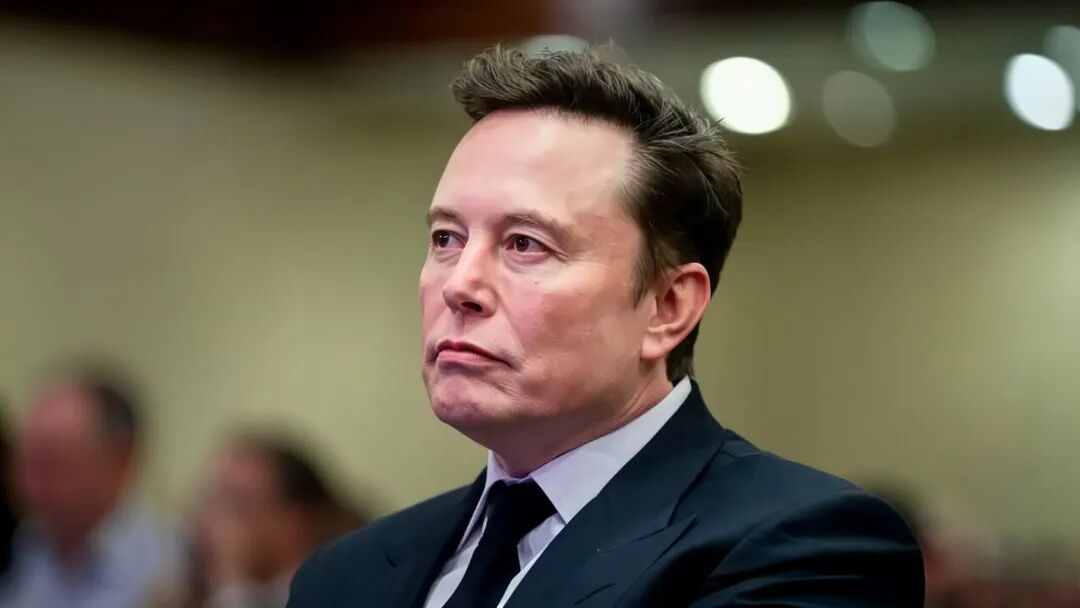 Image Source: Weibo
This year's "golden September" auto market witnessed Tesla, which had held its prices steady in the Chinese market for 19 months, make its most surprising move yet.
Without any prior buildup or notice, Tesla launched a limited-time discount policy early on September 7th, catching consumers, competitors, and even frontline sales staff off guard. This seemingly simple promotion actually reflects Musk's strategic short-term trade-offs after recognizing changes in the Chinese market.
 Image Source: Tesla
The discounts were straightforward: The Model 3 saw an immediate price drop of 5,000 yuan for in-stock units, while all Model Y variants were reduced by 10,000 yuan. Combined with 5-year zero-interest financing, limited-time paint options, and insurance subsidies, the entry price for the Model 3 dropped to as low as 222,500 yuan, and the Model Y to 253,500 yuan, hitting recent lows.
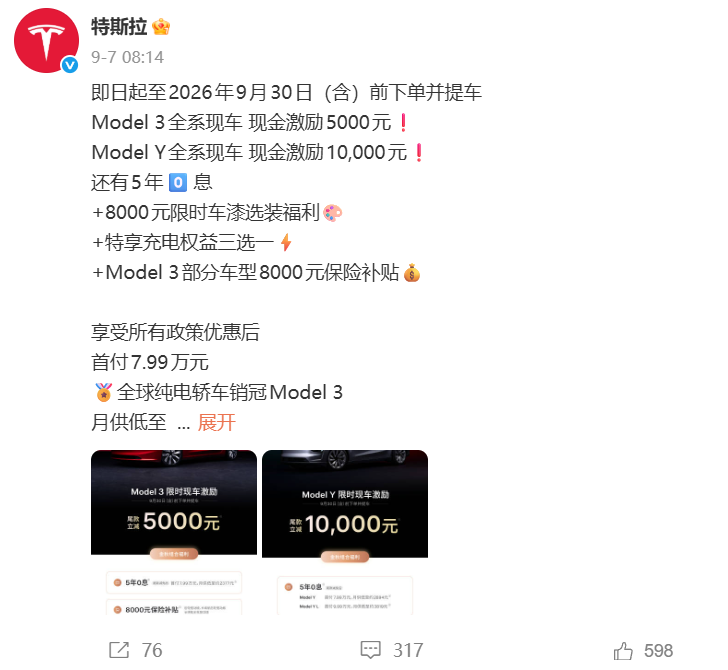
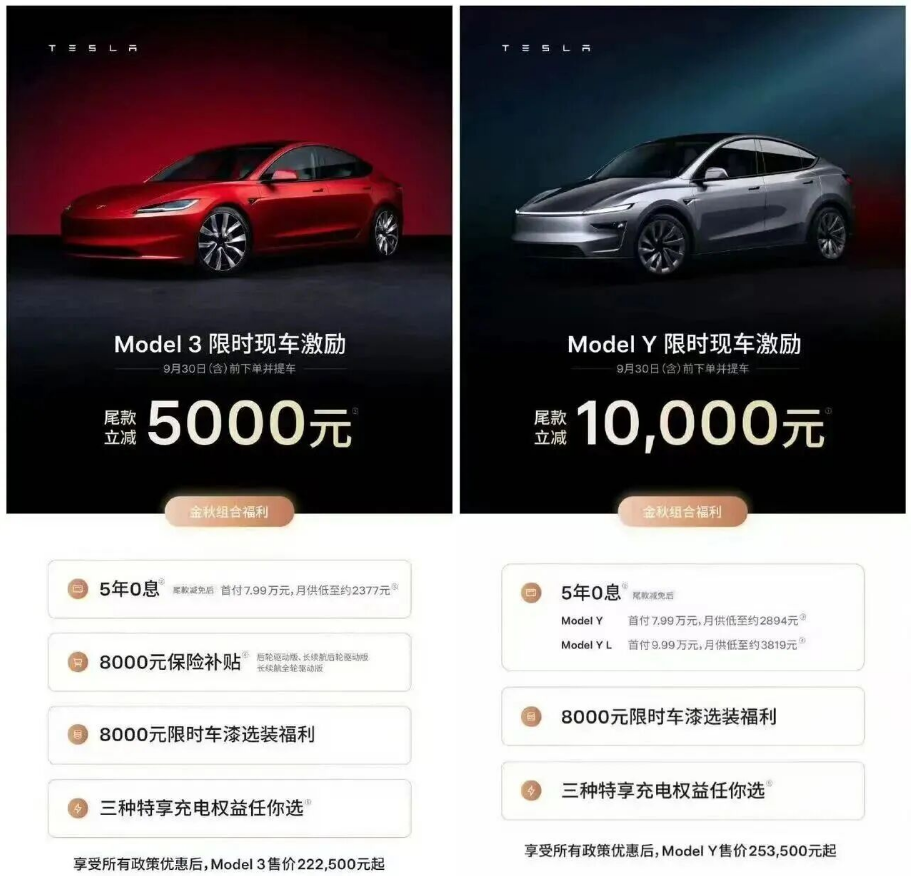
Image Source: Weibo
As news spread, Tesla stores across the country became bustling hubs. Quiet showrooms were suddenly crowded with potential buyers, inquiries flooded in, test drive appointments were fully booked, and popular configurations of in-stock units were quickly cleared. On the first day of the promotion, orders nationwide exceeded 4,000, with some stores closing over 60 deals in a single day, marking a concentrated sales surge.
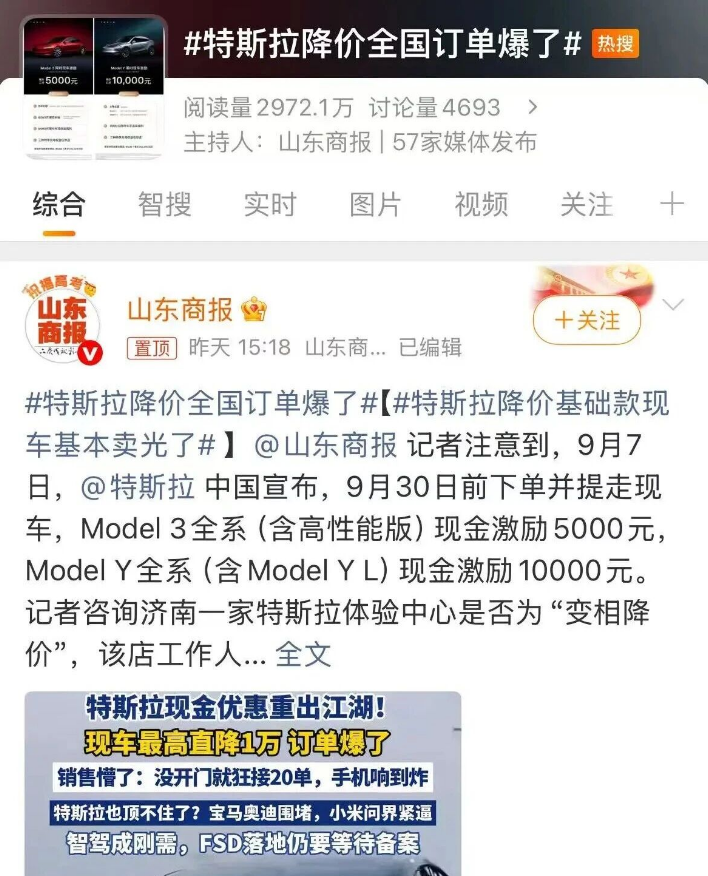 Image Source: Weibo
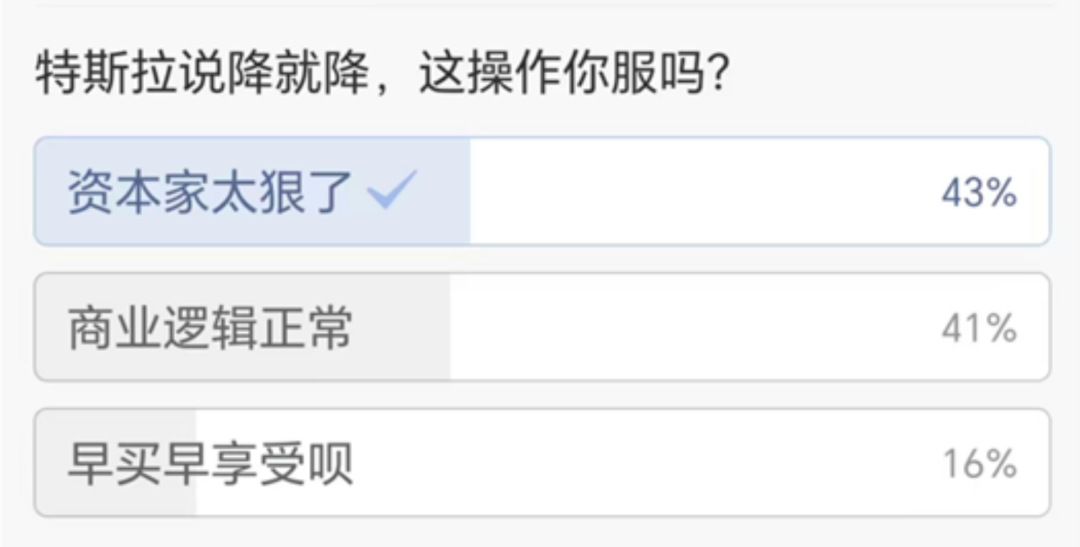
While some rushed to take advantage of the low prices, existing owners felt let down. Many had just purchased their vehicles and now faced losses exceeding 10,000 yuan. Some users complained that sales staff had assured them of price stability, only to see sudden discounts, fueling dissatisfaction among current owners.
Kept in the Dark! This Is Musk-Style Decision-Making
A controversial aspect of this price cut was that not only consumers but also frontline sales staff and customer service were notified only on the day the policy was announced.
The extremely high level of confidentiality, last-minute issuance, and rapid implementation reflect Musk's typical management style: highly centralized decision-making with short chains of command, prioritizing the group's strategic goals above all else. To boost quarterly deliveries and accelerate inventory turnover, the company prioritized overall interests, inevitably overlooking the feelings of existing users.
In response to demands from existing owners for price difference compensation, charging or FSD benefits, and price protection mechanisms, Tesla's reply was straightforward: Completed deliveries are not eligible for retroactive adjustments, and no compensation plans for existing owners will be implemented.
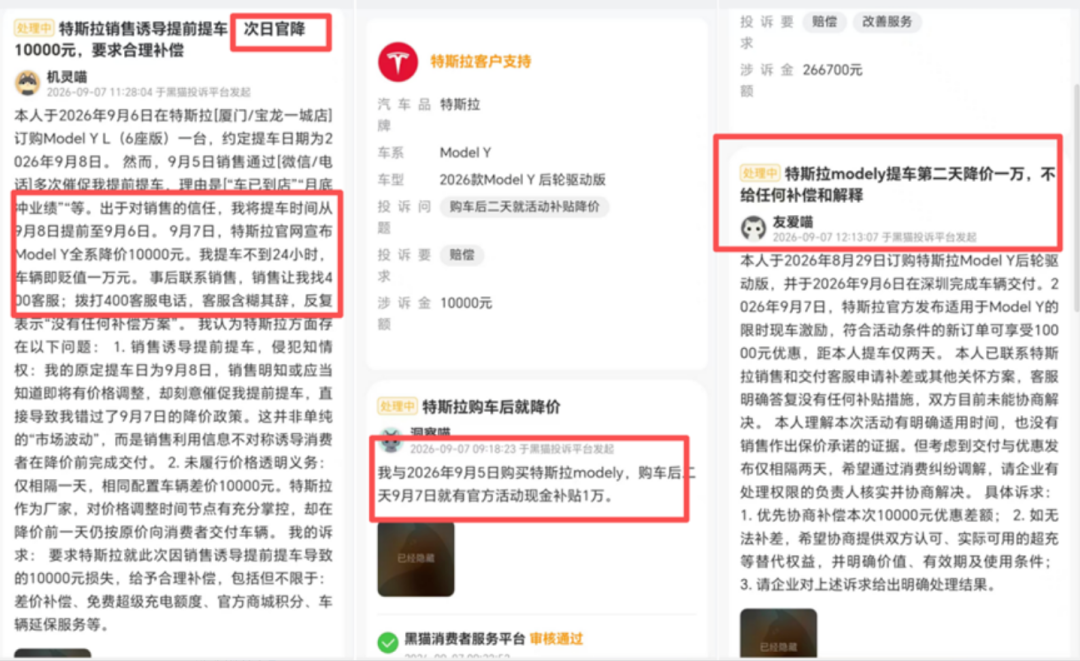
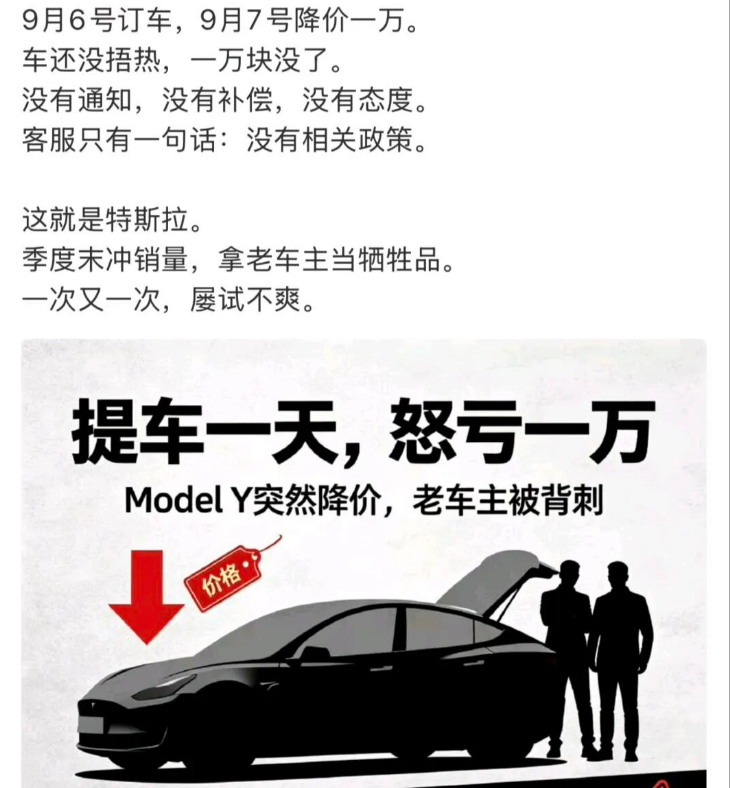 Image Source: Weibo
Externally, Tesla deliberately avoided using the term "price cut," instead referring to it uniformly as a "limited-time cash incentive for in-stock units." The logic behind this approach is clear: avoid altering the official suggested price (MSRP) to maintain brand positioning; use limited-time stock policies to boost sales and clear inventory; and separate promotions from formal price adjustments. While seemingly offering consumer benefits, this is actually Tesla's standard practice for balancing sales targets with brand image, yet it leaves existing owners in an awkward position.
A Simultaneous Market Stir! Xiaomi Pengcheng's Aggressive Price Cuts Expose Industry Realities
Interestingly, on the same day Tesla's surprise price cuts dominated headlines, domestic new energy vehicles staged a "dimensional reduction strike," vividly demonstrating the auto market's underlying logic that price determines orders.
On the evening of September 7th, Xiaomi Pengcheng's series of extended-range SUVs officially launched, immediately sparking widespread online attention. The new model introduced four configurations, covering the mainstream markets of mid-to-large five-seater and large seven-seater vehicles: N70 Pro at 209,900 yuan, N70 Max at 239,900 yuan, N90 Max at 269,900 yuan, and the N90 Max Explorer Edition at 299,900 yuan, capping prices under 300,000 yuan and precisely targeting Tesla's main price range.
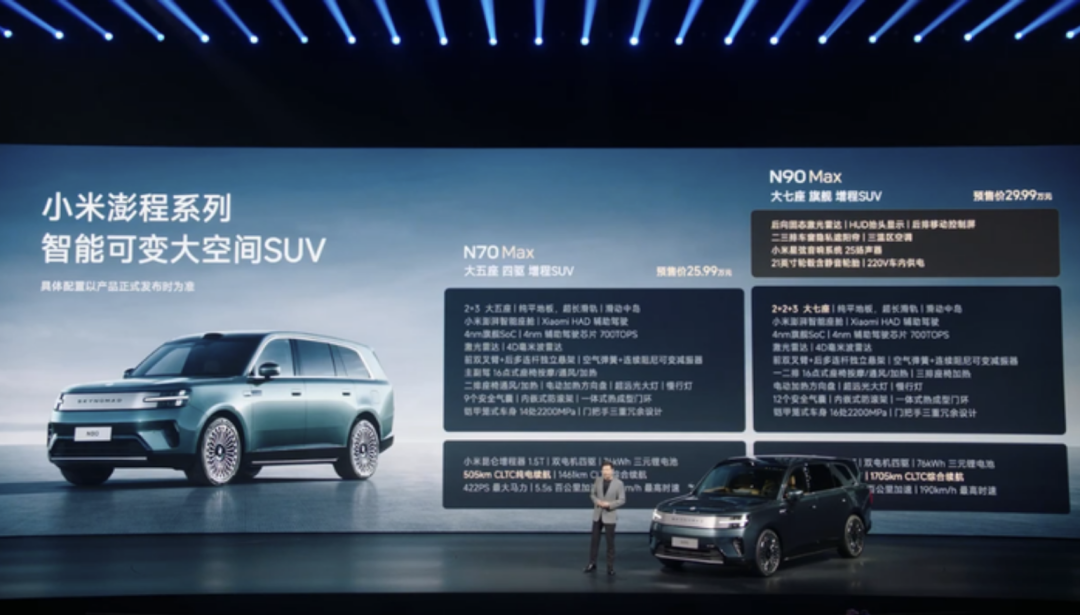
Image Source: Jiemian News
Even more striking was the price contrast. Previously announced pre-sale prices had already impressed many consumers, with the N70 Max pre-priced at 259,900 yuan and the N90 Max at 299,900 yuan. However, at the launch event, prices were further reduced—the N70 Max by 20,000 yuan and the N90 Max by a staggering 30,000 yuan—while a new entry-level model priced at 209,900 yuan was introduced, aggressively pushing the entry threshold for mid-to-high-end smart SUVs below 210,000 yuan.
Consumer price expectations were fully met, and the cost-effectiveness advantage became instantly prominent. Users who had been hesitating abandoned their indecision and placed orders. When the order channel opened at 10 PM, Xiaomi Pengcheng secured over 10,000 orders in just four minutes, demonstrating terrifying explosive power.
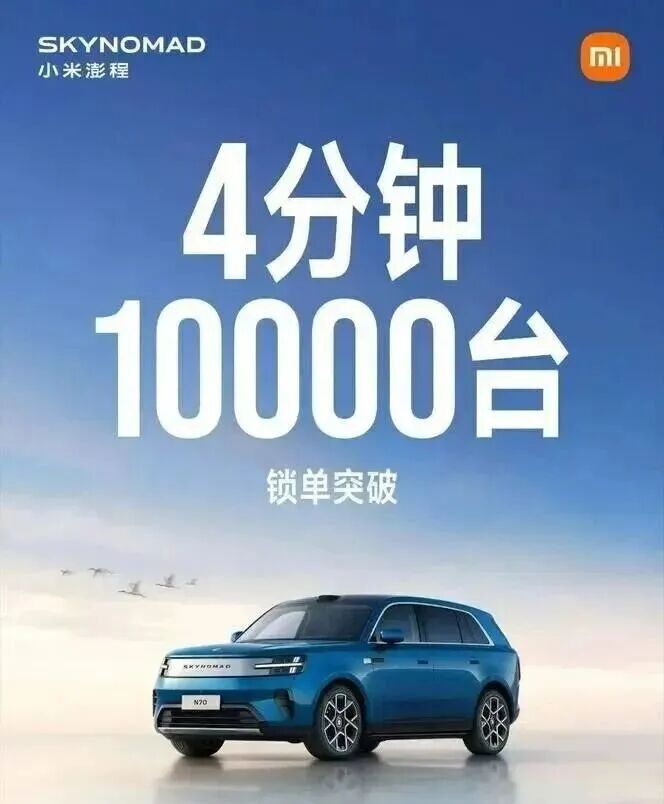
Image Source: Weibo
It's important to note that Xiaomi's order-locking rules are stringent. Locking an order confirms the model, configuration, and color, initiating production scheduling and disallowing casual cancellations. These 10,000 orders represent highly intentional and certain real demand, with minimal exaggeration and far higher value than ordinary reservations.
Within a single day, two major automakers saw synchronized order surges, creating a stark contrast: Tesla relied on "post-purchase discounts and limited-time subsidies" to boost sales, while Xiaomi directly captured market share with "launch-day price breaks and pre-sale price drops." One side made passive adjustments to stabilize its position, while the other proactively priced to precisely harvest the market, thoroughly proving that in today's new energy vehicle market, brand halos no longer dominate—genuine price competitiveness is the ultimate key to driving sales.
A 180-Degree Attitude Shift: From Dismissal to Recognition—Understanding Musk's Perception of Chinese Automakers
To understand Tesla's recent moves, one must consider Musk's significant shift in perception regarding domestic automakers, a microcosm of the domestic new energy industry's rise.
In the industry's early stages, Tesla led globally. When asked about Chinese brands like BYD, Musk initially dismissed them strategically, not considering domestic automakers as peers. At that time, domestic electric vehicles were still catching up, and a significant gap existed.
In just a few years, the domestic supply chain exploded. BYD integrated the entire vehicle chain, with sales soaring; Geely and Changan continued to grow; NIO, XPeng, and Li Auto deeply cultivated the high-end market; while Xiaomi and HiMoon Smart Travel directly entered Tesla's main price range.
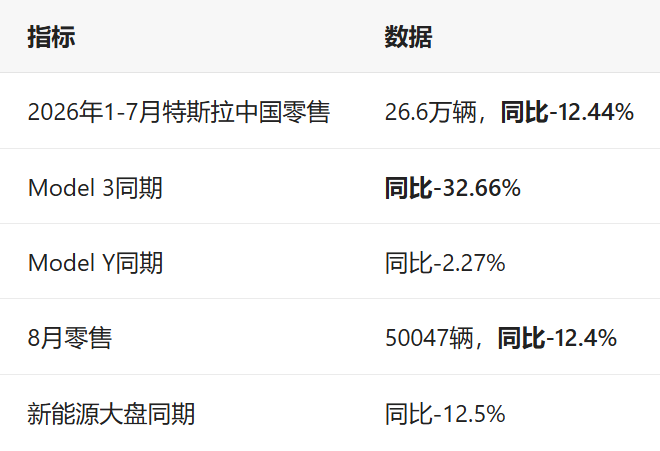
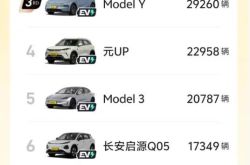
Data from the China Passenger Car Association shows that in August 2026, Tesla's retail sales in China reached approximately 50,000 units, down 12.4% year-on-year, marking the third consecutive month of decline. For the first eight months of the year, Tesla's cumulative retail sales in China stood at around 316,300 units, also down 12.4% year-on-year.
As past interview clips resurfaced, Musk publicly revised his earlier views, acknowledging the strong competitiveness of domestic models. In subsequent earnings calls and public interviews, he went further: Chinese automakers are the most competitive globally, and China hosts the world's most fiercely competitive auto market. He even stated that without trade barriers, Chinese automakers could shine globally.
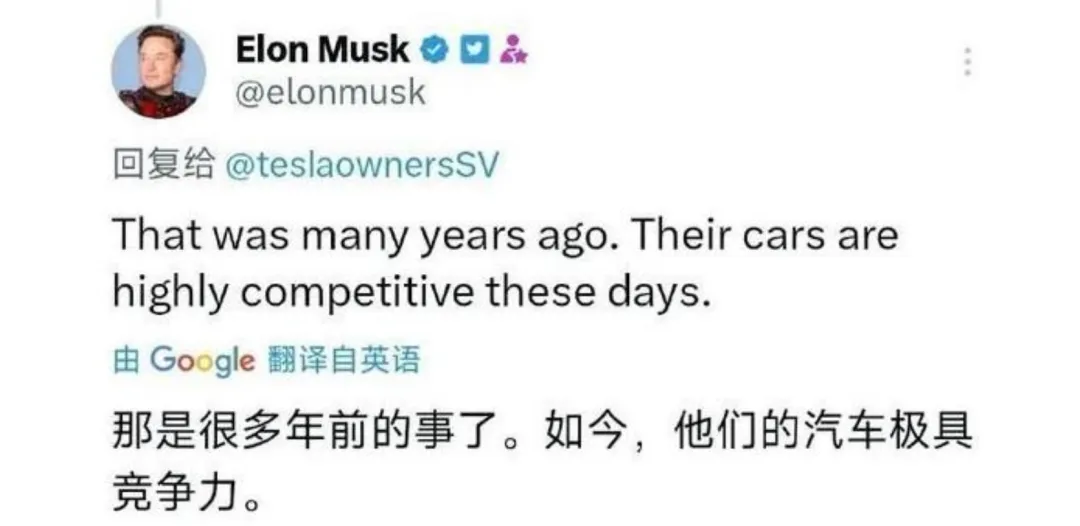 Image Source: X Social Platform
When BYD surpassed Tesla in pure electric vehicle sales, Musk did not shy away from acknowledging his rival's progress. Instead, he redefined Tesla, emphasizing that the company is not just an automaker but also an AI and robotics technology firm, attempting to build differentiated barriers at a higher dimension. This is not surrender but a strategic adjustment by a top entrepreneur who clearly sees reality.
Many contrast Musk's earlier remarks with his current price cuts, seeing contradiction. In fact, what he opposed then was unbridled, vicious price wars, not reasonable price adjustments. Musk's underlying business logic remains unchanged: disrupt industries through technology, reduce costs through scale, and drive energy transformation through popularization. In the industry's early stages, high margins supported R&D; as the market matures, price adjustments expand the user base—this is simply adapting to circumstances.
This round of surprise promotions is not passive defense but proactive offense. Domestic new energy has already entered a phase of intense internal competition, and clinging to original pricing would only lead to continuous market share loss.
Revenue Growth Without Profit Increase: The Real Dilemma Amid Industry Intensification
Financial data vividly reflects the real pressures Tesla faces, struggling with the industry-wide issue of revenue growth without corresponding profit increases. In Q2 2026, Tesla achieved record-high revenue and deliveries for the same period, but hit by industry-wide price wars, operating profit plummeted 57%, and automotive business gross margins fell to a near-four-year low. The more units sold, the thinner the profit per vehicle.
Musk's choice to prioritize volume over price is essentially a trade-off: moderately sacrificing short-term profits to maintain market position, stabilize capacity utilization and cash flow, and support long-term R&D in intelligent driving and new models. Capital markets have never expected short-term exorbitant profits (windfall profits) from Tesla but rather long-term value from technological iteration and ecosystem expansion. Even with temporary profit pressures, many institutions remain supportive.
The decline in the Chinese market is now visible. As Tesla's most crucial overseas growth market, domestic sales have fallen year-on-year for three consecutive months, with cumulative sales for the first eight months down 12.4%, and market share dropping from a peak of 15% to 6.6%.
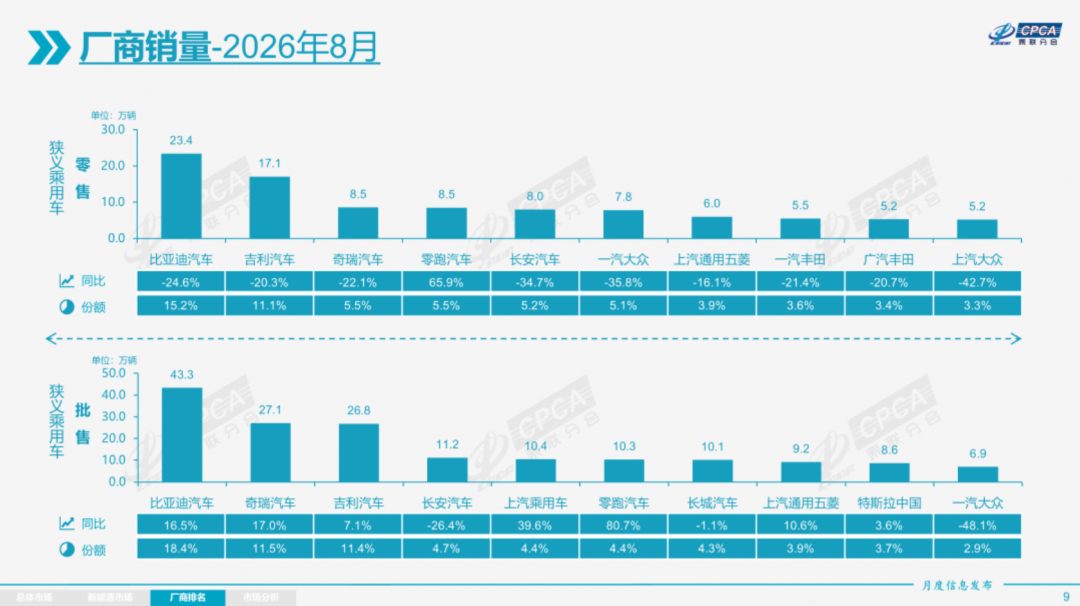
Image Source: Sina Finance
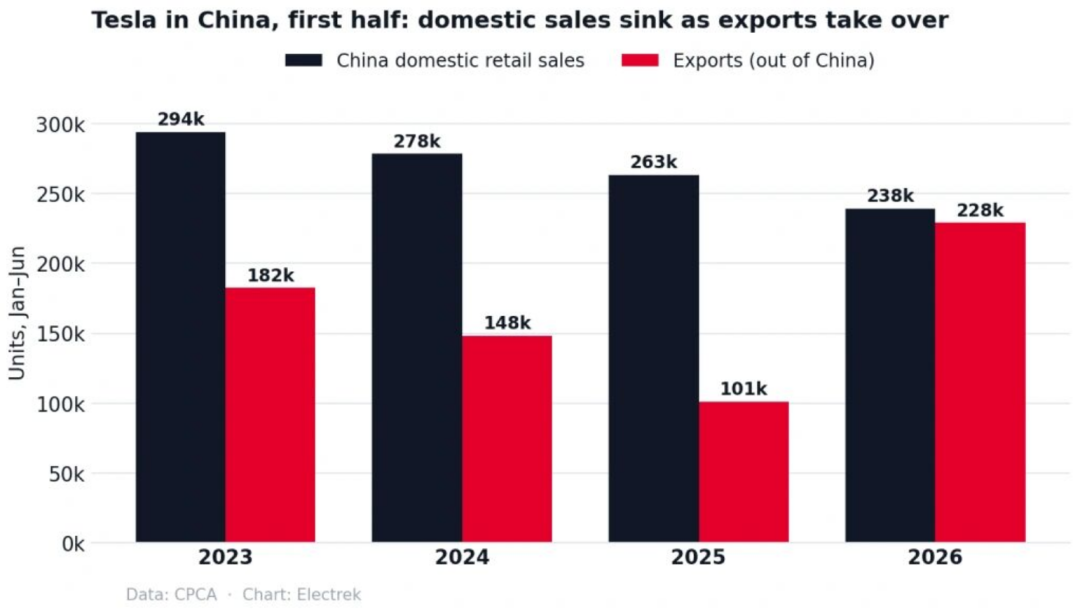
Tesla's Declining Deliveries Image Source: moomoo
Tesla's technological moat is also narrowing. Once, FSD intelligent driving was Tesla's core ace, but now local solutions like Huawei ADS deeply adapt to domestic road conditions, with deployment scenarios more closely aligned with local travel environments, directly diluting FSD's first-mover advantage. With competitors catching up across the board, Tesla must use pricing to stabilize its position.
Bleeding Edge Layouts Require Automotive Business to Fuel Dreams
Beyond market intensification, the capital market's underwhelming expectations for new products have also accelerated this strategic adjustment. Musk is renowned for his forward-looking layouts, with ventures spanning electric vehicles, aerospace, AI, and humanoid robots.
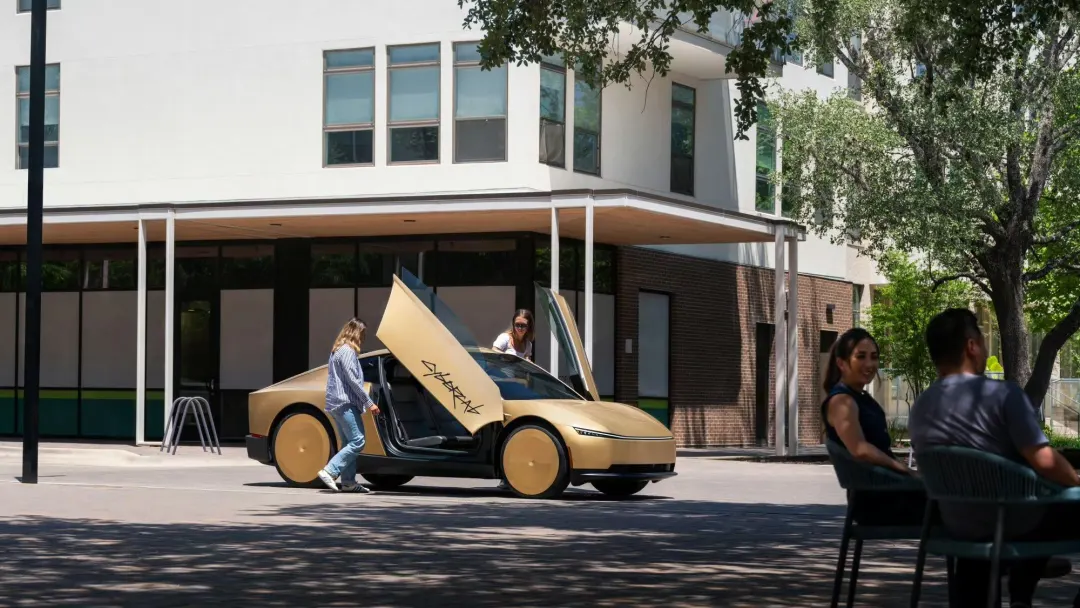
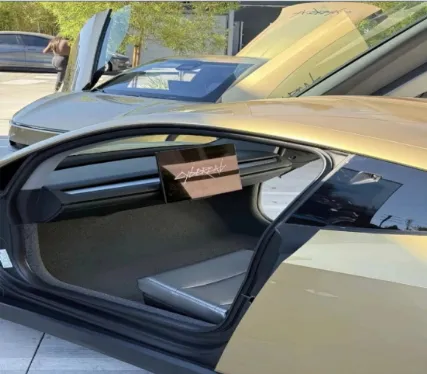 Tesla Cybercab with No Steering Wheel or Pedals Image Source: Xiaohongshu
The Cybercab driverless taxi, seen as Tesla's second growth engine, faced high external expectations. However, the product update lacked disruptive breakthroughs, creating a gap between reality and market expectations. Affected by this, Tesla's stock price plummeted nearly 6% in a single day, with its market cap evaporating by over 600 billion yuan overnight.
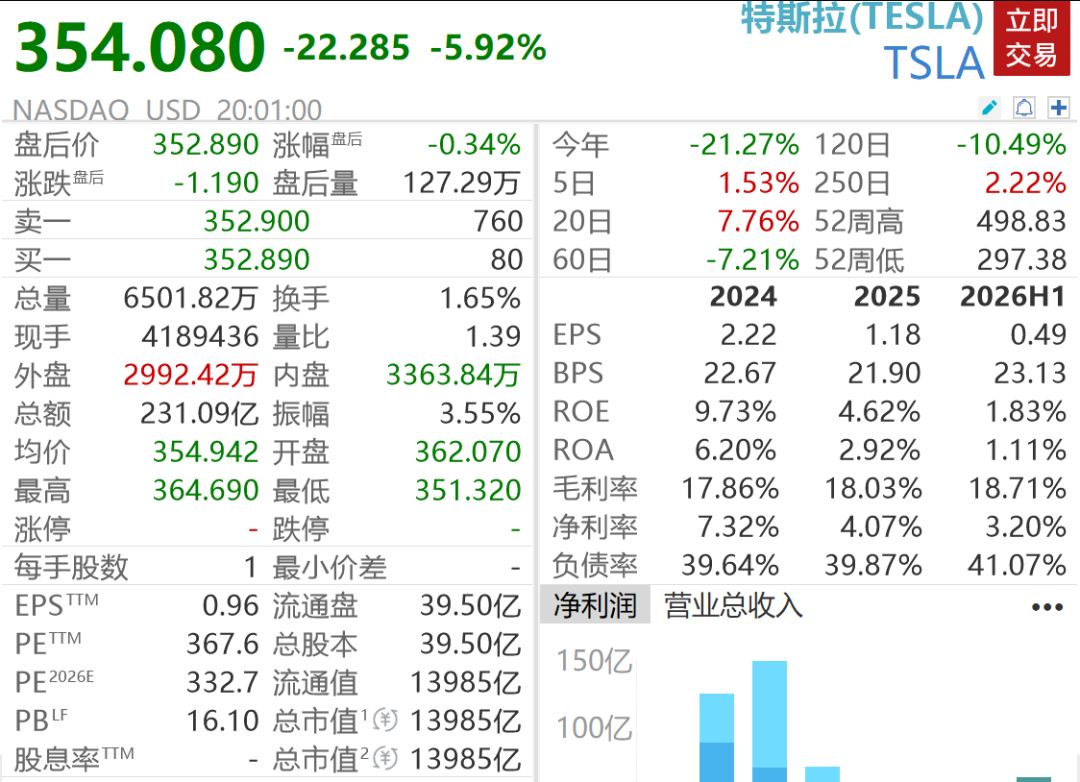 Image source: Snowball
Large-scale recalls are a normalized quality control optimization process after mass production by automotive companies and a common approach used by global automakers. They do not indicate a complete collapse of the quality system.
Musk once ushered the industry into the smart electric vehicle era. Now, with the maturation of domestic supply chains and rapid technological progress, electric vehicles have become increasingly accessible. Tesla's move to abandon its premium pricing strategy and cater to the mass market signifies a strategic repositioning in response to the evolving landscape. This shift, from setting industry standards to actively adapting to market demands, underscores the resilience of a market leader.
Conclusion: Not the Demise of a Giant, but a Fresh Start in the Competitive Arena
This abrupt price reduction during the peak September sales season is not merely a tactic to clear inventory. It is part of Musk's overarching strategy, which includes inventory clearance, stabilizing quarterly deliveries, maintaining cash flow, hedging against fierce competition, and creating more room for cutting-edge R&D.
Sudden price cuts are bound to stir controversy, particularly among existing owners who may feel their experience has been devalued—a challenge faced by all major automakers. Objectively speaking, Tesla's lowering of the entry barrier also contributes to the broader adoption of electric vehicles, aligning with the long-term goals of energy transition.
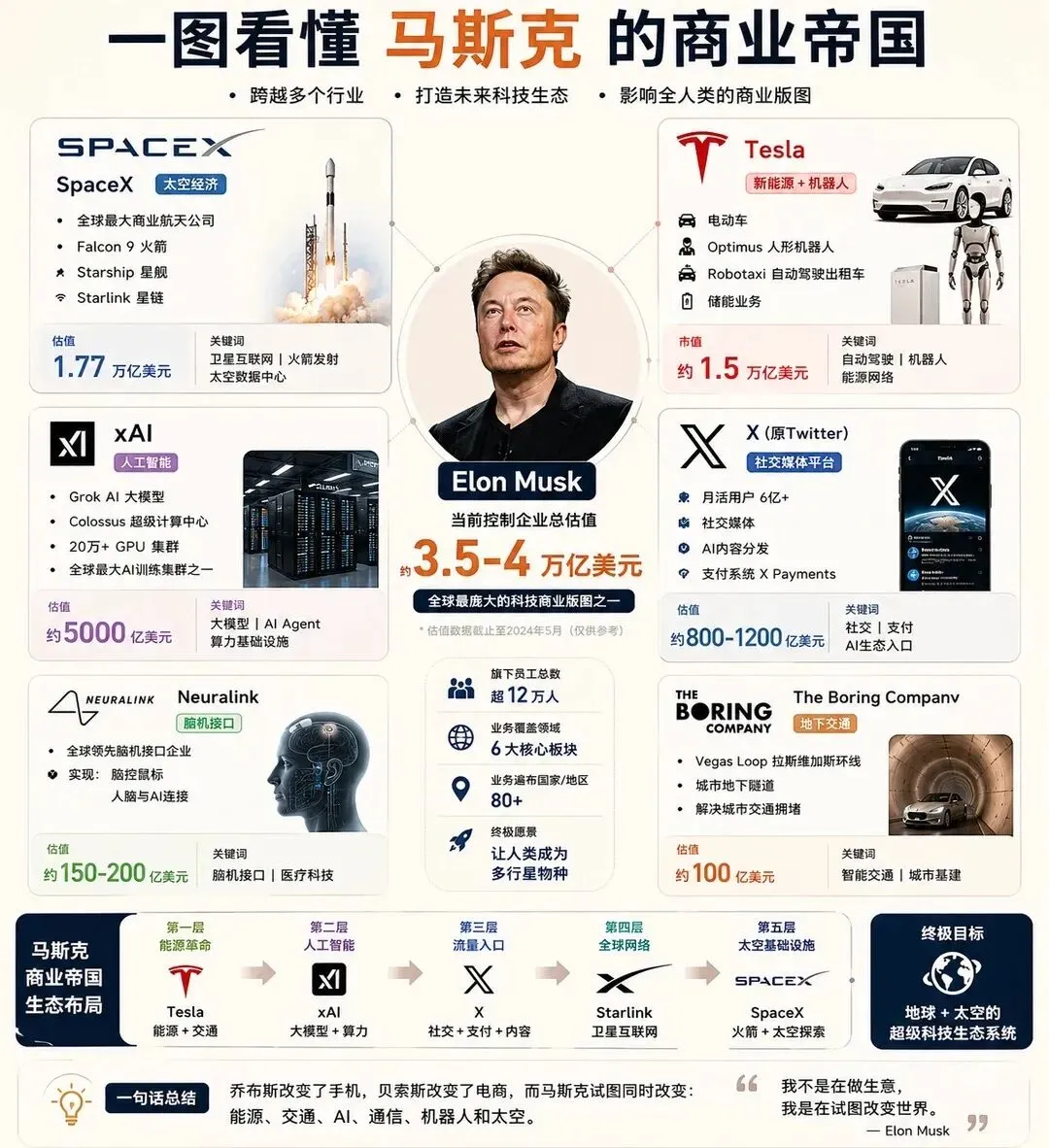 Image source: Weibo
As an entrepreneur who continuously pushes boundaries in aerospace, automotive, and AI, Musk's visionary outlook remains at the forefront of the industry. His willingness to acknowledge the rise of Chinese automakers and objectively assess their strengths reflects a rare and commendable entrepreneurial spirit. Short-term profit fluctuations and products that fall short of expectations cannot fully eclipse his industrial contributions.
This round of price reductions does not signal Tesla's decline but rather marks its new chapter as it transitions from a high-end niche player to a mass-market brand, solidifying its presence in the Chinese market. Amid the strong ascent of domestic automakers, the competition is just heating up, and Tesla remains an indispensable force in the new energy sector.
Disclaimer: This article is solely a financial commentary on major companies and does not constitute investment advice. The corporate data and regulatory events mentioned herein are sourced from publicly available information and are for reference only. The specifics should be based on official releases. Images are sourced from the internet; if there are any copyright issues, please contact us for removal.
-
![]()
Sales Plummet, Auto Industry Titans Slash Jobs! Are Gasoline Cars Doomed?
-
![]()
DeepSeek Unveils New Model: Outperforming Pro, Priced Like a Flash
-
![]()
Ultimate Showdown in Large SUV Sales for August: ES8 Takes the Crown Again, AITO M9 Comes in Second
-
![]()
August SUV Sales Rankings: Leapmotor A10 Soars to the Top!
-
![]()
Price Slashed by 35,000 Yuan? BYD Unveils New Car: Intensified Competition from September 7
-
![]()
Twists and Turns: Musk Can't Wait Any Longer, Tesla Suddenly Cuts Prices
-
The Market Still Judges Cheetah Mobile Through an Old Lens, But Its Revenue Structure Has Evolved
-
Starting at 9999 yuan! Hu Yifei, the iPhone 18 you've been waiting for is here