FAW Takes Stake in GAC, Uniting North and South Toyota
 09/15 2026
 326
326
Lead-in
Introduction
As GAC and FAW join hands, a major consolidation in China's auto industry is about to unfold.
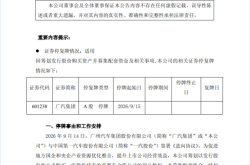
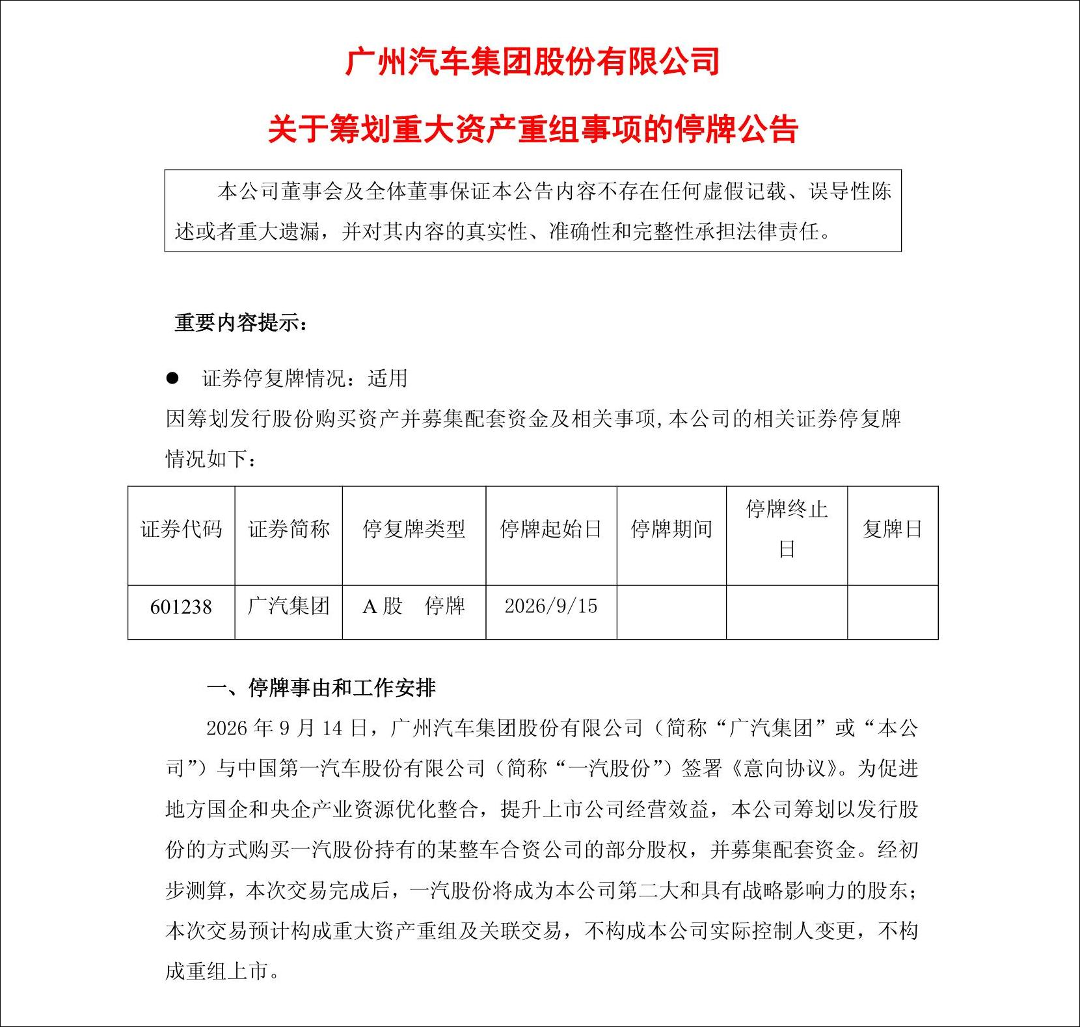
On the morning of September 14, GAC Group's A-shares were suspended, while its Hong Kong-listed shares opened 8.64% higher before the market.
Seizing this opportunity, speculation arose that FAW might form a de facto joint venture with GAC through asset transfers and equity stakes, potentially sending management to GAC. However, GAC's after-market announcement clarified: It signed a Letter of Intent with China FAW Group Co., Ltd., planning to acquire a portion of equity in a vehicle joint venture held by FAW Group through share issuance and raise matching (supporting) funds...
Does this information mean to stop outside speculation, or is the reality different from what everyone thinks?
Clearly, given the current market conditions and the operational status of GAC and FAW, regardless of official responses, mutual resource benefits are evident. As China's auto industry struggles with intense internal competition, FAW and GAC—as absolute leaders in the automotive sector—aim to avoid passively drifting in this fierce battle.
Survival is not the ultimate goal for central and state-owned enterprises. As Chinese auto groups like Geely, BYD, and Chery point the way forward for the domestic industry while spreading China's influence globally, which auto group can afford to stand aside?
The rise of Chinese automobiles demands a collective, fierce spirit akin to warriors, not isolated moments of individual glory.
So, has GAC recognized its issues over the past two years?
If one only looks at the 8.7 billion yuan loss in 2025 and the 4.4 billion yuan loss in the first half of 2026, GAC might seem beleaguered today.
But if you examine the rise of Aion and Trumpchi, the history of their joint ventures, and their determination to restart cooperation with Huawei, you'll understand that GAC—a group that once earned billions in profits and sold over 2 million vehicles annually—is not incapable but underestimated the difficulty of "turning around an elephant."
Around the 2025 Spring Festival, whispers began circulating in the industry about "GAC and FAW integrating" and "FAW leadership heading south." However, due to the sudden emergence of too much uncertainty, related discussions were suppressed.
Now, based on GAC Group's announcement, if it truly brings FAW Toyota under its wing, the combined power of North and South Toyota could be significant. Leveraging Toyota's strategic resolve and forward-looking Layout (layout) in China, GAC will undoubtedly be the beneficiary.
01 GAC Anticipates Reform, Even More So, Rebirth
How has GAC fared these past two years? The outside world has a strong sense of this. Not only because the rise of the new energy vehicle (NEV) industry has created new cracks in China's auto market, with disruptors shattering the old order, but also because GAC's existing systems have made it inefficient in the industrial tide, with pain spreading throughout the organization. All these changes are imposing new demands on GAC.
In July 2022, Stellantis and GAC Group announced the termination of their joint venture, GAC Fiat Chrysler, and the orderly cessation of Jeep's localization efforts;
In October 2023, GAC Mitsubishi officially halted production and restructured, followed by industrial and commercial changes, with the Japanese shareholder exiting, marking Mitsubishi's complete withdrawal from the Chinese market;
In January 2024, GAC Hino completed its equity adjustment, and the following year, the company's name was officially changed from "GAC Hino Motors Co., Ltd." to "GAC Lingcheng New Energy Commercial Vehicle Co., Ltd.";
Over the years, affected by market changes, several joint ventures under GAC have Rush (hastily) come and gone. Does this mean GAC encountered bottlenecks in its operations early on?
Around 2020, GAC Aion emerged, competing in both B-end and C-end markets, once leading people to believe that "GAC is the most impressive state-owned enterprise in terms of transformation." This sentiment made everyone think that, regardless of how the joint venture business contracted, GAC always had a backup plan.
Facing an unfamiliar NEV market, GAC Aion's total sales were 120,000 units in 2021, reached 270,000 units in 2022, and by 2023, this figure soared to 480,000 units, far surpassing all large enterprises with a "national" background.
More profoundly, GAC Aion began considering going public, seeking external capital favor, while GAC Group demonstrated to the entire industry how thoroughly it understood NEV development and how this understanding filled the development void left by stalled subsidiaries.
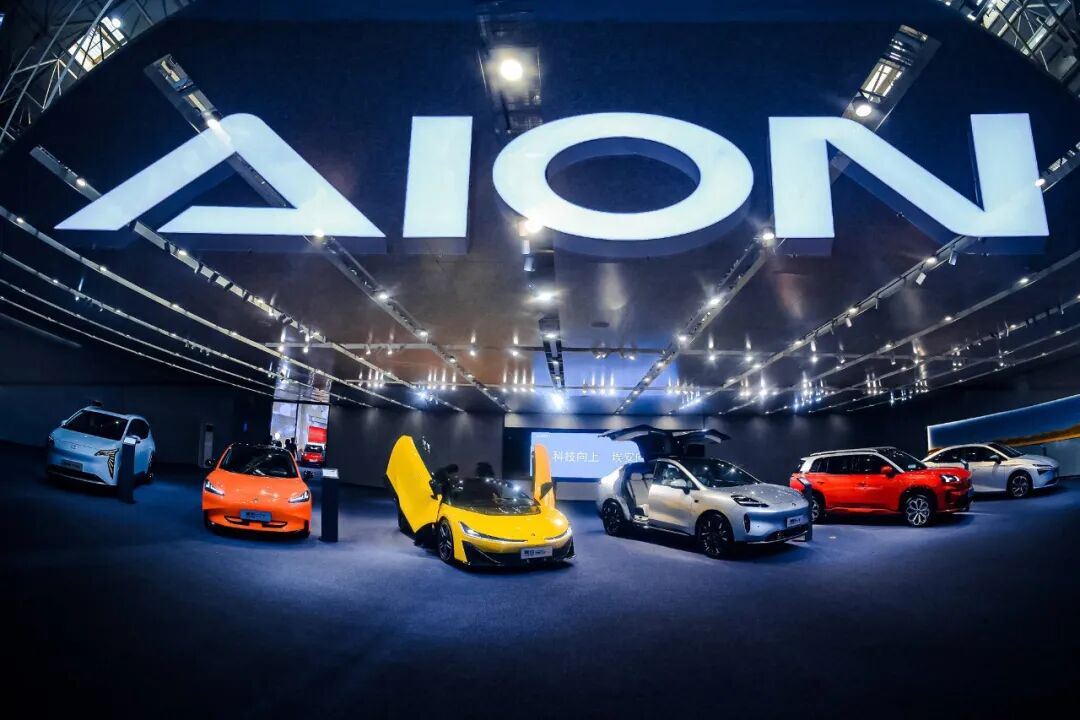
Countless times, GAC has hoped that, starting with Aion, this veteran South China automaker could outpace market changes. However, as GAC followed the pace of industrial transformation, it failed to anticipate that the demands and perceptions of new-generation Chinese consumers were far from "traditional." Simultaneously, capital markets' attitude toward NEV companies shifted abruptly.
When Aion no longer pursued going public and joint venture businesses ceased being profit cows, in November 2024, newly appointed Chairman Feng Xingya led the group's top management to decide to move the headquarters' focus from Zhujiang New Town to Panyu, launching the "Panyu Initiative."
This wasn't just an office relocation; it transformed the group headquarters from a "bureaucracy managing investments, cadres, and budgets" into a "combat headquarters managing users, products, and pacing."
GAC is determined to start anew.
Subsequently, the group introduced IPD and DSTE, reducing new vehicle development time from 26 months to 18-21 months; in December 2025, Hyper and Aion merged into "Hyper Aion BU"; in January 2026, Trumpchi BU became independent; the Qijing, developed in collaboration with Huawei's Qiankun, immediately launched new models to fill GAC's gap in the high-end intelligent vehicle market;
Technologically, all-solid-state batteries, magazine batteries, Xingyuan range extenders, L3 testing licenses, OnTime Robotaxi, GOVY flying cars, and Huilun robots—GAC laid out its "future" on the table.
Thus, GAC's revenue was 96.5 billion yuan in 2025, with an 8.7 billion yuan loss; in the first half of 2026, revenue was 46.5 billion yuan, with a 4.4 billion yuan loss, but sales of self-owned brands rose 35.69% year-on-year. This paints the true state of GAC: unprecedented transformation intensity and organizational restructuring, but also unprecedented profit pain.
At this moment, FAW arrived. Signing the Letter of Intent, with the intention of releasing joint venture equity to GAC, its purpose is self-evident.
Of course, despite being geographically, culturally, and industrially distinct, FAW also faces its own trouble (troubles) in this era.
Besides FAW Jiefang, compared to SAIC Volkswagen, FAW-Volkswagen faces significant pressure; FAW Toyota competes with GAC Toyota using the same product lineup; the NEV segment lacks an "Aion-level" national pure electric asset; balancing resources between Hongqi and Besturn is challenging;
Thus, to the outside world, this integration seems more like a mutually beneficial resource exchange, meeting each party's needs, rather than a story of one saving the other.
02 North and South Toyota: The Integration Curtain Rises
Based on earlier thoughts, if integration truly materializes, an interesting dual-core structure could emerge within GAC: Regardless of how sub-segments merge, logically, the Panyu headquarters would manage products, users, intelligence, and overseas markets; Changchun/group-level management would handle strategic resources, central enterprise coordination, commercial vehicles, and high-end brand matrices.
However, based on the current information from GAC Group, the scope defined by the joint venture agreement is not yet that vast.
With FAW entering as a major shareholder of GAC, GAC transforms from a "local leader" to a "national team southern base."
Once GAC issues additional A-shares to exchange for a portion of equity in the vehicle joint venture held by FAW, it is highly likely that this joint venture is FAW Toyota, as speculated at the beginning of the article. The final pattern (structure) will be the unification of North and South Toyota, officially presenting a complete form to compete with Chinese enterprises during this period of intense pressure on joint ventures.
The seismic impact of this resource integration will undoubtedly be unprecedented. Whether this marks the beginning of consolidation among Chinese automakers might also become clearer. As for the combined governance of North and South Toyota, its offensive capabilities are even more evident.
GAC's most valuable asset at present might still be GAC Toyota.
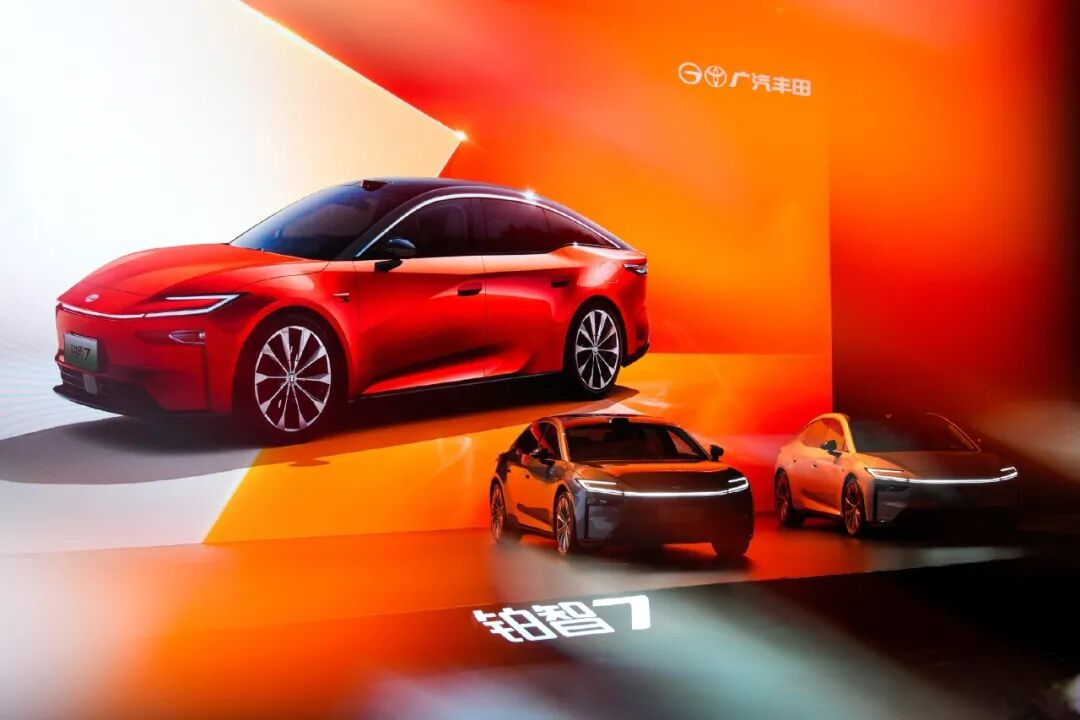
In 2025, GAC Toyota's cumulative sales reached 756,000 units, holding steady amid the decline of Japanese brands. Now, if North and South Toyota further collaborate in China, with complementary R&D and procurement and the consolidation of twin models, Toyota would no longer worry about allocating Chinese-exclusive vehicles, intelligent cockpits, or plug-in hybrid/range extender platforms. Even if joint ventures are no longer GAC's lifeblood, with Toyota's support, North and South Toyota will undoubtedly become the group's cash cow.
Sources indicate that the general manager and deputy general manager of GAC Toyota will be reselected or appointed.
Regardless of the truth of this information, Toyota's development trajectory in China is the top priority under this agreement.
To be honest, since joint ventures were individually hurt by changes in China's auto market 3-5 years ago, collaboration between North and South Toyota has suffered.
Operating independently requires them to compete fiercely in the same market segment. From the outside, GAC Toyota often believes that FAW Toyota's market judgment is inadequate, leading to price wars instead of a unified front against external competitors, given similar product strengths.
Under these circumstances, it's no wonder GAC is willing to exchange FAW becoming its shareholder for equity in FAW Toyota. With bound interests, FAW will not encourage hostility between North and South Toyota, while GAC, after acquiring FAW Toyota's equity, will gain greater influence, ensuring Toyota's future moves in China are not swayed by external forces.
Unsurprisingly, as Chinese automakers increasingly aggressively reclaim China's auto market, Volkswagen and Toyota will remain the only foreign automakers with remaining strength. Volkswagen now has three joint ventures in China, with imbalanced resource allocation. From Toyota's perspective, it does not want to be distracted by such issues.
"North and South Toyota should have merged long ago!"
This has been a consistent viewpoint from the outside world. Today, if the agreement becomes reality, this matter will truly be settled. Under the leadership of a new sales company, sister models under both sides would retain only global models, with dealer channels fully interconnected, allowing the sale and maintenance of all Toyota models.
At that point, for GAC, FAW's entry as the group's second-largest shareholder is not about resource plundering or outsiders dictating terms. Instead, it represents an epic reinforcement on the foundation of the "Panyu Initiative."
The best outcome of their organic integration would truly combine "the North's understanding of brands, its strength in the commercial vehicle market, the South's forward-looking industrial Layout (layout), its achievements in NEV development, the endorsement of central enterprises, and the flexibility of local state-owned enterprises."
This mutually beneficial resource exchange and collaboration will not be easy, especially in today's context, with too many onlookers hoping for the failure of joint ventures.
However, whether it's GAC or FAW, their joined hands resemble a depth charge thrown into the market. Even if the room for improvement is limited and North and South Toyota need more time to sort things out after merging, it could still alter the current ruthless industrial structure.
Editor-in-Chief: Li Sijia Editor: He Zengrong

THE END
-
![]()
Trading Suspended! GAC Group Launches Significant Restructuring
-
Cloud Computing in the Sky: Satellites Evolve from Eyes to Brains
-
Cloud Computing in the Sky: When Satellites Evolve from Observers to Processors
-
![]()
Is There a Future for Fuel Vehicles?
-
![]()
What is Insta360 Betting on with One-Fifth of Revenue Invested in R&D?
-
![]()
Find Ways to Make Agents Spend Money
-
![]()
Explosion in AI Inference: Can 'Unfortunate' SanDisk Achieve a Phoenix-like Rebirth?
-
![]()
Over 30 Car Brands Cut Prices in September, Yet Consumers Remain Unconvinced