Misconceptions and Misjudgments Surrounding Huawei
 09/23 2026
 406
406
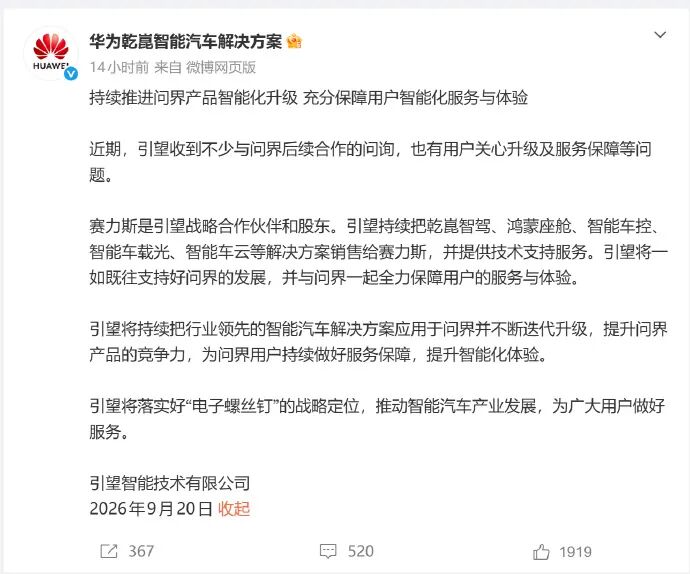
The separation between Huawei and AITO has ignited widespread debate. Numerous voices claim, "The world has endured Huawei's dominance for far too long." But is this assertion truly valid? As the inaugural automotive partner of Huawei, it would be inaccurate to suggest that Huawei initially "singled out" Seres. By differentiating its cooperation model with AITO from those with the other four brands and relinquishing its controlling stake, Huawei has inadvertently fueled a plethora of speculations and doubts from the external observers.
However, rather than framing Huawei's actions as "targeting" Seres, it is more apt to describe them as Huawei "weaning" Seres, with Seres actively participating in this "weaning process."
Through its collaboration with Seres, Huawei has unequivocally demonstrated its prowess. Not only AITO but also ZHIJIE and XIANGJIE have achieved remarkable success under Huawei's guidance. Without Huawei's involvement, these brands would unlikely have attained their current levels of popularity, prestige, and scale.
Yet, Huawei is but one entity, and even with extraordinary capabilities, it cannot single-handedly manage every aspect. Envision a scenario where, following AITO, Huawei is still responsible for overseeing all facets of four additional brands—'product definition, design, brand marketing, channel retailing, and service systems.' Can Huawei guarantee the triumph of every vehicle model? Even Huawei itself might acknowledge the improbability of such a feat.
After AITO regains its autonomy, Seres remains a shareholder in Yinwang. Consequently, in terms of intelligent driving and intelligent cockpits, it continues to be an integral part of the "Huawei ecosystem," with its core identity intact.
Is it truly justifiable to delegate tasks such as 'product definition, design, brand marketing, channel retailing, and service systems'—tasks traditionally within the purview of automotive companies—to Huawei? In reality, it is not, yet there exists a tacit agreement allowing Huawei to undertake these responsibilities.
Fortunately, Huawei possesses the capability to manage these tasks, at least to a significant extent. Whether it can handle everything comprehensively remains contingent on human effort. Yu Chengdong has already accomplished so much—what more could one reasonably expect? While someone might potentially surpass his achievements, such individuals are exceedingly rare, if not nonexistent. That is the current reality.
By disengaging from Seres, Huawei gains the opportunity to concentrate on other ventures. It is anticipated that for subsequent brands—XIANGJIE, ZHIJIE (mentioned twice, likely a typographical error, assuming one instance should be another brand), and SHANGJIE—Huawei will similarly establish benchmarks and then withdraw once a solid foundation is laid. There is little merit in remaining entangled; this is not Huawei's intended role, and in the long run, these tasks inherently belong to the automotive companies themselves.
Huawei should direct its focus towards automotive intelligence, intelligent driving, and intelligent cockpits. If Huawei insists on maintaining indefinite control over these brands, one could argue that it would be more prudent for Huawei to directly enter the automotive manufacturing sector and create a new brand, such as Huawei or Yinwang. There is no necessity for a multitude of brands that would ultimately compete against each other. From a corporate strategy standpoint, having a single brand is far more rational than managing five.
Thus, the current situation lacks logical coherence. Now that AITO has taken the initiative to "wean itself," it has essentially matured and can stand independently. Its future success will hinge on its own capabilities. Further reliance on Huawei is neither necessary nor feasible. The same principle applies to the other four brands—once they establish their footing, "weaning" becomes inevitable.
What Huawei needs to do is empower the entire industry through intelligence, intelligent cockpits, and intelligent driving, rather than confining itself to the five brands and two realms. These five brands and two realms merely serve as examples Huawei has set to showcase its capabilities to the industry. If Huawei were to disregard industry realities, it could create its own automotive brand that would be no less successful. However, Huawei has chosen a different path, refraining from encroaching on others' territories—that is visionary. Indeed, in this industry, there have been numerous instances, particularly reckless ones, of players overstepping their bounds. Some have acted with blatant disregard for ethics. It's a complex narrative. Previous readings include: "AITO Weans Off: China's Automotive Industry Enters the Post-Huawei Era," "The Launch of Li Auto i9: Do i8 Owners Feel Betrayed?", "The Galaxy TT, Starting at 129,900 Yuan: Will It Be Galaxy's Next 'Star Wish'?", "Aviation Fly-by-Wire Technology in Cars: Zhiji Says: Without Innovation, Consumers Won't Recognize You," and again, "AITO Weans Off: China's Automotive Industry Enters the Post-Huawei Era."
-
![]()
26 New Models Launch in 'Golden September', Automotive Market Hits Late-Month High
-
![]()
JAC Motors Hits Price Ceiling, Leverages Huawei to Step into the 'Post-Seres' Era
-
AI Sparks a New Era of Efficiency Revolution
-
![]()
'Token Loans' See Intensive Rollout, Banks' Credit Anchors Quietly Shift
-
![]()
Is Seres Parting Ways with Huawei? Seres Chairman Rarely Responds! Yet, Other Sectors Are Also Forging Their Own Paths
-
![]()
Misconceptions and Misjudgments Surrounding Huawei
-
![]()
Zuckerberg of ALL IN AI Can Finally Breathe a Sigh of Relief
-
![]()
China’s Automotive Aftermarket Embraces New Policies to Unlock Growth Potential