NIO Leads with RMB 20 Billion Investment, Geely Joins as Shareholder for the First Time
 09/29 2026
 506
506
NIO's battery swap network already has a vast and impressive reach.
From the end of 2023 onwards, automakers including Changan, Geely, JAC, Chery, GAC Group, and FAW have successively entered into battery swap cooperation agreements with NIO. These agreements encompass battery standards, network openness, and vehicle model development. The one constant throughout has been that these battery swap stations are predominantly funded and constructed by NIO, with NIO retaining asset and operational responsibilities.
On September 28, a significant shift occurred in this partnership dynamic for the first time.
Geely Holding invested 100% of the equity in its subsidiary YiYi Interconnect, along with RMB 640 million in cash, into NIO Power. Post-transaction, Geely will hold a 30% stake, while NIO China will maintain a 63.6% stake. Concurrently, NIO will acquire a 10% stake in Geely's subsidiary Haohan Energy, with NIO Power's post-investment valuation reaching approximately RMB 16 billion.

Previously, their cooperation had a somewhat "borrowing" aspect—Geely's vehicles would utilize NIO's stations for battery swaps, but the network remained under NIO's ownership.
This time, Geely has become a co-builder of the network.
And this network has already been extensively developed. As of September 28, NIO had established a cumulative total of 4,126 battery swap stations, facilitating over 125 million battery swaps. Among them, 1,062 highway battery swap stations connect nine vertical and eleven horizontal major urban agglomerations, spanning over 550 cities. According to the plan, this network will expand to 10,000 stations by 2030.
NIO has invested over RMB 20 billion in its charging and battery swap infrastructure. The longstanding debate over battery swaps stems from a simple fact: once stations are built, costs for land, power access, equipment, spare batteries, and operation and maintenance are incurred. Whether 20 or 100 swaps occur per day, most fixed costs do not decrease proportionally with traffic volume.
NIO Power's management previously provided a benchmark: a battery swap station reaches approximate break-even when it averages 50 to 60 daily swaps. This figure, derived from earlier generations of stations, is no longer strictly applicable today, but the underlying business logic remains unchanged.
For stations to be profitable, vehicles must frequent them.
Therefore, NIO has been progressively opening its battery swap network to external partners in recent years. In November 2023, Changan was the first to sign an agreement, followed by several other automakers. NIO's charging network opened even earlier, with other brands contributing a significant proportion of charging services over the long term.
This openness is genuine—a substantial portion of the electricity consumed by charging piles is used by brands other than NIO. However, ownership of the battery swap network has remained firmly with NIO.
The stalemate is not difficult to understand.
Battery swapping for vehicles is not akin to carrying an extra adapter cable for a phone. Battery pack dimensions, locking mechanisms, high-voltage connections, chassis structure, and software communication all need to be considered during the product development stage. For large automakers, this entails adjusting product platforms and supply chains. If the network they rely on is still controlled by another company, they will naturally approach their investments with caution.
NIO also has its own reservations. Its thousands of battery swap stations represent assets built with years of substantial investment and cannot easily relinquish equity or operational rights due to a single cooperation agreement. Thus, a delicate situation has emerged in recent years: while more names have joined the battery swap alliance, the number of external brand models massively using the same network has not grown at the same pace.
This time, Geely took a significant leap forward.
The YiYi Interconnect it introduced is already a substantial battery swap business. As of June 2025, YiYi Interconnect operates in 44 cities with 436 battery swap stations, having sold over 100,000 battery swap vehicles and completing over 45,000 daily swaps. Most of these vehicles come from operational markets such as taxis and ride-hailing services.
Operational vehicles are ideal customers for battery swaps. Taxis and ride-hailing vehicles operate long hours daily, and recharging time directly affects the number of orders drivers can accept. Reducing downtime by half an hour is not just an improvement in experience but in operational efficiency.
As of the end of June this year, Cao Cao Mobility operates over 42,000 custom vehicles, all utilizing battery swaps. Geely also stated that Cao Cao Mobility will fully adopt battery swaps, with its in-development native Robotaxi also set to use a battery swap solution, aiming for mass production in 2027.
NIO possesses a nationwide station network, while Geely brings high-frequency operational vehicles, its own battery swap assets, and the potential to introduce more vehicles in the future.
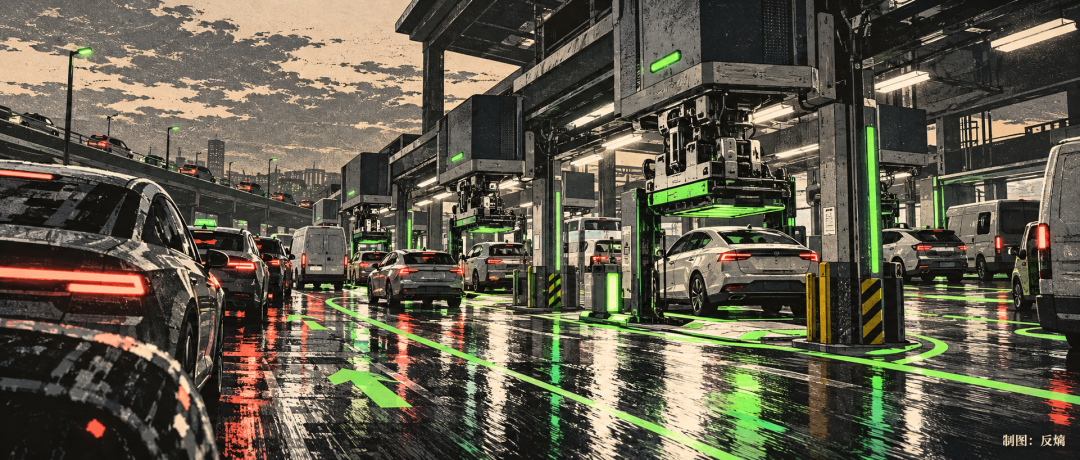
Both sides obtain what they need, satisfying their respective thirsts.
More importantly, Geely did not just remain at the agreement level but placed YiYi Interconnect and cash into NIO Power, transitioning from a partner to a shareholder.
In the past, whether Geely's models joined NIO's battery swap system mainly influenced the pace of their cooperation. Now, the utilization rate of battery swap stations, network operational efficiency, and the asset value of NIO Power directly impact the quality of Geely's 30% stake.
The transaction terms are also pragmatic. Geely's shareholding is tied to subsequent operational milestones. If some targets are not met, its shareholding may be adjusted downward but will not fall below 20%. On the other hand, Geely retains the right to invest an additional RMB 640 million to further increase its shareholding.
This provides room for both retreat and advancement.
However, one Geely cannot solve all the problems.
NIO plans to have 10,000 battery swap stations by 2030, requiring nearly 6,000 more stations to be added from the current 4,126. A larger network demands even greater vehicle traffic. Geely adds an important vehicle entry point to this network but does not eliminate the utilization rate issue.
The bigger question remains on the consumer (C-end) side.
Both sides have made it clear that they will jointly develop unified C-end battery swap technologies and standards, and Geely will also develop battery swap models for ordinary consumers. However, there are currently no answers regarding when these vehicles will be launched, which brands they will fall under, or how many units will be sold. If the system primarily serves NIO's own vehicles in the future, having an additional shareholder will not automatically fill the stations.
Meanwhile, CATL is also building its own battery swap network. As of the end of June this year, CATL's Chocolate Swap has established approximately 2,000 battery swap stations covering 180 cities. More intriguingly, CATL and NIO are not simply competitors; in March 2025, they announced cooperation in battery swap networks, standards, and battery assets.
Thus, the future battery swap market is unlikely to be divided into distinct camps. Competition and cooperation are likely to coexist long-term among automakers, battery manufacturers, mobility platforms, and energy replenishment operators.
The dynamics of the energy replenishment sector are far from settled.

But Geely's investment at least clarifies one question.
In recent years, when discussing battery swaps, the most common debate has been whether three-minute battery swaps or ultra-fast charging is more advanced. Today, this debate matters less. NIO has proven that battery swap stations can be built at scale and that users are willing to use them. The harder question is the next step: can this network evolve from a service system for one automaker into a shared infrastructure used and jointly invested in by multiple automakers?
The development of railways in the nineteenth century went through a similar phase. Building lines was just the first step. Only after track gauges were unified, lines connected, and trains could operate across networks did individual railways truly become part of a network.
Battery swaps face a similar issue today. The number of stations matters, but if vehicles, standards, and interest relations cannot truly align, even the densest station network can only serve a limited user base.
NIO has already built over 4,000 stations, and Geely now sits at the shareholder table for the first time as a major OEM group.
There is finally one more road builder. Moving forward, what matters more than adding another partner is how many vehicles actually drive into these battery swap stations each day.
What infrastructure fears most is idleness.
-
Is AI Security Becoming the Next Trillion-Dollar Market?
-
Major Overhaul in Joint Venture Automakers? GAC Toyota and FAW Toyota Officially Unite, Who’s on Deck?
-
What Strategies Should Xiaomi and Other Brands Adopt? Phone Sales Priced Below $200 Expected to Plummet by 230 Million Units, Marking a 40% Decrease
-
Per Capita Monthly Data Usage Hits 23.45G! Operators Reduced to Mere Channels for Apps Such as WeChat and Douyin
-
The Milestone of the 100,000th Vehicle: How Far Has BYD Progressed in Thailand?
-
![]()
NIO Leads with RMB 20 Billion Investment, Geely Joins as Shareholder for the First Time
-
![]()
【Electric Equipment】First National Subsidy for All-Electric Cargo Ship Received
-
![]()
Geely and NIO’s Charging and Battery Swap Networks Go Live