17.8 Million Electric Vehicles Take to Highways, National Day Charging Crunch Resurfaces
 10/08 2026
 386
386
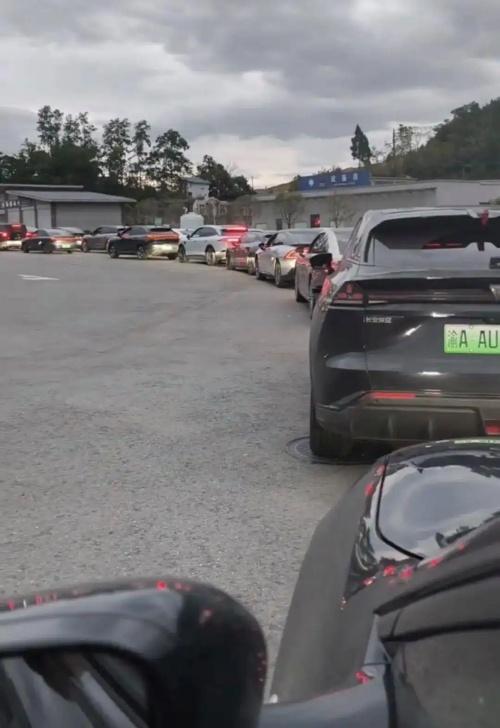
During this National Day holiday, highways served as the ultimate proving ground for new energy vehicles (NEVs).
According to the Ministry of Transport, the number of NEVs on national highways on the first day of the holiday was projected to reach 17.8 million—1.8 times the usual daily volume, accounting for roughly 25% of total highway traffic. Data from the National Energy Administration revealed that from October 1 to 3, NEVs underwent 2,968,600 charging sessions nationwide, with a total energy consumption of 71,619,300 kilowatt-hours (kWh), marking a nearly 50% year-on-year increase. On October 1 alone, charging volume soared to 28,046,900 kWh, up 60.4% year-on-year, setting a new single-day holiday record.
Behind these figures lies the very real anxiety experienced by many NEV owners at highway service areas.
Five-hour wait, ten-minute charge
The charging scene at popular highway service areas once again became a hot topic this year.
Some owners waited over five hours to charge after drawing ticket number 99 at the Lingjiang service area. At the Dazhou North service area on the G65 Baomao Expressway, an NEV with just 1% battery remaining broke down near a charging station, prompting staff and fellow owners to push it to the charger. Mr. Yang, a driver from Xi'an traveling to Shandong, waited two hours at a service area, only to face a charger malfunction after 10 minutes, forcing him to rejoin the queue. Mr. Tang, a driver from Wuhan, entered Hubei province on the 6th and waited three hours to charge—"even longer than when I set off on October 1," he remarked.
Many service areas resorted to a "restaurant-style queuing system": owners took a number and waited to be called by staff. Some introduced a rule requiring vehicles to vacate chargers after reaching 80% charge, aiming to improve turnover. However, many owners felt this exacerbated range anxiety—after hours of waiting, charging to only 80% left them uncertain about reaching their next destination.
Not a shortage of chargers, but peak demand overwhelms
Many initially attributed the issue to a lack of chargers, but the reality is more nuanced.
As of the end of September, approximately 89,000 charging facilities had been installed at highway service areas nationwide, including about 22,000 high-power chargers, achieving near-universal coverage. However, highway charging faces a critical challenge: the "tidal effect."
On weekdays, many charging stations at highway service areas sit idle, with utilization rates below 20%. During National Day and Spring Festival, traffic surges instantly, creating demand that far exceeds the designed capacity of fixed chargers. This presents an economic dilemma: expanding capacity for a few peak days each year would leave equipment underutilized for the remaining 300+ days, making the investment highly inefficient.
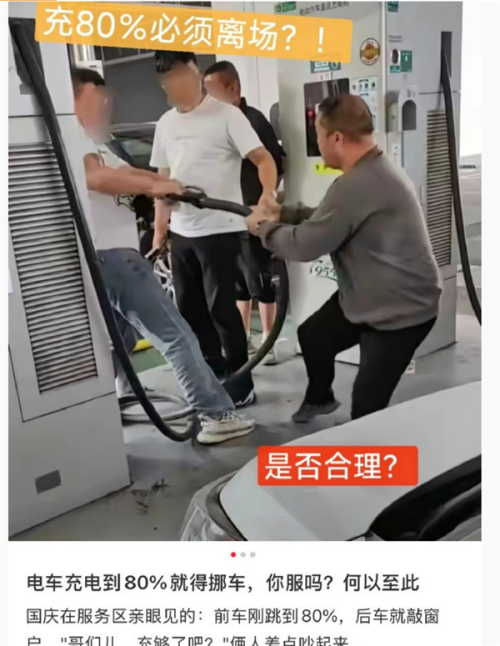
A deeper structural issue lies in the fact that, as of the end of June, China's NEV fleet had reached 48.97 million, yet the proportion of highway public chargers remains extremely low, with a vehicle-to-charger ratio of nearly 10:1 on highways. Urban owners with home chargers rarely rely on public charging, but during holidays, everyone converges on the limited public resources at highway service areas, causing a concentrated supply-demand mismatch.
Additionally, high-speed driving significantly reduces range. A model advertised with a 500-kilometer range may only travel just over 300 kilometers with air conditioning on and a full load—"70% of the stated range" has become the norm. Owners dare not wait until the battery is critically low before charging, often starting to search for chargers at 30%, further exacerbating congestion at service areas.
"Chargers chasing cars" emerges as a new solution
New approaches have emerged to tackle the tidal challenge this year.
The Ministry of Transport released a list of "especially busy service areas for charging" in advance, guiding localized deployments to help NEV owners plan trips and charging more rationally. Hunan deployed 32 mobile charging units, including emergency charging vehicles and charging robots; Hubei added 219 mobile units and 2,100 staff; Sichuan activated 154 mobile chargers at 72 busy service areas.
Charging robots are particularly noteworthy: owners enter their parking space number via a mobile app, and the robot automatically drives to the vehicle to charge, shifting from "cars seeking chargers" to "chargers chasing cars." Huan Zeping, operations director at Teld, stated that mobile charging is not a temporary fix but a standardized part of the highway charging system—operating in urban areas on weekdays and deployed to highways during holidays, forming a combined model of "fixed chargers as the foundation, mobile charging as backup, and platform-based smart diversion."
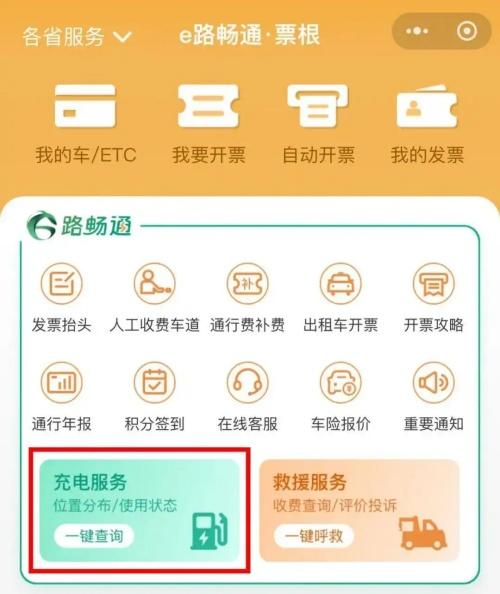
Additionally, the Ministry of Transport's "e-Road Smooth" WeChat mini-program launched simultaneously, allowing users to check charger locations and availability and call for rescue with one click.
Pure electric, extended-range, or plug-in hybrid: Which is better for long trips?
Notably, this National Day also sparked debate: Should extended-range/plug-in hybrid owners use highway service area chargers?
Some pure electric vehicle owners complained that 8 out of 10 chargers at service areas were occupied by hybrid or extended-range models, asking, "Why compete with us when you have a gasoline backup?" Extended-range owners countered that their smaller batteries charge faster, so they do not occupy chargers long, and in heavy traffic with air conditioning on, charging to only 80% would not get them to the next rest stop.
Industry practitioners offered more practical advice: extended-range/plug-in hybrid owners should primarily use gasoline on highways, leaving chargers for pure electric vehicles in genuine need; pure electric vehicle owners should plan ahead and, if facing a queue of over 10 vehicles, promptly exit the highway to charge at nearby county or commercial charging stations, which is usually much faster than waiting at service areas.
Conclusion
For the NEV industry, the collective National Day test serves as a mirror. It does not simply test the battery itself but an entire system: vehicle energy consumption algorithms, battery management systems, highway charging networks, and the charging prediction capabilities of in-car navigation. Many potential conflicts are masked in urban driving scenarios, only becoming apparent when millions of owners travel long distances simultaneously.
Annual National Day highway charging criticisms essentially reflect not the inadequacy of electric vehicles but the stress test of infrastructure under extreme conditions. The advantages of electric vehicles in urban commuting are undeniable, but their charging efficiency for long-distance travel still lags significantly behind the convenience of refueling. Of course, this does not mean electric vehicles are unsuitable for long trips. Reasonable route planning, off-peak charging, and controlling speed can effectively reduce travel anxiety.
In the short term, owners need to adjust expectations and strategies—travel off-peak, charge off the highway, and maintain range buffers. In the long term, a multi-layered charging system is taking shape, including ultra-fast charging networks, battery swap stations, mobile charging, and vehicle-to-grid (V2G) interactions. This year's peak of 17.8 million vehicles represents both a challenge and a catalyst for the rapid evolution of China's charging network. The true test will be passed when long-distance travel in an electric vehicle requires no special preparation—that will be the moment of genuine success!
-
![]()
New Energy Vehicle Sales in September 2026: BYD Leads, Leapmotor Surges Among New Forces
-
![]()
[Electric Equipment] BRETON Eyes African Mining Sectors: Venturing into Electric Mining Truck Sales
-
Anthropic is Going Public: Valued at 2 Trillion in 5 Years, Who’s Paying for the AI Bubble?
-
![]()
Going to work! Let's meet the new colleague: available 24/7, works hard for little pay, and has a great attitude.
-
![]()
Why Has NVIDIA Become the Biggest Winner in the AI Computing Power Race?
-
![]()
Day 4 of National Day: How are new energy vehicles performing for travel?
-
![]()
O-film Tech Becomes the Exclusive Supplier of Main Camera and 200MP Periscope Telephoto Lenses for Huawei Pura 90 Pro Series
-
![]()
Why is Baidu's AI large model rarely mentioned anymore?