UBS: Chinese Automakers March into Europe, Replicating Japan's Playbook from 50 Years Ago?
 10/19 2026
 539
Produced by Zhineng Technology
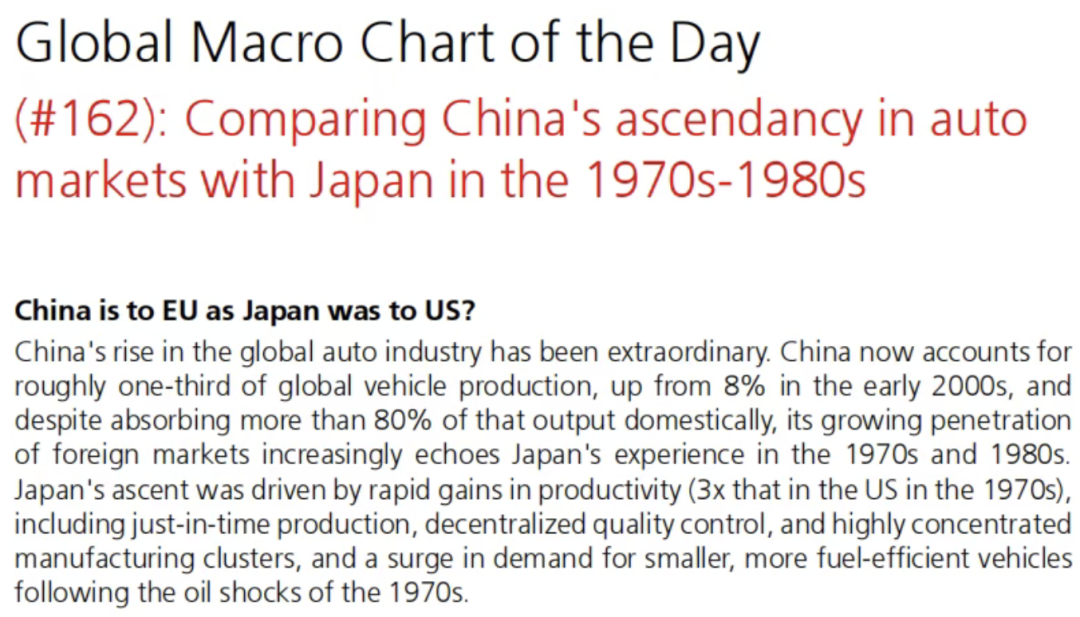
UBS has released a significant report comparing the trajectory of Chinese automakers entering Europe to that of Japanese automakers' offensive in the U.S. market during the 1970s-80s. The three curves—export share, market penetration, and trade friction—all align. Similarities dictate the pace, while differences determine the outcome.
Once manufacturing efficiency and product definition capabilities create a generational gap, market penetration becomes just a matter of time. Trade barriers can only alter the path.
01 Japan's U.S. Auto Saga: Barriers Only Alter the Path, Not the Destination
The global automotive business logic was rewritten by two oil crises in the 1970s.
While U.S. automakers were still producing large-displacement, high-fuel-consumption vehicles, Japanese automakers leveraged lean production, standardized manufacturing, and highly concentrated industrial clusters to achieve roughly triple the production efficiency of their U.S. counterparts (per UBS).
Highly concentrated industrial clusters compressed vehicle R&D and component sourcing within a very short radius, simultaneously reducing new model development cycles and manufacturing costs.
Fuel-efficient, durable, and affordable Japanese compact cars precisely addressed the pain points of ordinary households.
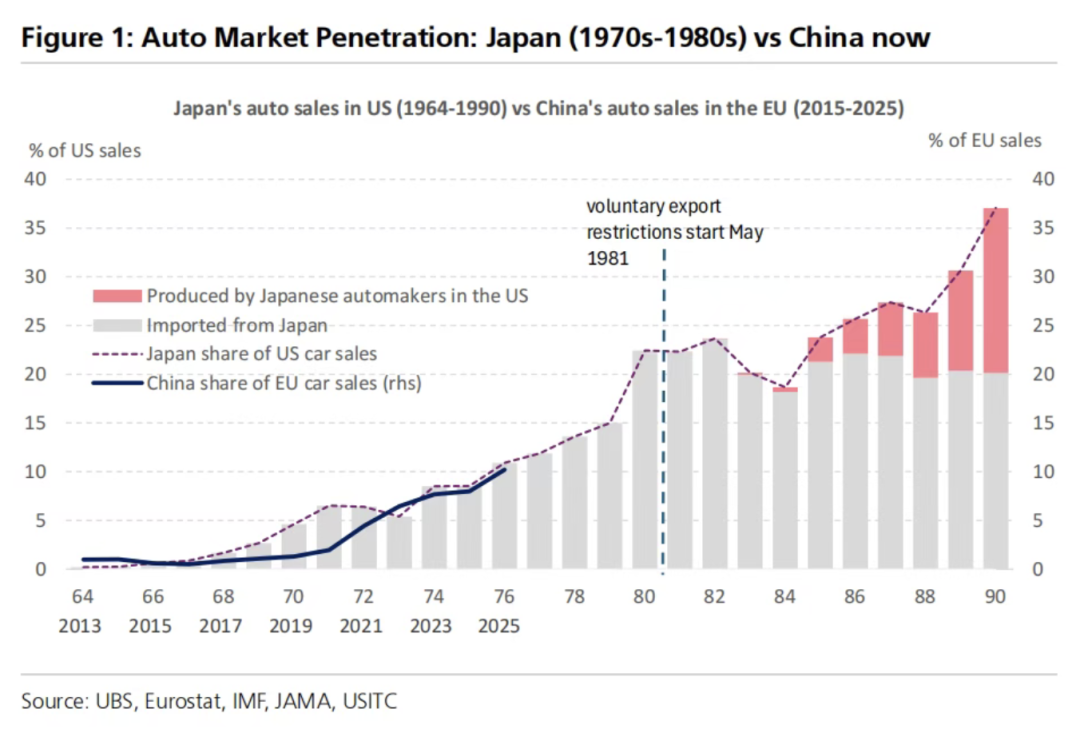
Japanese brands' share of U.S. auto imports surged from 3% in 1964 to 64% in 1980; their share of total U.S. sales jumped from 4% in 1970 to 22% in 1980.
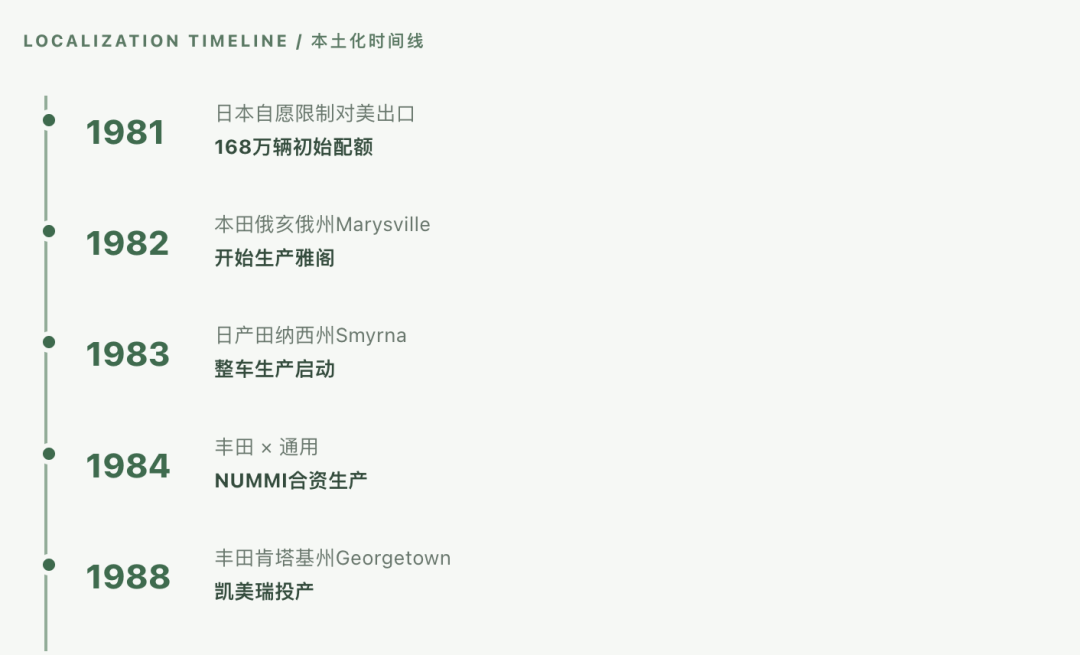
With declining U.S. domestic production and job losses, Washington took action. In 1981, the U.S. and Japan reached a Voluntary Export Restraint (VER) agreement, which UBS estimates had the practical effect of imposing a de facto 21% tariff.
Barriers failed to stop Japanese cars.
Japanese automakers responded by building plants directly in the U.S.: from 1982 to 1989, Japanese direct investment in the U.S. increased eightfold, with about half going to the automotive sector; Honda led the way in Ohio in 1982, followed by Toyota and Nissan; by 1990, Japanese cars' market share in the U.S. rose by another 15 percentage points.
The Voluntary Export Restraint ultimately achieved an ironic outcome: it transformed "Japanese cars exported to the U.S." into "Japanese cars made in the U.S."
After product capabilities created a generational gap, trade barriers could not stop penetration—they only altered the path, either forcing competitors to slow down or to build locally.
The VER failed to stop Japanese cars but pushed the U.S. Big Three to reform and unions to concede; the 1990s surge in demand for pickups and SUVs saved Detroit, and Japanese cars' U.S. share plateaued thereafter.
Barriers plus competitor learning eventually flattened the penetration curve but did not bend it. Chinese automakers in Europe now face the combination of these two factors.

China's European Auto Curve: Different Cards in Hand
◎ China's share of global automotive production has risen from about 8% in the early 21st century to roughly one-third today; while over 80% of capacity is still absorbed domestically, the pace of going global is accelerating.
◎ Chinese brands' share of EU auto imports surged from less than 3% in 2015 to about 25% in 2025; their share of total EU sales climbed from under 1% to over 10%.
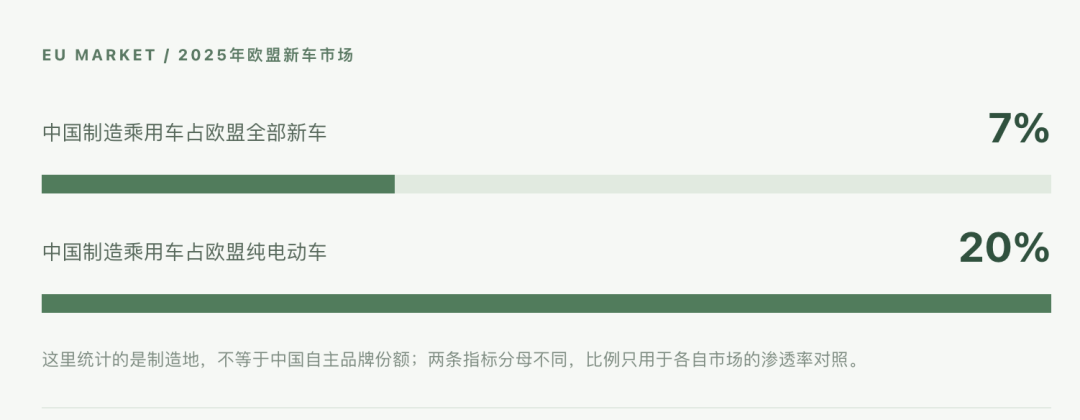
With import share at ~25% and total sales share exceeding 10%, Chinese cars still rely primarily on trade in Europe, with localized production just beginning. Japanese automakers faced a similar structure in the U.S. in the mid-1970s—and the rest is history.
Industry statistics show Chinese brands' monthly share in Europe reached ~12% in 2026, surpassing long-established Japanese brands.
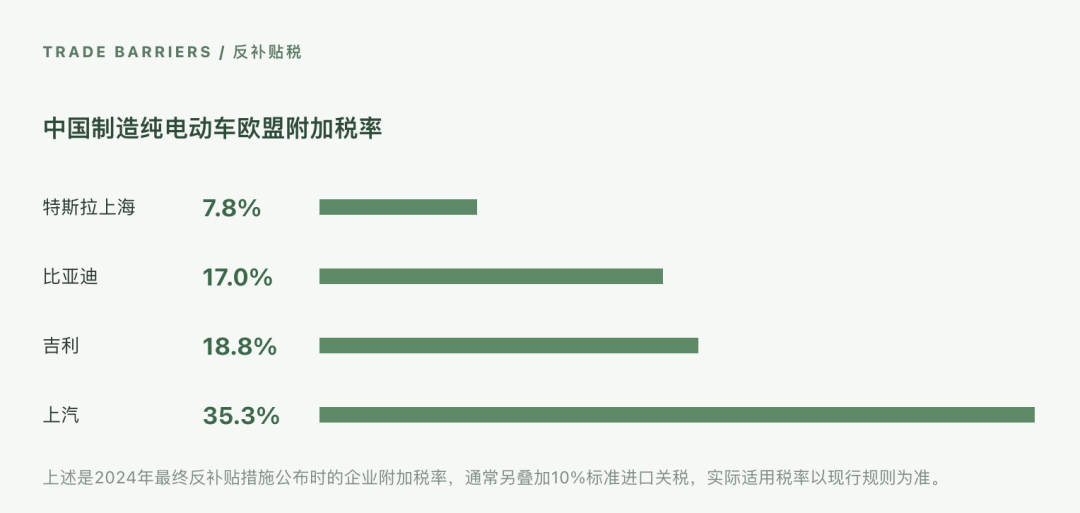
Europe has reacted faster than the U.S. did, imposing tariffs on Chinese pure electric vehicles. Chinese automakers then shifted incremental sales to internal combustion and plug-in hybrids, prompting Europe to consider tariffs on those as well.
While 1970s Japanese cars competed on manufacturing efficiency—fuel economy, durability, and affordability—Chinese automakers bring not just cost and supply chain efficiency but also intelligent experiences to Europe.
Smart cockpits, advanced driver assistance, and over-the-air updates—features that differentiate Chinese models from European peers at similar price points—are becoming new levers for market penetration.
Chinese automakers' European strategy superposition s (superimposes) manufacturing efficiency with product definition capabilities, a layer not fully explored in UBS's analogy.
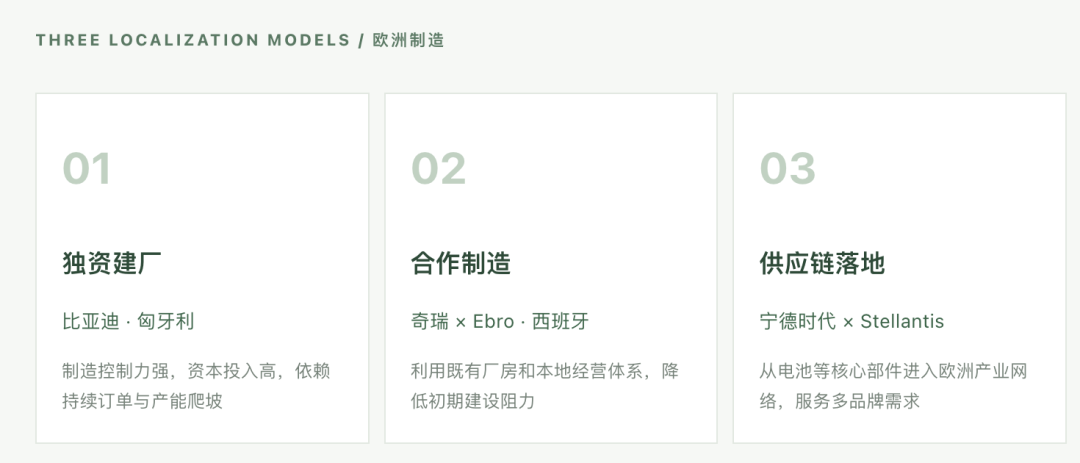
BYD is building a plant in Hungary, while multiple Chinese brands are acquiring stakes in European automakers.
◎ Localized production is becoming the essential path to bypass barriers and establish overseas roots.
◎ Meanwhile, Europe's "double game" has begun: Stellantis is partnering with Dongfeng in Europe to integrate Chinese EV technology using idle factory capacity; Volkswagen plans to cut 50,000 jobs by 2030 and reduce global production planning from 12 million to 9 million units annually.
Defending while collaborating is Europe's current posture.
The structure of Chinese automakers' global expansion also determines the stakes in Europe.
◎ The U.S. market will likely remain inaccessible until 2030,
◎ The Russian market is highly volatile,
◎ Southeast Asia, Latin America, and the Middle East compete on cost-effectiveness and channel (channel) strength,
◎ Europe is the only mainstream market offering scale, profitability, and brand endorsement value simultaneously. Whoever stabilizes here completes true globalization.
Chinese automakers' global market share will grow from under 20% in 2022 and ~25% in 2025 to over one-third by 2030; Western Europe's share is expected to rise from ~5% currently to 15%.
Chinese automakers' overseas sales will surge from 1 million to 6 million units in five years. UBS calls the next phase "Globalization Strategy 2.0," with keywords shifting from distribution to distribution networks, brand recognition, and localized manufacturing.
02 What Are the Differences?
Variable 1: Different demand-side shocks.
Japanese cars faced the oil crises—a sudden shift in purchasing logic driven by soaring oil prices, creating a window of opportunity.
Chinese EVs face Europe's self-imposed carbon neutrality timeline, where demand shifts are policy-driven and thus interruptible: tariffs come first, followed by subsidy thresholds, and "Made in Europe" local content requirements are on the way.
While Japan's window passively awaited adoption, Chinese automakers must actively defend theirs through faster localization and deeper supply chain integration.
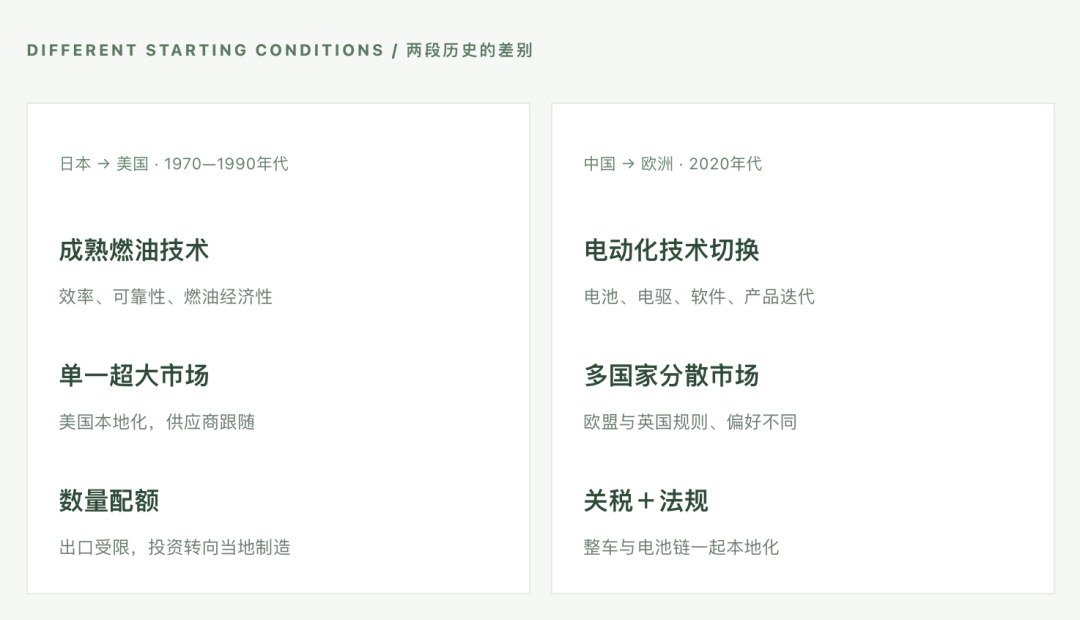
Variable 2: Different competitors.
The 1970s U.S. Big Three were slow to react, with Detroit taking nearly a decade to recognize the weight of lean production.
Today's European automakers are learning amid electrification, facing financial strain but pivoting quickly: they defend with tariffs and local content rules while integrating Chinese technology through joint ventures and partnerships.
Japan faced a sleeping giant; Chinese automakers face competitors who defend while learning.
This means Chinese automakers' European market share will face more rigorous scrutiny and faster countermeasures, likely resulting in a penetration curve with a shallower slope than Japan's.
Variable 3: Localization redefined.
Japan achieved capacity localization, producing "Japanese cars made in the U.S." while retaining Japanese branding.
Chinese automakers' localization requires clearing three hurdles:
◎ Supply chain: Localization ratios for batteries and electric drives directly determine cost and compliance headroom;
◎ Data: Europe's tightening data governance for intelligent vehicles threatens Chinese automakers' strongest selling point—intelligence;
◎ Branding: Shifting from cost-effectiveness narratives to brand narratives.
UBS's "Globalization Strategy 2.0" refers precisely to mainstream brand recognition and localized manufacturing—mere distribution no longer qualifies as strategy.
◎ European automakers are already using capital arrangements to hedge risks, exemplified by Stellantis' partnership with Dongfeng;
◎ Chinese automakers' capital penetration—equity stakes, joint ventures, technology licensing—represents different approaches to the same goal: deeper integration yields greater influence.
Summary
The law of industrial migration dictates that once a generational gap forms, penetration becomes inevitable—barriers can only alter the path. The U.S. used voluntary export restraints to grant Japanese cars a U.S. "passport"; if Europe relies solely on tariffs, it will grant Chinese cars a European "passport" instead.
-
Is Xiaomi to Blame? Porsche, the Dream Car for Chinese Consumers, Lays Off 30% of Staff and Faces Crisis!
-
![]()
Algorithmic Addiction: Meta Faces $1.4 Trillion Trial
-
![]()
Can Landspace Be China's SpaceX in Commercial Spaceflight?
-
Price Hikes Still Lingering, Price Cuts Suddenly Sweep In! The 50-Day Price Battle in the Smartphone Industry
-
![]()
Why Is Apple So Steadfast in Levying a 30% 'Apple Tax'?
-
Tech Titans Clash in AI Office Realm: Personal Agents or AI Hardware – Which Holds the Key?
-
![]()
Why build another training ground in Hong Kong when over 100 have already been established on the mainland?
-
Urban NCA as a Standard Feature: Will the 2027 Chang'an Qiyuan Q07 Tianshu Pilot Edition See a Price Drop?