A8 Made in China, Embracing Huawei: Audi's Greatest Opportunity
 10/26 2026
 547
Lead
Introduction
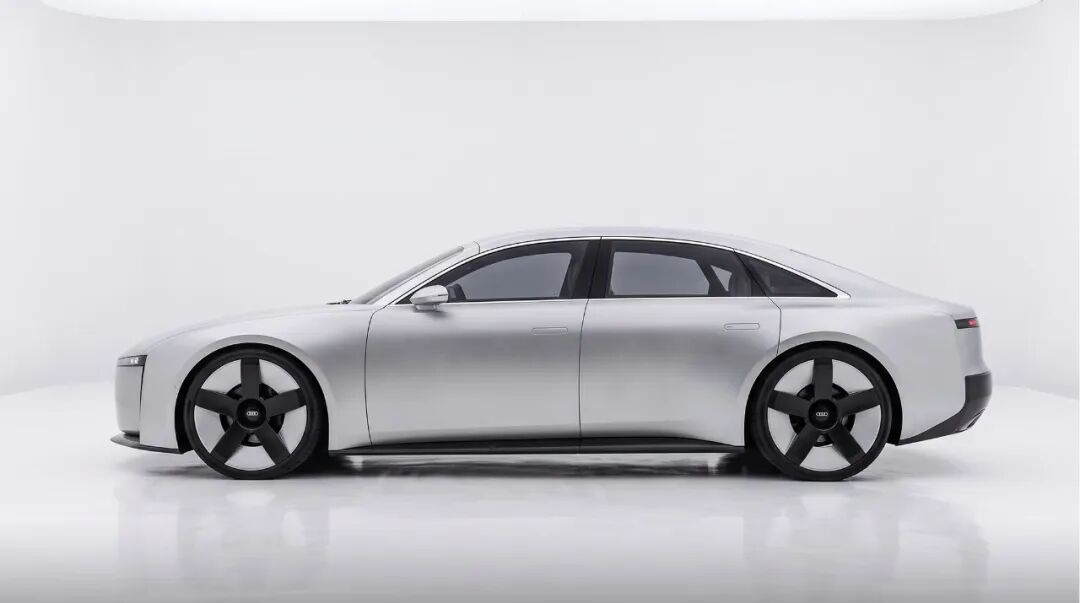
By handing over the production rights and intelligent technology R&D rights of the A8, Audi is essentially betting its flagship definition rights on China for the first time—and this represents its greatest path forward.
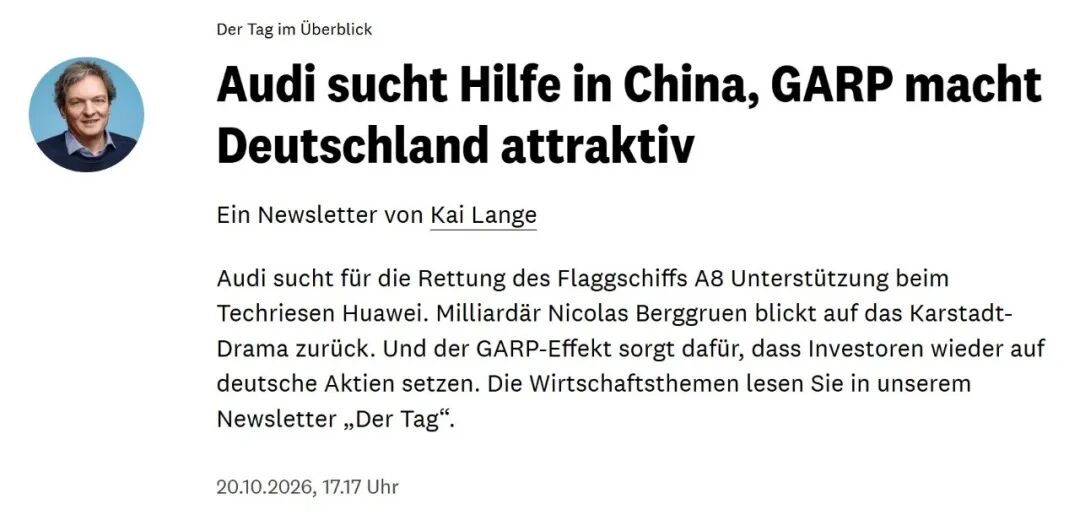
Germany's Manager Magazin recently revealed that the Audi A8 will be produced in China, with core technological development entrusted to Huawei.
The original wording was direct: “Der A8 soll nicht mehr aus einem deutschen Werk nach China exportiert, sondern in einer eigenen Variante direkt in China gebaut werden. Und zwar im Kern entwickelt vom unheimlichen Techriesen Huawei.”
In English, this means: The A8 will no longer be exported to China from German factories but will instead be built directly in China as a separate variant, with its core developed by the formidable tech giant Huawei.
The term “unheimlich (formidable)” captures the German media's mix of apprehension and reluctant acknowledgment.
There are two core pieces of information: The A8 will be made in China, adopting Huawei's core technologies. However, domestic descriptions of “using Huawei's platform” are misleading when compared to the original text. The German term “Kern entwickelt (core development)” refers to intelligent technologies, not the entire vehicle platform.
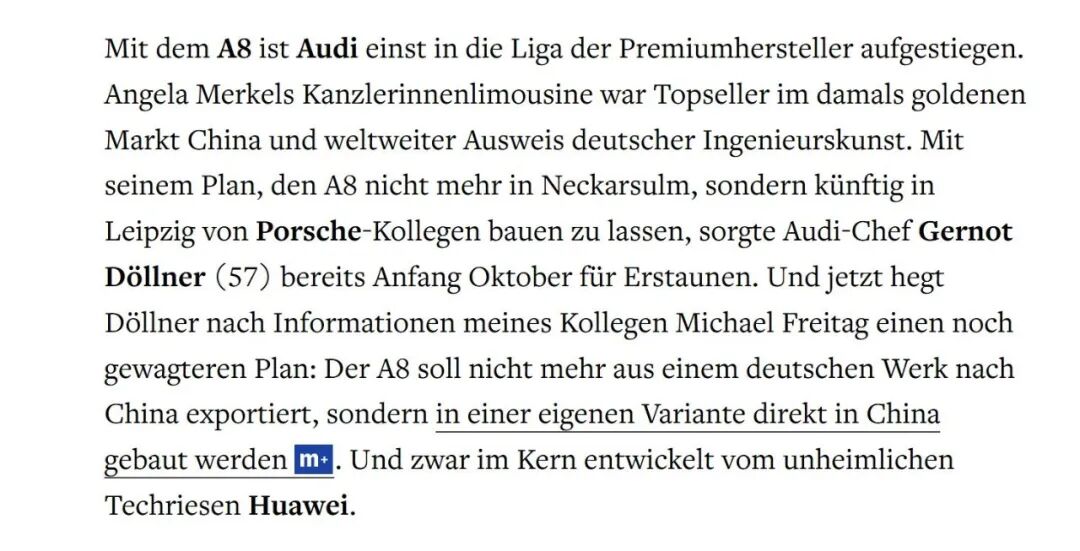
This move should not be interpreted merely as “Audi can't hold on and is turning to Huawei for help.” Viewing Gernot Döllner's recent strategic decisions as a cohesive plan reveals a Linkage Bureau (interconnected strategy): Shifting the A8's platform and factory aims to enhance sportiness, while embracing Huawei and local production seeks to improve intelligence and break through in China.
Looking further ahead, the Q9 has already debuted, providing a pivot point for Audi's new, higher-end flagship. Narrowing the gap with Mercedes-Benz and BMW becomes an actionable product reality rather than just a slogan.
However, breaking through in China and advancing in intelligence are precisely Audi's two toughest challenges right now. The judgment is clear: A8 localization and embracing Huawei represent Audi's greatest opportunity.
01 The Interconnected Strategy Behind A8 Localization and Huawei Partnership
Manager Magazin's revelation centers on two impactful points: The A8 will be produced in China, and Huawei will provide core technologies.
First, localization.
Based on FAW-VW Audi's existing setup, a product of the A8's caliber will likely be placed in Audi's flagship factory in China, potentially even matching production lines for high-displacement engines.
In terms of powertrain layout, focusing initially on fuel and plug-in hybrids is a prudent choice, but leaving room for a pure electric (BEV) option in the medium to long term makes logical sense—running parallel tracks with the PPE or subsequent SSP BEV platforms alongside the MSB fuel/plug-in hybrid versions, avoiding over-reliance on a single approach.
Now, Huawei.
The “core technologies” likely refer to HarmonyOS cockpit and Huawei's ADS intelligent driving system, supplemented by cloud technologies, Huawei Optical, and other auxiliary technologies.
This is not starting from scratch. Audi has already implemented HarmonyOS and Huawei ADS in its PPE platform models, the A6L e-tron and Q6L e-tron, with Huawei technology also available as an option for the new Q5L and A6L fuel models. The path has been tested; for the A8, the goal is to elevate integration depth and iteration speed to the next level.
However, an industry rumor merits attention: Audi's version of Huawei ADS is constrained by decision-making chains—Chinese teams submit requests, German headquarters approves them, leading to back-and-forth delays. The final version of Audi's ADS lags behind what runs on local brands' vehicles by generations.
Rumors suggest that at one point last year, Audi was still using ADS 2.0, while local brands had already rolled out ADS 4.1 across their lineups.
If accurate, this gap is manageable for models like the A6L and Q6L but fatal for the A8.
A flagship sedan falling two to three versions behind in intelligent driving is tantamount to surrendering on a dimension users interact with daily. Producing the A8 in China and shifting R&D decision-making there is the most direct solution to this problem.
The speed of version iteration depends on proximity to users and decision-making centers. Having German headquarters interpret China's fierce intelligent driving competition across seven time zones and a cultural divide is unrealistic.
If A8 localization brings Huawei's integration depth and iteration rhythm, the car's intelligent foundation will be fundamentally different from Audi's current offerings.
Revisiting Döllner's factory relocation decision clarifies the strategy further. The next-gen A8 will shift to the MSB61W longitudinal premium platform, shared with the Panamera, supporting 48V mild hybrids and plug-in hybrids. Designed from the outset as a multi-powertrain architecture, it is not BEV-exclusive.
The next-gen Panamera, code-named G4, will focus on fuel and plug-in hybrids, skipping BEV—a route the new A8 will likely follow as a platform sibling.
Leipzig currently co-produces the Panamera and Macan, demonstrating flexible capability to handle fuel, hybrid, and BEV powertrains on the same line. Hardware flexibility allows initial focus on fuel/hybrid A8 variants, with a BEV A8 to follow once a refreshed BEV platform matures—running two parallel tracks.
Thus, the revelation is not fragmented. Localization, Huawei, platform shifts, and factory relocations are four facets of a single strategy. Audi is planning not a minor tweak but a ground-up rebuild, from skeleton to nervous system.
02 Döllner's Challenge: Catching Up to Mercedes-Benz and BMW
The numbers must be crunched first.
In 2025, BMW sold 2.4637 million units globally (+0.5%), Mercedes 2.16 million (-10%), and Audi 1.6236 million (-2.9%), declining for two consecutive years.
In China, Audi sold 617,500 units, BMW 625,500, and Mercedes 575,000. Audi ranks second among BBA but has seen three straight years of negative growth in its home market.
FAW-Audi reclaimed the top spot in fuel luxury sales with 570,100 units after six years, showing warming up (recovery) in its fuel base, but this masks overall contraction.
The financial gap is starker. Audi's 2025 revenue was €65.5 billion, with an operating profit of €3.371 billion (-13.6%) and a profit margin of 5.1%. BMW's revenue was €133.453 billion, with a net profit of €7.451 billion; Mercedes' revenue was €132.214 billion, with profit halved.
Audi's revenue is less than half of BMW's, with an even larger profit gap. Funding flagship product updates, localization, and Huawei technology integration—where will the money come from, and is it worth it?—are more pressing questions than “should we do this?”
Deeper than numbers is the inertia of brand positioning.
In China, Audi consistently ranks last among BBA in average transaction price, with figures varying by source but rankings undisputed. Third-party data shows Mercedes at RMB 400,000–440,000, BMW at RMB 370,000–400,000, and Audi struggling around RMB 300,000, even dipping below post-price war.
In some overseas markets, Audi's premium lineup competes for the same users as Buick and Ford's high-end models. This brand positioning traces back decades.
How “unambitious” has Audi been globally? Automobile commune recalls Volkswagen patriarch Ferdinand Piëch's story with the Phaeton.
Piëch pushed for the Phaeton after growing impatient with Audi's “conventional” approach to flagship sedans. The A8's lackluster redesign investments and lack of breakthroughs in technology or design led Piëch to launch a separate project under Volkswagen—the D1, with a W12 engine and Dresden's glass factory—to create a “Volkswagen-branded ultra-luxury car.”
The result is well-known: The Phaeton and A8 shared many technical resources, but neither displaced the S-Class or 7 Series in the D-segment, resulting in a double loss.
The lesson from this history is not “Audi shouldn't make flagships” but that flagships cannot be defined solely by platforms and spec sheets. What was missing then was technological sharpness; today, it's intelligence and localization sharpness.
Now, product lineup.
Mercedes' GL/GLS has a long history, and BMW's X7, sharing a platform with the Cullinan, has been out for years. The Audi Q9, rumored for ages, finally debuted in July 2026, over 5.3 meters long, directly entering the full-size luxury SUV segment dominated by the GLS and X7. Its late arrival is a fact.
Had Audi not deep cultivation (deeply cultivated) China early and elevated its status through official car associations, it would struggle to compete with Mercedes and BMW there.
Thus, Audi's two toughest challenges are clear: breaking through in China's hyper-competitive market and catching up to Chinese brands in intelligence.
The former hinges on product definition and cost efficiency; the latter on decision speed and iteration rhythm. A8 localization and Huawei adoption directly address both. Success would rewrite Audi's position within BBA; failure would echo the Phaeton's lessons.
03 Placing Flagship Definition Rights in China
BBA has deep cultivation (deeply cultivated) China for decades, but localization previously meant little more than “lengthening axles, adjusting configs, and switching to local suppliers.”
R&D decision-making remained rooted in Germany. However, smart EV competition has flipped the table: iteration speed is itself product strength. Chinese brands push intelligent driving updates quarterly, while traditional luxury brands deciding by “model year” risk falling further behind.
Audi boasts China's most complete local R&D and manufacturing system, a 30-year partnership with FAW, and local products like the A6L and Q5L validated by the market.
These assets, applied to “building the A8 in China and deeply integrating Huawei tech,” serve as ready leverage. The question is whether German headquarters will cede genuine flagship definition rights to China.
If A8 localization succeeds, its impact will extend beyond Audi. Volkswagen Group owns ultra-luxury brands like Porsche and Bentley.
China's manufacturing prowess, supply chain depth, and iteration efficiency in the smart EV track (sector) no longer need “overtaking” rhetoric—it is happening. When manufacturing and tech momentum accumulate, having top-tier brands produce flagships in China becomes not a debatable choice but a matter of time.
The A8 is a pivotal link in this chain: It proves flagship sedans can be defined, built, and armed with cutting-edge intelligence in China while remaining Audi.
Returning to the initial judgment: A8 localization and Huawei adoption represent Audi's greatest opportunity. Not because Huawei can “save” the A8, but because this is Audi's first chance to redefine its flagship sedan in the world's most competitive, fastest-iterating market.
Automobile commune notes that among BBA, BMW acted first in 2022, localizing its C-segment SUV in China, then launching the X7 to maintain flagship height, with the X5L reaping years of benefits. Now, Audi seems eager to replicate this success.
Döllner moved the A8 from Neckarsulm to Leipzig, brought Huawei into flagship core development, and took localization to the D-segment—a tier never before touched.
The pieces are in place; only one question remains: How much genuine decision-making power will Audi bring to China?
Editor-in-Chief: Yang Jing Editor: Wang Yue

THE END
-
The “Model Deluge” Strategy: Once a Boon, Now a Bane for Domestic Smartphone Makers
-
![]()
Significant Move! General Office of the State Council: Mitigate the Impact of AI Applications on Employment Substitution
-
![]()
Is There Still Time for the Audi Q9 to Make Its Mark?
-
The 'Little Golden Dragon' from Xiamen Faces Challenges in Going Global
-
![]()
Huawei Steps into Battery Swap Arena, NIO Welcomes the Move
-
![]()
Electrification Drives BBA to Delegate Authority
-
![]()
A8 Made in China, Embracing Huawei: Audi's Greatest Opportunity
-
Guangdong's 'Province-Wide Pass' for Autonomous Vehicles Comes into Force: Five Departments Collaborate on Regulations, Yet Cross-City Operations Still Require City-Specific 'Permits'