Electrification Drives BBA to Delegate Authority
 10/26 2026
 437
Lead
Introduction
In the age of electrification, if BBA aims to maintain its strong sales performance and influence in China—as it did during the gasoline era—it must relinquish control to those with an in-depth understanding of the Chinese market.
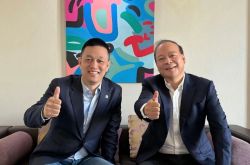
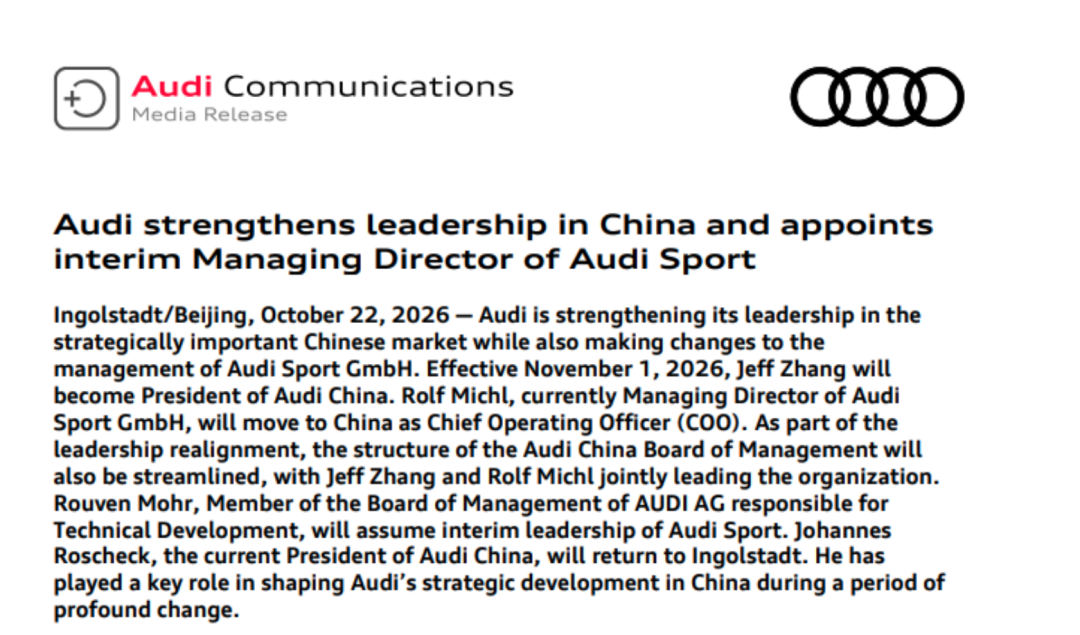
On October 22, Audi announced a personnel change on its official website: Jeff Zhang will assume the role of President of Audi China starting November 1, while current President Johannes Roscheck will return to the headquarters in Ingolstadt. Rolf Michl, General Manager of Audi Sport GmbH, will relocate to become Chief Operating Officer of Audi China, establishing a streamlined dual-leadership structure alongside Zhang.
Although the announcement itself is concise, in the eyes of many observers, this personnel shift carries significant weight amidst today's evolving market landscape.
Numerous reports have identified Zhang as the first Chinese president in this role, marking a milestone in Audi's—and potentially other leading BBA brands'—accelerated localization efforts. However, sources close to Audi later suggested that Zhang might hold Singaporean nationality.
While Audi has not officially clarified Zhang's nationality, whether he is Chinese or of Chinese descent, his professional background underscores the unique importance of this personnel move within the luxury automotive sector.
Audi's rationale for this adjustment is straightforward: with the rapid evolution of the Chinese market, the emergence of new competitors, technological advancements, and shifting customer expectations, automakers face increasingly stringent demands. Thus, a team blending global expertise, local market insights, and execution capabilities is essential. In essence, to succeed in China, one must increasingly rely on those who truly understand the Chinese market.
01 Empowering Those Who Understand the Chinese Market
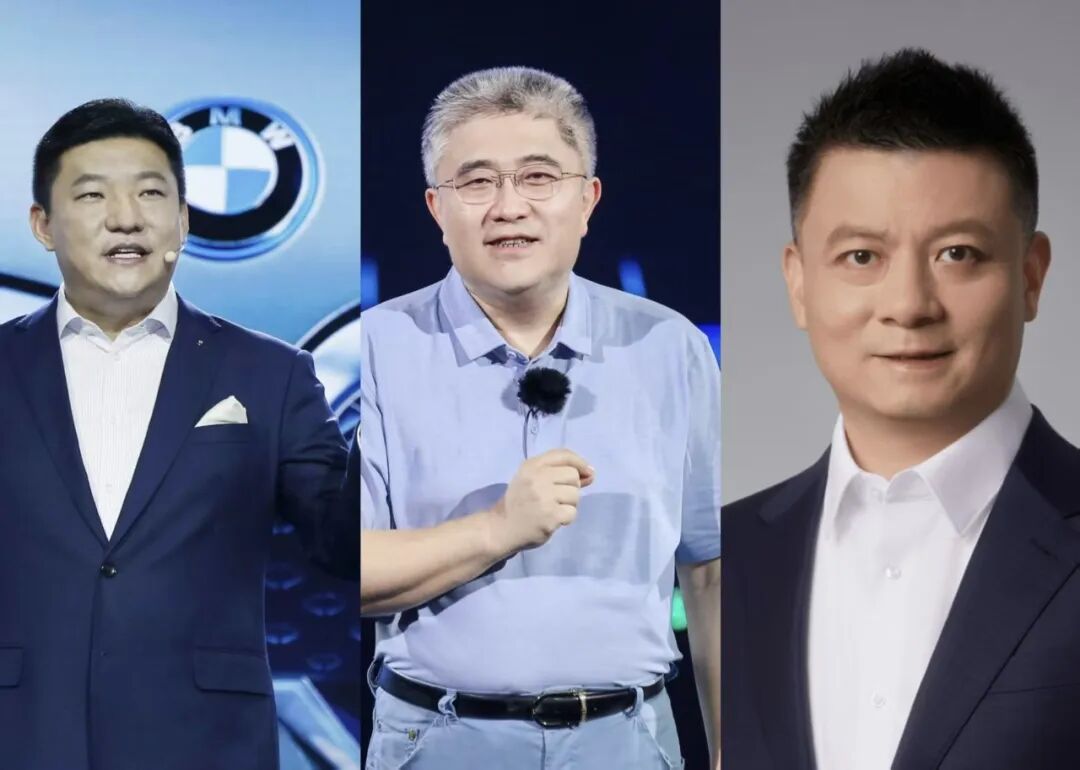
BMW was the first among the BBA trio to appoint a Chinese executive.
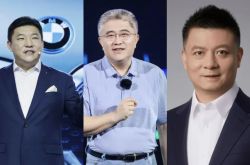
Rewind to 2016, when Liu Zhi became President of BMW (China) Automobile Trading Ltd., the primary entity responsible for imported BMW sales in China. This marked the first time a Chinese national held the top position within BMW's Chinese operations.
During Liu's tenure, BMW's sales in China continued to soar, and he further strengthened the foundation for imported vehicle sales and the dealership network.
Four years later, in June 2020, BMW Greater China appointed Shao Bin as its new president, succeeding Liu Zhi. Shao Bin, too, is Chinese.
However, a point often overlooked is that while these two Chinese presidents managed BMW (China) Automobile Trading Ltd., the entity handling imported vehicle sales, the position of President and CEO of BMW Group Greater China has consistently been held by Germans since its inception.
In other words, BMW has utilized Chinese executives to oversee sales and distribution channels, but ultimate regional responsibility has remained in foreign hands.
Mercedes-Benz followed a similar trajectory.
In March 2023, Beijing Mercedes-Benz Sales Service Co., Ltd. announced that Duan Jianjun, Chief Operating Officer of Sales, would assume the role of President and CEO on May 1—marking the first time a Chinese executive led Mercedes-Benz's sales company.
Duan joined Mercedes-Benz in 2013, ascending from Executive Vice President of Sales and Marketing to COO of Sales over a decade before securing this position. Until his departure from Mercedes-Benz earlier this year and subsequent appointment as President and CEO of Volvo Cars Greater China in May, Duan became a highly sought-after talent among foreign brands.
When comparing the achievements of these Chinese executives with those of their foreign counterparts, the results are clear.
During the gasoline era, foreign executives and the dealership networks they established propelled BBA to the pinnacle of China's luxury car market. In 2023, the three brands collectively delivered nearly 2.3 million new vehicles in China—BMW with 824,900 units, Mercedes-Benz with 765,000 units, and Audi with 729,000 units—each accounting for over one-third of their global sales.
These were the glory days for foreign luxury brands in China. However, the tide of electrification has rendered their long-standing strategies obsolete.
By 2025, BMW's sales in China had declined to 625,500 units, Mercedes-Benz to 575,000 units, and even Audi fell below 650,000 units in 2024. The past triumphs were built under foreign systems, and today's challenges have similarly emerged from within those same systems. This is precisely the market context in which Zhang Jun and his peers have stepped onto the stage.
Now, let's examine Zhang Jun's background. His experience is extensive. From 2018 to 2020, he held management positions at Audi China, where he personally assembled the sales team for SAIC-Audi and was deeply involved in strategic projects with FAW-Audi, gaining insight into the dynamics of both channels.
He also oversaw Alfa Romeo and DS operations in China for Stellantis before moving to Chery to handle European market expansion, transitioning from foreign luxury brands to a Chinese automaker's global outreach. This background is precisely what Audi lacks most at present: someone who understands how luxury brands operate in China and has experienced how Chinese automakers leverage localization strategies to go global.
Thus, the industry saying that "Audi has brought back Zhang Jun to put out fires" may be somewhat tongue-in-cheek, but it highlights a real issue. After five years and four presidents, Audi China desperately needs someone who understands both SAIC and FAW, as well as Chery-style strategies, to revitalize its increasingly complex chessboard in China.
02 The Essence is Building Future Competitiveness
If Zhang Jun's appointment is viewed merely as replacing a foreign executive with a Chinese or ethnic Chinese one to manage the Chinese market, it underestimates Audi's strategic move. The true focus of this personnel adjustment is electrification.
Consider Audi's electrification progress in China. Audi has positioned China as a frontier base for electrification, with its Changchun plant, capable of producing over 150,000 electric vehicles annually, serving as its most critical asset in the country.
In terms of product lineup, within the Four Rings brand, the Q6L e-tron family underwent a generational shift in April this year, priced between RMB 269,800 and RMB 419,800, clearly aiming to compete in the mainstream pure electric SUV segment. The A6L e-tron, based on the PPE 800V platform, targets the relatively untapped luxury pure electric sedan market. On the SAIC-Audi front, the all-electric AUDI brand has successively launched the E5 and E7X models, with the E7X's pre-sale price starting at RMB 289,800.
Most intriguing is Audi's strategic shift in intelligence.
The Q6L e-tron fully integrates Huawei's ADS (Advanced Driving System), while the A5L ADS version, all-new Q5L, and all-new A6L also adopt Huawei's solutions. The collaboration between FAW-Audi and Huawei ADS is said to have been six years in the making.
Three years ago, it would have been almost unthinkable for a German luxury brand to entrust the core algorithms of its intelligent driving system to a Chinese supplier. Yet today, it has become a standard move in Audi's electrification strategy in China. Meanwhile, the plan to divide operations between Northern and Southern Audi has largely been finalized this year, with SAIC-Audi retaining only the AUDI all-electric brand and the Four Rings logo fully assigned to FAW-Audi.
With channel consolidation complete, Audi's development strategy has become clearer.
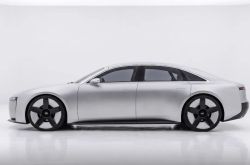
Moreover, Germany's Manager Magazin recently reported that the Audi A8 will be produced in China, with core technological development entrusted to Huawei. From the perspective of Automobile Magazine, relinquishing production rights and intelligent technology R&D for the A8 essentially means Audi is, for the first time, entrusting the definition of its flagship model to China—and this represents Audi's most promising path forward.
Regarding Audi's determination in electrification, a harsh market backdrop cannot be ignored.
Third-party monitoring data shows that in the first three quarters of 2026, Audi's sales in China reached 305,300 units, down 25.25% year-on-year; Mercedes-Benz sold 243,500 units, a 31.72% decline. According to first-half financial reports, the combined profits of the three BBA brands shrank by approximately €1.535 billion (over RMB 12 billion) in the first half of the year. The pain of electrification transformation has spared none of the three.
Besides Audi, Mercedes-Benz and BMW are also accelerating their electrification efforts and choosing to embrace Chinese local suppliers.
Mercedes-Benz's GLC has partnered with Momenta to develop urban and highway piloted driving; BMW's first model on the new Neue Klasse platform, the all-new iX3 long-wheelbase version, will begin deliveries in the fourth quarter, with its intelligent driving system also jointly developed with Momenta and trained on Chinese road data. The cabin relies on Alibaba Cloud and Tongyi large models, backed by a Chinese R&D team of over 3,000 people.
More notably, the trend of appointing executives with Chinese backgrounds or even Chinese nationality is not limited to the BBA brands.
Wu Shengbo, President of Ford China, and Jia Mingyi, President of Lincoln China, are both Chinese faces at the helm. Duan Jianjun's transition from Mercedes-Benz to President and CEO of Volvo Cars Greater China further indicates that this trust is extending from sales roles to regional leadership positions.
Why is this happening? The reason is clear. In the second half of China's auto market, success hinges on understanding Chinese road conditions, Chinese users, and Chinese suppliers—insights that cannot be gained by foreign executives sitting in offices poring over reports.
Therefore, it is more accurate to say that BBA is not just increasingly trusting Chinese people, but rather that they have realized that to continue selling well in China and maintain the influence they enjoyed during the gasoline era in the electrification era, they must relinquish control to those who truly understand this market.
Editor-in-Chief: Yang Jing Editor: He Zhengrong

THE END
-
The “Model Deluge” Strategy: Once a Boon, Now a Bane for Domestic Smartphone Makers
-
![]()
Significant Move! General Office of the State Council: Mitigate the Impact of AI Applications on Employment Substitution
-
![]()
Is There Still Time for the Audi Q9 to Make Its Mark?
-
The 'Little Golden Dragon' from Xiamen Faces Challenges in Going Global
-
![]()
Huawei Steps into Battery Swap Arena, NIO Welcomes the Move
-
![]()
Electrification Drives BBA to Delegate Authority
-
![]()
A8 Made in China, Embracing Huawei: Audi's Greatest Opportunity
-
Guangdong's 'Province-Wide Pass' for Autonomous Vehicles Comes into Force: Five Departments Collaborate on Regulations, Yet Cross-City Operations Still Require City-Specific 'Permits'