Sanhua: Falling Profits—Is the Robot Business Only Worth a Floor Price?
 10/30 2026
 493
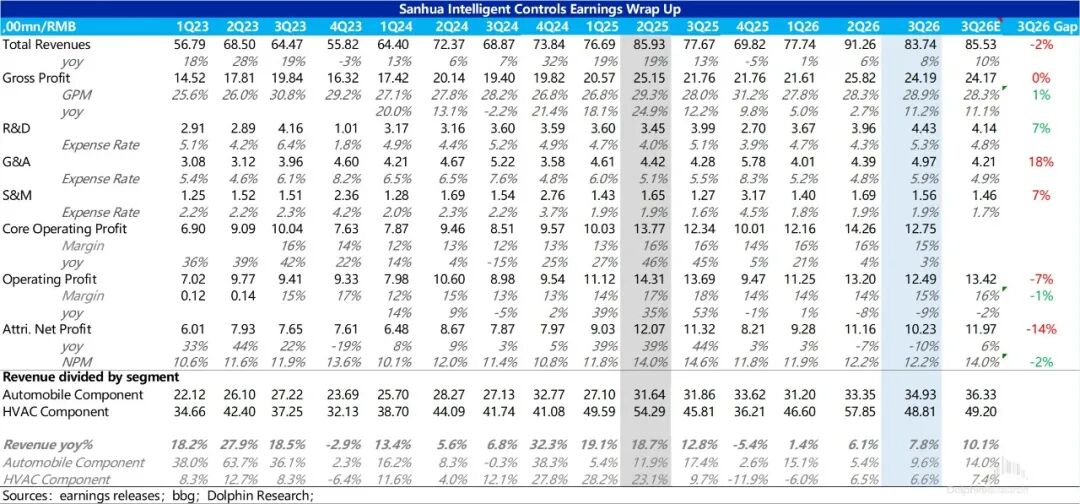
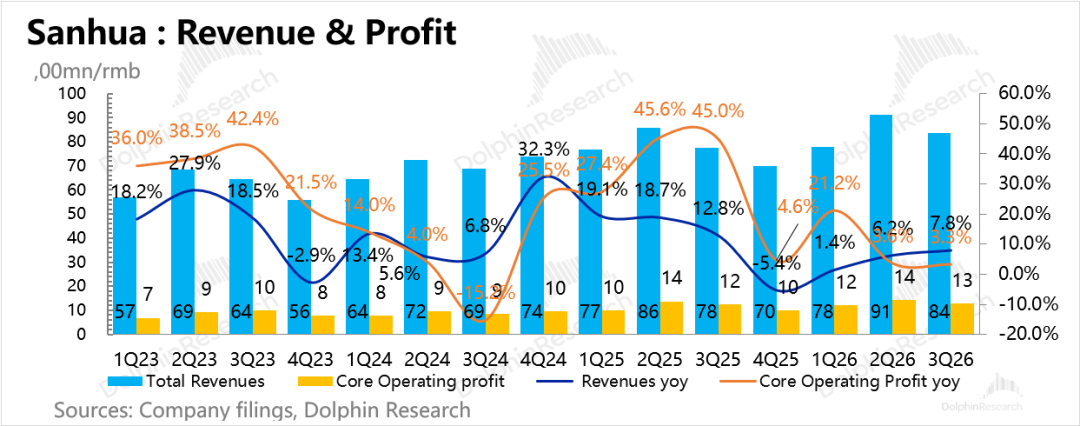
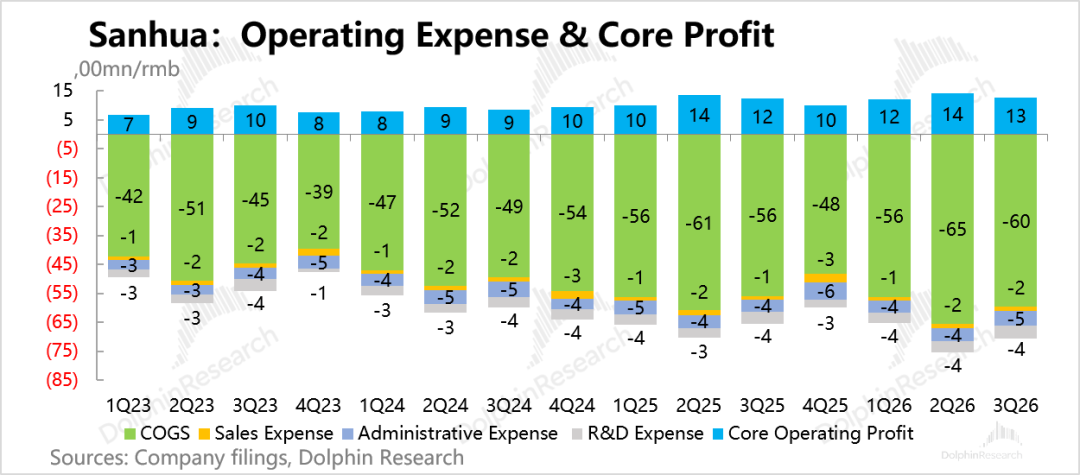
On the evening of October 28, Beijing time, Sanhua Intelligent Controls (2050.HK) released its Q3 2026 report. Overall, Sanhua Intelligent Controls' performance this quarter remained lackluster: revenue came in slightly below expectations, while gross margin unexpectedly beat expectations; however, higher expenses ate into profit, and net profit fell significantly short of consensus. Specifically:
1. Revenue was slightly below expectations, but growth in both major segments was improving: Q3 total revenue was 8.37 billion yuan, up 7.8% year-on-year, a slight acceleration from 6.2% growth in Q2, but still below the market expectation of 8.55 billion yuan (+10% year-on-year). Breaking it down:
① Auto parts growth rebounded: revenue from auto parts rose about 9.5% year-on-year to 3.49 billion yuan this quarter, a clear rebound from 5.4% growth in Q2, but below the market expectation of 14% year-on-year growth.
From an industry perspective, domestic demand for new energy vehicles remained weak in Q3. Domestic retail sales of new energy passenger vehicles in Q3 were about 3.04 million units, down 11% year-on-year, with incremental growth mainly coming from exports: Sanhua has a relatively high supply share in the best-selling models of export-oriented automakers such as Leapmotor and Geely.
On policy, starting April 1, 2027, the export tax rebate rate for new energy vehicles will be lowered from 13% to 9%; before it takes effect (from Q4 this year to Q1 next year), there may be a wave of pull-forward exports; the company's supporting vehicle exports are counted as domestic sales, so the ratio of domestic to export sales for auto parts in the first three quarters was about 67:33, with the export share declining year-on-year.
On customer structure, management said the combined share of major customers is already below 25%, with main customers including BYD, Leapmotor, Geely, Xiaomi, and Li Auto, further reducing dependence on any single major customer; integrated products grew 20%–30% year-on-year this year and now account for more than 50%.
② Refrigeration business growth continued to rise, with incremental growth from liquid cooling and overseas markets: refrigeration revenue rose about 6.6% year-on-year to 4.88 billion yuan this quarter, extending the 6.5% positive growth in Q2, but fell about 16% quarter-on-quarter after seasonal decline.
The industry level remains weak: after the reduction of national subsidies, domestic air conditioner output has continued to decline year-on-year since September 2025, with a decline of about 12% in July–August and a 16% year-on-year decline in Q3 output, with shipments even weaker (August domestic shipments -28%). Sanhua Refrigeration still achieved positive growth, with the core drivers as follows:
a. Data center liquid cooling ramp-up: Q3 liquid cooling revenue grew 50%–100% year-on-year; first three quarters liquid cooling revenue was about 1.8–2.1 billion yuan, including 1.2–1.4 billion yuan from data centers (Q3 400 million yuan, continuing to ramp quarter-on-quarter) and 600–700 million yuan from energy storage.
b. Overseas markets: North America revenue grew more than 20% year-on-year (benefiting from data center construction and commercial HVAC demand); Japan and Southeast Asia saw good demand driven by temperatures, rising air conditioner penetration, and energy efficiency upgrade policies.
c. But excluding liquid cooling, the domestic home appliance business still declined slightly, which is the main reason refrigeration growth did not meet market expectations. Management said the above trend (overseas liquid cooling ramp-up) can continue in Q4.
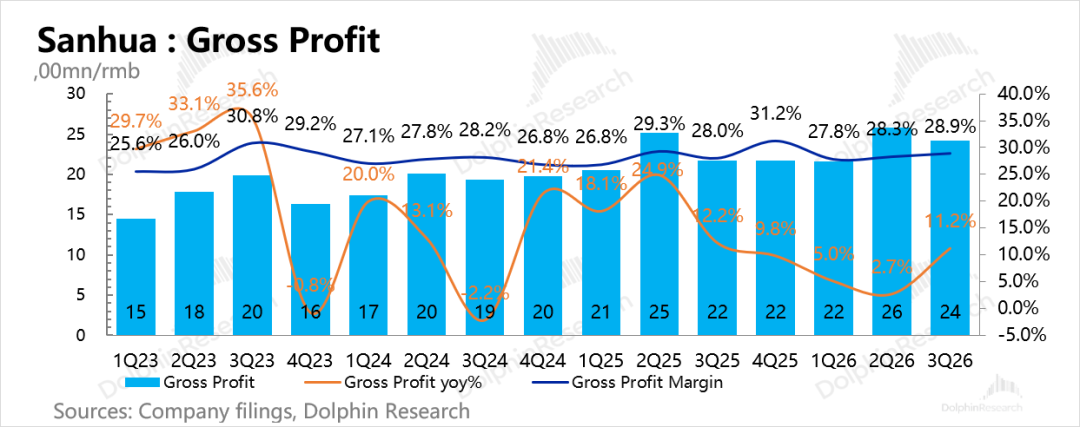
2. Gross margin beat expectations: Sanhua's Q3 gross margin was about 28.9%, above the market expectation of 28.3%, up about 0.6 percentage points quarter-on-quarter, showing good resilience amid high copper and aluminum prices and currency headwinds. Breaking it down:
Q3 gross margin for refrigeration components rose 1.5 percentage points year-on-year, mainly thanks to:
a. Mix uplift: both liquid cooling and export businesses have clearly higher profit margins.
Primary-side liquid cooling products (microchannel heat exchangers, filters, sensors) are mainly for North American customers; larger products require more advanced processes and carry higher gross margins. The secondary side (stainless steel brazed plate heat exchangers, chip cold plates, quick connectors, etc.) is the current focus of positioning, with orders exceeding supply, some individual items worth 50,000–100,000 yuan, and liquid cooling component value exceeding expectations; the company said customers' core demand is fast delivery rather than price, and margins are higher than existing commercial products.
Overseas refrigeration is mainly commercial, with high customization and a better profit structure than domestic.
b. Internal cost reduction: excluding liquid cooling and North America, gross margin was still improving, relying on material substitution such as stainless steel for copper and aluminum for copper, cost reductions from smart manufacturing, and a higher share of high-margin products. On copper prices, major customers implement copper price linkage clauses, with selling prices raised in tandem when copper prices rise, so the impact on gross margin is limited.
Gross margin for the automotive thermal management business was basically flat, slightly down: auto parts gross margin in the first three quarters was about 28.6%. There were three drags:
a. Exchange rates: the euro and yen depreciated about 5% and about 11% year-on-year against the renminbi, respectively, hurting the translation of revenue from overseas plants;
b. New plant ramp-up: new overseas capacity is still in the ramp-up period, with high fixed cost amortization;
c. Annual price reductions: intense competition in the new energy vehicle industry means automakers continue to press component prices down. Management's response is to shift from "land grabbing" to "intensive cultivation"—cost reduction across the entire value chain, focusing on high-profit projects, and increasing the share of integrated products (integrated products have higher profit margins and can drive component sales).
3. Net profit was significantly below expectations: Q3 net profit attributable to shareholders was 1.02 billion yuan, down 9.6% year-on-year, about 15% below the market expectation of 1.20 billion yuan; non-recurring net profit was 1.02 billion yuan, down 5.1% year-on-year, whereas in the first half non-recurring net profit was still up 6.8% year-on-year.
The profit decline had two main reasons:
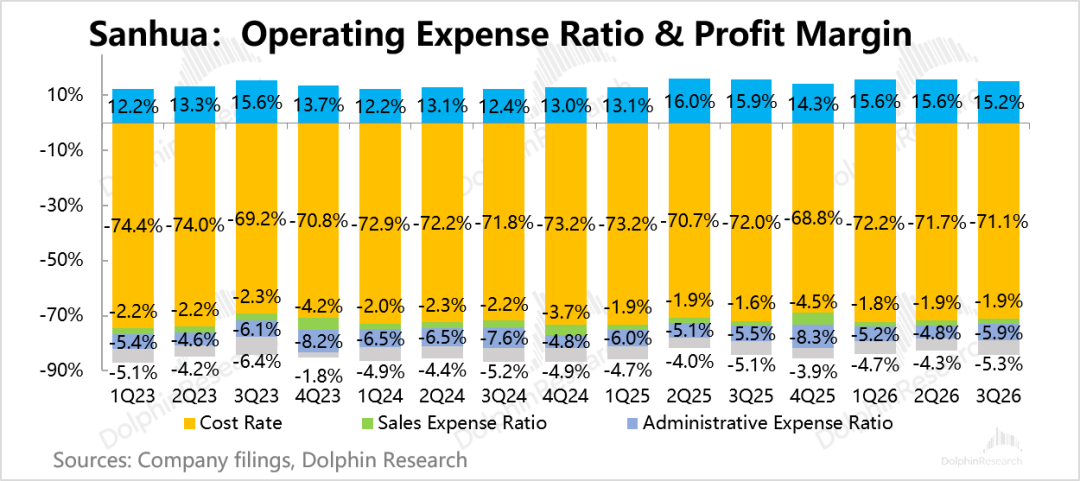
a. Three expenses rose significantly: total three expenses this quarter were about 1.1 billion yuan, up 16% year-on-year, including R&D expenses of about 440 million yuan, with the expense ratio rising above 5%, corresponding to increased investment in liquid cooling and new robot businesses; management expenses also increased noticeably quarter-on-quarter.
b. Other expenses: increased investment losses and exchange losses, and other income from government subsidies (decreased year-on-year).
Breaking it down by segment:
Refrigeration segment: Q3 net profit was about 550 million yuan, down about 10% year-on-year, with net margin of about 11.2%, down 0.4 percentage points quarter-on-quarter. Investment losses were mainly recorded in this segment; management said that after excluding non-recurring items, refrigeration segment profit was still growing year-on-year.
Auto parts segment: Q3 net profit was about 480 million yuan, down about 10% year-on-year, with net margin of about 13.6%, up 0.4 percentage points quarter-on-quarter, but clearly down from more than 16% in the same period last year.
Revenue grew nearly 10% year-on-year while profit fell year-on-year, mainly due to the triple squeeze of exchange rates, new plant ramp-up, and annual price reductions.
Dolphin View:
Overall, Sanhua Intelligent Controls' Q3 2026 performance remained lackluster: revenue grew 8% year-on-year, a slight acceleration from Q2 but still below expectations; gross margin beat expectations driven by the mix of liquid cooling and North American business, but exchange losses remained, R&D and management expenses rose, and subsidies decreased, causing net profit attributable to shareholders to fall 9.6% year-on-year, about 15% below consensus.
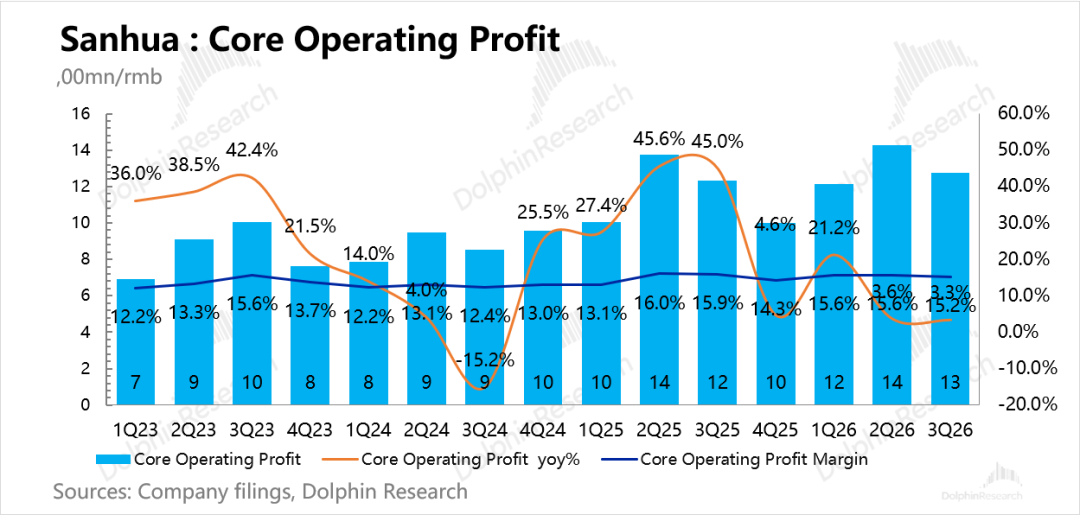
More notably, non-recurring net profit also fell 5% year-on-year this time, and even excluding factors such as exchange losses, Dolphin's defined core operating profit (gross profit - core three expenses) rose only 3% year-on-year.
For the full-year performance, management only said that after excluding investment losses and exchange losses, it can still achieve the beginning-of-year target (the initial target was about 15% profit growth). But based on the actual statements, net profit attributable to shareholders in the first three quarters was 3.07 billion yuan, down 5.4% year-on-year. Therefore, Dolphin expects Sanhua's 2026 net profit to be 4.0 billion yuan, down 3% year-on-year. Core net profit is 4.88 billion yuan, up 6% year-on-year.
Management's medium- to long-term targets announced this time are more noteworthy—the new five-year plan for 2026–2030:
a. Traditional household refrigeration: average annual growth of about 10% (excluding liquid cooling and commercial);
b. Commercial refrigeration, microchannels: double from current levels by 2030, with annual growth of 15%–20%; controllers have a low base and may grow three to four times in five years;
c. Auto parts: annual growth of 15%–20%, driven by electrification penetration (still rising in Europe and Southeast Asia), heat pump replacement of PTC due to autonomous driving (China penetration may reach more than 90%), and integration.
Dolphin believes these targets are clearly higher than the company's actual growth over the past two years (revenue grew only 5.2% in the first three quarters of 2026). Whether they can be achieved depends on the sustainability of the two incremental drivers: liquid cooling and overseas markets.
For Sanhua's share price, most of it comes from progress in imaginative businesses:
(1) Data center liquid cooling: this is the most substantive progress this quarter and the most quantifiable short-term growth driver. Liquid cooling revenue in the first three quarters was 1.8–2.1 billion yuan, and the full-year target of 50% year-on-year growth can be achieved; management said next year's liquid cooling "50%–100% growth can be seen."
At the product and customer level, the secondary side saw multiple breakthroughs in Q3: brazed plate heat exchanger projects from Taiwan-based CDU manufacturers landed in batches and entered the whitelist; projects with customers such as Vertiv and Schneider landed; in North American cloud vendors' next-generation self-developed ASIC liquid cooling projects, Sanhua's sensors and flow control valves have entered batch production; in the NVIDIA ecosystem, the company entered through Taiwan-based companies while also engaging directly.
On the primary side, microchannel products have a share of more than 50%, orders are locked through next year, and new capacity in Mexico and Thailand is being invested.
In terms of value, the company's existing products cover 20%–30% of liquid cooling system value, and after secondary-side mass production this may rise to 40%–60%, with quick connectors and manifolds as the main increments.
Currently, primary-side products account for about 70% of the company's liquid cooling sales; in projects under discussion, primary and secondary sides are already about 5:5, and after the secondary side ramps next year, the revenue structure will gradually move toward 3:7.
Dolphin estimates that 2026 liquid cooling + energy storage revenue will be about 3.2 billion yuan. If it grows 50%–100% in 2027, that corresponds to about 4.8–6.4 billion yuan, or an estimated 12.5%–17% of company revenue, and secondary-side margins are higher than existing commercial products, which is also a positive driver for gross margin.
The company insists on only making components and not complete CDU units, avoiding competition with customers such as Vertiv and Envicool, but it will do regional module integration. This positioning is relatively prudent.
(2) Humanoid robots: the company still has not given a timetable or revenue figures, only saying that actuators will be subject to official information from the major North American customer, some projects will enter batch production by year-end, and robot revenue next year will double from this year.
At the product level, the company has laid out body joint actuators, finger joint modules, robot thermal management, and sensors, covering about 60% of robot hardware value in total; the dexterous hand coreless motor module has landed with leading domestic dexterous hand manufacturers and entered the small-batch stage.
At the industry level, Tesla confirmed at its Q3 earnings call that Optimus has been put into production at the Fremont factory and began internal deployment, and the ramp indeed accelerated in Q3:
According to a September 25 report by The Information, weekly output of Optimus at Tesla's Fremont factory had risen to several hundred units in August, about ten times the dozens per week in Q2; the goal is to build a continuous automated production line with weekly output of more than 1,000 units by year-end and about 20,000 units per week by the end of 2027.
On the order side, according to Cailianshe, Tesla placed a batch order of about 5,000 units with its core supply chain in early September and conducted a new round of factory audits of core suppliers such as Tuopu, Sanhua, and Junsheng.
But it should be noted that the start of complete-unit volume ramp-up does not mean the market's expectations for Sanhua's robot business are rising in tandem; on the contrary, sentiment has clearly cooled.
First, the complete-unit ramp shows a "slow-start" S-curve: dexterous hands and joint assembly still rely heavily on manual labor, insufficient alignment precision of assembly equipment leads to a high rework rate, and dexterous hand durability and tactile sensors also have reliability issues—so mass production is being realized more slowly than previously expected.
Second, new entrants in actuators are increasing and competition is intensifying, and the market's previously optimistic assumption that "Sanhua will win more than 50% share" has begun to loosen.
From a valuation perspective, we assume 2026 after-tax core operating profit (excluding disturbances such as exchange losses) of about 4.15 billion yuan, up about 6% year-on-year. Given that Sanhua's traditional main business is a global thermal management leader with strong certainty, assigning 15x PE to the 2026 main business—close to the historical bottom of about 13–15x for A-shares in 2012–2014 and below the long-term average of about 22x—corresponds to a reasonable valuation of about 62.3 billion yuan for the main business.
For the more imaginative robot business, we give a range: in the conservative case (1 million humanoid robots globally in 2030, Sanhua share 20%), about 45 billion yuan; the neutral-to-optimistic case follows last quarter's assumptions (Optimus annual sales of 1 million units in 2030, actuator value of about 50,000 yuan per unit, Sanhua share 50%, net margin 15%, 30x PE), about 112.5 billion yuan. Considering intensifying share competition, Dolphin believes the reasonable range leans toward the conservative case.
Based on the above analysis, Dolphin's judgment on H-shares and A-shares differs.
H-shares currently have a market cap of about 80 billion yuan; after deducting the main business, the implied valuation of new businesses is only about 18 billion yuan—less than the conservative case of 45 billion yuan. This is equivalent to the market giving the robot business only a "floor price" discount, while the growth of liquid cooling has not yet been separately priced, so downside is relatively limited.
A-shares have a market cap of about 146 billion yuan; after deducting the main business, the implied valuation of new businesses is about 84 billion yuan—already in the middle-upper part of the above range. This means the market is still pricing in more optimistic share assumptions, and the cost-effectiveness is clearly inferior to H-shares.
But it should be emphasized:
a. Profit recovery in the main business is slower than expected; non-recurring net profit has already declined year-on-year, the full-year profit growth target of about 15% is basically unattainable, and there will still be disturbances from expense investment and exchange rates from Q4 to Q1 next year;
b. Robot share faces the risk of dilution; Tesla's factory audits and "V3 supplier repricing" mean share allocation is still changing;
c. Liquid cooling is the incremental driver with the strongest certainty; the progress of secondary-side breakthroughs will determine whether 2027 growth is 50% or 100%.
Therefore, in terms of investment pacing, the current point in time warrants focus on:
① The batch progress of liquid cooling secondary-side projects from Q4 to Q1 2027, and the ramp-up of North American CSP self-developed ASIC liquid cooling projects;
② Whether Optimus weekly output can reach 1,000–2,000 units by year-end, and the final share allocation for Sanhua's actuators;
③ Whether the full-year profit guidance given by management after the start of 2027 will fulfill the double-digit growth in the five-year plan.
The above will be the key catalysts for sentiment repair and valuation re-rating.
Introduction to Sanhua Intelligent Controls' Main Business
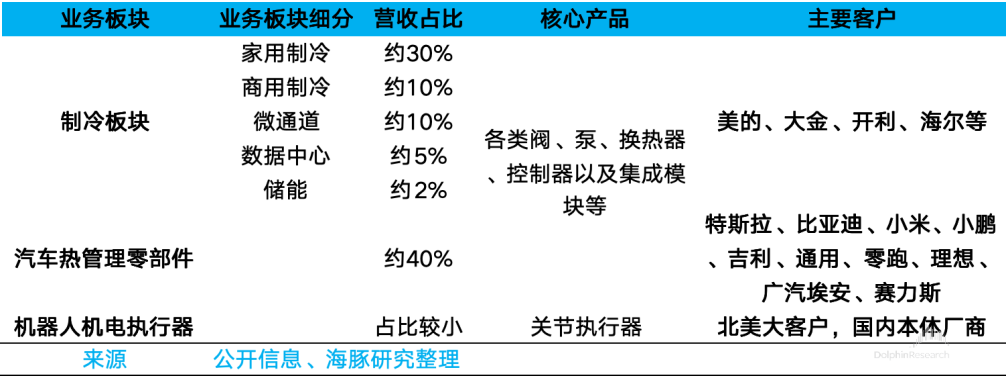
Sanhua Intelligent Controls' business is mainly divided into two major segments: refrigeration components and automotive components.
The downstream of refrigeration components is mainly refrigerators and air conditioners—overall a relatively mature and stable industry, but some sub-segments have faster growth rates. For example, the overseas market for commercial refrigeration still has room for further penetration. In addition, the most market-watched area is the application of its valves, pumps and other products in data center liquid cooling, energy storage thermal management and other fields.
Automotive components are mainly used in thermal management of new energy passenger vehicles. The largest customer is Tesla, but the proportion of domestic customers such as BYD is rising rapidly. Benefiting from the increase in thermal management demand for new energy vehicles, there is still room for improvement in value per vehicle, but it is periodically affected by sales fluctuations of major customers.
In addition to the above segments, the company has added a third major business segment: strategic emerging industries, focusing on data centers, energy storage and biomimetic robots. Data centers and energy storage mainly supply thermal
management components, which had generated about 2 billion yuan in revenue in 2025. Robots mainly involve joint actuators. Considering that the industry has not yet scaled up, the revenue contribution is expected to be limited, but the company was among the earliest to connect with major North American customers and leads in technology and production strength, so it is one of the most market-watched business segments.
For analysis of the company's business, see "Sanhua Intelligent Controls: An Unremarkable Business, How Does It Always Catch the Trend?" and "Sanhua: In the Era of AI Robots, Will the Cross-Industry 'Veteran' Have the Last Laugh?"
- END -
// Reprint authorization
This article is an original article by Dolphin Research. Authorization is required for reprinting.
// Disclaimer and general disclosure notice
This report is intended only for general comprehensive data use, aimed at general reading and data reference for users of Dolphin Research and its affiliates, and does not take into account the specific investment objectives, investment product preferences, risk tolerance, financial condition and special needs of any person receiving this report. Investors must consult an independent professional adviser before making investments based on this report. Anyone who makes investment decisions based on the use of or reference to the content or information mentioned in this report shall bear the risk themselves. Dolphin Research shall not be liable for any liability or loss that may be directly or indirectly caused by the use of the data contained in this report. The information and data contained in this report are based on publicly available materials and are for reference only. Dolphin Research strives for but does not guarantee the reliability, accuracy and completeness of the relevant information and data.
The information mentioned or views expressed in this report shall not, under any jurisdiction, be treated or regarded as an offer to sell securities or an invitation to buy or sell securities, nor do they constitute suggestions, inquiries or recommendations regarding the relevant securities or related financial instruments. The information, tools and materials contained in this report are not intended or proposed to be distributed to citizens or residents of any jurisdiction where the distribution, publication, provision or use of the relevant information, tools and materials would conflict with applicable laws or regulations or would cause Dolphin Research and/or its subsidiaries or affiliates to be required to comply with any registration or licensing requirements in that jurisdiction.
This report reflects only the personal views, opinions and analytical methods of the relevant creators, and does not represent the position of Dolphin Research and/or its affiliates.
This report is produced by Dolphin Research, and the copyright belongs solely to Dolphin Research. Without the prior written consent of Dolphin Research, no institution or individual may (i) produce, copy, reproduce, reprint, forward or otherwise create any form of copy or reproduction in any way, and/or (ii) directly or indirectly redistribute or transfer it to other unauthorized persons. Dolphin Research reserves all relevant rights.
-
Profit Structure Reshaped as BYD's Q3 Profit Rebounds | Q3 Report
-
Geely Q3 Net Profit Up 28%: Premium Overseas Expansion Drives Earnings Recovery | Q3 Report
-
![]()
Xiaomi Invests 1.7 Billion Yuan in Sunwoda, Becoming Third-Largest Shareholder After Li Auto
-
![]()
Sanhua: Falling Profits—Is the Robot Business Only Worth a Floor Price?
-
![]()
Geely Launches Three Fuel Vehicles in a Single Week: Defensive Move or a Bigger Strategy?
-
![]()
When Every Company Dons the AI "Hat"
-
![]()
Toy Giant ZURU Moves China HQ to Shenzhen's China Resources Tower with 30,000 sqm Lease
-
![]()
SDD Spec-Driven Development Tutorial — The More Features You Add, the More AI Starts "Making Things Up"