October New Energy Sales Revealed: BYD Closes In on 500,000 Monthly Sales, Xiaomi and XPeng Take Off
 11/02 2026
 609
Truly a golden September and silver October.
Today is the first day of November, and once again it's the day when new energy automakers roll out their October delivery and sales figures.
Based on patterns from previous years, October is the second month of the automotive market's "golden September and silver October" period and typically a peak season for vehicle sales. Yet with the overall market downturn this year, the September auto market was noticeably quieter than in years past. Although total sales rebounded from the previous few months, they remained significantly below the same period last year.
So how will new energy automakers fare in October? Can they sustain the "silver October" momentum of previous years? Today, Dianchetong (ID: dianchetong233) takes a look with you.
Strong Showing from New Forces: Leapmotor Keeps Above 100,000, Xiaomi and XPeng Take Off
There is little suspense about the sales champion among new force brands in October—Leapmotor retains the crown with monthly deliveries of 106,127 units, a slight increase from 105,656 in September.
Although Leapmotor's delivery growth narrowed in October compared with September, in Dianchetong's (ID: dianchetong233) view, the company has now entered a stable development phase. Minor month-on-month fluctuations in monthly deliveries are normal. As long as Leapmotor can steadily maintain deliveries above 100,000, it will stay far ahead of other new forces and firmly hold the sales champion throne.
Beyond Leapmotor, Xiaomi and XPeng also delivered surprising results in October. In September, both automakers surpassed the 40,000-unit mark, and in October they simultaneously joined the "50,000-unit club," demonstrating very clear growth momentum.
Xiaomi, for its part, again declined to disclose a specific figure and only announced October deliveries of 50,000+ units. Compared with September's 40,000+, Xiaomi grew by roughly 10,000 units in October. The rapid delivery growth clearly stems from steady deliveries of the Pengcheng series driving sales upward.
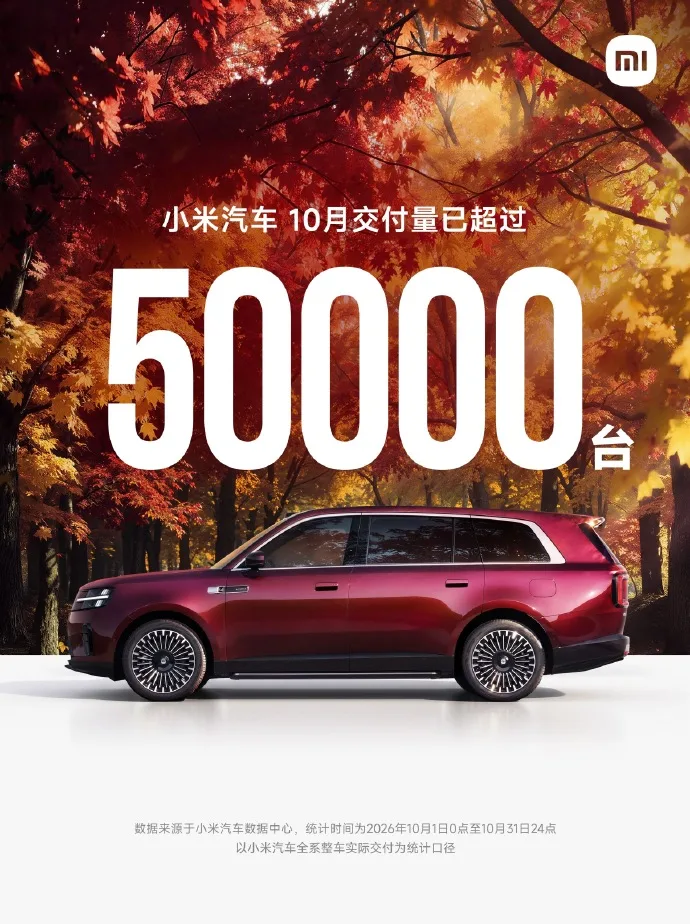
(Image source: Xiaomi Auto)
It should be noted, however, that Xiaomi Auto set an annual delivery target of 550,000 units at the start of this year. According to public information, cumulative sales from January to September were 286,475 units. Even adding October's 50,000+ deliveries, a gap of roughly 200,000 units remains. Judging from Xiaomi's current sales performance, it clearly cannot complete those 200,000 deliveries in the remaining two months, making Xiaomi Auto's annual target very likely unattainable this year.
Still, as an automotive brand with only five years of car-making history, achieving monthly sales above 50,000 units is highly commendable. Can Xiaomi make history again in the remaining two months and push deliveries even higher?
Then there is XPeng, with October deliveries of 50,237 units, an increase of nearly 9,000 units over September—also XPeng's highest monthly delivery volume ever.
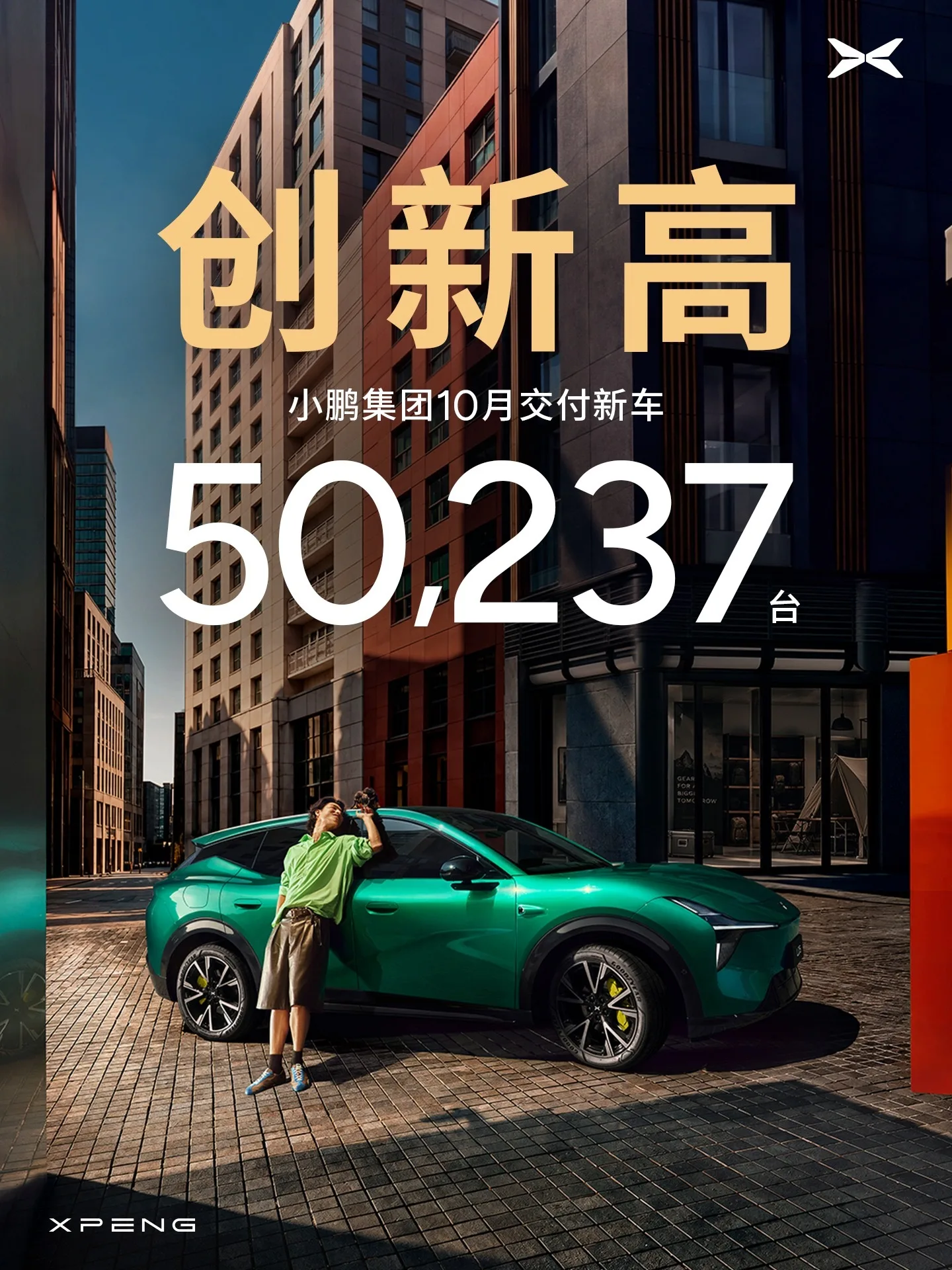
(Image source: XPeng)
In a recent report on XPeng's MONA L05 launch event, Dianchetong (ID: dianchetong233) noted one point: XPeng achieved success in both the mainstream market and the high-end flagship market this year, and XPeng's impressive October delivery performance once again confirms this view.
Starting November 1, XPeng MONA L05 has begun deliveries. How much sales increment can this car bring to XPeng? Will XPeng's monthly deliveries in November hit a new high again? Dianchetong (ID: dianchetong233) is also looking forward to it.
With XPeng and Xiaomi both surpassing the 50,000 delivery mark, October's "40,000-unit club" was empty, while brands with monthly deliveries exceeding 30,000 units were NIO and HIMA.
First, NIO: the company's October deliveries were 34,246 units, a slight decline compared with September. Among them, the NIO brand accounted for 18,125 units, Onvo 8,383 units, and Firefly 7,738 units. Compared with September, NIO brand sales declined somewhat in October, while the other two brands remained stable.
It is worth mentioning that NIO has no plans to launch new cars this year. The company's current focus is to sell existing models well, so NIO's monthly deliveries will not change significantly at this stage. However, NIO still has relatively obvious room for growth. For example, the Onvo brand, aimed at the mainstream market and family vehicle usage, still has considerable growth potential. We look forward to NIO continuing to make efforts and bringing further sales growth across all price segments.
HIMA's deliveries also declined somewhat compared with September, to 33,537 units. With the facelifted AITO M8 not yet officially launched and the Zunjie brand continuing to suffer from negative public opinion, HIMA still achieved monthly deliveries of more than 30,000 units, reflecting consumer recognition and the brand's resilience.
Li Auto's October deliveries were 29,025 units, also declining to a certain extent compared with September. However, Li Auto was in the stage of switching many models to self-developed batteries in October, and its main volume model, the i6, was also facelifted that month, so the sales decline was foreseeable. It is believed that as multiple models equipped with self-developed batteries complete capacity ramp-up, Li Auto's deliveries will return to the 30,000-unit level.
Traditional Automakers Achieve Month-on-Month Growth, Sub-brand Electrification Transformation Accelerates Again
Traditional brands also put in a relatively impressive October. Although affected by the overall industry sales decline, some automakers experienced a certain degree of decline compared with the same period in previous years, compared with September data, many automakers also achieved month-on-month growth. BYD and Geely even achieved year-on-year growth.
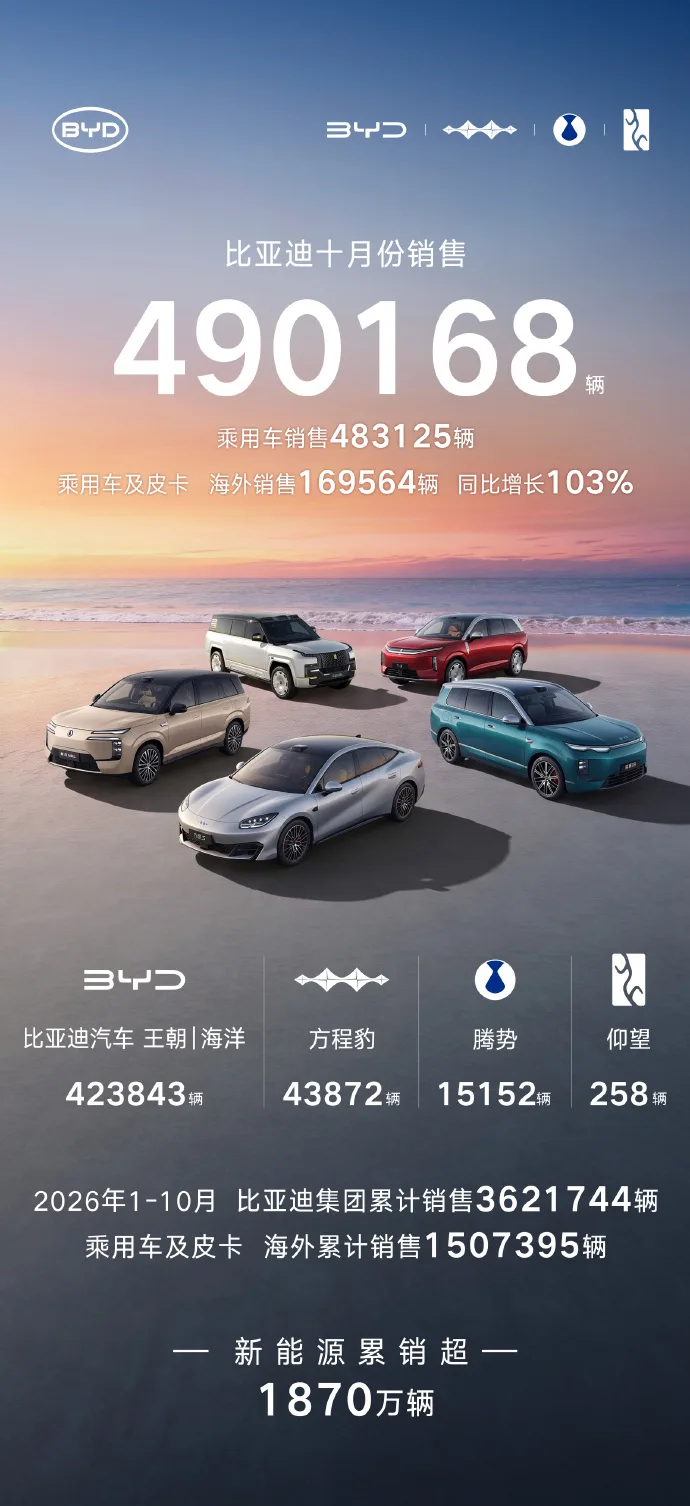
First, BYD: October total sales were 490,168 units, of which passenger vehicle sales were 483,125 units, and overseas sales of passenger vehicles and pickups were 169,564 units. Its total sales increased significantly compared with September but did not yet break the 500,000-unit mark, and export sales declined slightly compared with September.
Specifically for each sub-brand, Dynasty + Ocean sales were 423,843 units, Fang Cheng Bao sales were 43,872 units, Denza sales were 15,152 units, and Yangwang sales were 258 units.
(Image source: BYD)
In October, Dynasty + Ocean sales remained strong. With the gradual sufficiency of second-generation blade battery supply and the release of more new cars, facelifts, and model changeover models, these two brands are bound to usher in higher sales. It is worth mentioning that Dynasty Network and Ocean Network already launched three all-new/next-generation models in October: the Da Han, the second-generation Seagull, and the third-generation Qin PLUS. In November, they will also launch two next-generation models: the second-generation Seal 07 and the third-generation Tang. In the remaining two months of this year, sales of Dynasty Network and Ocean Network are expected to grow further.
As for Fang Cheng Bao, sales performance was basically flat compared with September. The Fang Cheng S is still in the capacity ramp-up stage, and it is believed that after the capacity problem is resolved, Fang Cheng Bao's sales will see significant improvement. Denza's sales declined, and it is hoped that the launch of the N8 can change this situation.
SAIC Motor's total October sales exceeded 430,000 units, but the group did not announce specific October data for its own brands. Its new energy vehicle sales in October were 258,600 units, a year-on-year increase of 25.12%. Its MG brand has separately announced sales: global new energy sales exceeded 85,000 units, and domestic sales exceeded 31,000 units.
It can be seen that with the launch of models such as the MG4 and MG 07, the MG brand's sales performance is also growing steadily, and its presence in the domestic new energy market is gradually increasing.
Geely Automobile Group's October sales were 310,183 units, also achieving slight growth compared with September. Among them, new energy model sales were 214,996 units, including 140,758 pure electric models and 74,238 plug-in hybrid models, and export sales were 107,153 units.
The sales data for each sub-brand are: Geely Galaxy 153,385 units, Lynk & Co 21,958 units, and Zeekr 32,483 units. Geely Galaxy and Lynk & Co increased compared with September. Affected by the launch of the new Z20, Lynk & Co's monthly sales also exceeded 20,000 units. Zeekr declined slightly but still maintained sales above 30,000 units. As Geely's high-end brand, Zeekr continues to play a benchmark role.
Great Wall's October sales were 120,374 units, also achieving slight growth compared with September. Among them, new energy sales were 49,499 units, and overseas sales were 62,862 units.
Affected by the launch of the 2027 Ora Good Cat, the sales of Great Wall's Ora brand and new energy sales both increased in October, with Ora brand sales reaching 12,187 units.
At present, Great Wall's momentum in advancing electrification transformation remains undiminished. In recent months, it has also completed annual model updates for the Ora 5 and Ora Good Cat. However, the reason Great Wall's total sales and new energy sales are currently sluggish mainly lies in the fact that its models positioned for volume sales are not selling in volume and cannot compete with other traditional brands and new force brands, resulting in great potential for Great Wall's sales still waiting to be tapped. However, Great Wall is also transforming and adjusting step by step, and it is believed that its qualitative change will be seen one day.
As of the time of writing, the total sales data of large groups such as Changan, Chery, and GAC have not yet been announced, but some new energy brands under large enterprise groups have already announced their sales data.
Changan's Changan Qiyuan and Changan Deepal had October sales of 63,648 units and 32,642 units respectively, and the combined sales of the two sub-brands are also very close to the 100,000-unit level.
GAC Aion Hyper BU's sales were 42,357 units. As Aion is transforming from the B-end to the C-end, its sales performance has also recovered to a certain extent. In November, the Aion Ray7 will also officially launch. I wonder whether this new car positioned as young and sporty can further accelerate Aion's transformation toward the C-end market?
Final Thoughts
The delivery/sales data of various automakers in October this year does look quite interesting.
The delivery/sales of many automakers increased significantly compared with September, not following the usual "golden September and silver October" convention, showing us the entirely new changes that electrification transformation has brought to the market.
There are only two months left this year, and it is also time for many automakers to push for year-end sales. So which automakers will achieve sales growth in these two months, and which will remain unnoticed? We will continue the discussion at the beginning of next month and early next year.
Source: Leitech
Images in this article are from: 123RF licensed image library Source: Leitech
-
![]()
AR Anti-Reflection Coating: "Reduce Reflection, Increase Transmission" — But the Essence Is Systems Engineering
-
![]()
The Year Computing Power Was Tightest: Baidu's Full-Stack Bet Begins to Pay Off
-
![]()
Metalenz Acquires Israeli Startup PxE Imaging to Advance Optical Metasurface Technology
-
![]()
Business Focus: Optical Giant ams OSRAM Posts €829 Million in Q3 2026 Revenue
-
Jet Fuel Price Surge Inflates Costs, Net Profit Falls Over 20%; Spring Airlines Issues 10 Billion Yuan in Bonds to Fund 27.6 Billion Yuan Aircraft Purchase
-
![]()
A $5 Trillion Foreign Trade Hub Hosts a Landmark Gathering of Chinese and Global Titans
-
Baidu's AI Revenue Tops 50% for the First Time, Yet Shares Hit Record Low—Baidu Is Still Essentially Selling Computing Power
-
![]()
China's 6G Communications Breakthrough: Q/V-Band Experiment Hits 27Gbps, Setting New Domestic Record