Has Smart Driving Been Racing for Years—and Is the First Truly Calculable Business Case Emerging on Trucks?
 11/04 2026
 522
Recently, smart driving supplier Zhuoyu held a commercial vehicle launch event in Zhuhai and put forward the slogan: one system, payback in one year.
But Zhuoyu CEO Shen Shaojie also gave another number: the domestic commercial vehicle smart driving penetration rate is less than 1%.
That is interesting. Fleets are among the people who calculate accounts best; in the industry, even one brake is converted into seven or eight yuan. If it really can pay back in one year, why are fewer than one in a hundred vehicles equipped with it?
There have been many interpretations of Zhuoyu smart driving over the past two days, but most stop at "all six top heavy truck brands cooperate" and end-to-end, LiDAR. However, no one has interpreted the questions behind these conflicts at Zhuoyu:
Passenger vehicle smart driving has been in fierce competition for so many years, so why is it only now the turn of heavy trucks?
Can the fuel-saving account really be calculated? What are the prerequisites for it to hold?
With so many partnerships and vehicle models at the launch event, where exactly has the business reached?
I watched Zhuoyu's launch event replay from beginning to end, then checked some data to interpret these conflicting phenomena. First, the conclusion: passenger vehicle smart driving sells experience, and users find it hard to calculate how much it is worth; heavy truck smart driving sells an account book, and fleets can calculate for themselves whether it pays back.
This difference determines that commercial vehicles may be the next more solid incremental growth segment for smart driving.
01 Why is it heavy trucks' turn now? The space is large because the accounts can now be calculated
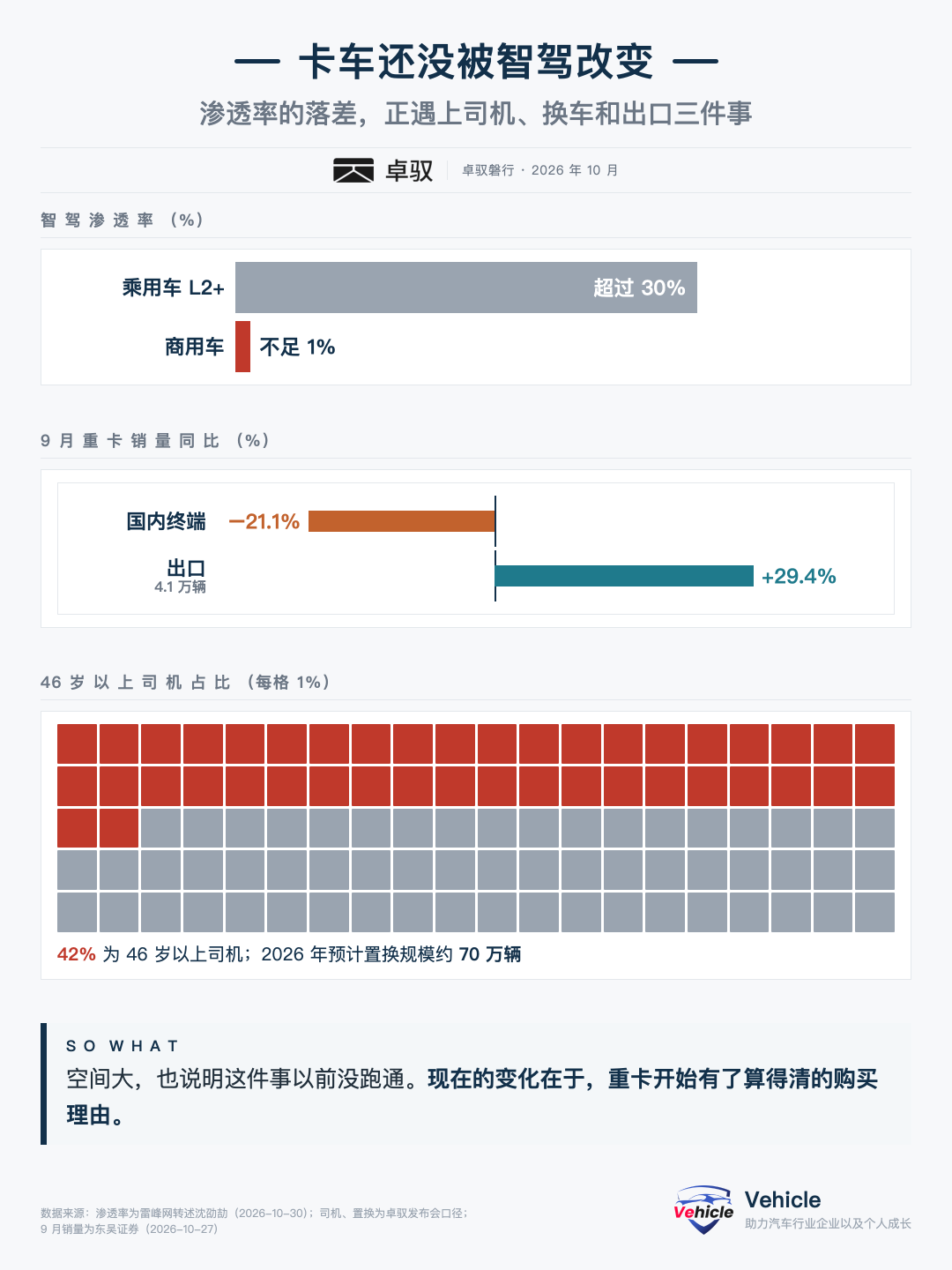
At the launch event, Shen Shaojie gave the comparison: the domestic passenger vehicle L2+ penetration rate has exceeded 30%, while commercial vehicle smart driving is still less than 1%.
The gap is so large because a fully loaded heavy truck of more than 40 tons is more demanding on perception, control, and cost, and fleets are very realistic. If a feature is merely "easy to use," they will not pay extra for it.
But now three things have changed.
Drivers are getting older: most truck drivers are already uncles. Data cited by Zhuoyu shows that drivers over 46 account for 42%, and young people are not very willing to enter this industry. Trucks are means of production, and driver fatigue and safety are real operational issues.
China is replacing vehicles: the market has entered stock replacement. Zhuoyu estimates that the replacement scale in 2026 will be about 700,000 vehicles, and vehicle replacement is exactly a window for upgrading configurations.
Incremental growth is overseas: statistics from Soochow Securities show that in September, heavy truck terminal sales fell 21.1% year on year, while exports grew 29.4%, reaching 41,000 vehicles in a single month.
This year, the industry's attention went around embodied intelligence for a while, and recently quite a lot has returned to smart driving, because general embodied intelligence is really not landing that fast, but intelligent assisted driving vehicles are indeed a kind of professional embodiment.
My understanding is that physical AI will sooner or later have to answer where it can generate returns. Trunk line logistics has scale, a clear cost structure, and customers willing to pay to save money.
As a tool-attribute professional embodiment, heavy trucks recognize only returns, so they move slowly. And precisely because they recognize only returns, they are worth looking at seriously now.
02 The account book: fuel saving is the entry point of this business. Eighty yuan a day holds, but conditions matter.
Fuel accounts for 30%-40% of heavy truck operating costs. There is a saying in the industry: "one brake, seven or eight yuan."
Experienced drivers can rely on experience to coordinate the retarder and engine braking well and push fuel consumption down. But people get tired, and if the driver or trailer is changed, the same footwork no longer works.
The mature approach in the industry is called rule-based fuel saving: engineers write operating conditions into tables and calibrate them by segments. The problem is that once slope, curvature, load, and the state of the vehicle ahead are superimposed, the rules cannot be written completely. This is the same problem passenger vehicles encountered back then.
Zhuoyu's approach is to let the model try by itself in simulation using reinforcement learning, then control gears and multiple braking methods. The company calls it a global first. I cannot verify that claim, but Zhuoyu is indeed the first to put forward the slogan and mass production.
What can be verified is the account book. Results announced by Zhuoyu: tracking 230 mass-produced vehicles, accumulating 20 million kilometers, a fuel-saving rate of 4.5%-7.5%, and saving 20,000-30,000 yuan per vehicle per year.
How should this account be understood?
How much is saved: Zhuoyu's algorithm is to save 10 yuan per 100 kilometers. Assuming a truck driver uses smart driving in shifts and drives 800 kilometers a day, that is 80 yuan. At 250 working days, that is 20,000 yuan; at 365 days, that is 29,200 yuan.
Back-calculating fuel consumption: back-calculating, the fuel cost per 100 kilometers is about 133-222 yuan, within a reasonable range for diesel heavy trucks.
Of course, the actual amount saved and the payback period depend on factors such as vehicle utilization rate, mileage, oil price, and system cost, and this cannot be directly equated.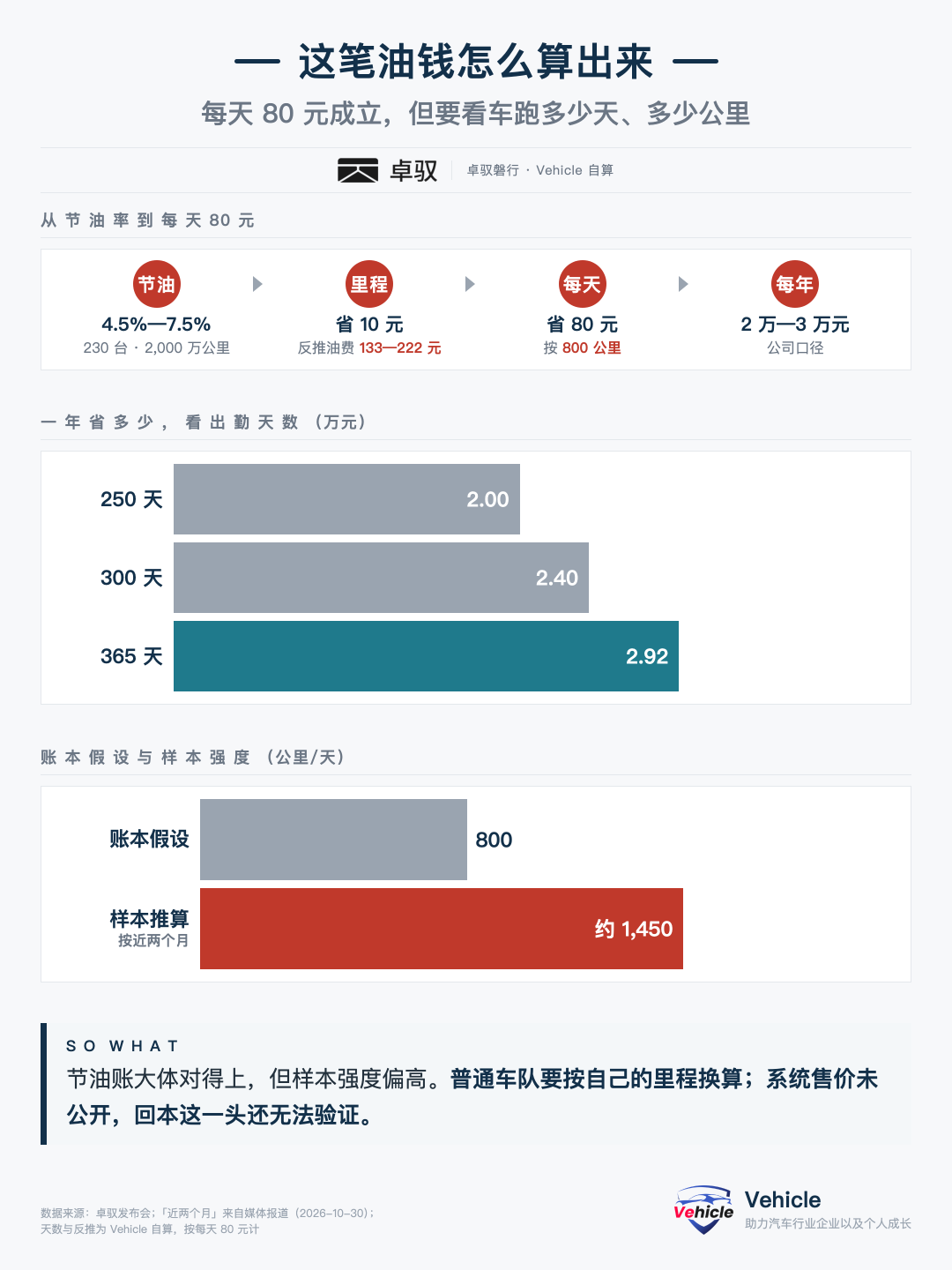
So for the question at the beginning, my understanding is: payback in one year and less than 1% are not contradictory. The product has just arrived, and there are not yet many vehicles that can calculate this account; ordinary fleets can recalculate according to their own actual situation and decide whether to adopt this system.
However, this matter is indeed the first time in history that a smart driving system can be treated as an operational investment with calculable returns, and the procurement decision can be handed over to the fleet's financial account. This is its biggest difference from passenger vehicle smart driving.
03 The same brain, why can it drive heavy trucks? Whether migration is labor-saving determines how far it can go
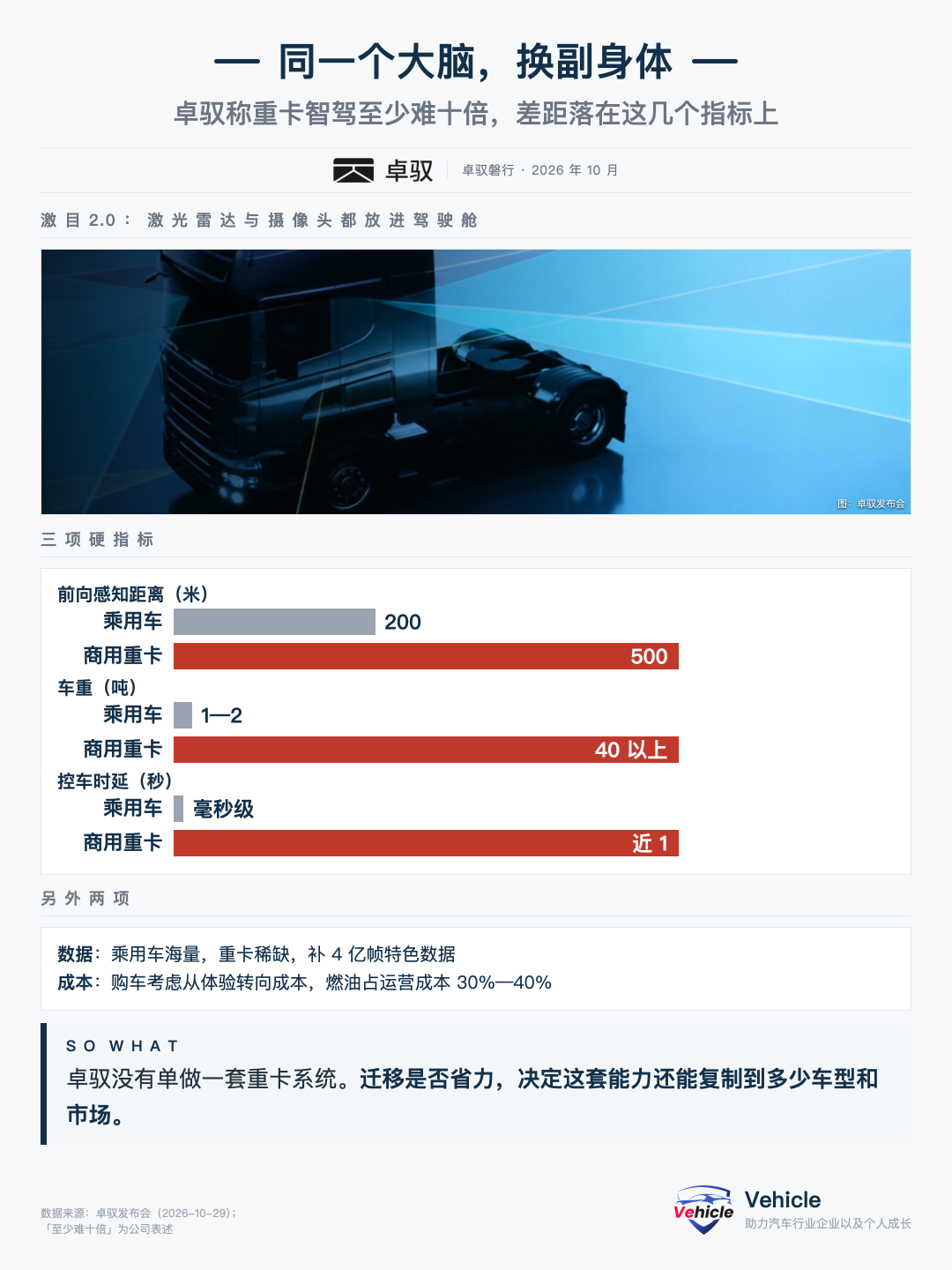
Liu Sikang, vice president of Zhuoyu Technology's commercial vehicle business, said on stage that heavy truck smart driving is at least ten times harder than passenger vehicle smart driving. This is Zhuoyu's claim, and I am skeptical at first, but after deep analysis, the gap is indeed obvious.
1. Less data: passenger vehicles have massive experienced-driver data, but high-quality heavy truck data is scarce.
2. Must see farther: 200 meters is enough for passenger vehicles, but for heavy trucks, braking distance alone requires at least 200 meters, and perception must be extended to 500 meters.
3. Low fault tolerance: passenger vehicles are 1-2 tons, but heavy trucks are often more than 40 tons. If there is a problem, it is a big problem.
4. Harder to control the vehicle: passenger vehicles are basically millisecond-level, which is fine, but heavy truck braking chains inherently have nearly 1 second of extra delay.
5. Cost-sensitive: fuel consumption is directly tied to the wallet.
There are generally two solutions in the industry. One is to specially build a set of algorithms and models for heavy trucks, and many players in the industry take this path.
Zhuoyu chose another: migrate passenger vehicle foundation models, inherit more than 3 billion kilometers of data, supplement 400 million frames of heavy truck data, and then adjust sensor configuration and dynamics.
As an analogy, this is somewhat like asking an experienced driver who has driven small cars for many years to take the Class A license exam. Road experience can be carried over, but judging vehicle size and throttle and brake must be learned again.
The most special part of Zhuoyu's smart driving hardware is Jimu 2.0. Both the LiDAR and cameras are placed inside the cabin and can detect 500 meters. This reduces the impact of wind, sand, rain, snow, and flying stones, which is an engineering requirement unique to heavy trucks.
Cross-vertical migration is the first real test of the foundation model route. It can effectively reduce adaptation costs and enable replication to more vehicle models and scenarios, and is key to the continued validation of this technical route.
04 Where has the commercial vehicle business reached?
Three progress points, one logistics map
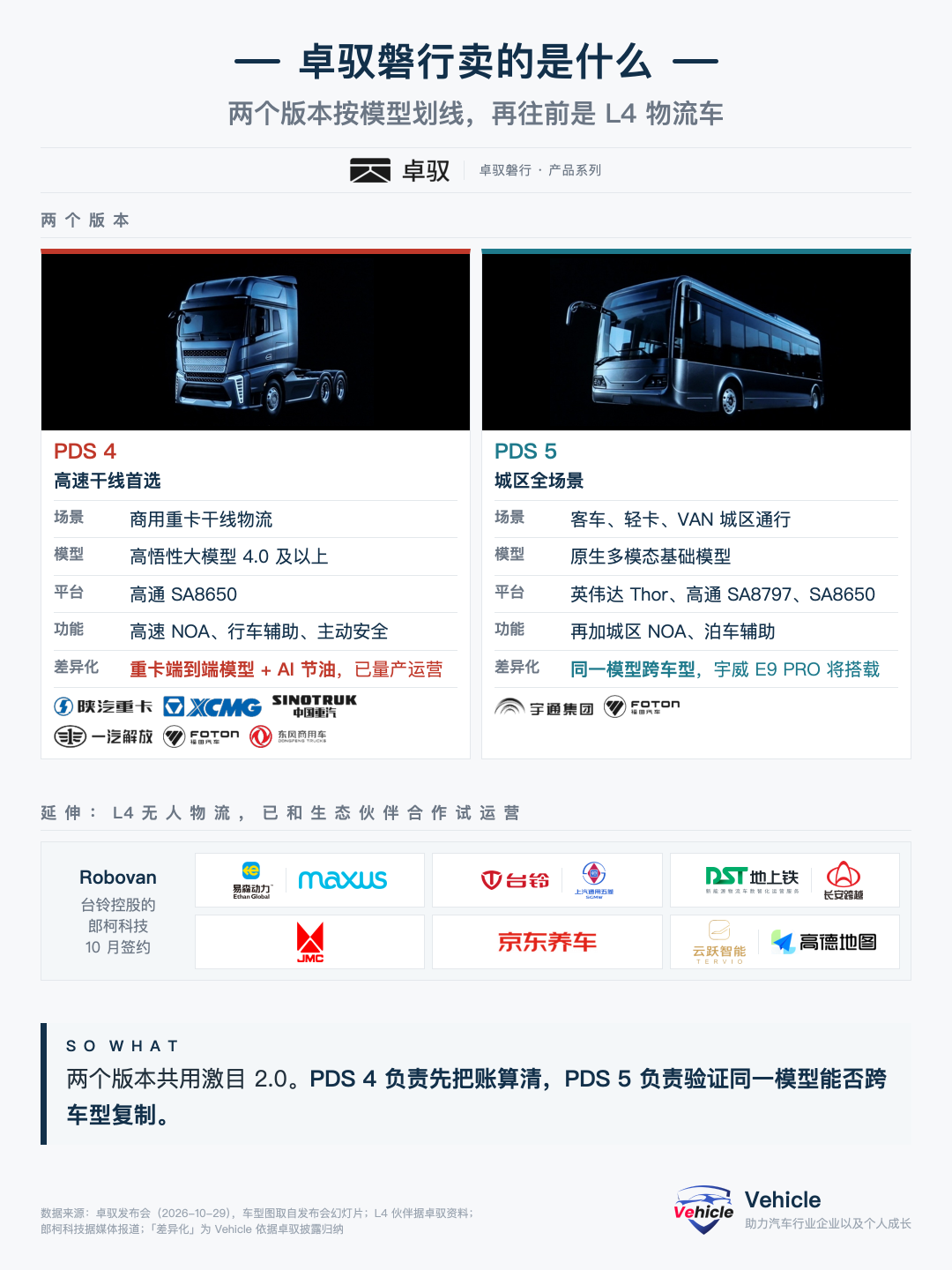
First, products. Zhuoyu's passenger vehicle solution is called Chengxing, and its commercial vehicle solution is called Panxing. Zhuoyu's metaphor is Bumblebee and Optimus Prime. Panxing is divided into two tiers by model version.
PDS 4, high-speed trunk lines: based on the Highly Intelligent Large Model 4.0 and above, Qualcomm SA8650, providing high-speed NOA, driving assistance, and active safety. The differentiation is the end-to-end model plus AI fuel saving. Looking at this configuration, Zhuoyu has again squeezed the 8650 hard, and the cost-performance ratio is probably stretched well.
PDS 5, full urban scenarios: based on the native multimodal foundation model, with platforms including NVIDIA Thor, Qualcomm SA8797, and SA8650, adding urban NOA and parking assistance, targeting buses, light trucks, and VANS.
01 Customers: seven top players, progress in three tiers
Zhuoyu says that six heavy truck brands-XCMG, Shacman, Sinotruk, FAW Jiefang, Foton, and Dongfeng-together account for more than 93% of the market share, plus bus maker Yutong, for a total of seven. A new brand customer not yet publicly disclosed was also mentioned on stage.
Already running: Shacman Delong X5000 was mass-produced in June this year, with hundreds of vehicles running on express trunk lines. The launch event also showed a frontline case between Shacman and Yunda.
Models already released or nominated: XCMG Hanjing was released in September, Dongfeng Tianlong KH-L2+ was released in October, and Sinotruk Sitrak, FAW Jiefang J7 and J6 Pro, and Foton Auman Galaxy 5 are also being advanced. Nominations, or deliveries and roll-offs, may gradually occur within the year.
Next-generation versions: Yuwei E9 PRO will carry PDS 5 and support both high-speed and urban NOA, and Foton's new light truck and VAN platforms will also use it.
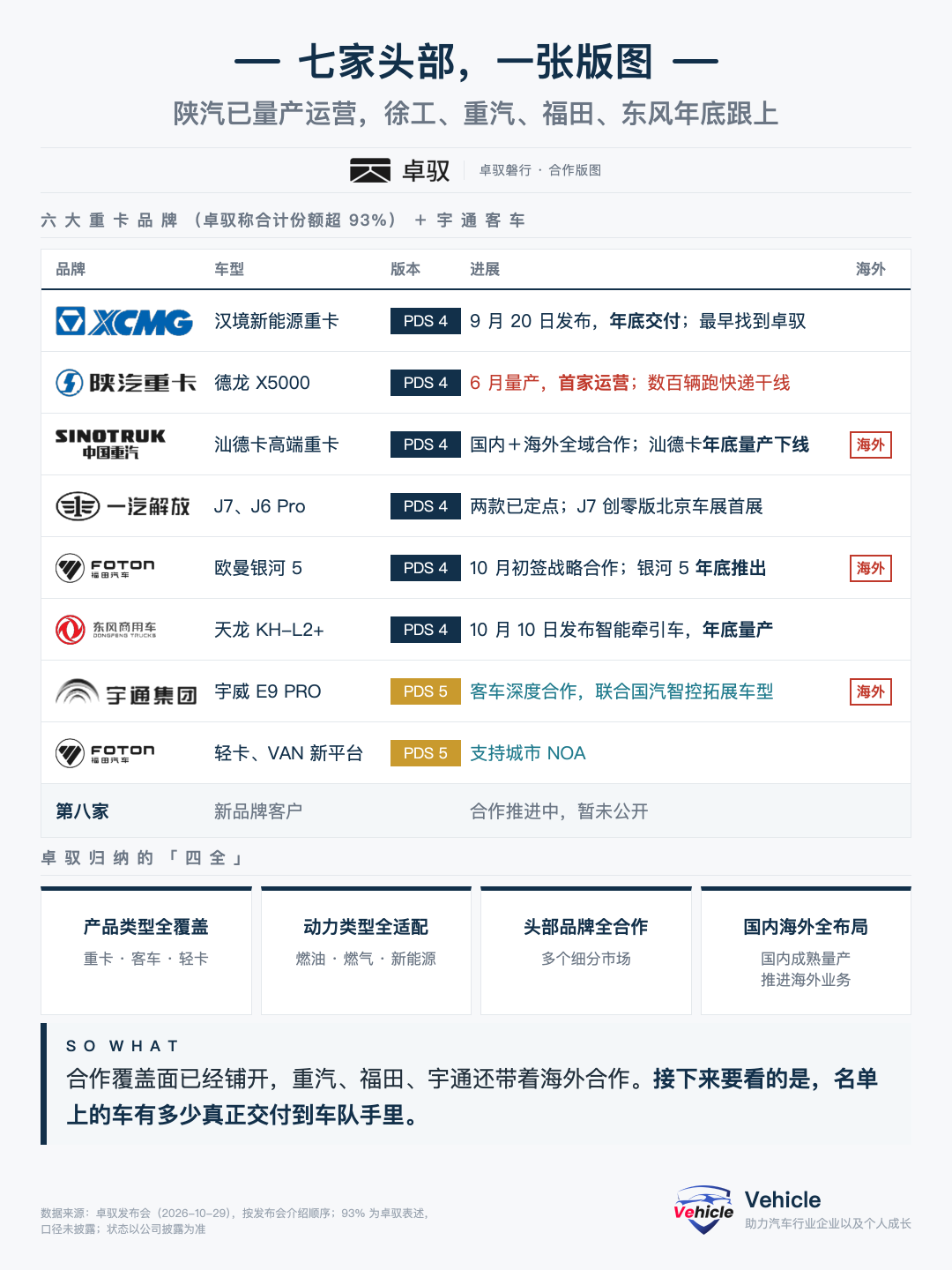
Usage rate is also worth looking at. On stage, it was said that the usage rate has been rising rapidly in the past two months, and the company's goal is to use high-speed NOA for more than 90% of high-speed mileage. This number explains the situation better than the partner list, because fuel saving only occurs when the system is turned on.
Zhuoyu summarizes these achievements as the "four alls": full coverage of product types, full adaptation to power types, full cooperation with top brands, and full layout domestically and overseas. Full power adaptation is easy to overlook: fuel, gas, pure electric, hybrid, and hydrogen fuel all need adaptation. This is the reality of the heavy truck market and also the advantage of Zhuoyu's accumulated "oil-electric same intelligence" in the passenger vehicle market.
02 The map: from trunk lines to the last mile
Putting these businesses onto the route of one shipment, what I see is a larger picture.
Goods first travel on trunk lines, which is the main battlefield of PDS 4 and heavy trucks; after entering the city, there are light trucks and VANS, corresponding to PDS 5; the last mile is handed over to unmanned logistics vehicles. The Robovan jointly developed by Zhuoyu with SAIC Maxus and Yisen Power has already been put into trial operation.
This line has just moved one step further. According to media reports, on October 30, the day after the launch event, the Langke Technology intelligent logistics vehicle headquarters project was signed in Wuxi, controlled by Tailing Technology, with Zhuoyu, Ruili Kemi, and others taking stakes.
In terms of division of labor, Tailing is responsible for vehicle manufacturing, after-sales network, and delivery scenarios; Zhuoyu provides smart driving technology and intellectual property licensing; Ruili Kemi provides brake-by-wire and chassis.
Tailing's role is very interesting. It is an electric two-wheeler company, and its dealer network already has transportation demand.
Currently, intelligent logistics vehicles equipped with Zhuoyu's smart driving solution have been tested in Tailing stores, mainly for transporting two-wheeled vehicles and auto parts.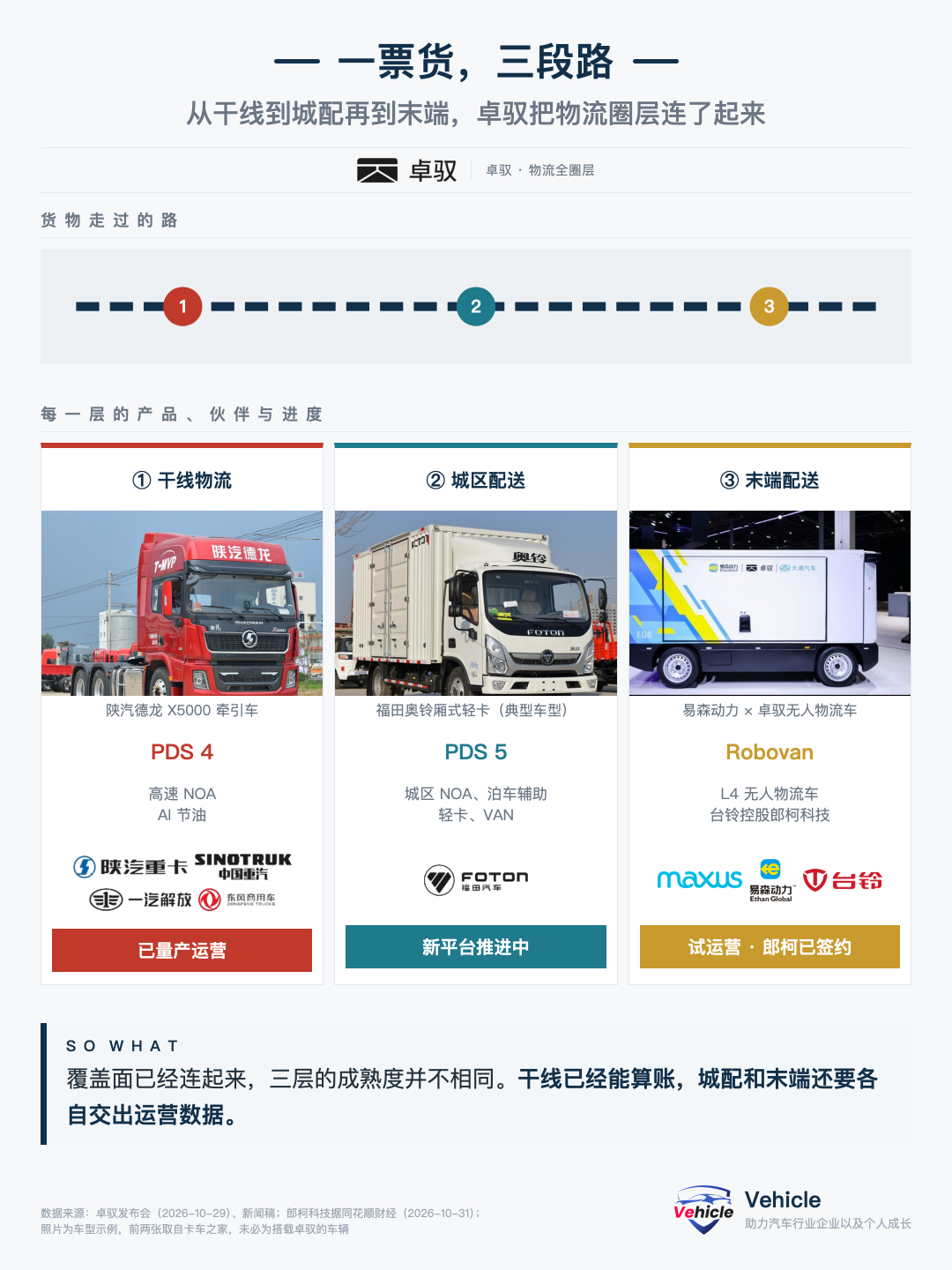
Shen Shaojie's exact words were: from trunk line logistics to urban distribution, and finally terminal delivery. The cooperation with Foton is very typical; the same agreement covers heavy trucks, light trucks, and unmanned logistics vehicles.
My judgment is that the value of the full circle lies in the fact that the same foundation can repeatedly amortize R&D. Each additional layer gives the model and data one more place to be used. But the progress of the three layers differs greatly: trunk lines already have operating data, while urban distribution and terminal delivery still need to prove their own accounts.
Passenger vehicle smart driving compares the experience of a single scenario, while on the commercial vehicle side, the comparison has begun over who can cover the entire journey of one shipment.
05 Going overseas: first follow the vehicles, then pass the Europe test
The next step after domestic mass production
This map is also extending outward. Commercial vehicle smart driving going overseas has one more path than passenger vehicles: Chinese trucks already have scale overseas. First Commercial Vehicle Network estimates that heavy truck exports in 2025 will be about 330,000 vehicles.
Based on September market shares compiled by Soochow Securities, the five partners together account for 95.9% of heavy truck exports. This reflects the breadth of channel coverage, and Zhuoyu already holds a first-mover advantage.
Currently, Zhuoyu has established overseas cooperation with Sinotruk, Foton, and Yutong. Europe is another front; its Braunschweig headquarters opened in May, and the German team continues to expand.
The Wolfsburg road test on September 26 was a public trial: Volkswagen ID. Buzz, WB025 section, 24.9 kilometers, 23 minutes, focusing on stop lines, construction lanes, roundabouts, right of way, and speed limits—all areas where regulatory differences are most concentrated.
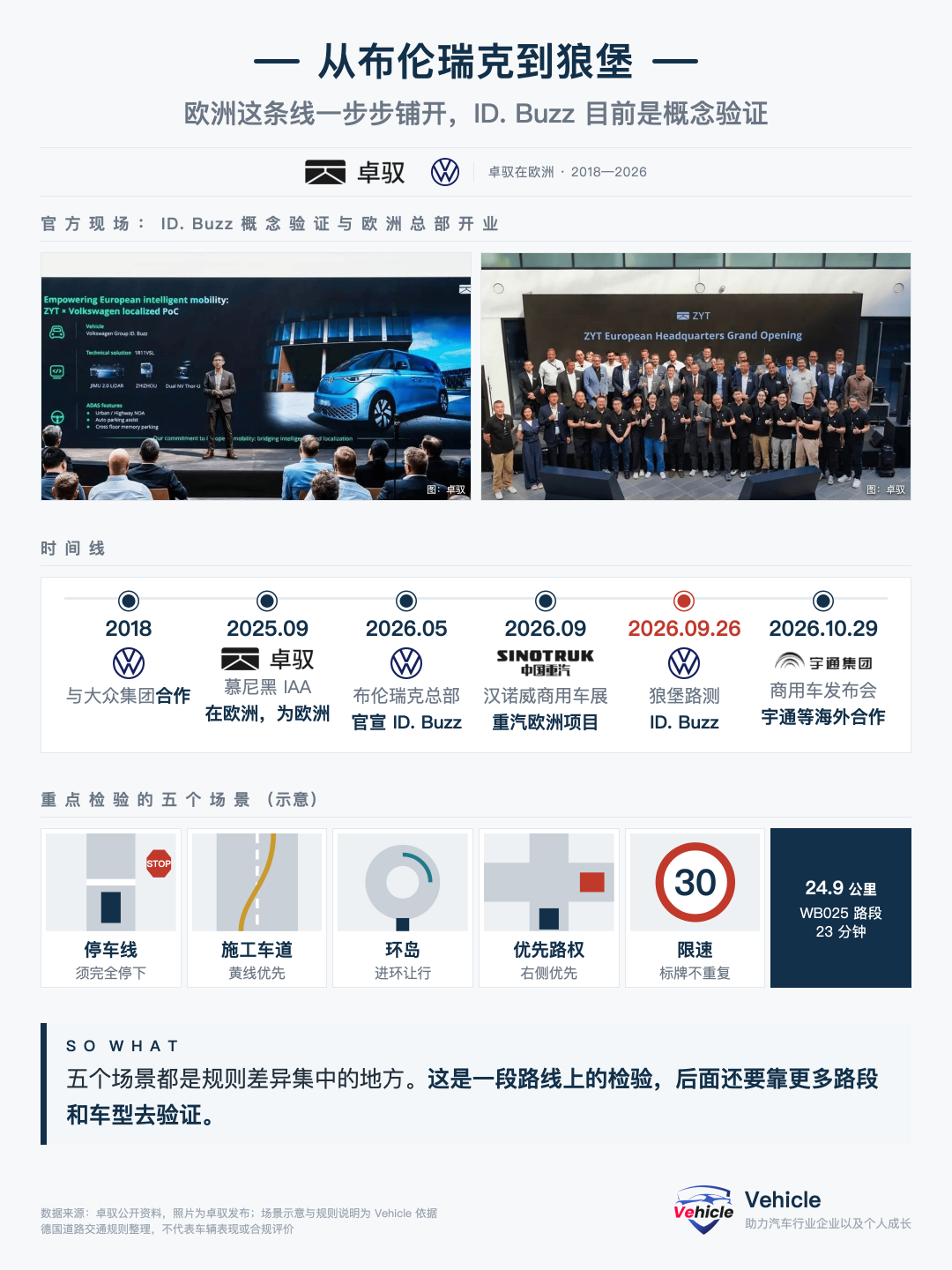
The real test is shifting from "the vehicle has arrived" to "smart driving is actually being used." This is the first piece of empirical evidence, and more road sections and vehicle models will be needed going forward.
06 Final thoughts
Don't just watch the launch event—keep an eye on these three numbers
After watching this launch event and breaking down the figures Zhuoyu provided, I have two judgments about the so-called second half of smart driving.
1. Competition in smart driving is shifting from the number of features to performance requirements, and ultimately it must be able to calculate returns clearly. Today, commercial vehicles are the first to reach this stage.
2. The value of foundation models must be proven by migration costs across vehicle models and regions, and this may be the first step toward embodied intelligence.
Next time you watch a smart driving launch event, you can start by asking: can smart driving help sell vehicles?
That's today's sharing. If you find it useful, please like, forward, and click Wow, and you're also welcome to share your views in the comment section.
*Reproduction and excerpting without permission are strictly prohibited-
-
![]()
ZTE Rumored to Sell Phone Business at 40 Billion Yuan Valuation, with a Major Internet Company Set to Take Over? Official Response Arrives
-
![]()
Prompt Engineering in Practice: Giving Six AI Characters Distinct Speaking Styles
-
![]()
Xingyu Co., Ltd.'s Q3 Net Profit Falls Nearly 40%: Chinese Automotive Lighting Has Won on Styling, but the Profits Are Gone
-
![]()
More like twins: the growth paths of these two automakers are strikingly similar
-
![]()
Chinese Automakers Go Global: Entering the "Export Quota Competition" Phase
-
![]()
New Energy Vehicle Exports Surge, but Smart Driving Remains an Overseas Weak Spot
-
![]()
"Rush-built cars" face regulatory crackdown
-
![]()
Long Gone From View, These New Forces Are Still Fighting to Come Back