Automotive Chip Giant Raises Prices Again: Can Automakers Still Absorb the Costs?
 11/04 2026
 331
NXP, the automotive chip giant, has once again signaled price adjustments to its channels. According to industry chain sources, the new round of price adjustments will take effect on January 1, 2027, covering selected distribution and direct supply product lines.
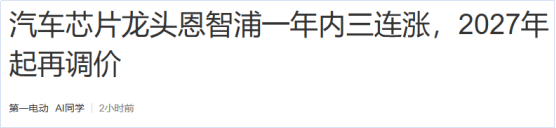
This marks NXP's third round of price adjustments within 2026, following the previous two rounds implemented in April and June respectively—only two months apart.
With three price hikes in a single year, NXP's stated reasons have been highly consistent, all citing continued increases in raw materials, energy, labor, logistics, and upstream supplier costs.
NXP is the world's second-largest automotive semiconductor manufacturer, primarily engaged in automotive processors, MCUs, and wireless connectivity chips. Its products are widely used in core areas such as body control, powertrain systems, and smart cockpits, with customers spanning major global automakers and Tier 1 suppliers.
This means NXP's price increase will ripple through the entire automotive industry chain.
Moreover, since 2026, major automotive-grade suppliers such as Texas Instruments, Infineon, STMicroelectronics, Renesas, and ADI have all raised prices in succession.
For automakers, cost and profitability pressures are set to become more pronounced. At present, terminal price competition in the domestic auto market remains intense. Most automakers are already grappling with operational challenges such as narrowing profit margins and long cost transmission chains. Coupled with the deepening transformation toward automotive intelligence, the value of automotive-grade chips per vehicle continues to rise. The successive price adjustment moves by leading semiconductor manufacturers will directly increase rigid expenditures on the vehicle procurement side.
NIO has previously disclosed that its per-vehicle cost in the second quarter of this year rose by 14,000 yuan compared with the end of 2025, adding about 1.5 billion yuan in costs for the quarter.
This is not an isolated case in the industry, and rising costs across various items have further squeezed the profit margins of vehicle manufacturers. Relevant data shows that in the first half of 2026, the average profit margin of domestic vehicle manufacturing fell to 1.5%, a nearly ten-year low.
For most automakers, it is difficult in the short term to fully absorb this incremental cost through internal lean cost reduction, and it is equally difficult, in the current terminal price competition environment, to smoothly pass on the full cost increase to downstream consumers.
This is especially true for automakers that have not yet established diversified supply chain layouts. The long validation cycle and high introduction costs of automotive-grade chips mean it is difficult for them to quickly complete alternative material switching in the short term. This cost-side uncertainty will continue to affect subsequent vehicle pricing strategies and production scheduling arrangements.
-
![]()
Can Li Jiaqi Help Chen Yusen Land a Big Result?
-
![]()
Attention Inflation: Big Tech Is Busier but Earning Less -
China's Auto Export Champion Sees Revenue Hit Record High
-
![]()
"Little Blue Light" Returns with Its Exclusive Color—Is the L3 Era Approaching?
-
![]()
Can the M-Hero X700 Become the Ultimate Box That Balances Off-Road Capability and Family Use?
-
![]()
Young People Are No Longer Buying Cars
-
![]()
Self-Driving Tech Is Getting Cheaper and Cheaper—Are Suppliers Sacrificing Profits for Market Share?
-
![]()
BYD's 490,000 Vehicles Dominate the Field as Joint-Venture Automakers Beat a Hastier Retreat: October Auto Market Undergoes Major Shakeup