Why Isn't the Auto Industry Panicking Over Nvidia's Leadership Change?
 11/16 2026
 363
Introduction
Even without the butcher Huang, we're not about to eat pigs with their bristles on.
"Chief Qiao ran the Beggars' Gang for decades, working diligently, and actually turned it into the number one gang in the jianghu. Then Quan Guanqing fabricated a scandal about him having an affair with Madam Ma, slapped a Tongliao hat on him, and just like that, all of Chief Qiao's contributions were wiped out and he was expelled from the gang! Where is justice? Where are the people who support Chief Qiao? Doesn't he have a loyal core team?"
One thing many foreigners dislike most about us is that because China's history and cultural heritage are so long, we have truly practiced the meaning of "there is nothing new under the sun." And so, regarding the recent series of events surrounding "Jensen Huang's affair," Chinese netizens once again had a flash of inspiration. Even better, one commenter in the comments section chimed in with: "No help for it—who told him not to be a Song dynasty man."
All these changes came too suddenly, because originally this man appeared in American political circles as a loyal and indispensable minister.
Just at the beginning of the year, Jensen Huang was still at CES talking up "strong demand from Chinese customers for H200," and promised that if the US Commerce Department permitted sales to China, 25% of sales revenue would be turned over to the national treasury. When Trump visited China in May, he specifically notified Huang to rush over and accompany him midway. Even just over a month ago, he was at Nvidia's GTC conference in Berlin talking about "AI factories compressing on-site deployment from six months to fourteen days." As for the $193.7 billion in data center revenue for fiscal year 2026 and pushing Nvidia's market cap to four trillion dollars—these were achievements laid out on the table for all to see.
From the helmsman of a top tech giant driving the AI revolution, a patriot doing his utmost to reduce the national deficit—falling from the peak took just a little over a week. An apology letter, independent investigation, external lawyers, new revelations involving direct subordinates, reports that the board was preparing to dismiss him, and lawmakers calling for action—all landed one after another. And with Jensen Huang's departure, Nvidia's stock fell over 13% at market open, evaporating nearly $500 billion in intraday trading.
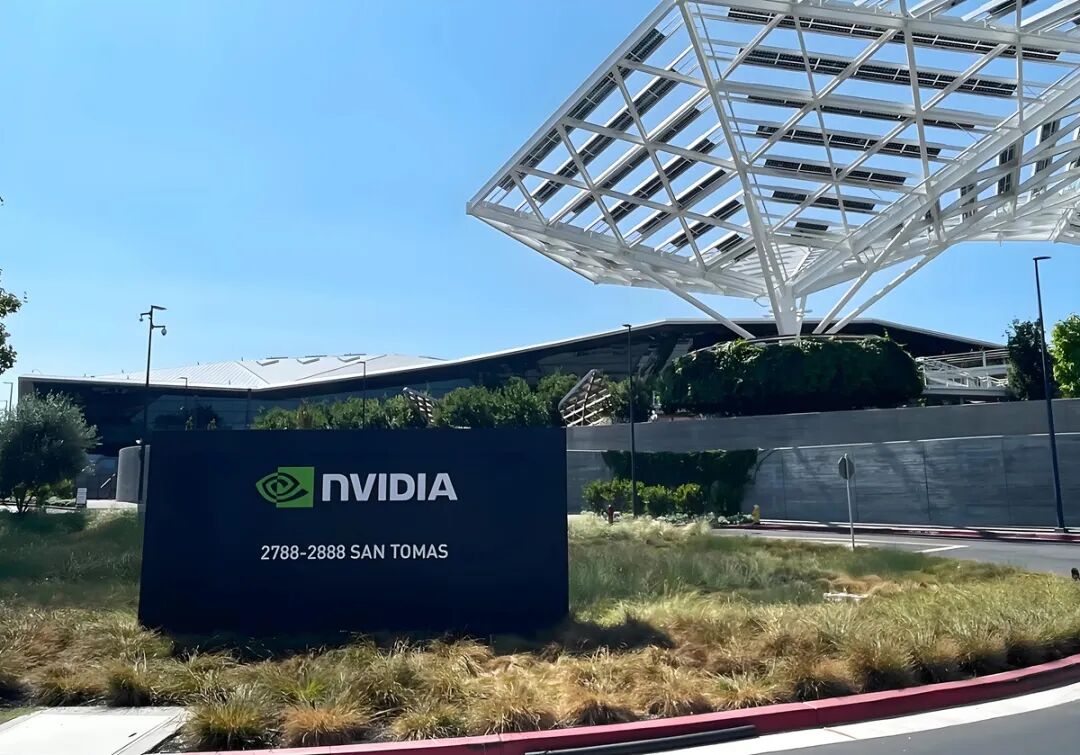
What's interesting, however, is that compared to the raging public opinion in the US and the Chinese masses enjoying the drama, the auto circle has been quiet in a way that's a bit off-script. Although a few executives have used it as dinner table conversation, in reality no OEM held overnight meetings, let alone emergency discussions and adjustments by project teams. Designations proceed as usual, OTA updates continue as usual.
Don't think this calm is due to sluggishness, because Nvidia's penetration into China's domestic auto industry is deeply embedded.
Based on information from multiple public databases, among domestic passenger car intelligent driving domain control chip installations from January to September this year, Nvidia's three mainstream products totaled approximately over 2.2 million units, with market share heading straight toward 40%. At Nvidia GTC 2026, GM, Toyota, Mercedes-Benz, and Hyundai all sent representatives, and BYD and Geely were also present.
Deeper than chips is the computing power cards and various supporting development tools Nvidia provides—DriveOS, CUDA, Omniverse, and DRIVE Sim all live in the same environment: cloud DGX training, OVX simulation, vehicle-side AGX inference. Perception debugging, synthetic data, and virtual validation of in-vehicle design all run on it. Tesla's Cortex 1 is equivalent to over 100,000 H100s, XPeng's cluster exceeds ten thousand cards, and the majority of the bill for each iteration of intelligent driving large models is recorded here. And domestic giants like BYD and Geely have also joined Nvidia's autonomous driving development platform NVIDIA DRIVE AGX Hyperion.
For such a company to suddenly change leaders, and in such a bizarre manner, at such rapid speed—how could the auto industry not be affected? Why are domestic automakers and related supply chain companies so calm?
01 A Key "Foundation," But Not the Only One
When Nvidia launched the DRIVE platform in 2015, what OEMs were buying was actually a computing power board. But after a decade of development, what's being handed over is an entire package.
On the vehicle side, from Orin's 254 TOPS to Thor's 2000 TFLOPS, with DriveOS, DriveWorks, and the Halos safety system in between. In January 2026, Nvidia open-sourced the Alpamayo chain-of-thought model, AlpaSim simulation tool, and physical AI datasets together; NuRec can restore road test videos into editable 3D scenes—changing trajectories, swapping weather, generating dozens of training samples.
Even the underlying models are completely free and open—Nvidia places its return expectations on computing power demand. And Chinese automakers have been the most enthusiastic beneficiaries of this dividend.
Li Auto's AD and XPeng's XNGP urban navigation were all built on Nvidia's platform. BYD's God's Eye B uses a single Orin-X on the Han L and Tang L, while God's Eye C uses Horizon Robotics' Journey series. Xiaomi's SU7 and YU7 use Orin and AGX Thor.
According to Gasgoo statistics, among domestic intelligent driving domain control chips from January to September this year, Orin-N was about 929,000 units at 15.6%, Thor-U about 777,000 units at 13.0%, and Orin-X about 528,000 units at 8.8%—the three combined firmly holding the top spot in intelligent driving chip installations. For comparison, Huawei's Ascend 610 had roughly 860,000 installations at 14.4%.
Of course, based on experience since 2016, anything that cannot be controlled by ourselves domestically will be substituted. And our substitution didn't start on November 12. The quiet-as-a-chicken behavior not only reflects silence due to the sensitivity of the matter but also demonstrates that there's no need for an overreactive "the sky is falling" attitude because preparations exist.
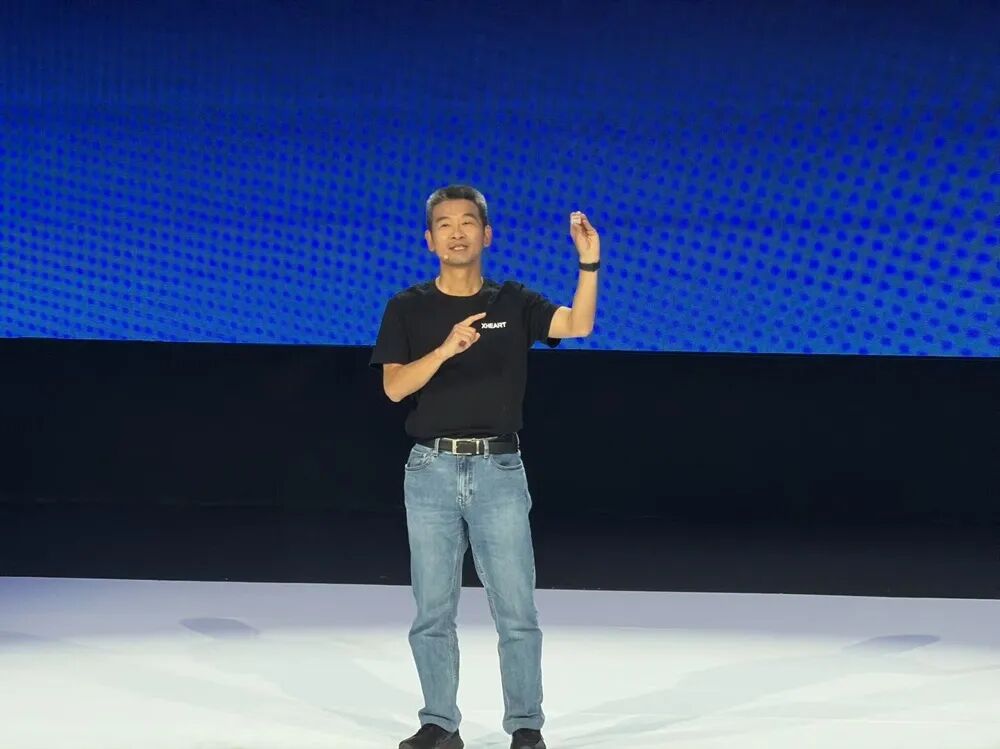
Image | By late 2026, computing power autonomy and self-developed chips are an absolute consensus in China; the image shows the XHEART X7 Ultra launch event
In the first half of 2026, in the self-owned brand passenger car full-stack intelligent driving chip market, Horizon Robotics ranked first with 31.94%, and among urban NOA high-end suppliers, Horizon Robotics ranked second with 22.82%.
According to Horizon Robotics, the Journey 6 series has already secured designations from over 25 automakers and over 100 vehicle models domestically. This author found NE Times new energy data stating that Horizon Robotics' chip shipments in September alone were 183,583 units, with market expansion accelerating.
In addition, self-developed chips from XPeng, NIO, Li Auto, and BYD will also gradually hit the road in the future. Huawei's Qiankun ADS, relying on its self-developed MDC platform and Ascend automotive-grade chips, has achieved a full-stack closed loop, with its supply chain completely separated from Nvidia. Xiaomi's Xuanjie D100 is slated for 2027.
According to CAAM figures, the domestic rate of automotive-grade chips rose from 4.7% in 2022 to 11.9% in Q1 2026. The current shortcoming is that for high-end computing SoCs, domestic self-sufficiency remains below 10%. We must acknowledge the gap in high-end products, but overall share is continuously narrowing.
02 No One Can Stop Our Pace
Nvidia's announcement explicitly states that operations, customer commitments, and product roadmaps will not be interrupted. And as of today, no automaker has disclosed any supply impact.
So we can broadly conclude that this turmoil will not cause a cliff-edge supply cutoff for short-term existing orders. The key is that it will inevitably affect access permissions and technology iteration for the next-generation DRIVE—that is, the next round of designations.
Chips take two to three years from designation to installation, and already-designated projects have long-term framework contracts. Replacement costs are so high that no OEM would disrupt its plans. Similarly for Nvidia, for vehicle-side chips under signed contracts—contracts that neither break existing Commerce Department rules nor can be breached without facing massive compensation—continuing to execute is the natural course.
Especially given that this field already has a large number of Chinese companies attempting to step in and substitute, in order to optimize financial data and prop up the stock price amid the current situation, there's absolutely no way they would suddenly "cut off supply."
But the key issue must land on the focal point of computing power cards. Without additional computing power, how can OEMs and intelligent driving suppliers complete various simulations, algorithm training, and other work? Actually, this area has also seen relatively positive changes over the past year.
According to IDC data, in the China data center AI chip market by shipment volume in the first half of 2026, Nvidia shipped about 678,000 units with a 34% market share, down about 44% from the first half of 2025. For comparison, Huawei's Ascend series reached 28% market share with 572,000 units. The gap between the two has narrowed from 31 percentage points a year ago to 6 points.
Ascend relies on the CANN ecosystem to handle model migration, while Hygon and Cambricon are landing in different scenarios; migrating cloud training to domestic clusters is no longer just a contingency plan.
Of course, we can't just say the nice things—after all, this "holding up" comes at a cost. Domestic computing power is still constrained by production capacity, interconnect bandwidth, and ecosystem maturity. CUDA's moat won't be broken in the short term, and the toolchain needs time to be honed. Meanwhile, constrained by semiconductor processing equipment, our substitute products still have disadvantages in transistor density and energy consumption. This problem has always existed, so domestically over the past two years there has been a widespread shift to running external procurement, self-development, and domestic substitution in parallel.
A media commentator made it very clear these past couple of days: the stability of domestic computing power card supply over the past year was largely dependent on Jensen Huang's personal balancing act within the boundaries of Commerce Department rules. We did rely on his personal efforts to preserve quite a few existing orders and signed contracts. However, the successor Crees, when facing the current situation, will inevitably prioritize compliance and risk control, and most likely will not continue this flexible mediation approach. Even the remaining existing supply margins, fine-tuned quotas, and version iteration space may all tighten.
Under such circumstances, domestic computing power will shift from a backup option for supplementary pilots and watchful standby to a mandatory risk-control necessity.
For OEMs, the current optimal solution is to accelerate self-development and domestic substitution plans while implementing overseas solutions that can still be executed.
03 The Elegy of North American Chinese Elites
After the Nvidia board sent the man away, a joint letter from hundreds of employees quickly spread online, with fierce language demanding the board collectively resign, calling for Jensen Huang to return, and so on. However, this letter doesn't hold up to scrutiny—media compared the wording to the 2023 OpenAI employee revolt letter and found it was almost copied verbatim. What's more telling is that the letter said the board fired him, while the announcement and the 8-K filed with the SEC both used "resigned."
The real thing is actually less dramatic but carries more weight. Wired magazine found a post on the internal suggestion box from a senior engineer, with over 1,600 comments below, most asking to bring the boss back. Someone mass-emailed all employees demanding clarification of the decision process, and someone placed flowers in front of the headquarters logo. On the anonymous workplace community Blind, of 232 registered users showing as Nvidia employees, nearly 90% believed Jensen Huang should continue in his role. Many even said that the company they'd worked at for over a decade had just had its "central axis" pulled out by a single announcement.
Using the term "central axis" to describe Jensen Huang and Nvidia is actually not an exaggeration. The most counterintuitive thing about this company is that there is no number two figure. There are thirty-six executives who report directly to Jensen Huang—no COO, no one-on-ones, no formal succession plan. Huang himself has explained the reasoning: GPU, memory, networking, power, cooling, and software must be optimized together; adding a filtering layer in between makes co-design impossible. Information is shared with everyone simultaneously, and the one-generation-per-year product cadence is bound to this approach.
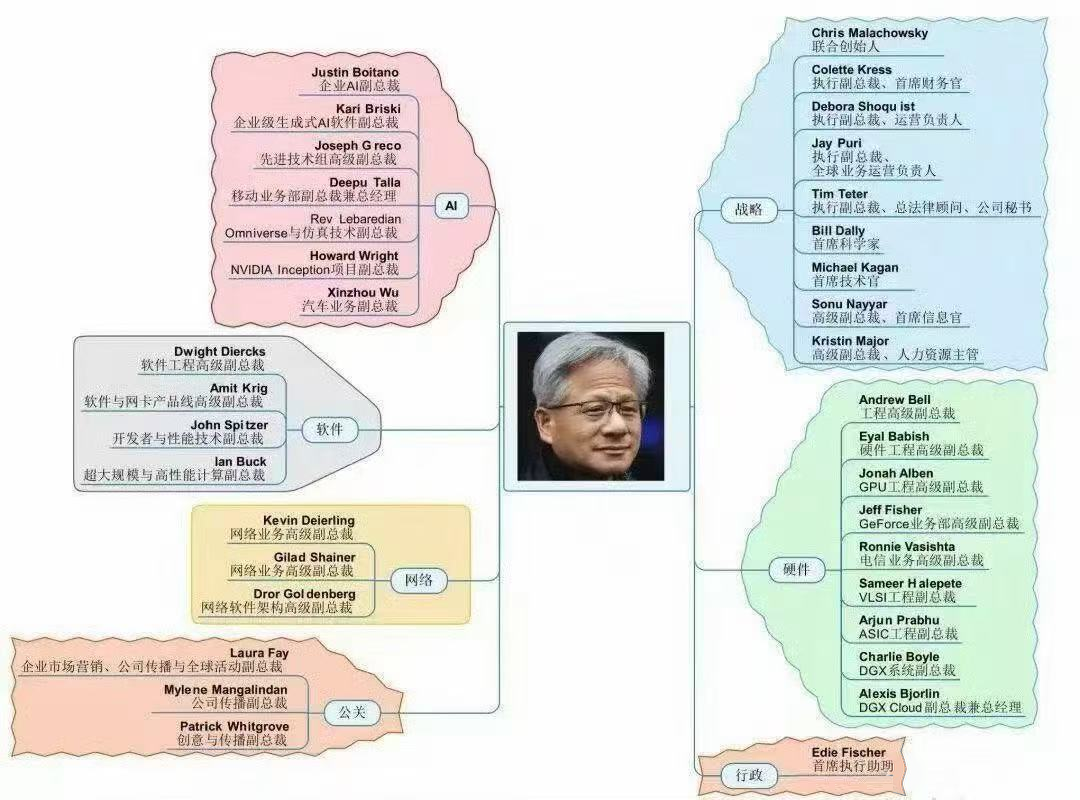
And that's exactly where the problem lies—thirty-six people reporting to one person simultaneously doesn't mean any one of them can replace that person. Apart from Jensen Huang himself, no one has been given cross-business-line integration authority, and no one has been systematically cultivated as a backup. Although this leather-jacket-loving CEO holds only a small stake and doesn't even have super-voting rights, he is truly Nvidia's irreplaceable core, the "central axis" of all operations. What has kept him at the helm of this company for thirty-three years isn't the charter—it's that daily operating system with him as the bus. The flatter the organization, the cleaner the cut.
The successor Crees served as CFO for thirteen years—long enough to steady the ship through a transition period, fine for keeping the books, but stepping on the gas is another matter entirely. Nvidia has a playbook that runs on personal credit: invest in customers first, then have those customers use the money to come back and buy cards. Swap in a compliance-first manager, and this kind of investment will certainly be curtailed. The new management will most likely also install a COO, consolidating dozens of reporting lines into conventional hierarchies. But is this really something a board resolution and a single meeting can solve?
A man who built a four-trillion-dollar company and ran around securing licenses for his own chips has proven able to surrender all his duties within a week—before investigation conclusions even came out. A scholar at Fudan put it bluntly: this incident reminds non-white elites that the American Dream has a visible ceiling. Point taken.
Qiao Feng was expelled from the Beggars' Gang, and the gang remains—only in the future, no one will be able to settle matters with a single glance. Nvidia without Jensen Huang indeed won't stall—after all, the product line is already booked out years ahead. But what about years from now?
And we here are actually quite curious about one question—Jensen Huang has fallen, so which "little yellow man" is next? Is it "Auntie Su"?
On November 13, 2026, Beijing time, Reuters disclosed that Jensen Huang had an intimate relationship with another Nvidia employee—the third revealed in the past week. The turmoil is not over, and has already become an "Aqina Sethhei"-style affair.
After Jensen Huang resigned as chief executive, many are asking: to what extent will this company continue to commit to the automotive business going forward? Actually, the answer isn't in San Jose—it's in Washington.
After the midterm elections, the partisan wrangling between Republicans and Democrats in American political and business circles has intensified, with all sides fighting over who controls that money-related channel.
Jensen Huang, caught in the middle, is indeed in an awkward position. He was a competent CEO, doing his utmost to protect market cap and profits, and lobbying to ease export restrictions to China is not out of line for the head of any multinational corporation. However, in America's current political system, this makes him a special symbol—someone who both inspects and seeks to expand business with China, and who carries a Chinese face—much easier to target than a white face. In such a sensitive period, if not him, then who else would be sacrificed?
Of course, this author still says: even without Nvidia, our smart cars and AI industry will continue to move forward.
In May 2026, Huawei released the Tao Law, the core of which is to replace geometric scaling with time scaling, using logic folding to stack circuits in layers and connect them with vertical channels, pressing down signal propagation delay layer by layer, so that performance can be improved without upgrading lithography nodes. This targets the current reality: Moore's Law is slowing, and more than 80% of the energy consumption of large AI clusters is spent on data movement.
Over the past six years, our company has been following this path. Kirin 2026 is the first to use logic folding, with public measured results showing transistor density increased by about 55% and energy efficiency by 41%. The industry judges that by 2031 it can reach a level equivalent to 1.4nm process.
On the autonomous chip manufacturing side, SMIC and Hua Hong's mature processes, JCET and Tongfu's packaging, and NAURA and AMEC's equipment are all making continuous efforts. And Huada Jiutian's EDA is also continuously catching up.
The core of competition in China's automotive intelligence is shifting from involution over computing power parameters to supply chain resilience and self-controllability. This is a positive signal.
For OEMs, what they should do is actually still the most basic things: deliver well on already nominated projects, get second suppliers running, and complete the vehicle-grade validation of self-developed chips page by page.
Whose board of directors changes at other companies, or even how those companies will fare, actually has little to do with us. After all, for OEMs, what intelligent driving ultimately delivers is not the computing power number of the hardware carried on a single vehicle, and even has little to do with how much total computing power is mastered domestically; its essence is whether the entire system can deliver the functions it claims.
Editor in charge: Shi Jie Editor: Wang Yue

THE END
-
![]()
Robot Vacuum Makers Go Global: After Taking the Top Market Share, Where Did the Money Go?
-
![]()
From "Baidu It" to "Doubao It" — A Change in More Than Method
-
![]()
Huang Steps Down: Nvidia Loses Its Soul—So Why Should Chinese Assets Pay the Price?
-
![]()
Secures Nearly 100 Million Yuan in Financing! How Does This Company Integrate Optics into Packaging?
-
Production Set to Begin Early Next Year: Lanyu Vision's 4.5-Million-Square-Meter New Plant Successfully Capped
-
![]()
It's Almost Over! October China Fuel Vehicle Sales Released: Sales of Numerous Classic Family Sedans Plummet
-
Car Quality Network: Q3 Service Complaints Jump 55.6% QoQ, with Transaction Segment Driving the Surge
-
In the Era of Intelligent Organizations, What Kind of AI Cloud Do Enterprises Need?