XPeng Q3 Deliveries Up 2.1%, Revenue Up 19.1%, Per-Vehicle Gross Profit Back to RMB 23,900
 11/17 2026
 473
Produced by Zhineng Technology
XPeng Q3 2026 Financial Report:
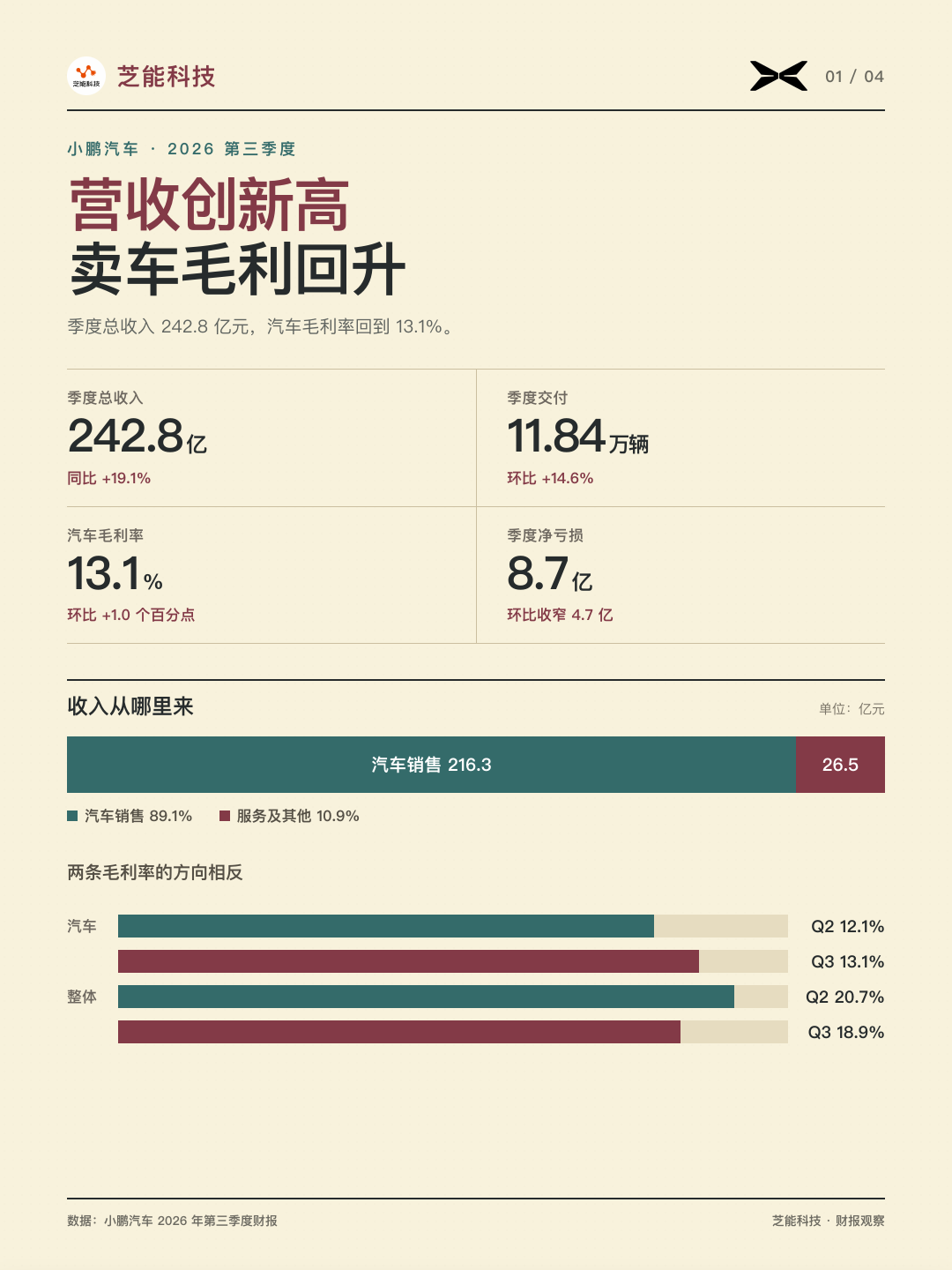
◎ Revenue of RMB 24.28 billion, up 19.1% year-on-year, with 118,390 vehicles delivered, up 2.1% year-on-year.
◎ Sales growth was modest, while revenue rose by nearly 20%, reflecting changes in model mix and overseas business on the revenue side.
◎ Automotive gross margin rose to 13.1%, with per-vehicle revenue of approximately RMB 182,700 and per-vehicle gross profit of approximately RMB 23,900, both higher than in Q2.
◎ Overall gross margin was 18.9%, with a net loss of RMB 870 million, compared with RMB 380 million in the same period last year.
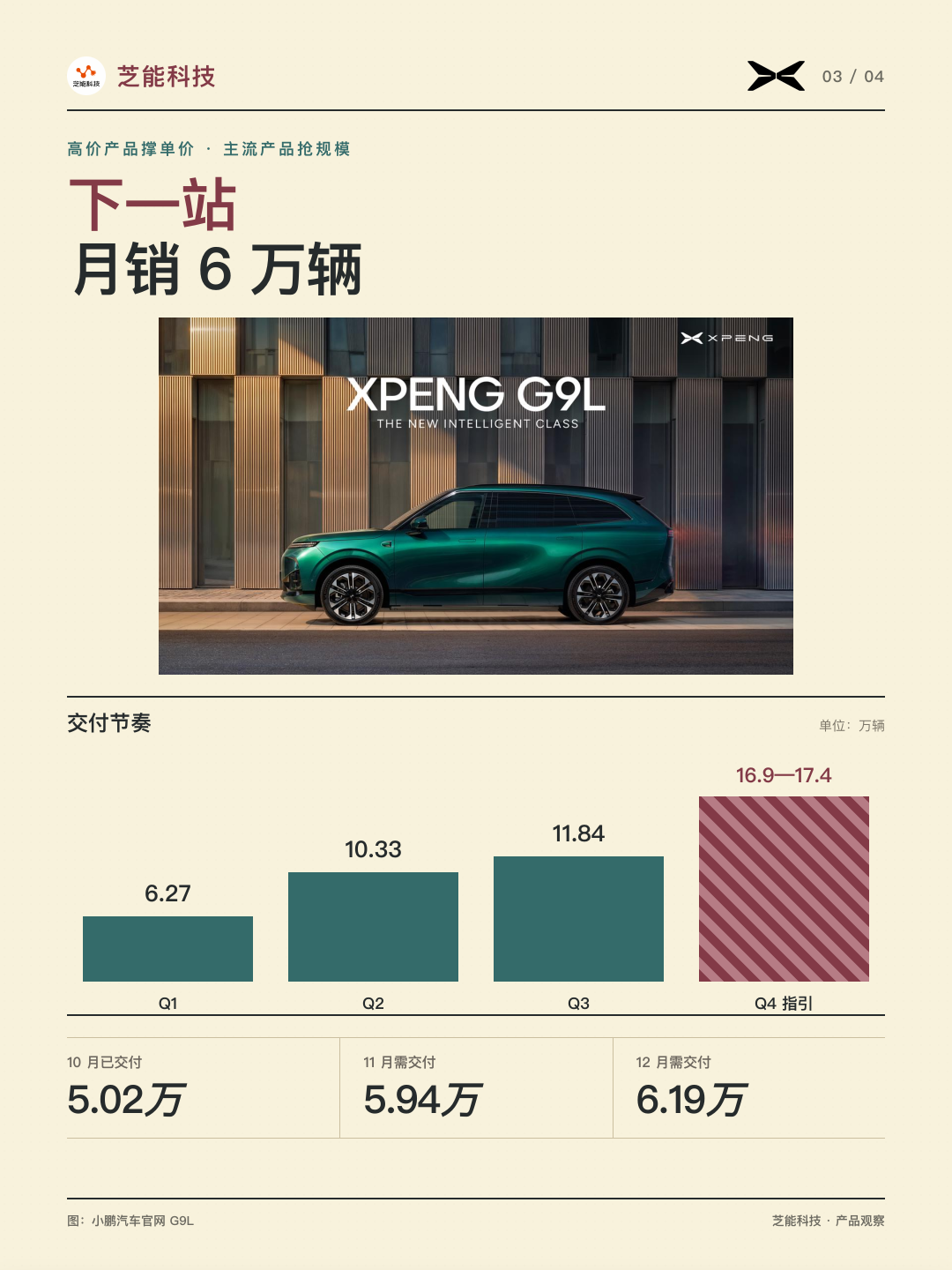
Q4 delivery guidance is 169,000–174,000 vehicles, with Robotaxi demonstration operations, IRON mass-production preparations, and Turing chip deployment advancing simultaneously.
01 Revenue Up 20%, Sales Volume Up Only 2.1%
◎ Q3 deliveries were 118,400 vehicles, up 14.6% quarter-on-quarter and 2.1% year-on-year;
◎ Automotive sales revenue was RMB 21.63 billion, up 26.9% quarter-on-quarter and 19.8% year-on-year.
Automotive revenue per vehicle was approximately RMB 182,700, RMB 17,600 more than RMB 165,100 in Q2.
◎ High-priced models such as the GX entered full delivery, raising the revenue mix;
◎ Overseas deliveries were 27,882 vehicles, accounting for 23.6% of total deliveries.
XPeng operates two product groups simultaneously: MONA and mainstream SUVs pursue scale, while higher-priced models and overseas markets raise per-vehicle revenue, with automotive revenue growth clearly outpacing sales volume growth.
Automotive gross margin was 13.1%, 1 percentage point higher than 12.1% in Q2 and flat compared with the same period in 2025.
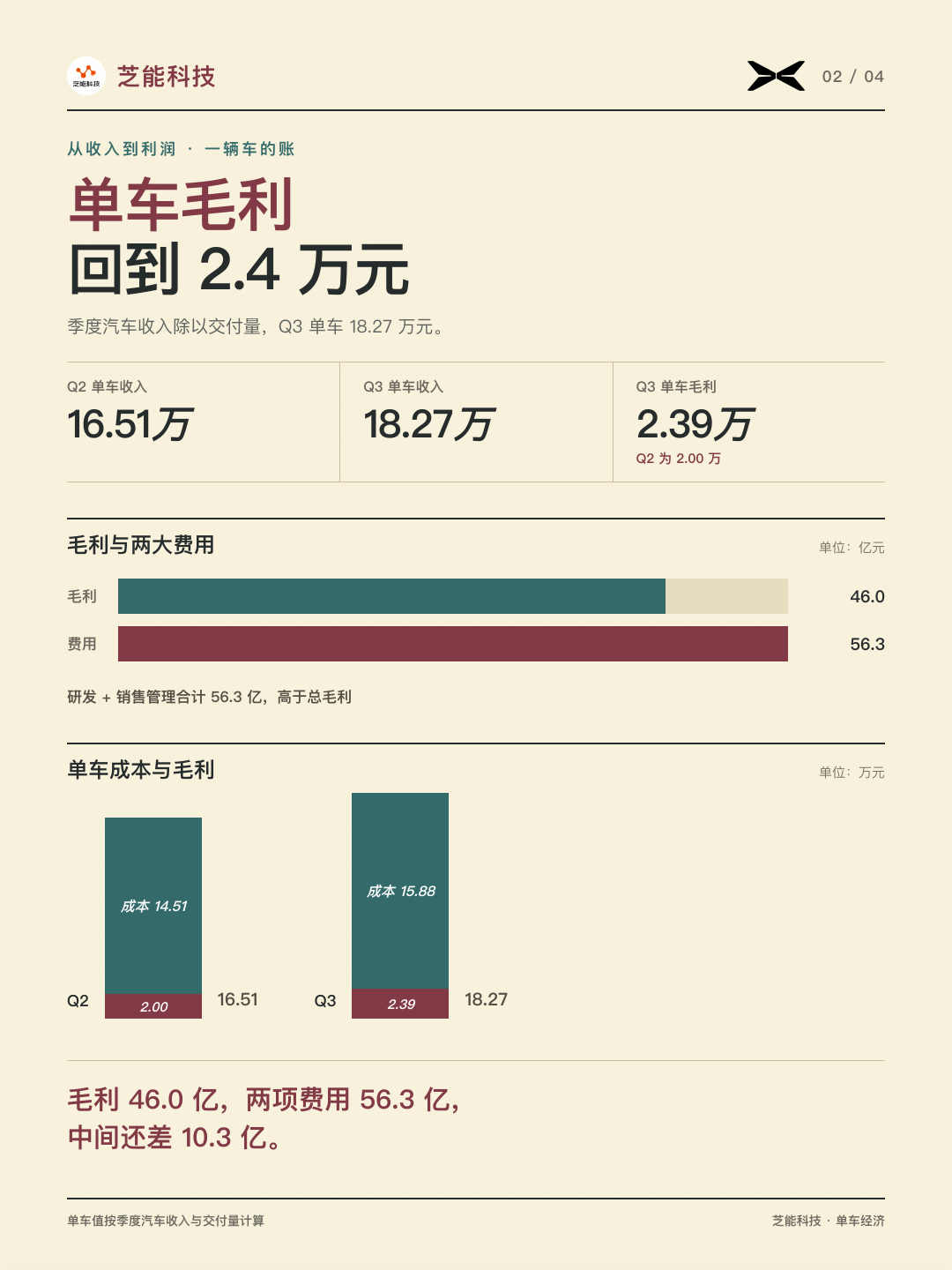
Based on revenue and gross margin, Q3 automotive gross profit was approximately RMB 2.83 billion, compared with approximately RMB 2.06 billion in Q2, an increase of RMB 770 million quarter-on-quarter; per-vehicle gross profit was approximately RMB 23,900, compared with approximately RMB 20,000 in Q2.
A higher proportion of high-priced vehicles will also push up per-vehicle costs, while fluctuations in memory, battery, and material prices and model ramp-up costs will consume part of the scale benefits.
The company mainly attributed the increase in automotive gross margin this quarter to improved product mix, and did not separately disclose the potential cost reduction from the Turing chip.
Overall gross margin fell from 20.7% to 18.9%, with the gap outside automotive. Services and other revenue was RMB 2.65 billion, slightly down from RMB 2.70 billion quarter-on-quarter, with gross margin falling from 75.1% to 67.1%, and services gross profit down approximately RMB 250 million quarter-on-quarter.
Milestone revenue from Volkswagen-related technology R&D services declined, partially offset by carbon credit revenue.
Automotive gross profit increased by RMB 770 million while services gross profit decreased by RMB 250 million, bringing gross profit from approximately RMB 4.08 billion to RMB 4.60 billion.
R&D expenses were RMB 2.85 billion, and selling and administrative expenses were RMB 2.78 billion, totaling RMB 5.63 billion, higher than quarterly gross profit of RMB 4.60 billion, leaving an expense gap of approximately RMB 1.03 billion. Net loss was RMB 870 million, narrowing by RMB 470 million from RMB 1.34 billion in Q2, compared with RMB 380 million in the same period last year.
Q4 delivery guidance is 169,000–174,000 vehicles, corresponding to revenue of RMB 30.4 billion–31.8 billion.
50,237 vehicles were delivered in October, and November and December combined still require 118,800–123,800 vehicles, averaging 59,400–61,900 vehicles per month.
As MONA and mainstream-priced SUVs ramp up, the per-vehicle revenue lifted by high-priced vehicles in Q3 will decline; if services revenue remains at RMB 2.65 billion, Q4 per-vehicle automotive revenue will roughly fall in the range of RMB 160,000–172,000, with a midpoint of approximately RMB 167,000.
Whether automotive gross margin can stay above 12% and whether R&D and selling expenses can continue to be diluted are key points to watch in Q4.
02 Physical AI Is Still in the Investment Phase
XPeng's approach is similar to Tesla's, but its product portfolio is more complex: it uses self-developed autonomous driving chips and vision-language-action models to expand into robotaxis and humanoid robots.
Vehicles provide mass-production scale and road data, and the same set of R&D capabilities is reused across more products.
The Turing chip and second-generation VLA are advancing simultaneously.
◎ The chip must balance computing power, power consumption, reliability, and cost in production vehicles;
◎ End-to-end and VLA models must withstand complex road tests in China and overseas.
◎ Whether users continue to use them and are willing to pay for capabilities determines the return on software investment;
◎ Actual intervention rates, safety performance, and cross-border compliance determine commercial boundaries.
Robotaxi has obtained L4-level demonstration operation qualification and can conduct demonstrations in Guangzhou, moving from road testing to operational validation.
There is still a gap between demonstration operations and driverless, regular, paid operations: fleet scheduling, remote support, insurance liability, per-vehicle utilization, and cleaning and maintenance all must be included in costs, and per-vehicle operating efficiency needs to cover vehicle depreciation and back-office operations.
IRON is a longer curve.
◎ In August 2026, the robotics business completed its first financing round of more than US$900 million, with a post-money valuation of more than US$6.3 billion;
◎ In September, the automated production line was launched, with plans to enter large-scale mass production by the end of the year and deliver to the market in 2027.
Mass-production yield, task success rate, manual intervention rate, after-sales costs, as well as customer payment and repeat purchases, are the data that need to be disclosed in the next stage.
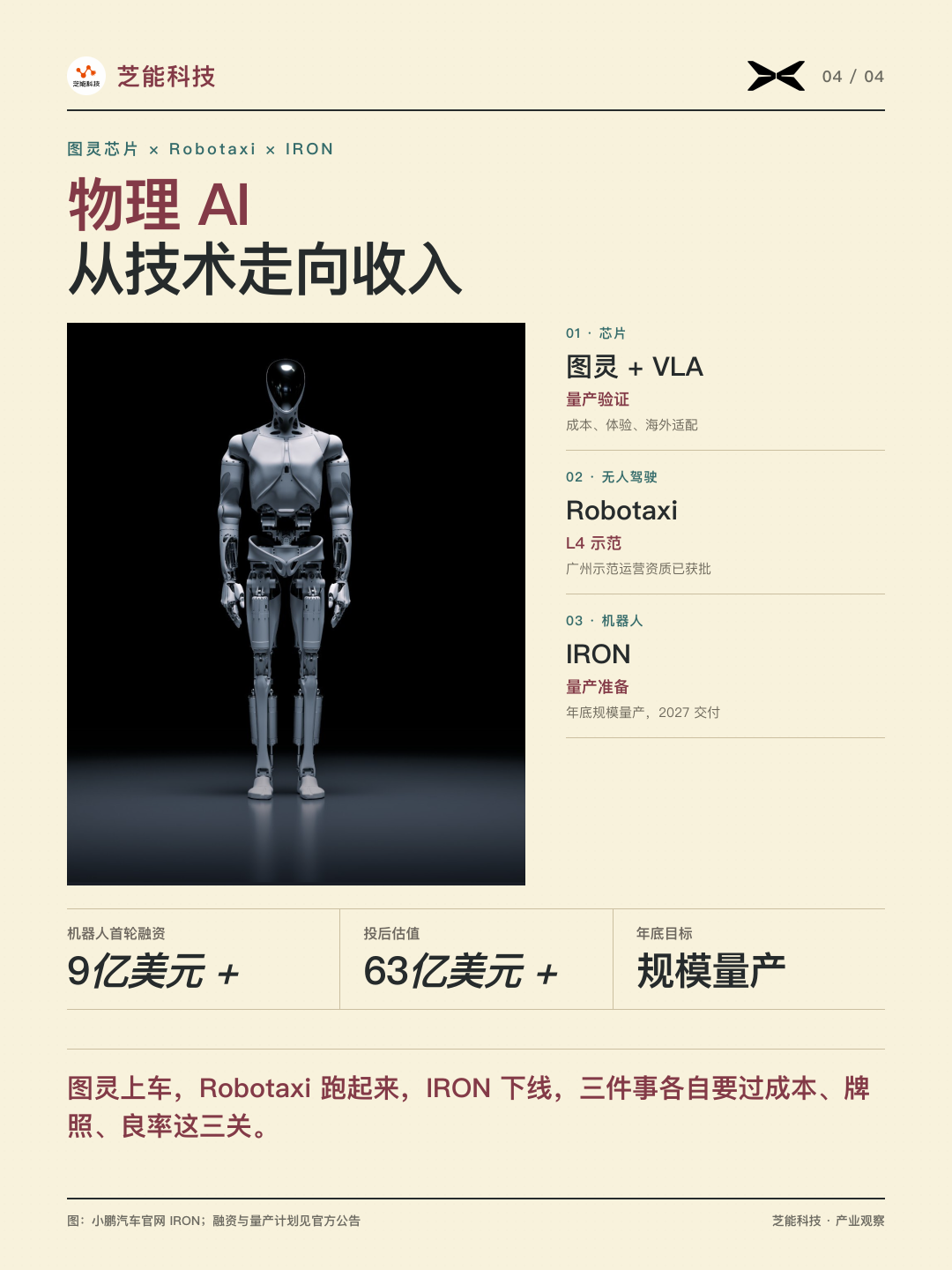
The three businesses play different roles:
◎ Chips and intelligent driving first serve automotive competitiveness,
◎ Robotaxi validates the operating model,
◎ IRON validates delivery from the production line to the customer site.
The three share some AI foundational capabilities, while safety certification, operating scenarios, and revenue cycles differ.
Cash and cash-like resources on the books were RMB 45.41 billion, RMB 4.93 billion more than at the end of Q2, including restricted funds, short-term investments, and time deposits. Continued investment in physical AI will depend on the cash-generation capability of the automotive business.
Summary
XPeng's automotive gross profit and per-vehicle revenue improved in Q3, the high gross margin of technical services declined, losses narrowed, and expenses remain relatively heavy.
If Q4 deliveries approach 170,000 vehicles, it will validate mass-production and sales organizational capabilities; going forward, the focus will be on whether automotive gross margin can withstand price changes, whether Robotaxi generates operating revenue, and whether robots move from demonstrations to deliveries.
-
![]()
AR Anti-Reflection Coating: "Reduce Reflection, Increase Transmission" — But the Essence Is Systems Engineering
-
![]()
The Year Computing Power Was Tightest: Baidu's Full-Stack Bet Begins to Pay Off
-
![]()
Metalenz Acquires Israeli Startup PxE Imaging to Advance Optical Metasurface Technology
-
![]()
Business Focus: Optical Giant ams OSRAM Posts €829 Million in Q3 2026 Revenue
-
Jet Fuel Price Surge Inflates Costs, Net Profit Falls Over 20%; Spring Airlines Issues 10 Billion Yuan in Bonds to Fund 27.6 Billion Yuan Aircraft Purchase
-
![]()
A $5 Trillion Foreign Trade Hub Hosts a Landmark Gathering of Chinese and Global Titans
-
Baidu's AI Revenue Tops 50% for the First Time, Yet Shares Hit Record Low—Baidu Is Still Essentially Selling Computing Power
-
![]()
China's 6G Communications Breakthrough: Q/V-Band Experiment Hits 27Gbps, Setting New Domestic Record