Can You Believe It? Volkswagen's Turnaround Hinges on New Energy Vehicles
 11/25 2026
 432
Introduction
Introduction
Three models combined to push Volkswagen brand's October new energy deliveries past 28,000 units—a result long overdue for the German giant.
This year has not been kind to Volkswagen Group.
Official figures show that in the first three quarters, Volkswagen Group delivered 5.88 million vehicles worldwide, down 10.6% year-on-year. Sales revenue came in at €233.4 billion, down 2.2%. Operating profit was a mere €0.1 billion—compared with €5.4 billion in the same period last year, a plunge of nearly 99%. The operating margin stood at 3.8%, still a long way from the 9% target for 2030.
The dual pressure on sales and profit has also taken a direct toll on Volkswagen Group's global ranking. In the first half of 2026, Toyota's global sales reached 5.39 million vehicles, ranking first among global automakers for the seventh consecutive year. Judging by the pace of the first three quarters, it is almost certain that Volkswagen will once again surrender the global top spot this year.
Pressure is forcing Volkswagen to accelerate its reforms.
On September 3, the Volkswagen supervisory board voted to approve the "2030 Future Plan." On top of the existing job optimization plan, roughly 50,000 more positions will be adjusted globally, bringing the cumulative optimization scale to about 100,000. The model lineup will be halved by 2035, and the four German plants in Emden, Zwickau, Hanover, and Neckarsulm are being evaluated for production suspension or conversion.
Across all of Volkswagen's global regions, the decline in the Chinese market is the most glaring.
Data shows that in the first three quarters, Volkswagen delivered about 1.379 million vehicles in China, down 30.2% year-on-year. In the third quarter alone, it delivered 405,800 vehicles, with the year-on-year decline widening to 38.5%. The financial report explicitly cites the shrinking Chinese market, intensified price competition, and the rising share of low-margin electric vehicles as the main drags on profit. Excluding Chinese joint ventures, the group's global sales dipped only about 1% year-on-year.
The reason: the core base of fuel vehicles is being continuously eroded by domestic automakers, and the shortcomings of the previous-generation ID series in intelligent features have gone unaddressed for too long, leaving Volkswagen's gap in China showing no sign of closing. Yet entering the fourth quarter, with the successive delivery of several all-new models, Volkswagen may finally have a chance to stage a comeback in the Chinese market.
01 Three New Models Put Volkswagen Back on the Joint-Venture New Energy Map
In the October sales rankings, Volkswagen finally delivered some substantial results.
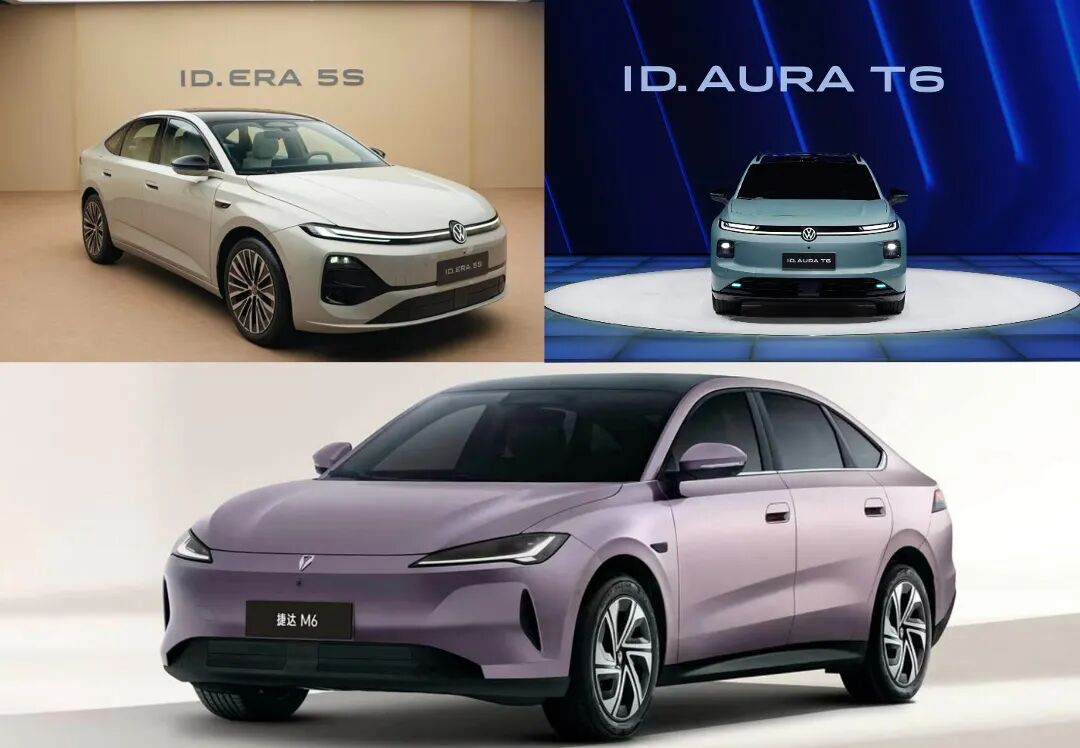
FAW-Volkswagen's ID. AURA T6 delivered 12,032 units in its first full sales month after launch, taking the top spot in retail sales of all-electric mid-size SUVs. SAIC Volkswagen's ID. ERA 5S retailed 7,100 units in its second full sales month, topping the plug-in hybrid sedan rankings. The Jetta M6, launched on October 22, exceeded 1,200 units in sales in just nine days.
Driven jointly by the three models, Volkswagen brand's October new energy deliveries exceeded 28,000 units in a single month, up 346.9% year-on-year, setting a new monthly high.
This result is long overdue for Volkswagen.
Just a few years back, Volkswagen's new energy business in China was almost entirely carried by the ID.3 alone. It was the only all-electric model in the Volkswagen system with stable monthly sales above 10,000 units—to some extent, the "hope of the whole village" for the joint-venture new energy camp. But with prices pushed down and costs not amortized, losing money on every car sold made SAIC Volkswagen "unable to bear it," ultimately leading to production line restructuring and the launch of the all-new ID.ERA sequence to fight again.
From a single model selling in volumes at low prices to three models across three lines—all-electric SUV, plug-in hybrid sedan, and entry-level all-electric sedan—ramping up simultaneously, Volkswagen's situation is now different.
Regarding the performance of Volkswagen's new energy vehicles, there is also outside skepticism: are these sales champions merely "champions with qualifiers"?
But when we break down the segments, we find that Volkswagen's performance is solid.
Take all-electric mid-size SUVs, for example—one of the largest single segments in the current new energy vehicle market. After FAW-Volkswagen's T6 took the top spot in retail sales in this segment, even when placed in the overall all-electric SUV market, it ranks seventh.
Competition in plug-in hybrid sedans is even fiercer—a segment dominated by domestic brands such as BYD and Geely. In the October rankings, BYD Qin PLUS DM, Seal 06 DM, and Seal 05 DM ranked 2nd, 3rd, and 4th, while Geely swept the remaining five spots in the top ten. Volkswagen's 5S seizing the top spot in such a landscape is no self-congratulation with qualifiers attached.
A closer look shows that the three models each succeeded with different approaches, but ultimately, Volkswagen's most tangible change is undoubtedly deeper localization: from product definition to pricing power to intelligent experience, Volkswagen's new energy vehicles are increasingly led by Chinese teams and local supply chains.
As early as October 28, at Volkswagen China's first Tech Day, Chairman and CEO Ralf Brandstätter disclosed that within just a few weeks, locked orders for the T6, 5S, and Jetta M6 exceeded 38,000, 31,000, and 12,000 units respectively, with market feedback proving that the three self-developed new cars have been recognized by Chinese users.
At the same Tech Day, Volkswagen also unveiled the technology system behind the three hit models—VEGA, covering three core areas: vehicle platform, electronic and electrical architecture, and advanced driver assistance.
The CMP platform self-developed by the Chinese team covers the mainstream A-segment market and supports both battery electric and plug-in hybrid; the next-generation CSP platform targets flagship battery electric and extended-range models; the CEA electronic and electrical architecture completes an architecture upgrade every two years; in terms of driver assistance, Volkswagen China launched its first self-developed full-scenario L2++ solution, Hyper Sense 8 (HS8).
Moreover, this system was not built out of thin air. As early as 2020, Volkswagen China announced an investment totaling over €15 billion (approximately 117.1 billion yuan), and in 2023 established VCTC, its largest R&D center outside Germany, shifting some R&D decision-making power from Wolfsburg to China.
Under this system, the product launch cycle has been shortened by more than 30%, and development costs for some key models have been reduced by up to about 40%. The R&D architecture has leapfrogged from MEB to quasi-central computing-body domain, with the self-developed AI toolchain C-Brain embedded across the entire R&D chain. According to the plan, Volkswagen China will begin delivering L3-level autonomous driving capabilities in the second half of 2027.
02 The Recovery Is Only the Beginning—Where Does the Future Lead?
It is worth noting that Volkswagen's recovery is not an isolated corporate event.
On the eve of this year's Guangzhou Auto Show, a batch of joint-venture smart electric vehicles—including FAW-Volkswagen ID. AURA L5, Dongfeng Nissan NX7, and Buick Zhijing Shijia 2.0T—entered a dense cycle of deliveries, pre-sales, and debuts. These products were uniformly defined with deep involvement from Chinese teams, priced in the 100,000 to 200,000 yuan range, and are regarded as new products of the joint-venture electrification 2.0 era.
Data from the China Passenger Car Association shows that in October this year, retail sales of new energy vehicles by mainstream joint-venture brands grew 69% year-on-year—the only segment among the three camps (domestic, luxury, and joint venture) to achieve positive new energy sales growth that month. The retail penetration rate of mainstream joint-venture new energy vehicles was 19.7%, a significant increase from before, with some joint-venture brands exceeding 10,000 units in monthly sales.
Although in the overall new energy market, joint-venture new energy vehicles accounted for only 5.9% of retail share in October—up 2.6 percentage points year-on-year, still a clear gap compared with domestic brands—it is nonetheless considerable progress compared with their own past.
In this round of joint-venture recovery, Volkswagen has been the most prominent. In October, SAIC Volkswagen's new energy sales were 18,000 units and FAW-Volkswagen's 14,900 units, with the north and south Volkswagen advancing simultaneously across battery electric, plug-in hybrid, and extended-range routes.
Objectively speaking, Volkswagen's recovery in China's new energy market is not accidental. It is fair to say that without the earlier real money and organizational adjustments, there would be no such sales rebound in October.
After all, among traditional auto giants, Volkswagen is one of the earliest to transform and the most resolute in investment. From the early establishment of an independent new energy division to the global launch of the ID.3 and ID. series, its electrification pace has never truly stopped. The 2020 investment plan of over €15 billion and the shift of R&D focus to local teams laid the groundwork for the launch of today's three models.
What is more noteworthy is that the capability system Volkswagen has honed in China is in turn becoming an asset for its globalization.
Brandstätter revealed that by 2030, Volkswagen China plans to achieve annual exports of at least 300,000 vehicles, and currently Volkswagen brand and Jetta models produced in China have begun exporting to the Middle East, Central Asia, and African markets.
Among these, technology export is more critical than vehicle export. The CMP platform and CEA architecture will become the technological foundation for Volkswagen in Global South markets, and South America will be the first to introduce China-developed technology before 2030. According to Germany's Manager Magazin, Volkswagen plans to introduce the CEA architecture to Europe for about three-quarters of the next-generation models of the Volkswagen, Skoda, and Cupra brands.
At the same time, Volkswagen's orders in Europe are also climbing.
Data shows that in the first three quarters, Volkswagen Group's European orders grew 4% year-on-year to 3 million vehicles, with battery electric vehicle orders up 39%. As of the end of September, the European order backlog was about 1.1 million vehicles, with battery electric accounting for nearly 40%, and the entry-level battery electric small car family received about 150,000 orders shortly after launch.
In the future, if Volkswagen's new energy momentum in China can continue, it will have a chance to make up the sales gap in the Chinese market in the fourth quarter. The recovery in European orders will also, from both the profit expectation and strategic discourse perspectives, in turn influence Wolfsburg's judgment on the group's new energy route.
After all, the platforms, architectures, and iteration speed forged in China's fierce competition are exactly what Volkswagen lacks most when facing electrification competition in Europe.
But looking calmly, the current results are still only a phase. In the past two years, the short-term sales that joint-venture brands gained through price cuts quickly exposed product shortcomings once discounts faded, with many models starting strong and ending weak. Volkswagen's early ID series and Japanese brands' early battery electric products all took such detours.
Whether the products of this 2.0 era can sustain deliveries for multiple consecutive months, and whether the volume-selling experience can be replicated into a complete matrix covering sedans, SUVs, and MPVs, still needs to be verified by rankings in the coming quarters.
However, for Volkswagen, three models ramping up in a single month is a good start, but taking every step well now is more important than rushing to declare it has already turned things around.
Responsible editor: Yang Jing Editor: He Zengrong

THE END
-
Why Are Listed Companies' Financial Reports Starting to Take Douyin E-commerce's Business Logic Seriously?
-
AI Steps on the Gas: A 167-Year-Old Cold Case Finally Hears an Echo
-
![]()
Short Dramas: Big Tech's Q3 Earnings Scapegoat or Lifeline?
-
![]()
Coating Material Selection: Four Critical Gates — Contrast, Absorption, Stress, and Process Window
-
![]()
Maishi Optoelectronics Completes IPO Coaching Acceptance Inspection, Securing 2 Billion Yuan in Financing This Year
-
Second Financing Round of the Year! Chengfeng Technology Secures Tens of Millions of Yuan in B+ Round
-
![]()
Why Can't Hongguo Swallow Bilibili?
-
![]()
The Day After Jensen Huang's Return: The Fed Pours Cold Water on the Rally