New Car Launches Haven't Slowed? Everyone Still Seems on Edge
 11/25 2026
 569
Introduction
Introduction
115 new cars are waiting in the wings.
Since regulators began cracking down hard on "rushed cars," this trend in China's auto market has somewhat subsided. But a calm surface doesn't mean there's nothing stirring underneath. Just before the Guangzhou Auto Show, an industry expert noted that as of November 20, 191 all-new and model-changeover vehicles had been launched in 2026—close to the historical high of 197 in 2024—and the full year is very likely to set a new record.
"What's declined are facelifts, down 39.1% year-on-year since May, while new models rose 59.5% over the same period. In 2027, the more likely decline will be in derivative versions, not genuine new cars."
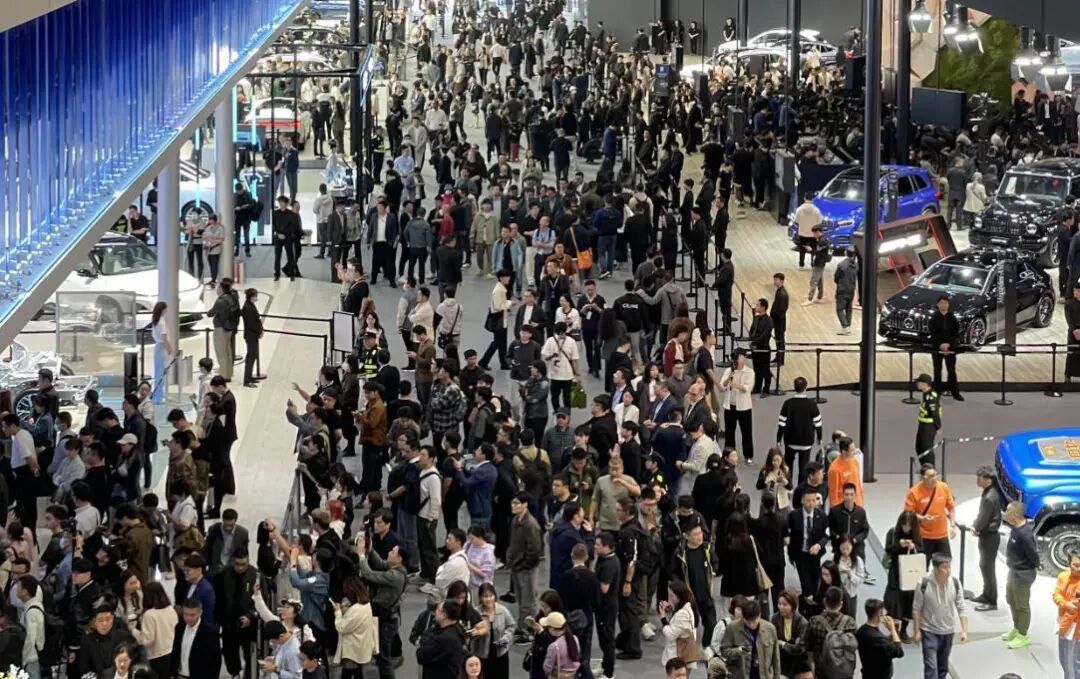
Looking at the Guangzhou Auto Show itself, the number of debut models is said to have reached 115, of which 93 are global debuts. In other words, the common assumption that this year's Guangzhou Auto Show might devolve into a promotional exhibition is off the mark—automakers' level of attention has not declined.
Their attitude may also signal that the anxiety hanging over all auto brands may not completely dissipate. And this anxiety—amplified by the arrival of Guangzhou Auto Show week, or even the entire November auto show month, a crucial month before the year-end sprint—has once again been magnified.
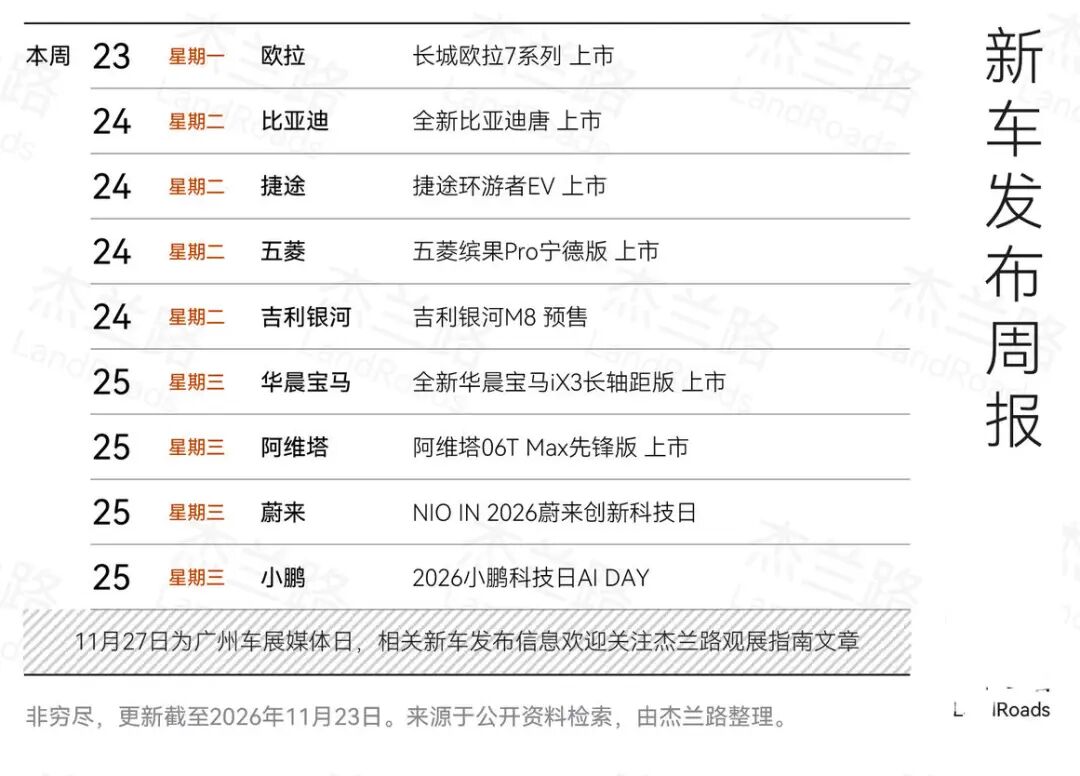
China's auto market once staged countless "Crazy Thursdays," when dozens of auto brands held new car launch events on the same day. As recently as November 12–13, within a mere 48 hours, China's auto industry held 12 new car launch events in succession, rolling out 17 new models in one go.
This pace hit a recent high and also laid bare the enormous pressure between year-end sales targets and brand building.
It is worth noting that, according to some tallies, none of the new cars launched this time came from new-energy startup brands. NIO, XPeng, Li Auto, and Xiaomi have basically wrapped up their new car launches for this year. In other words, the pre-show launch wave came mainly from China's traditional domestic brands and joint ventures—but ultimately this concentrated launch pattern reflects the situation automakers are in.
From an industry convention perspective, the Guangzhou Auto Show has traditionally been a peak period for year-end new car launches. After the "Golden September and Silver October" sales season ends, automakers have only about a month and a half left to sprint toward their full-year sales targets.
For reference, in 2025 many automakers still chose to stagger their launches, spreading pre-show new car releases over several weeks, whereas this year almost all brands compressed their launch actions into just 48 hours. It may seem like they avoided the on-site launch peak at the auto show, but in reality they collectively ran into a new pre-show peak.
This desperate rush to launch new cars is essentially the inevitable result of the asset-heavy nature of the auto industry. For a completely new model, the normal cycle from project approval to final market launch takes two to three years.
Large auto groups have numerous sub-brands and R&D teams and must balance resources and competitive relationships among different product lines through orderly new car launches, while the relatively flexible product iteration pace of new forces brands in turn further amplifies the sense of urgency among traditional automakers.
But such results have also alerted the industry, especially under regulators' strict crackdown on "rushed cars" and requirements for comprehensive testing. Data on new model filings submitted to China's Ministry of Industry and Information Technology in the second half of the year shows that more and more automakers are intentionally reducing the introduction of all-new models and shifting focus to defending existing market share.
However, a slowdown in product launch pace absolutely does not mean a reduction in the intensity of industry competition. The real problem is that the price war lasting for years has continuously lowered the industry's threshold for technological perception, directly causing the living space for brand premiums to be constantly squeezed.
Chery Chairman Yin Tongyue, when Chery's cumulative global sales surpassed 20 million units, announced on the spot that the company would "no longer pursue only sales volume, but pursue brand upgrading and value creation." He repeatedly stressed that "pursuing sales volume alone won't work," but the reality is that the entire industry remains mired in a price war, and endless involution for traffic has become the norm.
This contradiction is most evident in financial data. Take XPeng as an example: in Q3 2026, its total revenue reached 24.28 billion yuan, up 19.1% year-on-year, but net loss attributable to shareholders widened to 868 million yuan. The gross margin of its automotive business remained at 13.1%, basically flat compared with the same period last year.
XPeng's Q3 deliveries reached 118,400 units, up 2.1% year-on-year. October deliveries hit a new monthly high of 50,237 units, of which overseas deliveries were 13,326 units, up 166% year-on-year. This shows sales are recovering, but whether car sales can become a profitable business remains to be verified.
Similar brand-upgrading dilemmas are everywhere in the industry. Chery's Exeed brand has been cultivated for years but has yet to establish solid user recognition in the high-end market. Great Wall Motor's WEY brand transformed from the initial VV series to the Coffee series, and only after launching MPV models did it gain a foothold in the segment, after which it completely reorganized its marketing team.
A new brand's market recognition cannot withstand repeated adjustments—today emphasizing performance luxury, tomorrow pivoting to family intelligence, and the day after adjusting to individual expression. All the trial-and-error costs ultimately fall on terminal sales assessments.
Of course, there are also some positive examples. NIO, for instance, is one of the few companies able to maintain brand tonality. But this comes at a cost: to protect the high-end positioning of its main brand, NIO independently incubated two new brands, Onvo and Firefly, targeting different mass markets, while continuously investing in improving its nationwide battery-swapping ecosystem to ensure the service experience of main-brand users is not diluted.
This path of brand upgrading requires independent channel networks, strong full-cycle service capabilities, refined user operations systems, and years of sustained profit feedback and investment. In an industry environment where quarterly financial reports are strictly scrutinized and investors generally treat sales growth as a core assessment metric, brand-upgrading slogans detached from reality can easily end up as empty talk.
Therefore, in this low-level cycle, the trend of the market returning to brand value appears especially precious. The "2026 McKinsey China Auto Consumer Insights" report points out that this year marked a turning point: among key purchase factors for electric vehicles, brand jumped from long hovering at fifth place to second, behind only range and charging time.
The report also notes that the true winners in the future industry will inevitably be enterprises that can turn technological innovation into stable user experience, translate brand promises into consistently delivered services, and convert cross-industry collaboration into systematized competitiveness.
Today, once-core differentiating selling points such as range, advanced intelligent driving capabilities, and smart cockpit interaction are rapidly narrowing in gap due to industry-wide technology popularization. Brands are beginning to play the final role in value judgment, helping consumers make purchase decisions in a highly complex market.
For automakers, a true high-end transformation has never been achievable by shouting a few slogans. It is essentially a long-term restraint—calming down to solve users' real long-term pain points.
When other brands are being driven to sprint by short-term sales targets, companies willing to slow down and polish brand value may instead find a viable path out of the price war. Of course, there are no shortcuts on this road, but it may be the only correct answer for China's auto industry to move toward high-quality development.
Responsible editor: Yang Jing Editor: He Zengrong

THE END
-
Why Are Listed Companies' Financial Reports Starting to Take Douyin E-commerce's Business Logic Seriously?
-
AI Steps on the Gas: A 167-Year-Old Cold Case Finally Hears an Echo
-
![]()
Short Dramas: Big Tech's Q3 Earnings Scapegoat or Lifeline?
-
![]()
Coating Material Selection: Four Critical Gates — Contrast, Absorption, Stress, and Process Window
-
![]()
Maishi Optoelectronics Completes IPO Coaching Acceptance Inspection, Securing 2 Billion Yuan in Financing This Year
-
Second Financing Round of the Year! Chengfeng Technology Secures Tens of Millions of Yuan in B+ Round
-
![]()
Why Can't Hongguo Swallow Bilibili?
-
![]()
The Day After Jensen Huang's Return: The Fed Pours Cold Water on the Rally