Monthly Sales Average Over 30,000 Units at a Price Above 200,000 Yuan, Yet Xiaomi Loses 33,000 Yuan per Vehicle — What's Really Going On? | Mingjing Pro
 11/25 2026
 399
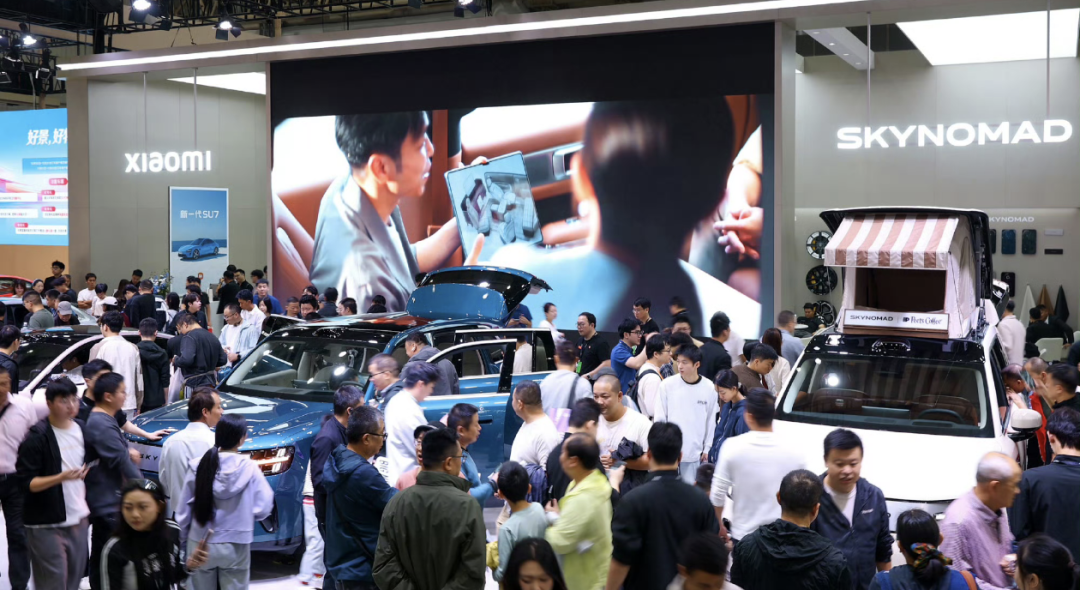
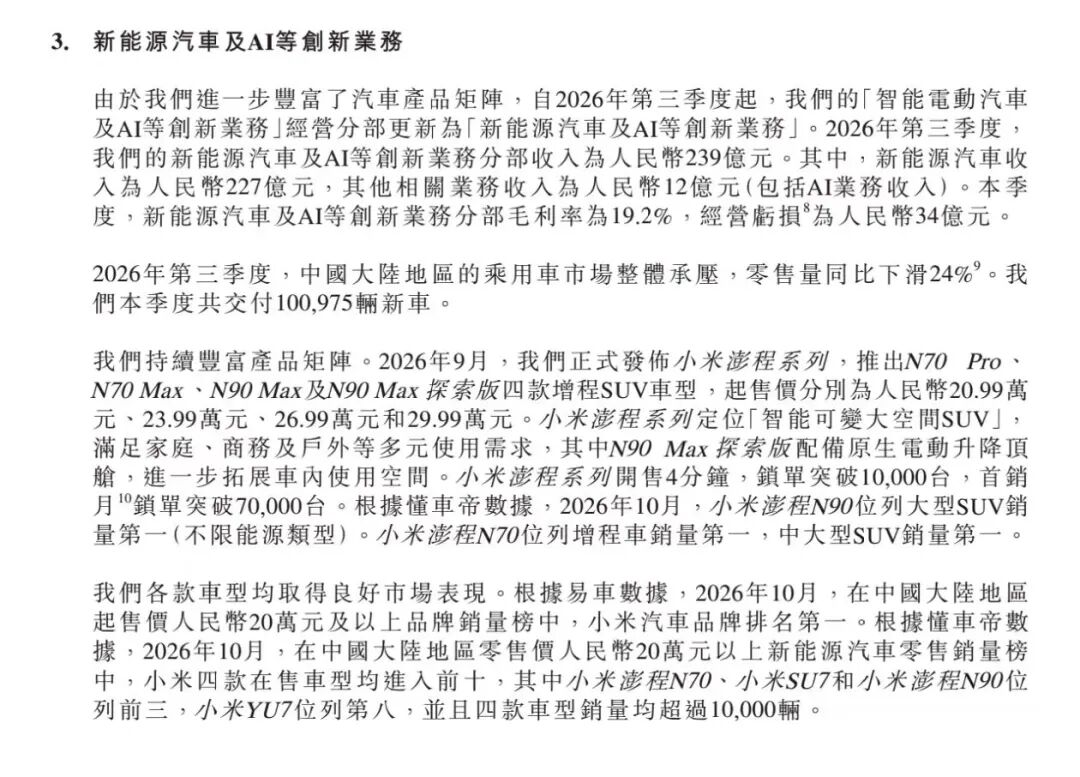
Many had expected Xiaomi Auto's performance to surge on the strength of its extended-range models, but in the third quarter the company instead turned in a report card marked by widening losses. According to Xiaomi Group's Q3 2026 financial report released on November 24, total revenue for the quarter came in at 107.2 billion yuan, down 5.2% year-on-year, while adjusted net profit stood at 4.884 billion yuan, down 56.8% year-on-year. Within that total, Xiaomi's new energy vehicle and AI innovation segment generated revenue of 23.9 billion yuan in the third quarter, down 17.7% year-on-year and 4.1% quarter-on-quarter. (Note: With the addition of the extended-range model Pengcheng, the company has renamed this segment from "smart electric vehicle and AI and other innovation businesses" to "new energy vehicle and AI and other innovation businesses" starting this quarter.)
Within this segment, new energy vehicle business revenue was 22.7 billion yuan, down 19.9% year-on-year and 5.1% quarter-on-quarter; AI innovation business revenue was 1.2 billion yuan, up 68.9% year-on-year and 21% quarter-on-quarter. On the profit side, the segment's gross profit for the quarter was 4.585 billion yuan, down 37.9% year-on-year and 4.3% quarter-on-quarter, with a gross margin of 19.2% — significantly lower than the 25.5% recorded in the same period last year. Operating profit came in at -3.4 billion yuan, compared with a profit of 700 million yuan in the same period last year, marking a year-on-year swing from profit to loss, with the loss widening further compared with the previous quarter.
Xiaomi Auto attributed the decline "mainly to reduced vehicle deliveries and changes in product mix (including a decline in the delivery share of Xiaomi SU7 Ultra)." The Xiaomi SU7 Ultra was officially launched on February 27, 2025, with an official guide price starting at 529,900 yuan. As Xiaomi Auto's performance flagship, its pricing directly targets the high-end electric performance sedan market. The model's highest monthly sales last year exceeded 3,000 units, and in 2025 its sales totaled around 15,000 units, contributing at least 7.5 billion yuan in revenue.
In terms of this year's sales, Xiaomi Auto delivered 100,975 vehicles in the third quarter, down 7.2% year-on-year and 3.1% quarter-on-quarter. The average selling price per vehicle was about 224,800 yuan, down 13.6% year-on-year and 2.0% quarter-on-quarter. Based on 22.7 billion yuan in revenue, 3.4 billion yuan in losses, and 100,975 new vehicles, JRJ.com calculated an average selling price of 224,800 yuan per new vehicle and a loss of about 33,671 yuan per vehicle. Of course, third-quarter Xiaomi Auto deliveries were still dominated by the new-generation SU7 and YU7. The higher-priced Pengcheng N90 only began deliveries in September, so its boost to the average price will only show up in the fourth quarter.
The gross margin of Xiaomi's new energy vehicle and AI innovation business in the third quarter was 19.2%, down 6.3 percentage points year-on-year and flat quarter-on-quarter. In 2026, the gross margin held steady in the 19.2%–20.1% range for three consecutive quarters. By comparison, XPeng's overall gross margin in Q3 2026 was 18.9%, with its vehicle-selling gross margin at 13.1% in the third quarter; Leapmotor's gross margin in Q3 2026 was 10.9%; and Seres' third-quarter gross margin was 21.0%.
In addition, rising costs also dealt a heavy blow to Xiaomi Auto's profits. "The automotive business faces cost shocks brought by high storage costs and rising commodity prices," said Lu Weibing, president of Xiaomi Group, at the third-quarter earnings call. Across the industry, many automakers have explicitly flagged pressure from rising costs. NIO Chairman Li Bin, for example, said that in the second quarter of this year NIO's average cost per vehicle rose by about 14,000 yuan compared with the end of last year. Li Bin expects the cost per vehicle to rise by a further 2,000 to 3,000 yuan in the second half of this year — meaning an increase of 16,000 to 17,000 yuan compared with the end of last year.
In addition, during a Chongqing forum in the first half of this year, Seres Chairman Zhang Xinghai disclosed that the unit price of memory chips had risen from 20 yuan to nearly 100 yuan, while the price of lithium carbonate climbed from 80,000 yuan per ton in the same period last year to 180,000 yuan per ton. At that time, the average cost per AITO vehicle rose by 15,000 to 20,000 yuan. Judging by second-half prices, these costs are very likely to rise further rather than fall.
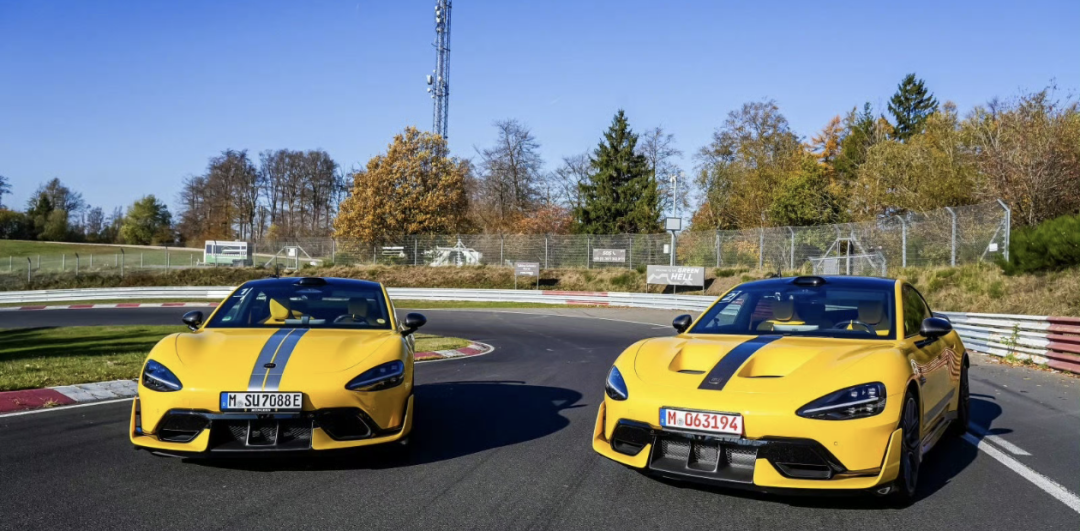
As for how to improve operating performance, Xiaomi's approach is to expand business scale on the one hand and improve internal operating efficiency on the other. First, Xiaomi will seek expansion into new markets. According to information from the earnings call, Xiaomi Auto plans to enter the European market in 2027 and will first land in the German market in the third quarter. According to Lu Weibing, Xiaomi Auto's overseas models will soon be sent to Sweden, Germany, Spain, and Italy for high-speed validation and functional testing at seven authoritative test sites, including the Arjeplog winter testing base and the Nürburgring.
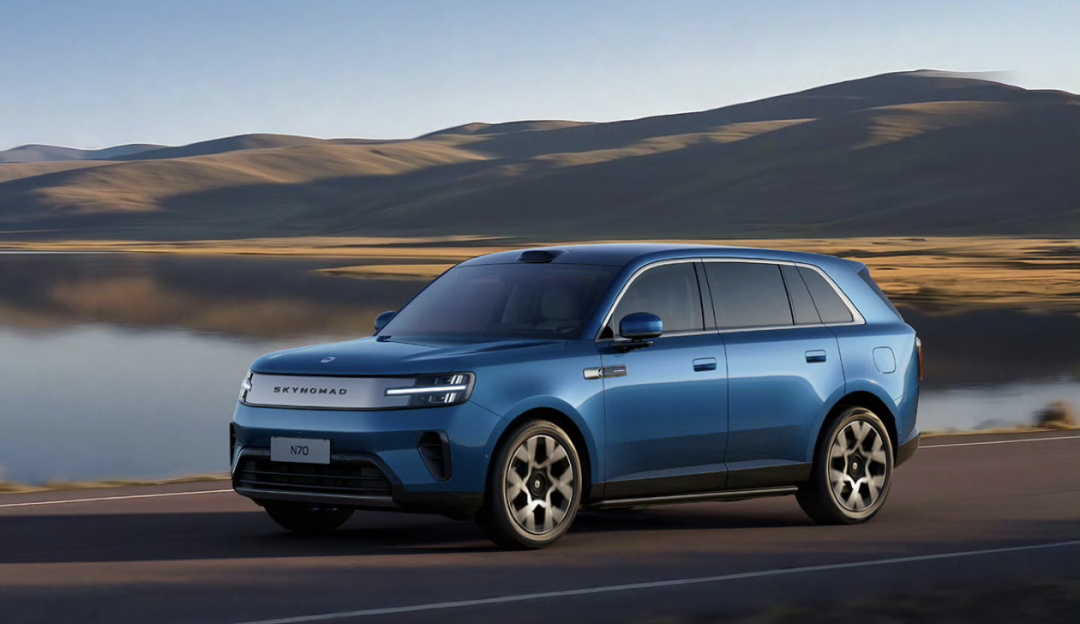
However, given that Fangchengbao was sued by Land Rover, the outside world is concerned that Xiaomi may face similar risks in Europe. As for subsequent market performance, Lu Weibing disclosed that Xiaomi Auto's October deliveries exceeded 50,000 units, a new single-month high for the year, with significant further improvement ahead. He believes the extended-range market still has great potential, and the launch of Xiaomi Pengcheng has brought new surprises to this track, with locked orders exceeding 70,000 in the first month of launch and sales now stable during the steady-state period.
At the same time, Xiaomi Pengcheng has greatly expanded and enriched Xiaomi Auto's user base, achieving breakthroughs in more circles: Pengcheng users are older than SU7/YU7 users, and as of now, users aged 35 and above account for more than 50%. At present, all Xiaomi products are priced above 200,000 yuan. At the current scale of about 50,000 monthly sales, Li Auto had already achieved profitability much earlier. Because its financial report did not disclose details, there is still no specific figure for the automotive segment's profitability.
According to research report analysis, Xiaomi had previously lowered its full-year delivery target from 550,000 to 450,000 vehicles (no adjustment this quarter, stating it would strive to exceed the target and not giving a 2027 target). Xiaomi delivered a cumulative 286,000 vehicles in the first three quarters and more than 50,000 in October, totaling about 336,000 in the first 10 months, meaning it needs to deliver about 114,000 vehicles in November–December (about 57,000 per month on average, an increase of about 14% from October).
According to data from the research institution, recent weekly orders show that in the week Xiaomi Pengcheng was launched (9/7–13), orders surged to 55,200 units, then gradually declined, stabilizing at 8,000–11,000 units per week since mid-October, about 2,500 more than before the launch (7,000 units/week). This means its products have entered a normal sales period, and achieving greater growth later will still depend on continuous marketing efforts.
-
Why Are Listed Companies' Financial Reports Starting to Take Douyin E-commerce's Business Logic Seriously?
-
AI Steps on the Gas: A 167-Year-Old Cold Case Finally Hears an Echo
-
![]()
Short Dramas: Big Tech's Q3 Earnings Scapegoat or Lifeline?
-
![]()
Coating Material Selection: Four Critical Gates — Contrast, Absorption, Stress, and Process Window
-
![]()
Maishi Optoelectronics Completes IPO Coaching Acceptance Inspection, Securing 2 Billion Yuan in Financing This Year
-
Second Financing Round of the Year! Chengfeng Technology Secures Tens of Millions of Yuan in B+ Round
-
![]()
Why Can't Hongguo Swallow Bilibili?
-
![]()
The Day After Jensen Huang's Return: The Fed Pours Cold Water on the Rally