NVH Failure Points Shift Forward: Chassis Vibration Complaints Nearly Sixfold in Two Years, New Test Questions Emerge on Urban Roads
 11/26 2026
 513
Where are NVH's new test questions? Users' answer is urban roads. The "2026 China Automotive Product Quality Performance Study," jointly released by Car Quality Network and Kairui Saichi Consulting, shows that based on surveys conducted in both 2025 and 2026, complaints related to chassis vibration (PP100, i.e., the number of people per 100 vehicles encountering the problem) have risen nearly sixfold within two years, while NVH (noise, vibration and harshness) failure points are shifting forward from highways to urban roads and everyday driving speeds.
▍Tire Noise Is Improving; Chassis Vibration Has Risen Sharply
Let's start with the changes in the three core issues over two years. Tire noise/road noise shows the most obvious improvement among the three: PP100 dropped from 13.45 to 11.93, and the complaint level also dropped from 6.93 to 6.44. Wind noise did not decrease but rose slightly, with PP100 rising from 12.26 to 12.42. Although the complaint level dropped from 7.03 to 6.52, its magnitude still ranks first among noise categories. The biggest change is chassis vibration, with PP100 surging from 1.27 to 7.07, an increase of about 5.8 points. Its complaint level of 7.69 is the highest among the three, and it has remained basically flat over the two years. This means that not only have chassis problems become more frequent, but the severity of individual complaints has also remained persistently high.
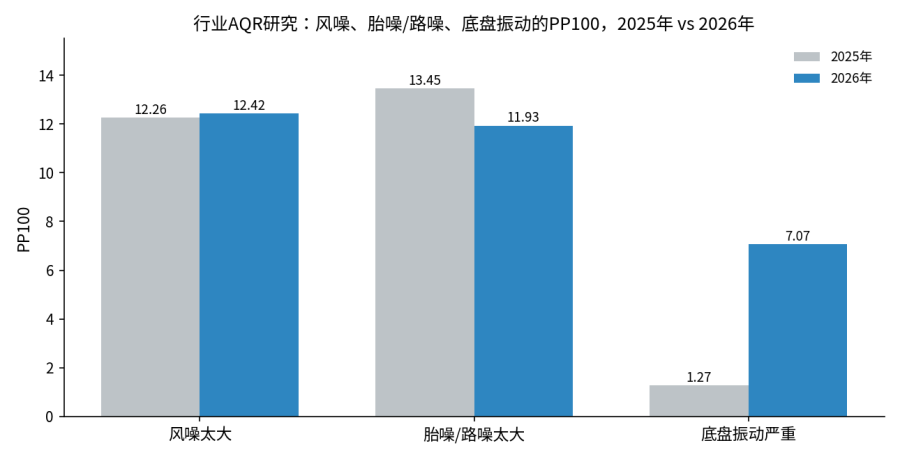
Figure 1 PP100 of wind noise, tire noise/road noise, and chassis vibration
Specifically regarding when problems occur, wind noise and tire noise are on average first exposed 2 to 2.5 months after purchase, belonging to sound insulation and sealing issues that "appear upon delivery." Chassis vibration complaints shift later with mileage and are more related to suspension bushing degradation and changes in shock absorber performance.
▍Noise Thresholds Are Rising, Yet Dissatisfaction Occurs at Everyday Speeds
Focusing on users' own statements, for "at what speed noise becomes unbearable," the 2026 figure is 105.0 km/h, 2.1 km/h higher than 102.9 km/h in 2025. The share of users who require acceptability only at 120 km/h and above also rose from 38.2% to 43.8%. More than 40% of users regard "quiet high-speed cruising" as a baseline expectation. User satisfaction with driving quietness rose from 5.70 to 5.84, and ride comfort rose from 6.72 to 6.96, indicating a consistent direction.
Higher expectations do not equal greater tolerance. Looking at complaining users' "unbearable speed," the problem becomes very clear: among users complaining about wind noise, 52.7% already find it unbearable at 80 km/h or below; the proportion is even higher for tire noise/road noise, reaching 65.9%, of whom nearly 11% cannot stand it at 40 km/h or below, that is, at regular urban speeds. In other words, the main problem is not at 120 km/h high-speed cruising, but on urban roads and expressways that people drive every day. Users can accept "a little noise on the highway," but cannot accept "noise in the city."
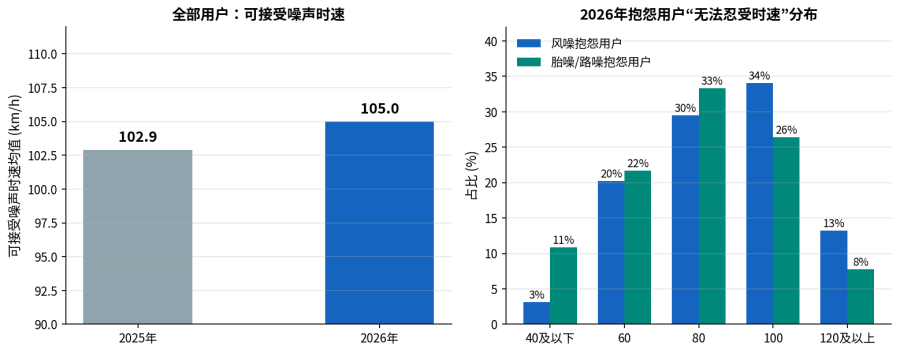
Figure 2 All users' noise expectations: acceptable speed and complaining users
▍Chassis Softness and Hardness: Mismatch Between Orientation and Expectations
"Severe chassis vibration" is the problem with the largest increase over the two years, as mentioned earlier. The data table also lists two sub-items separately: "damping too soft," with PP100 of 2.06 and complaint level of 6.82; and "damping too hard," with PP100 of 2.02 and complaint level of 6.91. Dissatisfaction with both softness and hardness exists simultaneously at the total level, and their magnitudes are almost identical.
Grouping complaints by powertrain type, the two voices point to different product orientations. Complaints about "too soft" are concentrated in products oriented toward comfort, while complaints about "too hard/bumpy" come more from models with rugged orientations and sporty tuning. The dominant orientations of the soft and hard camps are distinct and do not overlap, indicating that this is a mismatch between the orientations of different models and user expectations, rather than calibration fluctuation within the same model.
It can thus be seen that the orientation is not aligned with the expectations of target users. Some users expect comfort but get a "floaty" feel; some users accept a sporty orientation but are still put off by low-speed fine bumps. What chassis development must answer is not "how soft or how hard," but "which orientation has been chosen, can it be executed properly, and does it match the target users' usage scenarios?"
▍MPV Is the Hardest-Hit Area for Wind Noise
Looking at specific vehicle types, MPVs clearly lag behind. Based on statistics by vehicle type from raw data, MPVs have a wind noise PP100 of 30 and tire noise/road noise PP100 of 20, both the highest among all vehicle types. Tire noise complaint level reaches 9.5 points, close to "completely unbearable." MPVs have tall and large bodies, many door seam openings, and are often used for high-speed long-distance passenger transport, making them the category with the largest NVH supply gap. Moreover, this gap is category-wide, not a problem of individual models.
▍Pure Electric Is the Quietest; the Weakness of Plug-in Hybrids Lies in Low-Battery Conditions
NVH differences among energy types are much clearer than differences among vehicle types, and the two years of data point in the same direction: pure electric models are the quietest among the three powertrain types. In 2026, pure electric wind noise PP100 was 10.7 and tire noise 9.0; in 2025, they were 8.3 and 8.0, both the lowest among the three powertrain types in both years. Fuel vehicles were 14.2 and 14.8 in 2026. Plug-in hybrids were 13.2 and 12.9 in 2026, and 13.7 and 16.5 in 2025; all four figures in the two years were higher than the industry average, and the 2025 tire noise figure of 16.5 was the highest among the three powertrain types. Extended-range vehicles dropped to 8.6 and 6.5 in 2026, a clear decline from 14.3 and 12.9 in 2025. The tire noise PP100 of pure electric vehicles is only 50% to 60% that of fuel vehicles.
It is worth noting that pure electric vehicles have no engine noise as "masking," so tire noise and road noise should be more noticeable and users should be more demanding, yet their PP100 is instead the lowest. When quietness becomes the default experience of electric vehicles, users' expectations of "quiet" are raised overall.
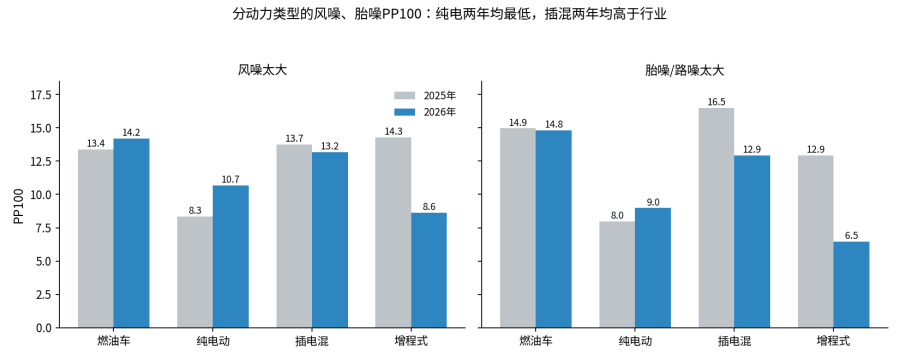
Figure 3 PP100 of wind noise and tire noise by energy type
The problems of plug-in hybrids and extended-range vehicles are concentrated in low-battery conditions. To accommodate engine compartments, extended-range and plug-in hybrid models have more complex sound insulation layouts. Once battery power is insufficient and the engine intervenes for direct drive, the noise experience immediately falls back to the level of fuel vehicles, or even worse. This is because the engine's cold-start speed is not smoothly constrained by vehicle speed and required power, making the noise more abrupt. For plug-in hybrid and extended-range products, NVH calibration must treat "low-battery conditions" as a separate scenario for validation, rather than testing only the fully charged state.
As industry competition further intensifies, how to balance cost and user experience is a trade-off every company must clarify. Which are users' basic needs and which are enhancement needs users are willing to pay for must be answered through real vehicle performance and user research.
▍Recommendations
Set development targets based on user thresholds: incorporate subjective perception standards into development targets. Currently about one quarter of users are already dissatisfied below 80 km/h, so target scenarios should extend downward from 120 km/h high-speed cruising to urban conditions.
Validate low-battery conditions separately for plug-in hybrids/extended-range vehicles: NVH calibration in the fully charged state does not represent the real experience. Noise when the engine intervenes for direct drive is more abrupt, so low-battery high-speed cruising should be treated as an independent validation scenario.
MPVs should prioritize closing the wind noise gap: wind noise PP100 of 30 and tire noise complaint level of 9.5 points are the most prominent NVH shortcomings. Sound insulation sealing and tire matching require category-level dedicated investment.
Calibrate chassis orientation according to target user expectations: soft and hard complaints come from orientation mismatches among different models, not calibration fluctuation. Comfort-oriented models should maintain high-speed stability and control body roll during lane changes, while sporty-oriented models should suppress low-speed fine bumps and pay attention to shock absorber degradation with mileage.
Layout 丨 Yang Shuo Data source: Car Quality Network, Kairui Saichi Consulting Image source: Kairui Saichi Consulting, Qianku.com
-
5. FSD V15 Major Upgrade: Deconstructing the Engineering Core UVE Behind Reality View
-
![]()
NVH Failure Points Shift Forward: Chassis Vibration Complaints Nearly Sixfold in Two Years, New Test Questions Emerge on Urban Roads
-
![]()
The Day Before the Guangzhou Auto Show
-
![]()
Core AI Computing Power Supplier Initiates IPO Tutoring, Backed by Chinese Academy of Sciences Lineage with SK Hynix Participation
-
![]()
Ban AI Glasses! German Consumer Association Formally Sues Meta
-
AI Hot Money Is Hitting a Turning Point
-
![]()
Buick's Firm Stance Against Building Range-Extender MPVs: What Exactly Is Buick Opposing?
-
Four Motors and 850 Horsepower—The BMW All-Electric M3's Specs Would Only Earn a Passing Grade in China