Great Wall Motor's Profit Plunges 55.69%: Wei Jianjun Tells Some Hard Truths at Gree
 11/27 2026
 404
Written by | Guanche Jun
"A car is a major household asset, and its depreciation rate has now reached an absurd level."
On November 26, Great Wall Motor Chairman Wei Jianjun visited Gree and made this strikingly pointed remark.
01
A look at the auto industry in 2026 reveals that things are indeed far from comfortable. According to data from the China Association of Automobile Manufacturers, Guanche Jun noted that in the first three quarters of 2026, domestic auto production and sales stood at 23.246 million and 23.271 million units respectively, both down 4.5% year-on-year; passenger vehicle figures fell even further, by approximately 6%.
The pie did not grow larger—it even shrank somewhat—yet the number of players has not decreased at all. As a result, the price war can only intensify.
The third-quarter reports bear this out. Times Finance previously reviewed the first three quarters' performance of 10 automakers, and the average net profit margin was -0.01%, compared with 2.18% over the same period last year.
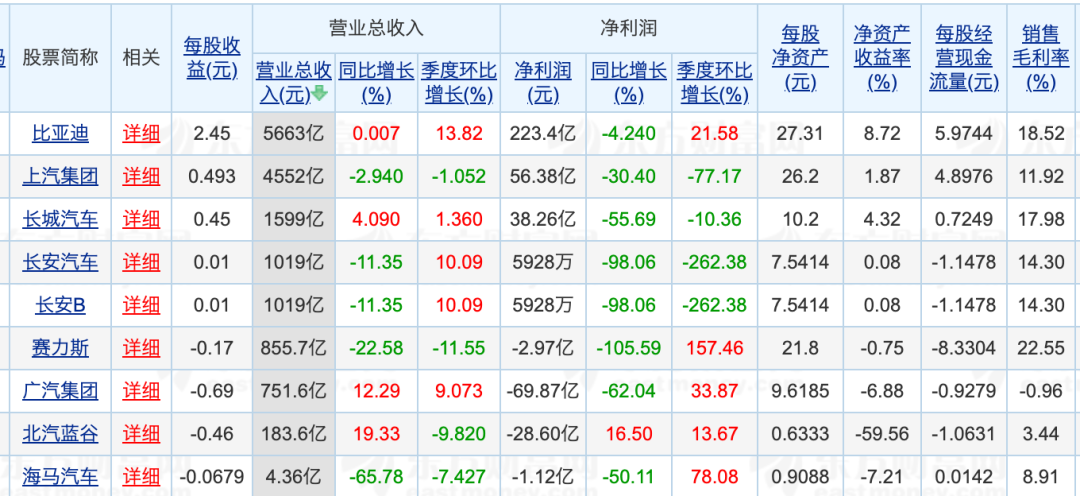
Take SAIC Motor, for example: revenue was approximately 455.221 billion yuan, ranking second in scale, while net profit attributable to shareholders was 5.638 billion yuan, down 30.4% year-on-year. In the third quarter alone, net profit was a mere 486 million yuan—and just 70 million yuan after deducting non-recurring items—equivalent to a full quarter's work for nothing.
BAIC BluePark lost 2.860 billion yuan, with a return on net assets of -59.56%, its books nearly bottoming out.
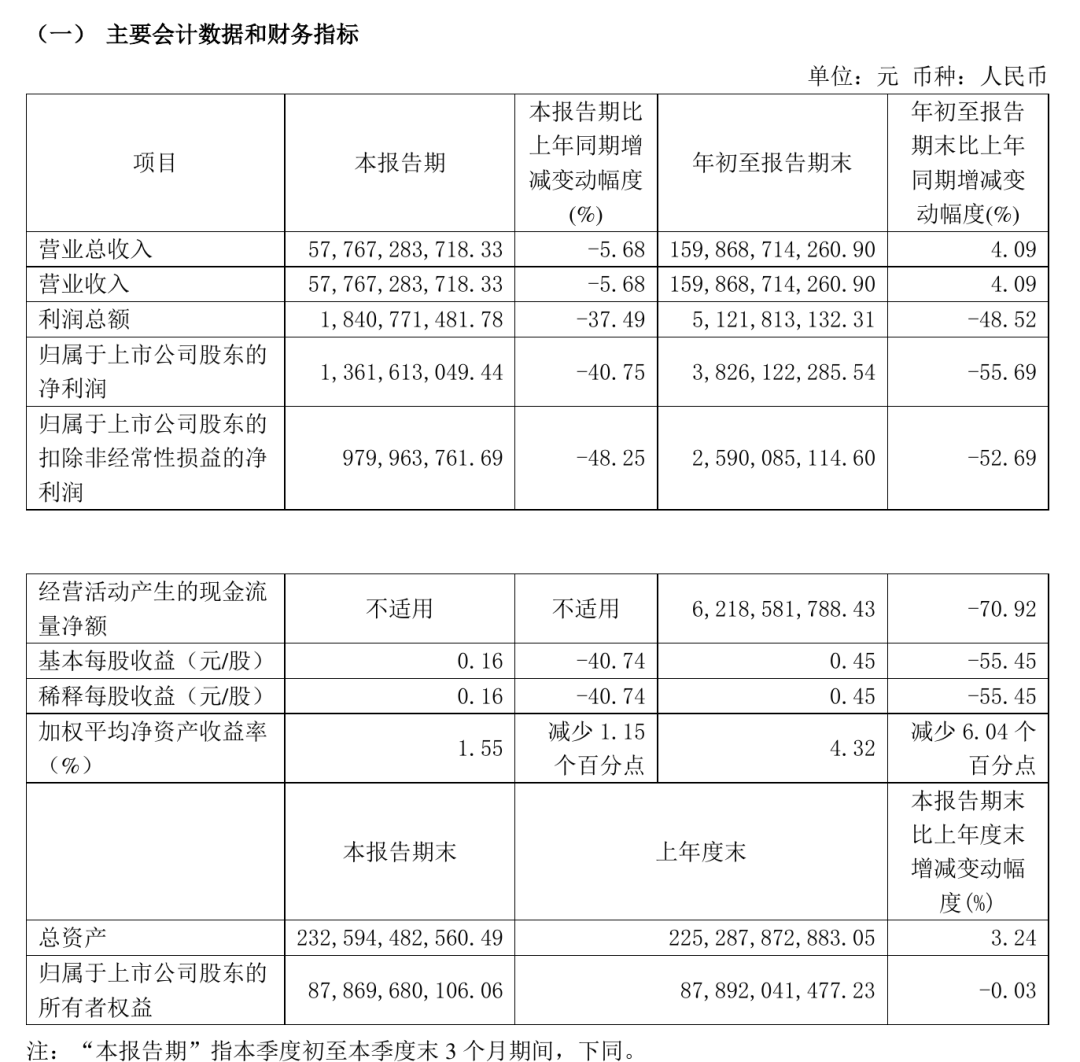
Great Wall Motor's total operating revenue in the first three quarters of 2026 was 159.869 billion yuan, up 4.09% year-on-year, but net profit attributable to shareholders was only 3.826 billion yuan, down 55.69% year-on-year; net profit after deducting non-recurring items was 2.590 billion yuan, down 52.69%.
The third quarter was even uglier: revenue was 57.767 billion yuan, down 5.68% year-on-year; net profit attributable to shareholders was 1.362 billion yuan, down 40.75% year-on-year.
Wei Jianjun said that "many automakers lack cash flow and can only barely hold on by cutting prices and squeezing suppliers." This sounds like he is talking about others, but in fact Great Wall itself is in the same boat.
In the first three quarters, Great Wall's net cash flow from operating activities was only 6.219 billion yuan, down 70% year-on-year.
He also said that "many auto companies are currently just living for liquidity, and in fact they are all selling at a loss." Applied to Great Wall, this is more or less relevant as well.
Revenue is rising, but profit has been halved. The more they sell, the thinner the margin.
So Wei Jianjun dares to speak to this extent because he is an insider himself, not someone making detached comments.
02
At the recent China Automotive Industry High-Quality Development Summit Forum, Chen Shihua, deputy secretary-general of the China Association of Automobile Manufacturers, said, "The profit level of the automotive manufacturing industry is at a historical low, and the profit margin of complete vehicle manufacturing is only 1.5%."
Based on a 1.5% profit margin, for a new car priced at 100,000 yuan, the automaker's profit is only 1,500 yuan.
In Guanche Jun's view, the price war has now gone beyond who is competing with whom and has become a vicious cycle: lacking cash leads to price cuts, price cuts lead to squeezing suppliers, suppliers cannot hold on and cut corners, quality declines and consumers will not buy, forcing further price cuts. This is exactly the vicious cycle Wei Jianjun described.
Then where is the way out? Dong Mingzhu offered two. One is technology—relying on "mastering core technologies" to keep the lifeline in one's own hands. Gree has 20,000 people doing research and development and multi-category development.
The other is more interesting. She advised Wei Jianjun that cars cannot be made into fast-moving consumer goods, and manufacturers must understand that "life comes first," and also said that "some industrial pests should be eliminated when necessary."
These words are not pleasant to hear, but they hit the point. Fast-moving consumer goods compete on low prices, rapid turnover, and quick elimination. Cars cannot do that, because they carry human lives and family assets. If cars are built and sold with the logic of fast-moving consumer goods, safety and quality will sooner or later be worn through by the price war.
Wei Jianjun's own answer is "building a corporate brand." He said Great Wall previously separated by channel, with SUV, pickup, and electric vehicles each going their own way, and in the future they should move toward one channel to give users a complete image.
He admitted that channel integration is not yet mature. Behind these words are Great Wall's difficulties: it has slid all the way from the top seller among independent brands to ninth place.
There is another layer. Wei Jianjun is betting the breakthrough on overseas expansion and channel integration. He said channel integration is not yet mature, but overseas experience is very important: "You have to step into pitfalls wherever you go, wasting time, money, and also facing risks, with compliance risks being even greater."
03
Finally, Guanche Jun wants to say that Wei Jianjun's remark that "depreciation is too absurd" is less a complaint than a reminder to the entire industry. If carmaking becomes a loss-making game of making a lot of noise for nothing, the ones who ultimately pay will certainly be every consumer who is still spending money to support domestic cars.
When profit is squeezed to only 1,500 yuan per car, how much can still be invested in research and development? How carefully can quality inspection still be done? If suppliers are squeezed to the limit, how long can parts quality be maintained? These questions ultimately fall on ordinary people sitting in the cars.
There are no winners in a price war. Only those who can hold up car prices through technology and brand will survive to the end.
This question must be answered by Great Wall Motor, and by the entire industry as well.
Charts and tables in this article without indicated sources are all from public disclosures through various channels, and this is hereby explained and acknowledged! The views in this article are for reference only and do not constitute investment advice.
This article is original by Leverage Guanches. Reproduction is prohibited without authorization! If you need to reproduce, please obtain authorization. In addition, when reproducing with authorization, please indicate the source and author at the beginning of the article. Thank you!
-
![]()
226 Trillion Tokens: Why Is DeepSeek Leading?
-
![]()
Can the Jones Matrix Not Handle Polarized Light? How Does the Mueller Matrix Handle It?
-
100,000 Units Is Just the Pass Mark — for Leapmotor to Truly Succeed, It Still Has One Weakness to Fix
-
From "Saying Nice Things" to "Getting Things Done": Big Tech's Personal AI Agents Have Arrived
-
![]()
Tencent Releases Next-Gen 3D Large Model Hunyuan Hy3D 3.6, With API as Primary Entry Point
-
Why Are Big Tech Profits Tightening Even as AI Revenue Rises?
-
![]()
Betting on AI and Embodied Intelligence! Zejing Co., Ltd. Signs Strategic Cooperation Framework Agreement
-
![]()
A High-Stakes Bet on Precision Optics: Yuxin Electronic to Acquire Huateng Optoelectronics for 160 Million Yuan