Ideal: Gross margin lightning "recovery", but sales still stuck?
 11/27 2026
 372
Li Auto (LI.O) released its Q3 2026 financial report after the Hong Kong market close and before the U.S. market open on November 25, Beijing time. Q3 results were comprehensively better than market expectations, especially with vehicle gross margin rebounding sharply to 15.3%; however, Q4 sales guidance was once again below expectations. Specifically:
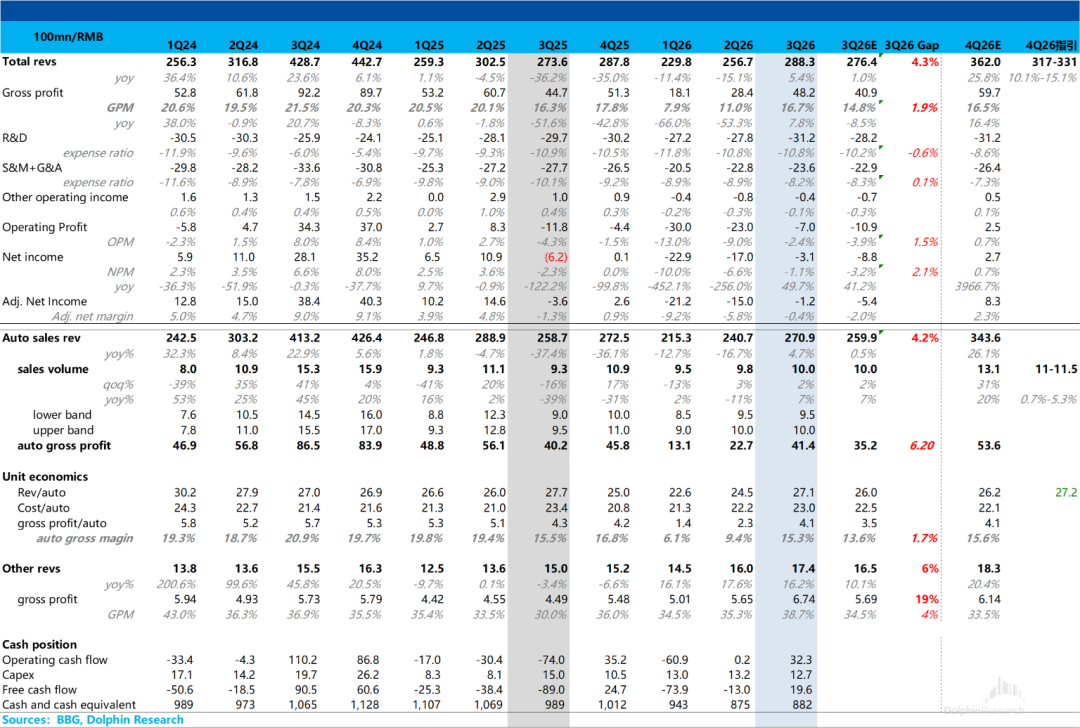
① Total revenue exceeded expectations, and vehicle ASP rose sharply QoQ: Q3 total revenue was 28.83 billion yuan (+5.4% YoY), of which vehicle sales revenue was 27.1 billion yuan, above the market expectation of 26.0 billion yuan.
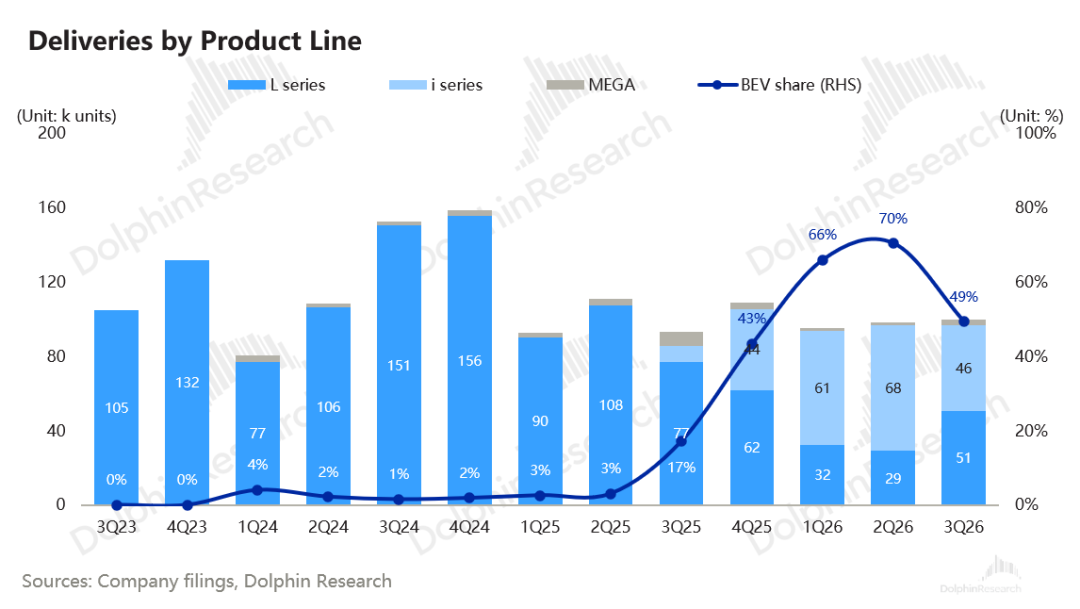
The revenue beat came entirely from ASP — vehicle ASP rose about 26,000 yuan QoQ to 271,000 yuan, mainly due to an upward shift in model mix: the lower-priced i6 entered a model-change gap in September (orders for the old model were suspended, and the new model was only launched on 10/28 and deliveries began in early November), with the i6 share falling about 25pct QoQ to 40%; at the same time, the redesigned L9/L8 and i9 began to ramp, and deliveries of the high-priced new Mega began.
② Vehicle gross margin recovered to 15.3% QoQ, greatly exceeding market expectations: vehicle gross margin rebounded 5.9 percentage points QoQ, significantly above the market expectation of 13.6%, reaching ahead of schedule the "above 15%" target set by management for Q4.
According to estimates, per-vehicle cost rose about 8,000 yuan QoQ, ASP rose about 26,000 yuan, and per-vehicle gross profit recovered from about 23,000 yuan to about 41,000 yuan.
In other words, rising cell and memory prices are still pushing up costs, but the ASP increase brought by higher-priced models far outweighed the cost increase, and the substitution effect of the M100 self-developed intelligent driving chip (first launched with the all-new L9 in May, reportedly at about half the cost of outsourced chips) also began to show.
The Lianting platform's self-developed battery/e-drive and 5C battery were released in October and only began to be installed with the new i6 in November, and are expected to continue driving Q4 gross margin recovery.
③ R&D expenses exceeded expectations, but losses narrowed sharply: R&D expenses were 3.12 billion yuan (above the market expectation of 2.82 billion yuan), mainly invested in 2027 new models and Lianting battery R&D, intelligent driving chips and software, etc. However, with the sharp QoQ rebound in gross margin, operating loss narrowed by 1.6 billion yuan QoQ to 700 million yuan this quarter (market expected a loss of 1.09 billion yuan), and adjusted net profit was 120 million yuan, already close to break-even.
Dolphin's view:
Overall, Li Auto's Q3 results clearly exceeded expectations: the upward shift in model mix drove both ASP and gross margin sharply higher, revenue exceeded the upper end of guidance, the loss reduction was far better than expected, and free cash flow also turned positive to 1.96 billion yuan.
But what the market is really focused on is Q4 guidance:
a) Sales guidance again below expectations, and order conversion pace for the redesigned i6 is relatively slow
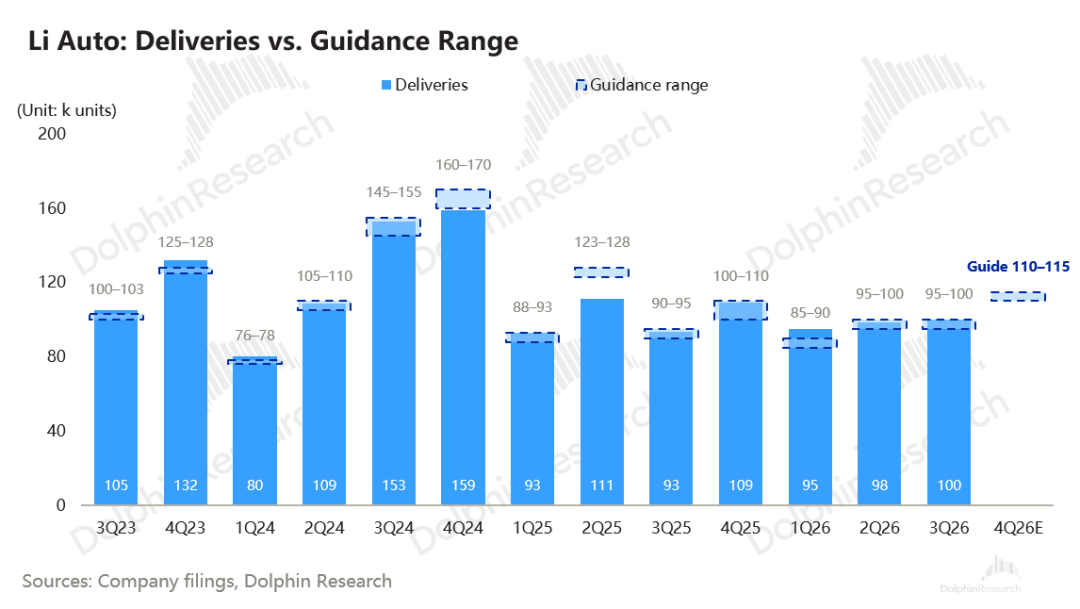
Q4 sales guidance is 110,000–115,000 vehicles (+0.7%–5.3% YoY), about 12%–16% below the market expectation of 131,000 vehicles. This is the second consecutive quarter significantly below expectations.
Since only 29,025 vehicles were delivered in October, the guidance implies average monthly deliveries of 40,000–43,000 in November–December, still short of the imagination brought to the market by "i6 orders of 50,000+ and capacity of 20,000 per month."
The increment mainly comes from the redesigned i6 launched on October 28 (96 kWh Lianting battery, priced at 249,800 yuan), which reportedly has cumulative orders exceeding 50,000, with November capacity ramping to 20,000 per month.
But L8/L9/i8 basically no longer require waiting, and retail insurance subsidies have doubled to 10,000 yuan; new orders for the i6 are also cooling (according to third-party weekly data, about 54,000 in the first week of November and about 17,000 in the second week), and store feedback indicates consumers still have concerns about the self-developed battery replacing CATL cells.
b) Revenue guidance below expectations, but implied ASP better than expected
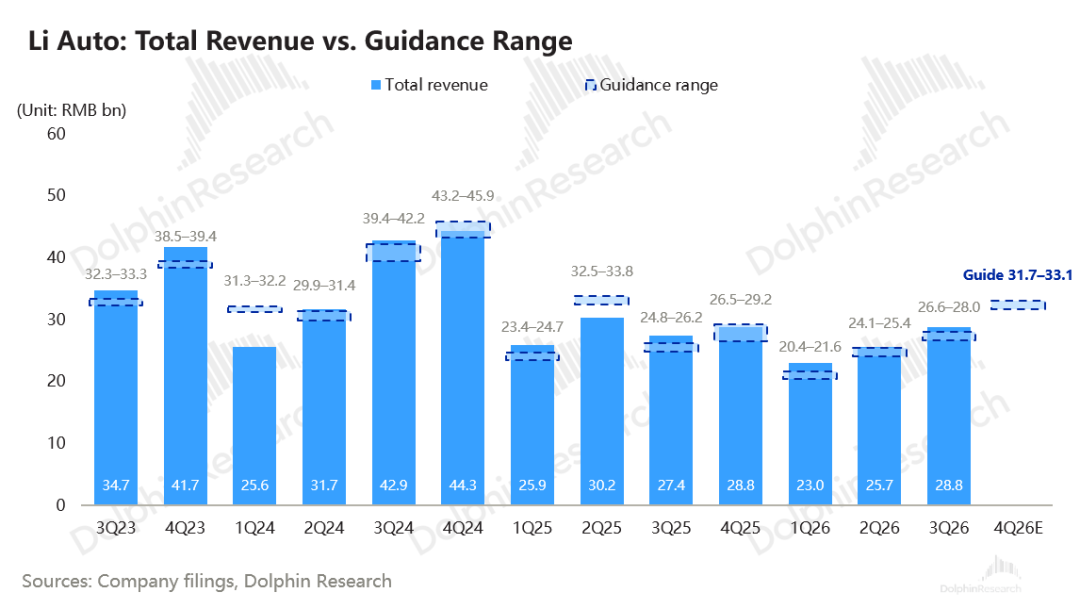
Q4 revenue guidance is 31.7–33.1 billion yuan (+10.1%–15.1% YoY), below the market expectation of 35.1 billion yuan, mainly because volume is below expectations; but implied per-vehicle revenue is about 272,000 yuan, flat with Q3 — full-quarter deliveries of MEGA and i9 basically offset the impact of the i6 share recovery, which is a positive signal for Q4 gross margin.
But the volume shortfall will show up in profit: based on revenue guidance of 31.7–33.1 billion yuan, a consolidated gross margin maintained at about 16.5%, and expenses of 5.5–5.9 billion yuan (Q4 R&D and i6 launch marketing seasonally higher), Q4 Non-GAAP net profit is roughly -100 million to 500 million yuan, roughly break-even, below the consensus profit expectation of 830 million yuan.
Dolphin believes the good parts of this quarter's results are: the main model model changeover has basically landed (only the new i6 awaits November deliveries), gross margin is back to 15%, M100 self-developed substitution has begun to show, and net loss has narrowed, proving that Li Auto is not "losing more the more it sells."
But Q4 sales below expectations also show that: Xiaomi Pengcheng N70/N90 were launched and delivered in September, with price bands of 259,900/299,900 yuan directly overlapping with L6/L9, and competitive pressure on the L series is increasing; combined with the relatively late delivery pace of the new i6, it is difficult to pull total volume back at once relying on the i6 alone.
And looking at the full year 2026:
① Li Auto's 2026 model model changeover has been fully completed, with the product focus shifting from the "range-extended L series" to the "pure electric i series"
From May to October, Li Auto successively iterated the L9, L8, and L6, launched the redesigned MEGA, the pure electric flagship i9, and the redesigned i6. The 2026 model model changeover has been fully completed, but the effects are clearly divergent:
On the pure electric side, orders for the redesigned i6 are strong, and the i9 surpassed 10,000 deliveries in less than two months after launch; on the range-extended side, the new L6 is stable at about 10,000 units/month, while L8/L9 need increased subsidies to hold up under encirclement by competitors such as Xiaomi's range-extended SUVs and AITO.
Dolphin believes Li Auto is changing from a "range-extended price setter" to a "pure electric chaser."
② Self-developed chips and batteries: cost reductions landed and began to monetize externally
a. Chips: M100 is now standard across the lineup; the chip subsidiary Mahe Chip completed 1.625 billion yuan in financing in October (Li Auto contributed 1 billion yuan, external investors 625 million yuan), with a post-money valuation of 16.63 billion yuan. Li Auto holds about 74% and continues to consolidate it; management said M100 will gradually be supplied externally, especially to robotics companies interested in embodied intelligence.
b. Batteries: at October Power Day, Li Auto released the "Lianting" self-developed electric technology system (battery, e-drive, energy replenishment), and the redesigned i6 switched from outsourced cells to self-developed batteries.
Lianting adopts a "R&D-led, manufacturing-cooperation" model: cells are contract-manufactured by Sunwoda, while battery packs, BMS, and thermal management are self-developed and self-produced by Li Auto, which also plans to inject 2.65 billion yuan into Sunwoda Power. This allows it to master system design while avoiding the heavy-asset investment of building its own cell plants. This is the key variable for whether gross margin can hold at 15% as i6 volume ramps in Q4.
③ Overseas expansion and business contraction: Li Auto is currently relatively lagging among new forces in overseas expansion. According to reports, its 2027 Europe target is only 10,000–20,000 vehicles, and China and Europe will set an upper limit of about 350,000 vehicles for PHEV exports starting in 2027, so short-term volume is limited.
Domestically, it is downplaying embodied intelligence promotion and returning resources to the core auto business and L4.
From the current stock price position of Li Auto:
Based on Q4 guidance, full-year 2026 deliveries are 403,000–408,000 vehicles, basically flat YoY, far below the company's early-year growth target of 20%+. On the revenue side, Q4 per-vehicle revenue is better than expected, with full-year revenue of about 109.2–110.6 billion yuan.
Li Auto's current market cap is already below its net cash scale at the end of Q3, and the market is pricing the company's business quite conservatively; meanwhile, the delivery of Q3 gross margin and cash flow also reduces the risk of "losing more the more it sells."
Since market cap is already below net cash, the overall P/S is effectively pricing cash. Dolphin switches to sum-of-the-parts valuation: net cash after excluding working capital, plus part of the equity value of Mahe Chip, already accounts for most of the current market cap. For the remaining auto business, the market-implied valuation is already at a very low level.
The 2027 sales increment is not clear: Q4 guidance corresponds to annualized sales of about 450,000 vehicles, already including full i6 production and full-quarter i9 and MEGA, while 2027 increment mainly comes from the full-year effect of 2026 model replacements and overseas expansion, with no official timetable yet for new models.
Dolphin estimates, based on 450,000–470,000 vehicles (+11%–16% YoY) and per-vehicle revenue of about 260,000 yuan, 2027 revenue of about 117.0–122.2 billion yuan.
The multiple for the auto business is also hard to give a high value: the year-end price war and slowing demand have pushed down sector valuations overall, and Li Auto's valuation premium as the range-extended leader has basically disappeared; Q4 guidance also shows that pressure on the L series in the 250,000–350,000 yuan price band remains; combined with the purchase tax halved starting in 2026 and possible cuts to export tax rebates, uncertainty in 2027 industry demand remains high.
Therefore, under a neutral assumption, Dolphin gives a relatively conservative valuation multiple to the auto business. The higher tier assumes that after i6 volume ramps in Q4, auto gross margin can still hold at 15%. Adding the auto business value plus cash and part of Mahe Chip, Dolphin's calculated fair valuation has only limited upside from the current price.
Overall, Li Auto is currently "cash support on the downside, but limited upside": further stock price recovery requires gross margin to return to a healthy level and 2027 sales to exceed expectations for verification.
The following is a detailed analysis
Since Li Auto's sales have already been announced, the most important marginal information is: first, Q3 vehicle gross margin; second, Q4 business outlook.
1. Vehicle gross margin greatly exceeded expectations
At last quarter's earnings call, management guided that Q3 vehicle gross margin would improve QoQ and return above 15% in Q4, with the recovery coming from the cancellation of the 33,000 yuan subsidy per unit for the old L6, full-quarter deliveries of the new L series, and ramping of higher-priced models such as MEGA and i9.
Actual vehicle gross margin this quarter was 15.3%, up 5.9 percentage points QoQ, significantly above the market expectation of 13.6%, mainly from the increase in vehicle ASP.
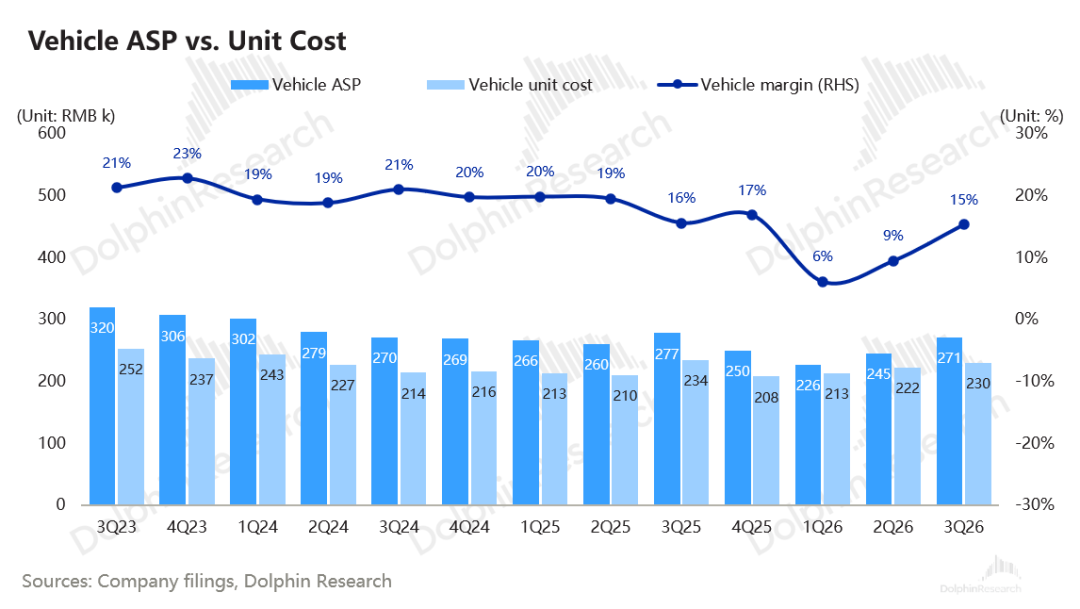
(Note: Q2 2022 is vehicle sales gross margin data after excluding the impact of 800 million+ yuan contract losses; Q2 2023 is vehicle sales gross margin data after excluding 400 million yuan warranty provisions; Q3 2025 is data including MEGA recall costs)
From the perspective of per-vehicle economics:
1. Per-vehicle price rose 26,000 yuan QoQ, mainly due to an upward shift in model mix
Vehicle ASP this quarter was about 271,000 yuan, up about 26,000 yuan QoQ, above the 260,000 yuan implied by consensus, and the company also explicitly said the QoQ revenue growth was "mainly due to the increase in average selling price brought by changes in product mix":
① Upward shift in model mix: the lower-priced i6 entered a model-change gap in September (orders for the old model were suspended, and the new model was only launched on 10/28 and deliveries began in early November), with the i6 share falling about 25pct QoQ to 40%; at the same time, the 450,000–510,000 yuan redesigned L9/L8 and the 370,000–400,000 yuan i9 began to ramp, and deliveries of the high-priced new Mega began.
② Tightened promotions: subsidies for the old L6 exited, and discounts before the i6 was discontinued narrowed; but from late September, L8/L9/i8 again increased promotions, partly offsetting the ASP increase.
2. Per-vehicle cost rose about 8,000 yuan QoQ, with raw material price increases and mix shift combined
Per-vehicle cost this quarter was about 230,000 yuan, up about 8,000 yuan QoQ: first, the BOM of higher-priced models such as MEGA, i9, and L9 Livis is itself higher, which is a "good increase" covered by ASP; second, price increases in cells, memory, and PCBs were fully reflected in Q3, and Li Auto has high intelligent configuration content and large memory usage, so it was relatively more affected, while deliveries only increased 1.7% QoQ, so scale dilution was limited.
But the substitution effect of the M100 self-developed intelligent driving chip (first launched with the all-new L9 in May, at about half the cost of outsourced chips) also began to show.
The Lianting platform's self-developed battery/e-drive and 5C battery were released in October and only began to be installed with the new i6 in November, and are expected to continue driving Q4 gross margin recovery.
3. Q3 per-vehicle gross profit was 41,000 yuan, up about 18,000 yuan QoQ
Q3 per-vehicle gross profit was about 41,000 yuan, up about 18,000 yuan QoQ, which also directly drove vehicle gross margin back to 15.3%, exceeding the market expectation of 13.6%.
2. Q4 sales guidance below expectations, implied ASP in revenue guidance above expectations
a) Sales guidance below expectations
Q4 sales guidance is 110,000–115,000 vehicles, below the market expectation of 131,000 vehicles. October deliveries fell to the lowest since February this year, mainly because only about 2,000 redesigned i6 vehicles were delivered; October production was 37,908 vehicles, about 8,900 more than deliveries, building inventory for November.
In addition, the company denied the i6 group-buying rebate activity and has reported it to the police, indirectly reflecting promotion pressure at the channel level.
Dolphin believes the guidance implies: i6 orders are gradually converting, but no more optimistic assumption was given for December capacity and delivery pace, while the range-extended L series is still losing speed, and it is difficult to pull Q4 back to 130,000 vehicles relying on the i6 alone.
b) Revenue guidance below expectations
The revenue guidance implies flat unit prices, mainly because the full-quarter deliveries of MEGA and i9, as well as the high-trim mix of L9 Livis, largely offset the impact of the rebound in the share of the lower-priced i6, which is a positive signal for fourth-quarter gross margin.
III. R&D expenses exceeded expectations, while selling and administrative expenses were broadly in line with expectations
1) R&D expenses: markedly up quarter on quarter
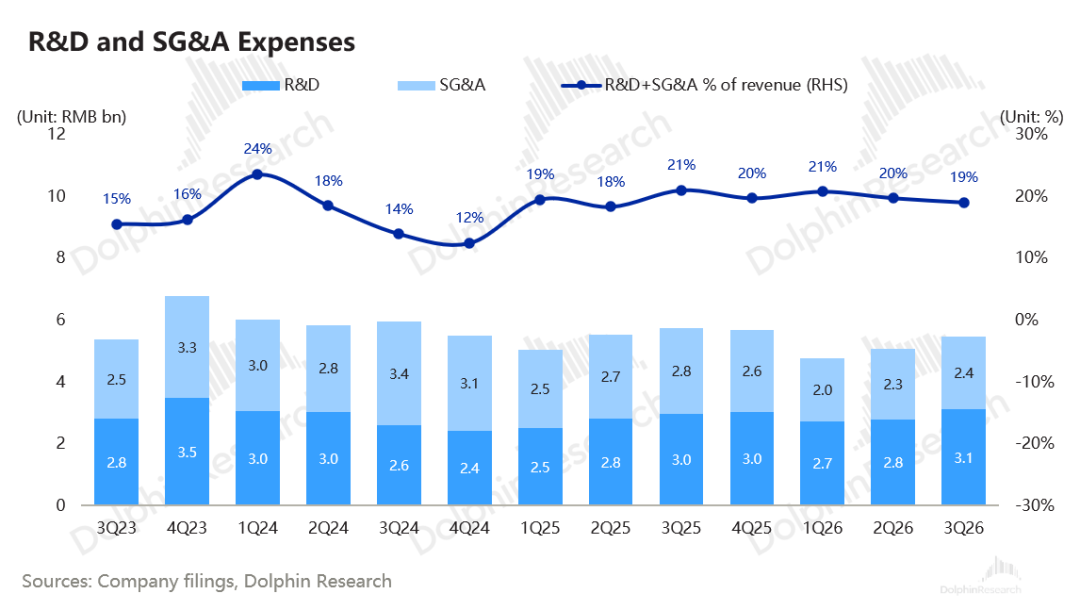
R&D expenses were RMB 3.12 billion, up 12.3% quarter on quarter and above the market expectation of RMB 2.82 billion. The company explained this as supporting product matrix and technology expansion. The investment directions were mainly:
a. 2027 new vehicles and self-developed core components including Lianshan battery, electric drive, and silicon carbide;
b. AI and chips: Mach VLA switched to a 3D ViT architecture in the October OTA, and Mach Xin can share part of R&D after bringing in external capital;
c. L4 autonomous driving, which Li Auto positions as the core capability of its "space robot," with a target of landing it by 2028 at the latest.
2) Selling and administrative expenses broadly in line with expectations
Selling and administrative expenses were RMB 2.36 billion, up 3.7% quarter on quarter and broadly in line with the market expectation of RMB 2.29 billion; down 14.7% year on year, mainly due to lower employee compensation and store rents.
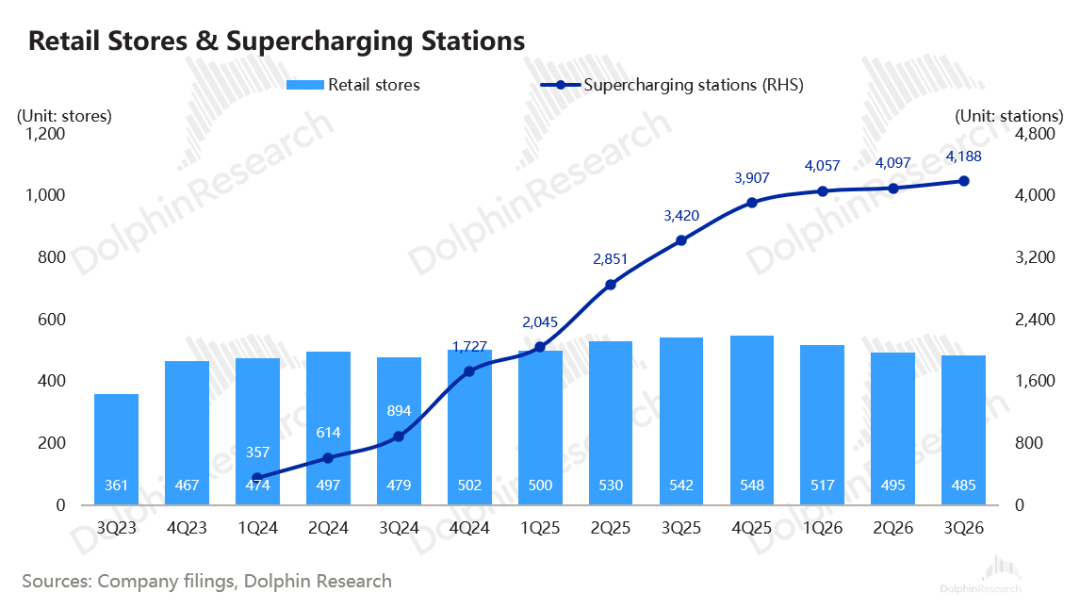
In the third quarter there were two launch events for the facelifted MEGA and i9, as well as a September Dubai launch event for entering the Middle East market, which increased marketing expenses somewhat; however, the effects of organizational optimization and store streamlining (485 stores at the end of the third quarter) continued.
IV. Free cash flow turned positive, and cash reserves remain ample
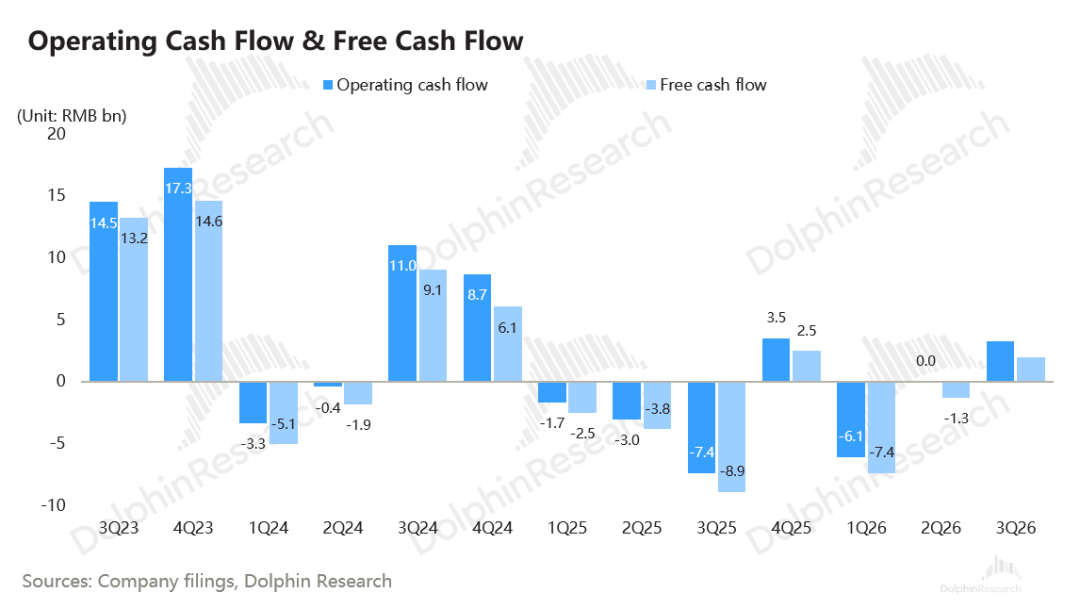
Operating cash flow was RMB 3.23 billion (RMB 15 million in the second quarter), mainly due to higher customer collections brought by a higher average selling price and narrowing losses; capital expenditure was RMB 1.27 billion, and free cash flow was RMB 1.96 billion, up RMB 3.3 billion quarter on quarter.
At the end of the third quarter, cash reserves (including cash, time deposits, short-term investments, and time deposits and financial instruments within long-term investments) were RMB 88.2 billion. After deducting about RMB 10.3 billion of borrowings, net cash was about RMB 77.9 billion, and cash on hand remains ample.
Regarding buybacks, the company announced a US$1 billion share repurchase plan in March 2026 and repurchased about RMB 1.56 billion in the third quarter (HK$493 million in Hong Kong shares + US$170 million in US shares). As of the earnings release, about US$694 million (about 69%) had been completed cumulatively, with cumulative repurchases accounting for about 5% of total share capital and about US$306 million remaining. With market capitalization below net cash, the per-share accretion effect of buybacks is more pronounced.
- END -
// Reprint authorization
This article is an original article by Dolphin Research. Authorization is required for reprinting.
// Disclaimer and general disclosure notice
This report is intended only for general comprehensive data use, aimed at general reading and data reference by users of Dolphin Research and its affiliates, and does not take into account the specific investment objectives, investment product preferences, risk tolerance, financial situation, and particular needs of any person receiving this report. Investors must consult independent professional advisers before making investments based on this report. Anyone who makes investment decisions due to the use of or reference to the content or information mentioned in this report must bear the risk themselves. Dolphin Research shall not be liable for any liability or loss that may be directly or indirectly caused by the use of the data contained in this report. The information and data contained in this report are based on publicly available materials and are for reference only. Dolphin Research strives for but does not guarantee the reliability, accuracy, and completeness of the relevant information and data.
The information mentioned or views expressed in this report shall not, in any jurisdiction, be treated or regarded as an offer to sell securities or an invitation to buy or sell securities, nor do they constitute suggestions, inquiries, or recommendations regarding the relevant securities or related financial instruments. The information, tools, and materials contained in this report are not intended or intended for distribution to citizens or residents of any jurisdiction where the distribution, publication, provision, or use of the relevant information, tools, and materials would conflict with applicable laws or regulations or would cause Dolphin Research and/or its subsidiaries or affiliates to be subject to any registration or licensing requirements in that jurisdiction.
This report reflects only the personal views, opinions, and analytical methods of the relevant creators and does not represent the position of Dolphin Research and/or its affiliates.
This report is produced by Dolphin Research, and the copyright is owned solely by Dolphin Research. Without the prior written consent of Dolphin Research, no institution or individual may (i) produce, copy, reproduce, reprint, forward, or otherwise distribute copies or reproductions in any form, and/or (ii) directly or indirectly redistribute or transfer them to other unauthorized persons. Dolphin Research reserves all relevant rights.
-
![]()
226 Trillion Tokens: Why Is DeepSeek Leading?
-
![]()
Can the Jones Matrix Not Handle Polarized Light? How Does the Mueller Matrix Handle It?
-
100,000 Units Is Just the Pass Mark — for Leapmotor to Truly Succeed, It Still Has One Weakness to Fix
-
From "Saying Nice Things" to "Getting Things Done": Big Tech's Personal AI Agents Have Arrived
-
![]()
Tencent Releases Next-Gen 3D Large Model Hunyuan Hy3D 3.6, With API as Primary Entry Point
-
Why Are Big Tech Profits Tightening Even as AI Revenue Rises?
-
![]()
Betting on AI and Embodied Intelligence! Zejing Co., Ltd. Signs Strategic Cooperation Framework Agreement
-
![]()
A High-Stakes Bet on Precision Optics: Yuxin Electronic to Acquire Huateng Optoelectronics for 160 Million Yuan