Q3 Net Profit Rises by Just 6%! Has Lante Optics Hit the Zenith of Prism-Driven Profits?
 10/28 2026
 364
On October 28, Lante Optics unveiled its financial results for the third quarter of 2026. Throughout the first nine months of 2026, the company achieved a revenue of RMB 1.573 billion, marking a 49.66% year-on-year surge; the net profit attributable to shareholders reached RMB 428 million, a 71.06% increase; the net profit excluding non-recurring items stood at RMB 420 million, up 72.85%; and the net operating cash flow amounted to RMB 581 million, reflecting a 49.3% year-on-year rise.
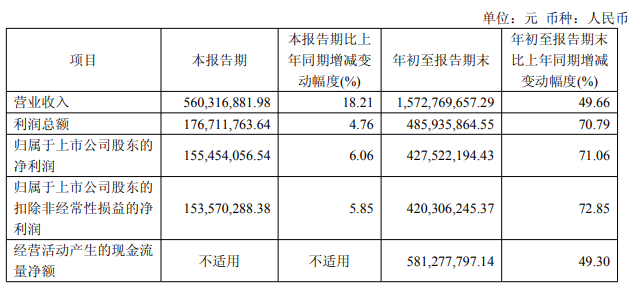
In the third quarter of 2026, the company's revenue was RMB 560 million, with the net profit attributable to shareholders at RMB 155 million. The year-on-year growth rates for both metrics decelerated to 18.21% and 6.06%, respectively.
The most striking feature of this financial report is the evident, albeit uneven, structural shift in Lante Optics' growth drivers, which are clearly heading in a new direction.
From a product-specific standpoint, revenue from optical prisms surged by RMB 291 million year-on-year, a 45.29% increase, fueled by the mass production of new compound prism projects and heightened demand for micro-prism terminals. Optical lens revenue climbed by RMB 129 million, up 45.57%, in line with the soaring demand for glass aspheric lenses in optical communications. Optical wafer revenue jumped by RMB 82 million, a 108.6% rise, signaling early penetration into AR and semiconductor applications, despite its relatively modest scale.
Prism revenue is intricately linked to the production schedules of smartphone optical solutions and is closely tied to the product cycles of key clients. Lens revenue follows the growth trajectories of 800G/1.6T optical modules and handheld imaging devices. Wafers are in the nascent stages of transitioning from validation to large-scale production.
During the period of robust prism growth in the first half of 2026, the official narrative consistently emphasized that the micro-prism business was "propelled by downstream customer demand." However, the demand surge from new models of major clients experienced a relatively moderate lull in the third quarter.
What truly warrants a longer-term assessment is the positioning of the lens and wafer lines post-third quarter.
Quantitative changes are also accumulating in the automotive sector, where glass aspheric lenses have penetrated the supply chains of confirmed partners like RoboSense, with mass shipments of certain products already in progress.
A common thread among these directions is that the pace of revenue recognition is dictated not by the product calendars of individual major clients but by the progress of customer validation and the speed of capacity ramp-up. The slowdown in the third quarter does not alter the trajectory of this growth curve.
The private placement initiative embodies this "structural shift," translating product-level projections into tangible capacity implementations. In January 2026, Lante Optics announced a private placement plan of up to RMB 1.055 billion. In June, in response to inquiry letters, it disclosed capacity planning and revenue projections for each project: The AR optical product industrialization project, with a total investment of RMB 501 million, focuses on producing 12-inch high-index glass wafers, lithium niobate wafers, silicon carbide wafers, and color-combining prisms, with projected annual revenue of RMB 917 million and an internal rate of return (IRR) of 17.20% upon full capacity utilization. The glass aspheric lens capacity expansion project, with a total investment of RMB 242 million, targets optical communications, consumer, and interchangeable lenses, with projected annual revenue of RMB 276 million and an IRR of 27.45% upon full capacity utilization. The micro-nano optical component project centers on wafer-level imprinting and etched micro-lens arrays, with projected annual revenue of RMB 176 million upon full capacity utilization.
According to the disclosure in the inquiry letter response regarding order reserves for the funded projects, as of the end of April 2026, there were already substantial orders on hand for the relevant products. On the AR wafer front, mass production and supply for renowned brands have been achieved through manufacturers such as R Company, S Company, I Company, and W Company. On the optical communications lens side, mass shipments have been made to manufacturers such as L Company and M Company. The significance of these capacity and order details lies in their securing of Lante Optics' capacity positions in the high-value chains of AR optics and high-speed optical module lenses beyond 2027.
Overall, the over 70% profit growth in the first three quarters underscores that the prism business remains a robust pillar of profitability. The real question is whether, as the consumer electronics dividend of prisms gradually transitions from a boom phase to a stable phase, lenses and wafers can assume a greater share in the revenue structure.
Lante Optics is currently in a transitional window where this shift has not yet been fully realized, but capacity and customer positioning have already been firmly established. The market's future developments are eagerly awaited.
-
Could the Three-Row, All-Electric Flagship SUV BMW iX7, Equipped with an 8K Giant Screen and Produced in North America, Become a Bestseller?
-
![]()
WorkBuddy Ignites the AI Office Ecosystem Battle
-
![]()
Second Working Conference on Drafting the Group Standard “Test Method for Optical Parameters of Optical Waveguide Sheets” Held in Suzhou!
-
![]()
Q3 Net Profit Rises by Just 6%! Has Lante Optics Hit the Zenith of Prism-Driven Profits?
-
Hurun Rich List Released: AI Starts Creating Wealth - 1 in Every 10 Billionaires Owes Their Fortune to AI
-
![]()
Top 10 Provinces by GDP in the First Three Quarters of 2026: Diverging Growth Models
-
![]()
Why Is Mobile Phone RAM Shrinking?
-
![]()
Who is Investing in Anthropic?