Zhipu Resembles Zhang Sanfeng, Minimax Mirrors Linghu Chong
 04/03 2026
 473
473
Zhipu harnesses Tao to master techniques, while Minimax advances through technical innovation.
Text by She Zongming
Lu Xun once remarked, "There are no paths on the earth; but as more people tread, paths emerge." However, his statement remains incomplete: The world has no diverging paths, but as more paths are forged on the ground, divergences arise.
In the Hong Kong stock market, the two leading large-scale AI model companies—Zhipu and Minimax—have embarked on divergent paths, each charting its own course.
On the surface, both companies leverage "computing power as their weapon, models as their core strength, and Tokens as their lifeblood," and have swiftly risen with the current AI boom: Nearly three months after going public, both reported triple-digit revenue growth in their initial financial reports, a feat envied by many peers. Their market capitalizations have both surpassed HK$300 billion, outpacing many second-tier internet giants.
Yet, in reality, these two companies operate quite differently, adopting contrasting strategies. On the journey towards AGI, they may share the same destination but take vastly different routes.
Recently, Zhipu and Minimax unveiled their respective "customized" formulas for AGI commercial value and AI platform value.
Zhipu CEO Zhang Peng stated that AGI commercial value = Upper Bound of Intelligence × Token Consumption Scale. In contrast, MiniMax founder Yan Junjie believes that AI platform value = Intelligence Density × Token Throughput.
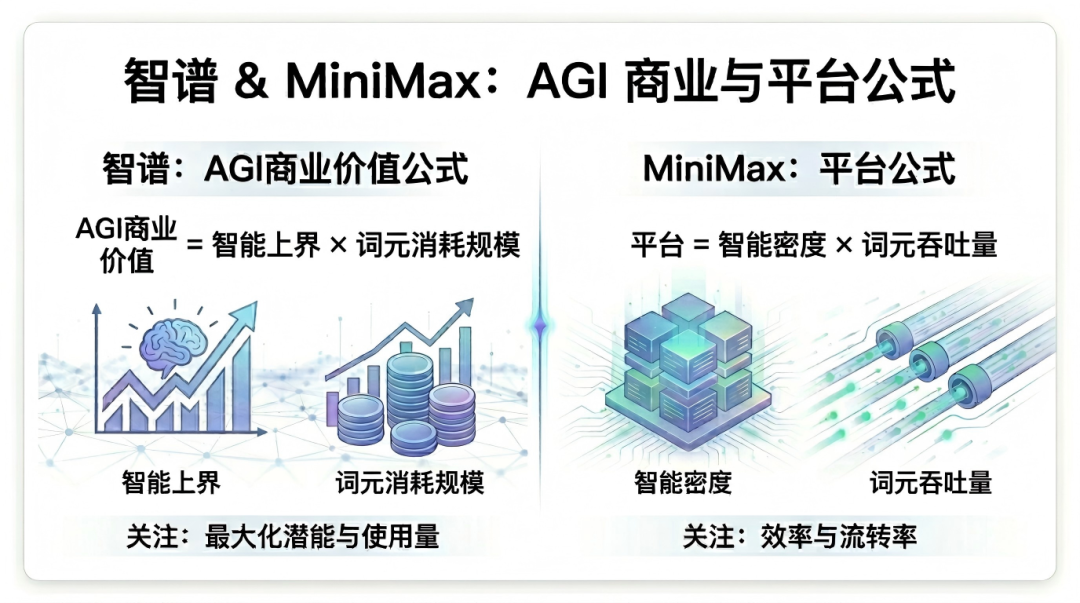
▲Image source: Silicon-Based Research Lab.
It is intriguing to observe how these two "values" differ. Although both incorporate the keywords "intelligence" and "Token," the concepts of "upper bound" versus "density" and "consumption scale" versus "throughput" are distinct: One aims to ascend, breaking through the limits of intelligence; the other seeks to penetrate, expanding the breadth of technological application.
One statement defines the path; one phrase splits the journey. If I were to liken Zhipu and Minimax to characters in Jin Yong's martial arts novels, my impression would be:
Zhipu resembles Zhang Sanfeng, pursuing the supreme peak of martial arts mastery, governing technique with Tao; Minimax mirrors Linghu Chong, pursuing ultimate efficiency in real-world combat, breaking through with technique.
01 /
According to tech observer Yuan Zheng's view that "Watt, Maxwell, Einstein = computational power singularities of biological computing power = human intelligence supercomputing," Zhang Sanfeng and Linghu Chong are clearly both human intelligence supercomputers.
Examining their unique skills through algorithmic logic reveals clear differences: Zhang Sanfeng delves into the fundamentals, exploring the ultimate limits and evolutionary boundaries of this algorithm; Linghu Chong, intuitive and spontaneous, explores the flexible deployment and efficient utilization of this algorithm.
In The Heaven Sword and Dragon Saber, Zhang Sanfeng possesses several distinct characteristics:
1. Noble lineage: Initially trained at Shaolin, he later founded Wudang, becoming a master of a prestigious sect.
2. Profound internal strength and high mastery, having created Tai Chi, a grandmaster of martial arts.
3. Steady, upright, and magnanimous demeanor, embodying the grace of a grandmaster.
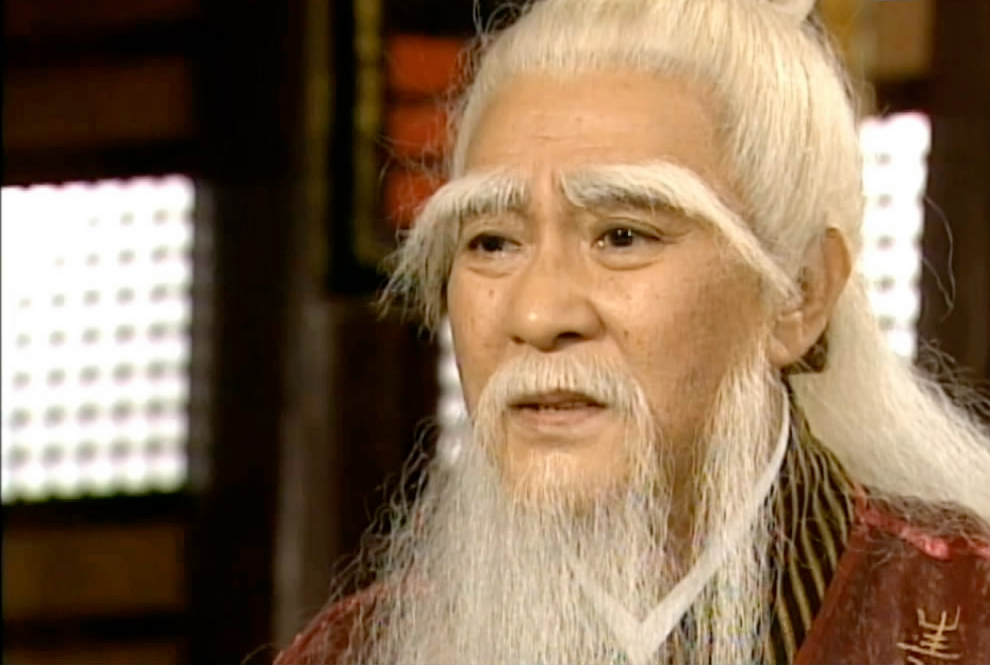
▲Zhang Sanfeng's image in an early adaptation of The Heaven Sword and Dragon Saber.
Zhipu's "character portrait" is not identical but highly similar.
It carries the aura of a prestigious lineage.
The industry knows that Zhipu is backed by Tsinghua University, endorsed by "state-owned capital," with deep academic roots and a legitimate background.
If you are unfamiliar, you can research Tang Jie's background and Zhipu's funding history.
It possesses unique prowess.
Just as Zhang Sanfeng can unblock the Ren and Du meridians in humans, Zhipu's self-developed GLM architecture integrates bidirectional encoding with unidirectional generation, unblocking the two major channels of semantic understanding and creative output.
As an "autoregressive fill-in-the-blank" design distinct from GPT's pure autoregressive paradigm, GLM can deeply read long texts, explore logic, and steadily control generation while minimizing hallucinations—much like building a foundation with the Pure Yang Unpolarized Technique and transforming moves with Tai Chi, it contains profound computational power internally while appearing harmonious and flawless externally.
It also embodies the demeanor of a grandmaster.
Proposing the L1-L5 AGI roadmap, developing the AutoGLM agent, and achieving the first breakthrough from pre-training to autonomous learning give it a pioneering spirit. Focusing on a To B MaaS model, centering on enterprise services and developer ecosystems, it maintains its position as China's largest independent large model company without the frenzy of C-end traffic, embodying a sense of steadfastness and righteousness.
Zhang Sanfeng once secluded himself to cultivate internal strength.
Zhipu has also relentlessly pursued AGI foundation models, quietly developing GLM for years, iterating the foundation every 3 to 6 months.
From GLM-130B becoming China's first open-source 100-billion-parameter model, to GLM-4.5/4.6 ranking first globally in open-source on multiple international authoritative benchmarks, to GLM-5 breaking new limits with its 745B MoE architecture, each iteration by Zhipu raises the ceiling of native intelligence capability—the "upper bound of intelligence."
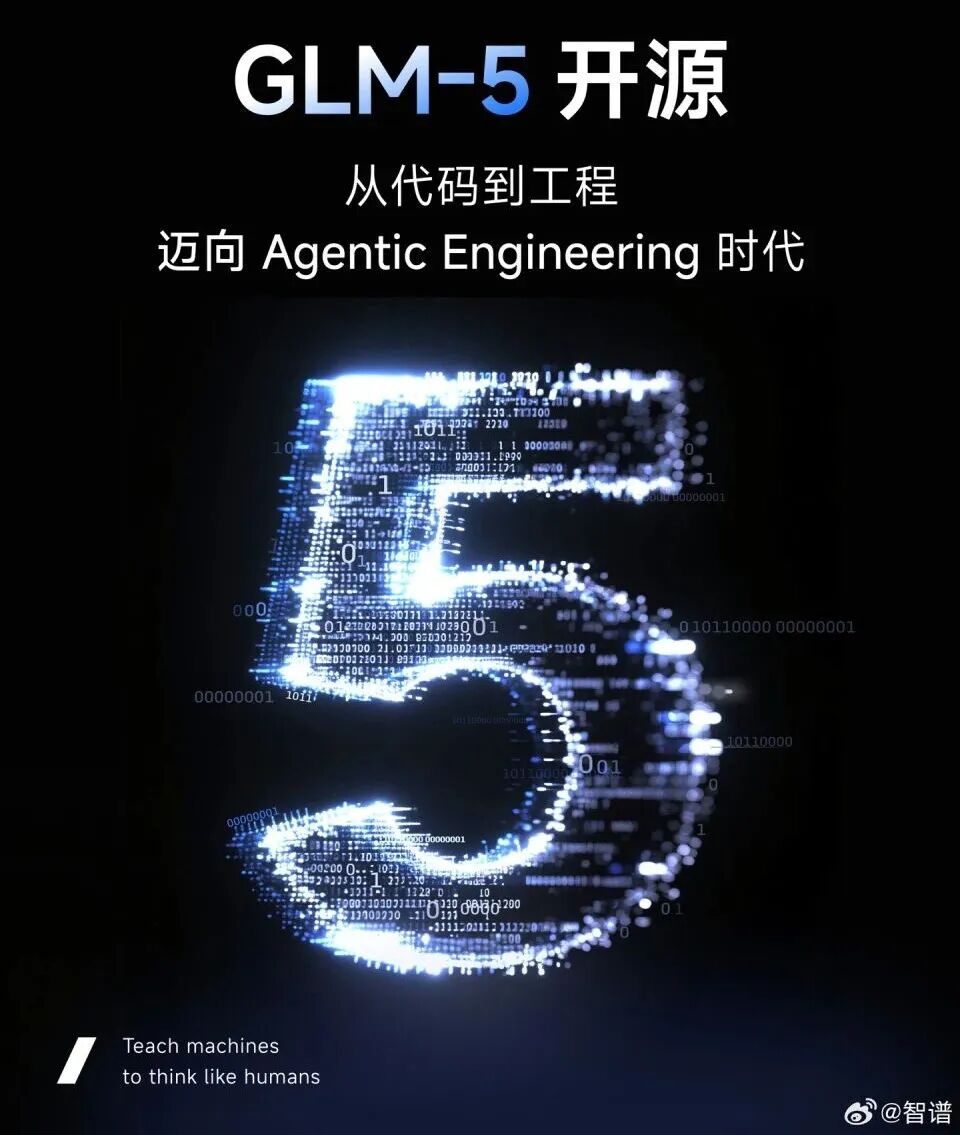
▲Zhipu's GLM-5 caused quite a stir upon its release.
After Zhang Sanfeng polished his skills daily, his internal strength reached perfection.
In November of the previous year, during the Code Arena (a global blind test by millions of developers), GLM-4.6 tied for first globally with GPT-5 and Claude, marking the first time a Chinese model stood shoulder to shoulder with OpenAI and Anthropic's top models in an international top-tier code evaluation—a testament to its strength.
Thanks to its hardcore capabilities, in Q1 2026, Zhipu's API defied market trends with an 83% price increase, yet saw a 400% surge in usage.
On April 1, Zhipu CEO Zhang Peng stated that Zhipu had defined AI productivity value for the first time—Token Architect Capability (TAC), condensing its formula into "Intelligence Usage × Intelligence Quality × Economic Conversion Efficiency," expressing Zhipu's goal to become the infrastructure that enhances TAC for all of society.
The key to achieving this may lie in emulating Zhang Sanfeng—focusing on internal strength, foundations, and mastery.
First establish the Tao, then the technique; first define the realm, then the outcome. Both follow this principle.
02 /
In Jin Yong's martial arts world, Zhang Sanfeng's profound internal strength contrasts with Linghu Chong's lightning-fast reflexes.
Linghu Chong's signature skill is the Nine Swords of Dugu.
The essence of the Nine Swords lies in "anticipating the enemy, infinite adaptability, and formlessness surpassing form."
It emphasizes "cleverness."
MiniMax's technical approach clearly captures this essence.
MiniMax's MoE (Mixture of Experts) and Lightning Attention mechanisms achieve higher "intelligence density" than many peers under the same computational constraints—also due to "cleverness."
Take MoE, for example: Its main advantage is "sparse activation." Faced with different enemies (tasks), it calls upon only the most skilled experts (sub-models) rather than mobilizing all disciples (parameters) at once.
This is a literal interpretation of "nimble swordplay."
In Jin Yong's writing, Linghu Chong has two key traits: agility and freedom.
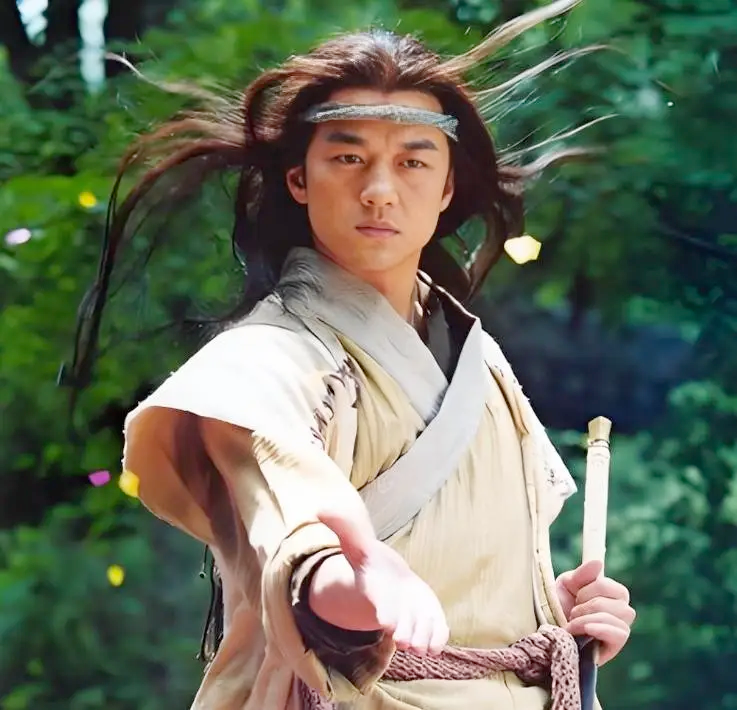
▲Li Yapeng's portrayal of Linghu Chong in The Smiling, Proud Wanderer.
In terms of agility, Linghu Chong is not confined to Hua Shan swordplay but integrates techniques from the Five Great Swords, adapting and evolving endlessly.
MiniMax also excels in agility: It doesn't follow a single-model path but pursues a full-stack, self-developed, multi-modal matrix, covering text, voice, video, music, and agents.
Linghu Chong roams the martial arts world, unorthodox in his approach—he can duel the Four Friends at Mei Manor or fight Dongfang Bubai at Black Wood Cliff, adapting to any scenario.
MiniMax does the same: Serving B-end clients like WPS AI and Xiaohongshu Search while creating global C-end hit apps, it covers all scenarios and modalities—like Linghu Chong's Nine Swords, encompassing total principle, sword-breaking, saber-breaking, spear-breaking, whip-breaking, rope-breaking, palm-breaking, arrow-breaking, and qi-breaking styles, leaving nothing out and breaking nothing.
In terms of freedom, Linghu Chong follows his heart and acts spontaneously.
MiniMax's development path is equally vibrant with "freedom"—undefined and unconstrained.
Minimax carries no "orthodox" burden nor follows a path of austere self-cultivation. Instead, it embraces flexibility, rapid iteration, and efficiency—unlike Zhipu's "heavy R&D, slow implementation," it adopts "R&D while implementing, iterating while implementing," seizing market opportunities with extreme human efficiency and ultra-fast iteration.
Linghu Chong's swordplay is precise and fast.
In Yan Junjie's formula, "intelligence density" corresponds to "swordplay precision"—solving complex, high-value needs with minimal Tokens is Minimax's strength; "Token throughput" corresponds to "swordplay speed"—driving explosive Token consumption through high concurrency, broad coverage, and frequent usage is also Minimax's forte.
The M2 series model once ranked top three globally in programming performance, with inference costs only 8% of Claude's; C-end products like Talkie (Xingye) and Hailuo (Hailuo Video) saw a 6x increase in daily Token consumption in six months, with API revenue growing nearly 300%—evidence of this.
Interestingly, when asked on Luo Yonghao's podcast, "None of your modalities are absolute first, but overall you're first-tier. What do you think?" Yan Junjie replied, "True AGI is multi-modal integration, not single-modal first. Being first in a single area doesn't matter; overall coordination and user experience do." "Outsiders say we're unfocused, but we're clear: First get each modality working, then integrate. We don't need to be first in everything."
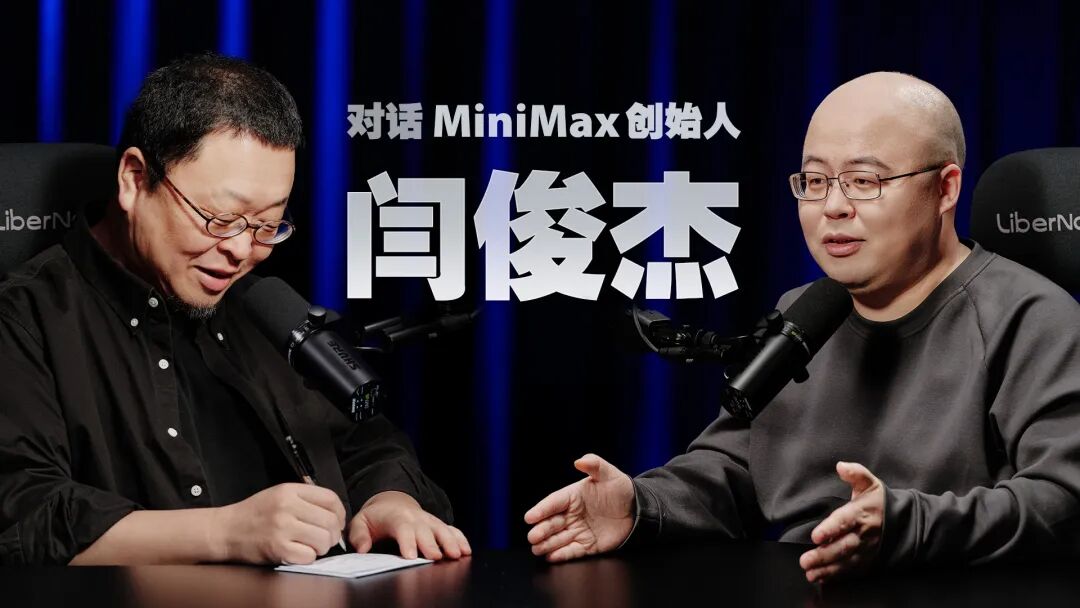
▲A few months ago, Yan Junjie discussed his AI insights on Luo Yonghao's podcast.
This also recalls Linghu Chong: He isn't "top in every ability" but "effective in every scenario."
His confidence comes from breaking through with speed and winning with efficiency.
03 /
Zhang Sanfeng seeks the "extremity of Tao," while Linghu Chong seeks the "breadth of technique."
To some extent, Zhang Sanfeng's experience can be summarized as: Martial arts achievement = Internal strength limit × Total qi utilization. The Pure Yang Unpolarized Technique works this way: The deeper the internal strength, the greater the power, growing stronger with use.
Linghu Chong's can be summarized as: Martial arts deterrence = Precision in striking the enemy × Speed and frequency of attacks. The Nine Swords emphasize unobstructed moves, breaking all techniques with speed, and deciding the outcome with cleverness.
Translating these units into an AI version yields the two approaches Zhipu and Minimax take in cultivating AGI.
Zhipu seeks "depth," aiming to stand at the technological pinnacle and reach the summit of intelligence.
Minimax seeks "breadth," aiming to reach more people and expand its ecological frontier.
Neither path is superior; it's about suitability.
Much like the recent discussions around "Zhang Xue vs. Zhang Xuefeng."
In many discussions, Zhang Xue is seen as the embodiment of extreme idealism, while Zhang Xuefeng represents extreme pragmatism.
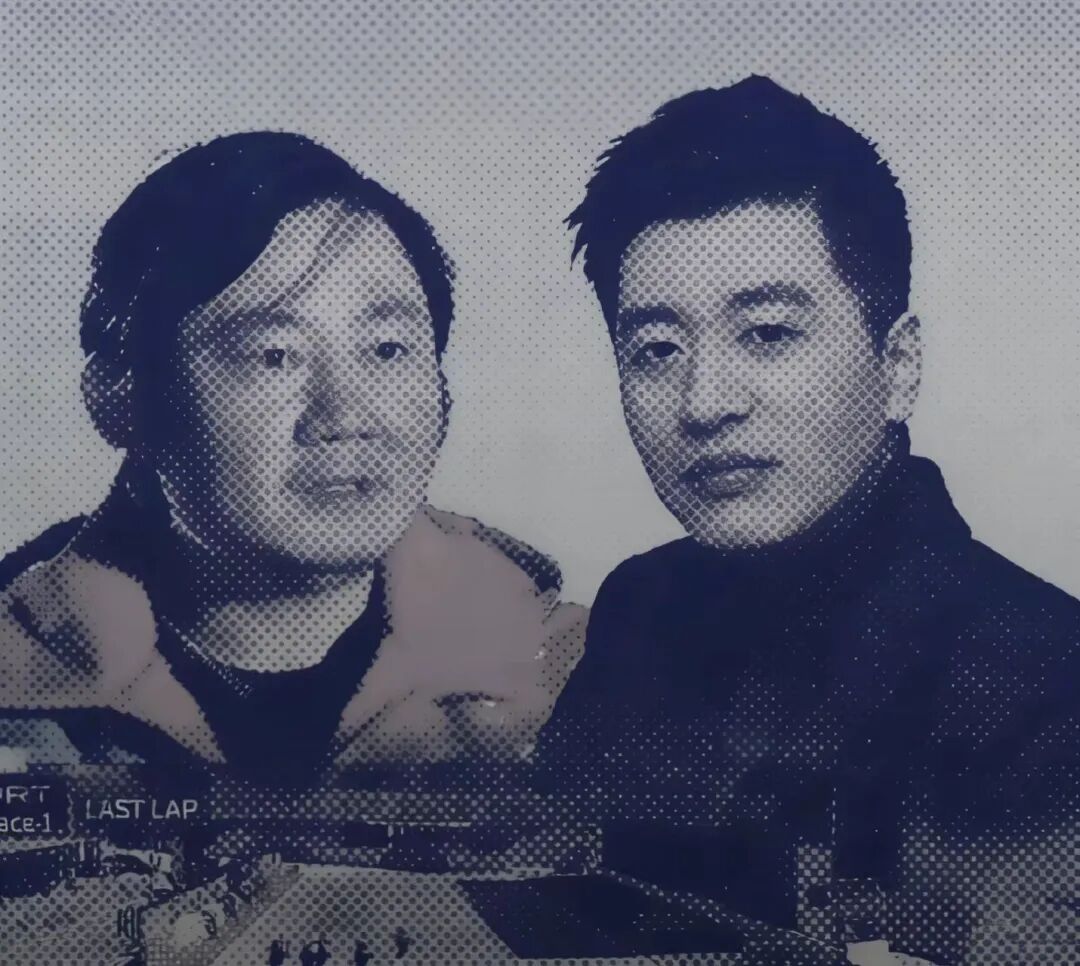
▲Zhang Xue and Zhang Xuefeng are seen as representatives of extreme idealism and extreme realism, respectively.
Applying this framework, Zhipu seems to align with Zhang Xue, demonstrating through its relentless pursuit of AGI that in the AGI era, technological barriers are fundamental, the upper bound of intelligence determines pricing power, and becoming "the strongest" comes before becoming "the most valuable."
Minimax aligns with Zhang Xuefeng, showing through its pursuit of effectiveness that in the AI platform era, efficiency is core, intelligence density is competitiveness, and solving problems, serving users, and expanding the ecosystem first are key.
Is either right or wrong?
Not at all. For AI companies, the key is which path suits them better.
Currently, both Zhipu and MiniMax have surpassed HK$300 billion in market cap—one continues to raise the upper bound of intelligence, the other continuously improves intelligence density.
This shows that the AI landscape accommodates diverse choices: It accommodates Zhang Sanfeng, aiming to reach the peak first and then dominate; it also accommodates Linghu Chong, always nimble and smiling as he roams the world.
There is orthodoxy and unconventionality, stability and agility. The great Tao lies ahead, and each walks their own path.
Such is the charm of the martial arts world.
Operated by Li Wan
Feel free to share on Moments. Reproduction requires permission.
-
![]()
The Allure of 'Acquisition Spree': Li Shufu's Left Turn, Xu Jiayin's Right
-
![]()
Strategic Transformation Yields Results: Phoenix Optics Reports 10.9% YoY Rise in Core Net Profit for H1 2026
-
![]()
Three Key Growth Trajectories Synergize! Crystal-Optech Reports 3.478 Billion Yuan in Revenue for H1 2026
-
![]()
Semi-Annual Report Sparks XPENG Motors Buzz
-
![]()
1.6 Billion Big Order Secured! SeeYA Technology's Revenue Soars by 287.87% in the First Half of the Year
-
![]()
Baidu's Profits Plunge by 68%: Unraveling the Mystery Behind the Numbers
-
![]()
Baidu’s Profits Tumble by 68%! Where Has All the Money Gone?
-
![]()
Hynix’s Taobao Store Shuts Down Abruptly: What Should Customers Do About Warranty Services for Memory Modules?