1.6 Billion Big Order Secured! SeeYA Technology's Revenue Soars by 287.87% in the First Half of the Year
 08/25 2026
 549
549
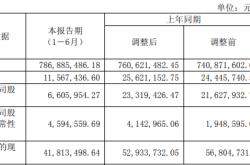
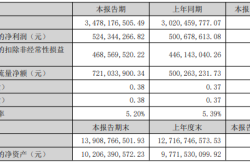
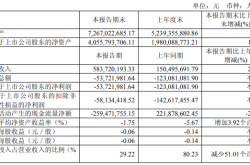
Recently, SeeYA Technology disclosed its semi-annual report for 2026, showing revenue of RMB 584 million during the reporting period, a massive 287.87% year-on-year increase. Although the net profit attributable to the parent company remained in the red at RMB -53.722 million, it significantly narrowed by 56.35% from the RMB -123 million loss in the same period last year.
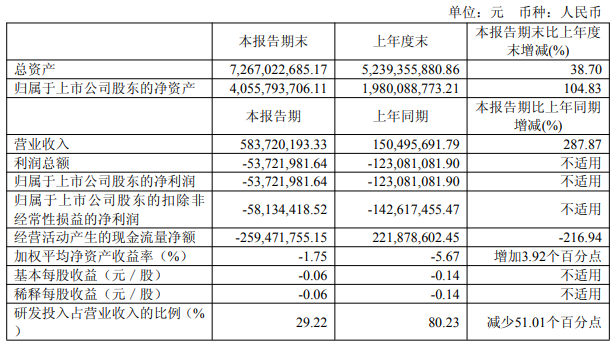
The direct driver of the revenue surge is the official transition of a strategic product development project for a specific customer into mass production and delivery, coupled with sustained increases in orders from other customers. Shipments of silicon-based OLED microdisplays in the first half of the year have already surpassed the total for 2025, with economies of scale beginning to materialize.
From a revenue structure perspective, the microdisplay business contributed RMB 509 million, accounting for 87.19%, while strategic product development revenue reached RMB 56.88 million, accounting for 9.74%. Together, these two core businesses accounted for nearly 97% of total revenue, further enhancing business focus.
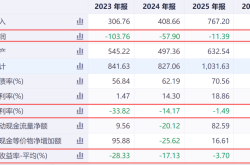
Accompanying the increase in shipments, the company's comprehensive gross profit margin rose to 28.03%, up approximately 12.5 percentage points year-on-year, while the net profit margin improved significantly from -81.79% in the same period last year to -9.20%. Notably, revenue in the second quarter alone reached RMB 408 million, a 308.51% year-on-year increase, with a net loss attributable to the parent company of just RMB 8.205 million, coming close to breaking even for the quarter.
It is noteworthy that revenue from overseas markets reached RMB 325 million, accounting for 55.64% and surpassing domestic market revenue for the first time. This structural shift signifies SeeYA Technology's transition from a local supplier to a core global microdisplay player.
However, the flip side of rapid growth is ongoing heavy R&D investment and cash flow pressures. R&D expenses in the first half reached RMB 171 million, a 41.24% year-on-year increase, accounting for 29.22% of revenue. The R&D team expanded to 284 personnel, with a cumulative total of 348 IP registrations or authorizations, including 202 invention patents. This full-stack self-developed capability in 'display chips + microdisplays + optical systems' forms the core barrier against international giants like Sony, but it also continuously consumes capital.
The net cash flow from operating activities was RMB -259 million, turning negative year-on-year. The company explained that this was primarily due to receiving customer deposits in the same period last year, whereas this period saw a significant increase in raw material inventory to secure capacity ramp-up and order fulfillment. This is essentially a Stage characteristics (phase-specific characteristic) of the business expansion period, with working capital occupy (occupation) from surging orders testing the company's cash flow management capabilities—a critical hurdle in transitioning from high growth to high-quality profitability.
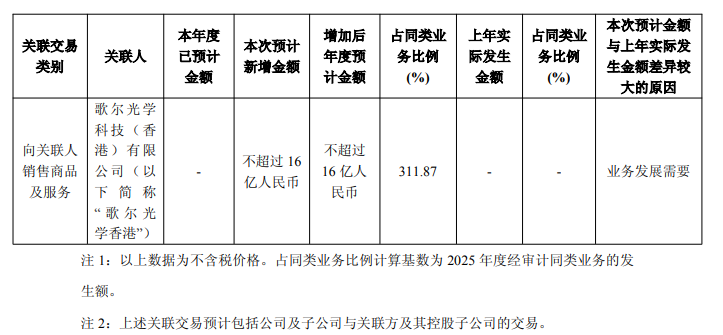
More imaginative than the semi-annual report data are the significant moves the company has disclosed following its listing. On March 25, SeeYA Technology officially listed on the STAR Market, raising RMB 2.268 billion. On May 28, it announced a proposed silicon-based OLED microdisplay sales contract with related party Goertek Optics Hong Kong for no more than RMB 1.6 billion, accounting for 311.87% of similar business transactions—the largest related-party transaction disclosed since the company's listing.
To this end, approximately RMB 1.609 billion of its IPO proceeds will be used for expanding a 12-inch silicon-based OLED production line, targeting an annual capacity increase to 10.8 million displays. As of the report's end, cumulative investment progress for the project stood at 51.67%, with the Reservation status (scheduled state) expected to be reached by February 2028. The speed of capacity ramp-up will become the most critical variable to observe in the coming quarters.
From an industry perspective, SeeYA Technology is indeed on the right track. Frost & Sullivan forecasts that global silicon-based OLED display sales will grow from RMB 1.27 billion in 2024 to RMB 67.93 billion in 2030, with a compound annual growth rate of 94.1%. In 2024, SeeYA Technology accounted for 35.2% of global XR device silicon-based OLED shipments, ranking second globally after Sony's 50.8%, and is the only domestic company to achieve million-unit shipments alongside Sony.
However, concerns cannot be ignored: the RMB 1.6 billion related-party transaction accounts for over 300% of similar business transactions, with revenue highly concentrated in a single related party. Any order fluctuations or product roadmap adjustments from this major customer could significantly impact the company's performance. Meanwhile, despite narrowing losses, the company has accumulated over RMB 900 million in losses over the past three and a half years. When it will achieve annual profitability remains a core suspense (suspense) for the market. Additionally, the accelerated commercialization of next-generation display technologies like Micro LED poses potential substitution risks for silicon-based OLED in the medium to long term.
SeeYA Technology's semi-annual report serves as both a scorecard for explosive growth in the upstream XR industry chain and a 'mid-term exam' during the capacity expansion phase—revenue soars, losses narrow, major orders land, and capacity advances. The growth narrative is established, but cash flow pressures, customer concentration, and an unrealized profitability turning point leave ample suspense .
For SeeYA Technology, the core challenge in the second half of the year is clear: whether it can truly convert the 287% revenue growth into sustainable profitability and healthy cash flow will determine its ultimate ascent from an industry 'dark horse' to a 'white horse.' OFweek Optoelectronics will continue to track developments.
-
![]()
The Allure of 'Acquisition Spree': Li Shufu's Left Turn, Xu Jiayin's Right
-
![]()
Strategic Transformation Yields Results: Phoenix Optics Reports 10.9% YoY Rise in Core Net Profit for H1 2026
-
![]()
Three Key Growth Trajectories Synergize! Crystal-Optech Reports 3.478 Billion Yuan in Revenue for H1 2026
-
![]()
Semi-Annual Report Sparks XPENG Motors Buzz
-
![]()
1.6 Billion Big Order Secured! SeeYA Technology's Revenue Soars by 287.87% in the First Half of the Year
-
![]()
Baidu's Profits Plunge by 68%: Unraveling the Mystery Behind the Numbers
-
![]()
Baidu’s Profits Tumble by 68%! Where Has All the Money Gone?
-
![]()
Hynix’s Taobao Store Shuts Down Abruptly: What Should Customers Do About Warranty Services for Memory Modules?