Will Unitree Learn from the 'Big Brother' UBTECH to 'Work in Factories'?
 05/20 2026
 681
681
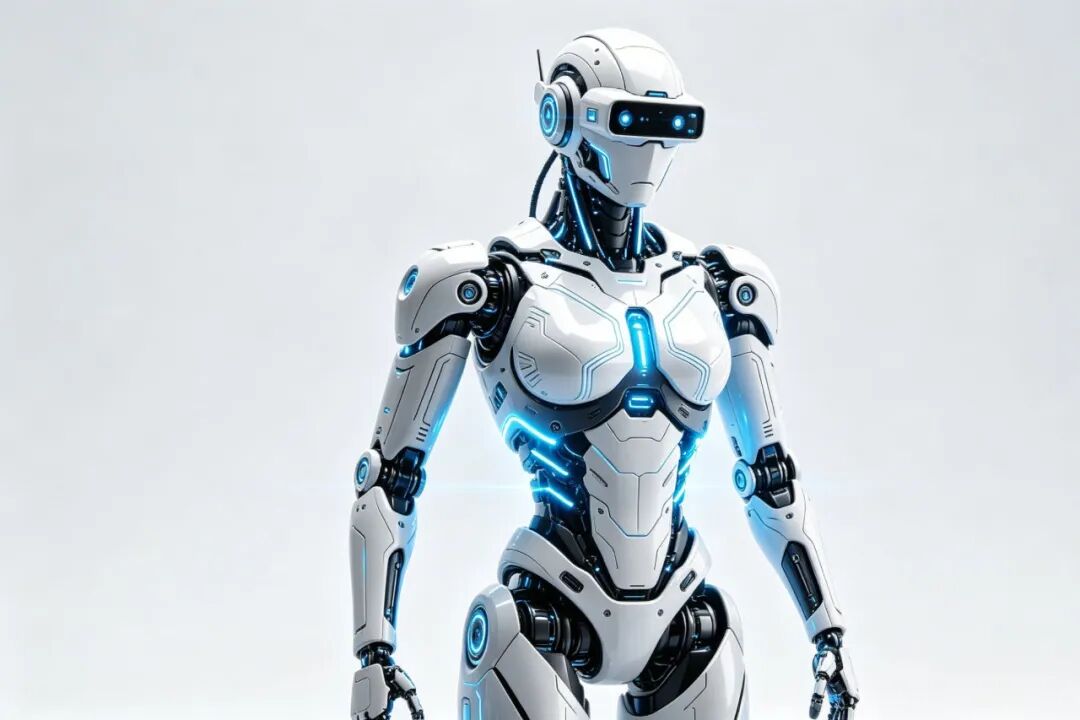
UBTECH roots itself in automotive factories, while Unitree mass-produces 'Gundams' for the upper market.
Source | Silicon-based Quadrant
While industry veterans are still toiling in the industrial trenches of 'robots tightening screws in factories,' Unitree Robotics has struck gold with profitability.
UBTECH, dubbed the 'first humanoid robot stock,' sold 1,079 humanoid robots in 2025, generating revenue of RMB 820 million, a staggering 2,203.7% year-over-year increase, yet still incurred a loss of RMB 700 million.
Unitree Robotics, which is eyeing a Sci-Tech Innovation Board IPO, shipped over 5,500 units in 2025, ranking first globally, with revenue reaching RMB 1.708 billion, a 335% year-over-year increase, and net profit exceeding RMB 400 million, a 674% growth rate.
While Unitree appears far more profitable, about 73.6% of its humanoid robot revenue comes from universities and research institutions, primarily serving as teaching tools for students and developers.
Education was once UBTECH's main battleground, a basic (entry-level) market with relatively low technical barriers.
In 2024, the education sector contributed the largest revenue share, approximately RMB 363 million. By 2025, revenue from full-size embodied intelligent humanoid robots surpassed the education sector, exceeding RMB 800 million and accounting for 41% of total revenue. More than 80% of this came from industrial scenarios, implying industrial revenue of approximately RMB 640 million, far exceeding the RMB 410 million from education.
Currently, UBTECH has formed partnerships with BYD, Dongfeng Liuzhou Motor, and Geely Automobile, with robots set to 'start mass employment' after a year of training.
Leading overseas companies, such as Tesla (Optimus), Boston Dynamics (Atlas), and Figure AI (Figure 02), have also deployed humanoid robots in automotive factories like Tesla, Hyundai, and BMW, long since beginning to 'work in factories.'
An important decision lies ahead for Unitree: continue as a 'toy/teaching aid' to mine the consumer market or follow the lead of industry veterans and learn to 'work in factories.'
01 Education as an Entry-Level Application
Founded in 2012, four years earlier than Unitree Robotics, UBTECH is headquartered in Shenzhen and was founded by Zhou Jian.
UBTECH's early commercialization focused on consumer and education markets, with products including the Alpha series educational robots, Jimu building block robots, Walker series humanoid robots, and Panda service robots.
In 2023, UBTECH listed on the Hong Kong Stock Exchange, becoming known as the 'first humanoid robot stock.'
In 2025, UBTECH's revenue reached RMB 2.001 billion, a 53.3% year-over-year increase. Revenue from full-size embodied intelligent humanoid robot products and solutions surged by approximately 2,203.7%, reaching RMB 820.6 million, becoming UBTECH's largest revenue source.
However, UBTECH continued to incur losses, with a RMB 789.8 million loss in 2025, primarily due to massive R&D investment, high deployment costs in industrial scenarios, long project delivery cycles, and increased AI training expenses.
Currently, UBTECH's product lineup is extensive, including logistics intelligent robots, industry-customized intelligent robots, smart lawnmowers, and the PC01, PC10, PC20, PC200 series pool robots, as well as the PS100 pool surface cleaning robot, smart floor-sweeping robots, smart litter boxes, feeders, pet grooming vacuums, and intelligent drying boxes.
Unitree Robotics, founded on August 26, 2016, is headquartered in Hangzhou, Zhejiang. Its founder and CEO, Wang Xingxing, is a post-90s entrepreneur who graduated from Zhejiang Sci-Tech University for his undergraduate studies and Shanghai University for his graduate studies.
From 2013 to 2016, during his graduate studies, Wang Xingxing developed XDog, a purely electric-driven, high-performance quadruped robot with full degrees of freedom.
After graduating with a master's degree in 2016, Wang Xingxing briefly worked at DJI but resigned after a few months to co-found Unitree Robotics with three classmates.
Unitree's early business focused on 'quadruped robots,' with its first general-purpose humanoid robot, H1, released in August 2023. In 2023, quadruped robots accounted for over 65% of its total revenue.
Currently, Unitree offers two product lines: quadruped robots (Go2, B2, AlienGo) and humanoid robots (H1 (full-size), G1 (medium-size), R series).
In 2025, Unitree's humanoid robot sales revenue surpassed that of quadruped robots for the first time, with global cumulative shipments exceeding 5,500 units. That year, Unitree achieved revenue of RMB 1.708 billion, a staggering 335.36% year-over-year increase.
The majority of Unitree's humanoid robot sales come from the G1 lightweight platform, priced at around RMB 100,000.
Currently, scientific research and educational institutions account for the highest share of Unitree's revenue at 73.6%, while industry applications account for only 9.0%.
02 Rollercoaster Pricing
Unitree Robotics' brand influence and pricing strategy have made it thrive in the consumer market.
A regular performer on the CCTV Spring Festival Gala, Unitree has built national-level influence.
In 2021, Unitree's robotic dog made its debut on the CCTV Spring Festival Gala with jumping performances. In 2025, Unitree's humanoid robots, dressed in floral jackets and holding handkerchiefs, performed a 'collective Yangko dance,' leaving a deep impression. In 2026, Unitree, along with Magic Atom, Galaxy General, and Songyan Power, staged a joint performance with four humanoid robots.
Unitree's humanoid robot pricing has been unstable, with product upgrades accompanied by price halving and further price reductions.
In August 2023, Unitree released its first humanoid robot, H1, priced at RMB 390,000. In October 2025, the second-generation H2 was released, with improved performance but a halved price of RMB 190,000.
In late April 2026, Unitree released the most affordable dual-arm humanoid robot, the R1 series, with a starting price as low as RMB 26,900.
Unitree can keep prices extremely low due to its 'hardware assembly and rapid iteration' strategy.
According to its prospectus, Unitree primarily relies on external procurement for core embodied intelligent large models, high-precision dexterous hands, radars, baseboard chips, and heavy-duty joint bearings.
Unitree Robotics has achieved rapid growth and profitability. In 2025, it achieved revenue of RMB 1.708 billion, a 335% year-over-year increase, with non-GAAP net profit exceeding RMB 600 million, a 674% growth rate, and gross margin improving to approximately 60%.
This is rare in an industry where robotics companies generally incur losses.
Currently, the three main battlegrounds for humanoid robots are industrial manufacturing and automotive assembly, scientific research education and secondary development, and commercial guidance and lightweight services.
In industrial manufacturing and automotive assembly, UBTECH's Walker S2 and other industrial humanoid robots have been deployed in automotive manufacturing, logistics, 3C electronics manufacturing, and semiconductor factory lines. In workshops, humanoid robots are primarily responsible for tightening screws, sorting components, quality inspection, and applying tape.
In scientific research education and secondary development, over 70% of Unitree's humanoid robot revenue comes from universities, research institutes, and corporate R&D centers. For this group, the RMB 26,900 R1 series or the RMB 99,000 G1 base model serves as a 'programmable dual-arm operation platform' for training algorithms and developing Agents.
In commercial guidance and lightweight services, low-priced lightweight robots are beginning to test the waters in exhibition hall guidance, corporate image displays, and even specific household tasks (such as Rubik's cube solving and simple sorting).
In 2023, all of Unitree's revenue came from scientific research and education. In 2024, scientific research and education accounted for 86.30%, while commercial consumption accounted for 13.7%. In the first nine months of 2025, scientific research and education accounted for 73.60%, commercial consumption for 17.39%, and industry applications for 9.01%.
In 2025, Unitree expanded into industry applications, engaging in corporate guidance, intelligent inspection, and intelligent manufacturing. However, the vast majority of the thousands of humanoid robots shipped were sold to universities, research institutes, and science museums. In these scenarios, robots serve as 'code execution carriers' and 'high-end teaching tools.'
Unitree believes that industry applications are currently in the development stage, but future intelligent manufacturing and other industry applications will see tremendous market demand.
03 Entering Factories Is No Easy Feat
As the 'big brother' in China's humanoid robot industry, UBTECH went through a long period of exploration, initially relying heavily on the education sector for revenue (such as the programming education business of its Alpha series robots).
However, by 2025, UBTECH had completed a decisive 'elephant turn.'
UBTECH's Walker S2 is the third-generation industrial embodied intelligent humanoid robot, featuring a hot-swappable autonomous battery replacement system that allows for three-minute autonomous battery swaps and 24/7 continuous operation. Equipped with a 52-degree-of-freedom bionic body, it can stably lift 15 kg of heavy objects within a full-space range of 0 to 1.8 meters and perform difficult maneuvers such as ground-level operations, extreme squatting, and long-distance grasping. Currently, it has entered the production systems of multiple automotive companies, focusing on three core positions: handling, sorting, and quality inspection.
In fact, leading overseas embodied intelligence companies have already 'entered factories.'
Tesla (Tesla Optimus) Gen-3 has begun working in Tesla's Fremont Factory and Gigafactories. Figure AI's robots, in collaboration with BMW, transport sheet metal parts into specific assembly fixtures at BMW's plant in South Carolina, USA. Boston Dynamics, in partnership with Hyundai Motor, has taken over loading cardboard boxes weighing up to 25 kg on factory packaging lines.
'Entering factories' is no easy task.
Scientific research and education scenarios are characterized by high environmental fault tolerance and do not require extreme continuous operational reliability. If a robot falls, it can be picked up; if code errors occur, they can be debugged on-site.
Industrial production lines demand 7×24-hour stable operation from robots, with extremely high requirements for Mean Time Between Failures (MTBF). Additionally, robots must address vibration resistance, dust and waterproofing, heavy-duty and high-torque operations, 'precise and dexterous manipulation,' and ensure industrial safety.
UBTECH has invested over RMB 1.4 billion in R&D over the past four years, accounting for 25.6% of revenue. This sustained high R&D investment has yielded industrial-grade humanoid robot products.
In comparison, Unitree has invested just over RMB 200 million in R&D over the past four years, less than one-seventh of UBTECH's investment.
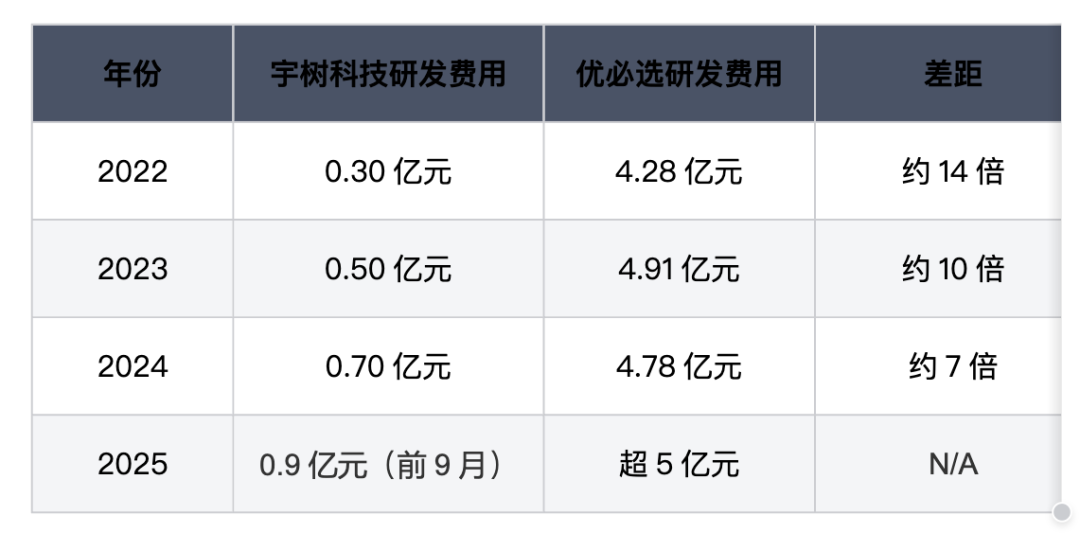
If Unitree continues to maintain its current low R&D investment, as UBTECH's Walker series, Tesla's Optimus, and other products undergo deep iterations and full-scale mass production, these pioneers will widen the technological gap with Unitree across generations in terms of AI large model generalization capabilities and industrial scenario data accumulation.
UBTECH has already proven with its 2025 financial report that 'working in factories' is not only feasible but can also drive explosive revenue growth.
Unitree Robotics enjoys strong sales and capital enthusiasm, but as a latecomer, it must consider whether to follow industry veterans like UBTECH and global pioneers in learning to 'work in factories' or focus on the 'consumer market.'
As humanoid robots become more prevalent in the consumer market, household robots for companionship, caregiving, and housework may become the next market sensation, facing ongoing cost and price wars—an area where Unitree currently holds an advantage.
Meanwhile, Unitree is also exploring new consumer-grade segments. In May 2026, Unitree released the GD01 manned bipedal transforming mecha, priced as high as RMB 3.9 million, targeting theme parks, immersive entertainment, film and television production, and special rescue operations.
However, when it comes to catching up on industrial technological sophistication, Unitree Robotics is already a step behind and must now accelerate its pace.
-
![]()
In the Next Decade of Joint Ventures, Honda Should Move Away from 'Stubbornness'
-
![]()
Operating Profit Plummets by 57%! What Caused Tesla’s Profitability to Decline in Q2?
-
![]()
Starting at 12,999 Yuan! Samsung’s Pioneering Wide Foldable Phone Unveiled: Sleek, Lightweight, and Ushering in a New Era for Android Foldables
-
![]()
Seven Bankruptcies Fail to Topple It! Aston Martin Raises £550 Million to Keep Afloat
-
![]()
Weichai's 'Triple Leap': From Diesel Engine Manufacturer to a 400 Billion Yuan Powerhouse
-
![]()
Tesla’s Financial Acumen Outshines Even Huawei’s
-
![]()
ChinaJoy 2026 Preview Roundup: AI Smartphones, AI PCs, and Robots Take Center Stage, Far Beyond Gaming!
-
Insta360 Faces Domestic NPE Lawsuit: Hunted Abroad, Ambushed at Home?