Has Google Sealed the Fate of Websites?
 05/20 2026
 505
505
Are Websites on the Brink of Extinction? Is AI Destined to Be Everlasting?
Google has not only transformed itself but also seemingly pronounced a death sentence on hyperlinks, albeit with a temporary reprieve.
At the I/O conference, Google unveiled Gemini Omni, Gemini 3.5 Flash, Gemini Spark, AI audio glasses, and Android Halo, seamlessly integrating robust AI and Agent functionalities across its entire hardware and software ecosystem (Search, YouTube, Android, Books, glasses, etc.). In contrast to OpenAI and other companies with more specialized applications, Google has clearly asserted its dominance.
The recent updates to Google Search all converge on a singular outcome: users will no longer need to navigate to web pages.
Agent Search Takes the Spotlight, Traditional Search Takes a Backseat
For decades, the search paradigm has remained relatively static: users input keywords, search engines return links, and websites garner traffic. In recent years, Google, Baidu, and Bing have gradually incorporated AI summaries into their search results, acting as temporary fixes to the existing system.
This time, Google has taken a bold step forward by introducing an alternative experience beyond the traditional 'search results page': Google Search AI Mode. Essentially a versatile ChatBox, it leverages Gemini 3.5 Flash to generate real-time responses, eliminating the need for users to sift through a list of blue links.
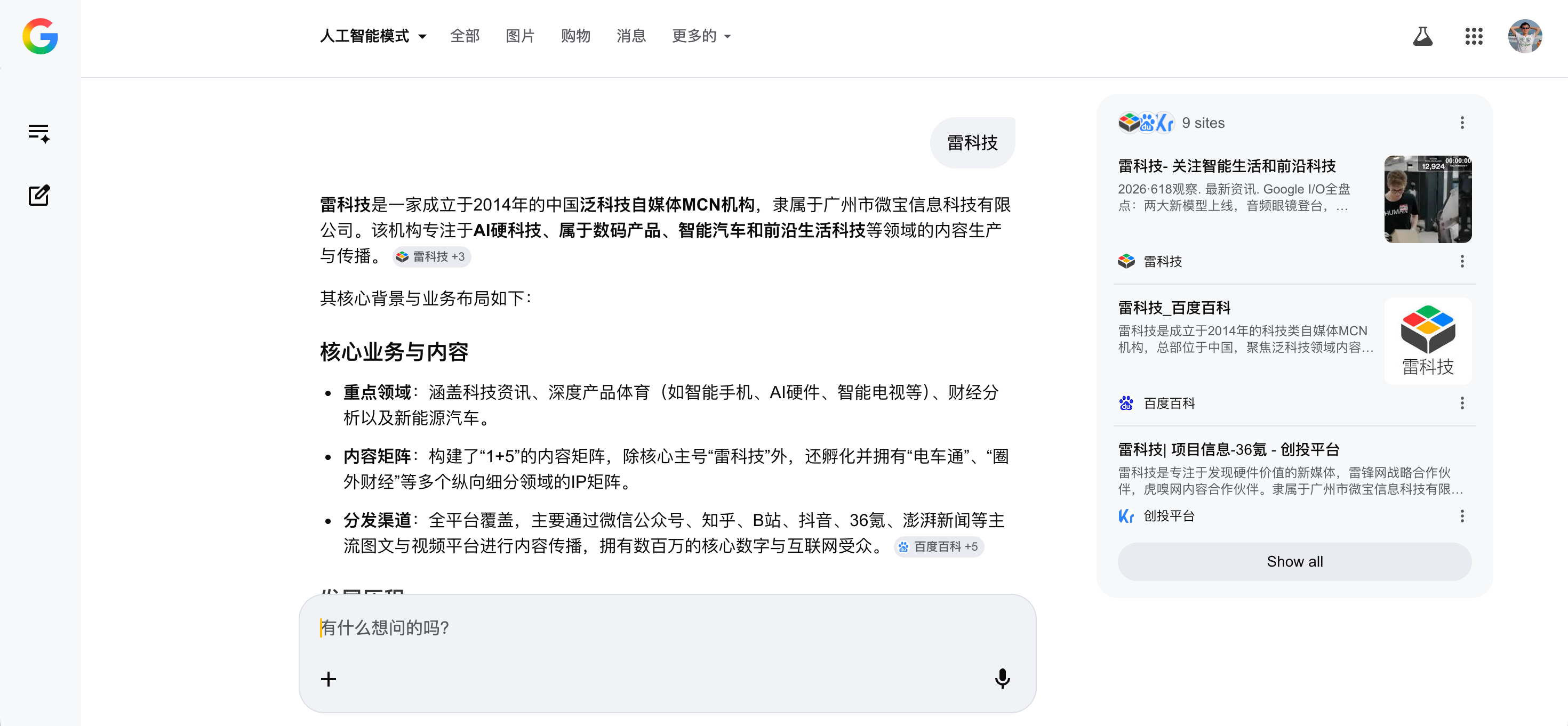
(Image Source: Google)
This approach is not entirely novel; apps like Doubao, Qianwen, DeepSeek, and Kimi have already been exploring similar territories. Domestic users have shown a particularly high acceptance of 'universal input boxes,' with Doubao's Monthly Active Users (MAU) surpassing 345 million. Despite occasional 'AI mishaps,' young people now instinctively turn to 'asking AI' as a more convenient alternative to 'searching the web.'
However, the outputs from ChatBoxes, including Google AI Mode, remain static, merely altering the method of information acquisition rather than the information's form itself.
Google's second strategic move directly challenges the 'web page' format by introducing a new 'Generative UI' that employs Antigravity technology to deliver results: not as static content, but as dynamic applications. For instance, searching 'how do mortise and tenon joints work?' generates a dynamic demonstration app; searching for a new car model transports users directly into an AI-generated 3D space where they can explore interiors, inspect seats, and simulate driving perspectives.
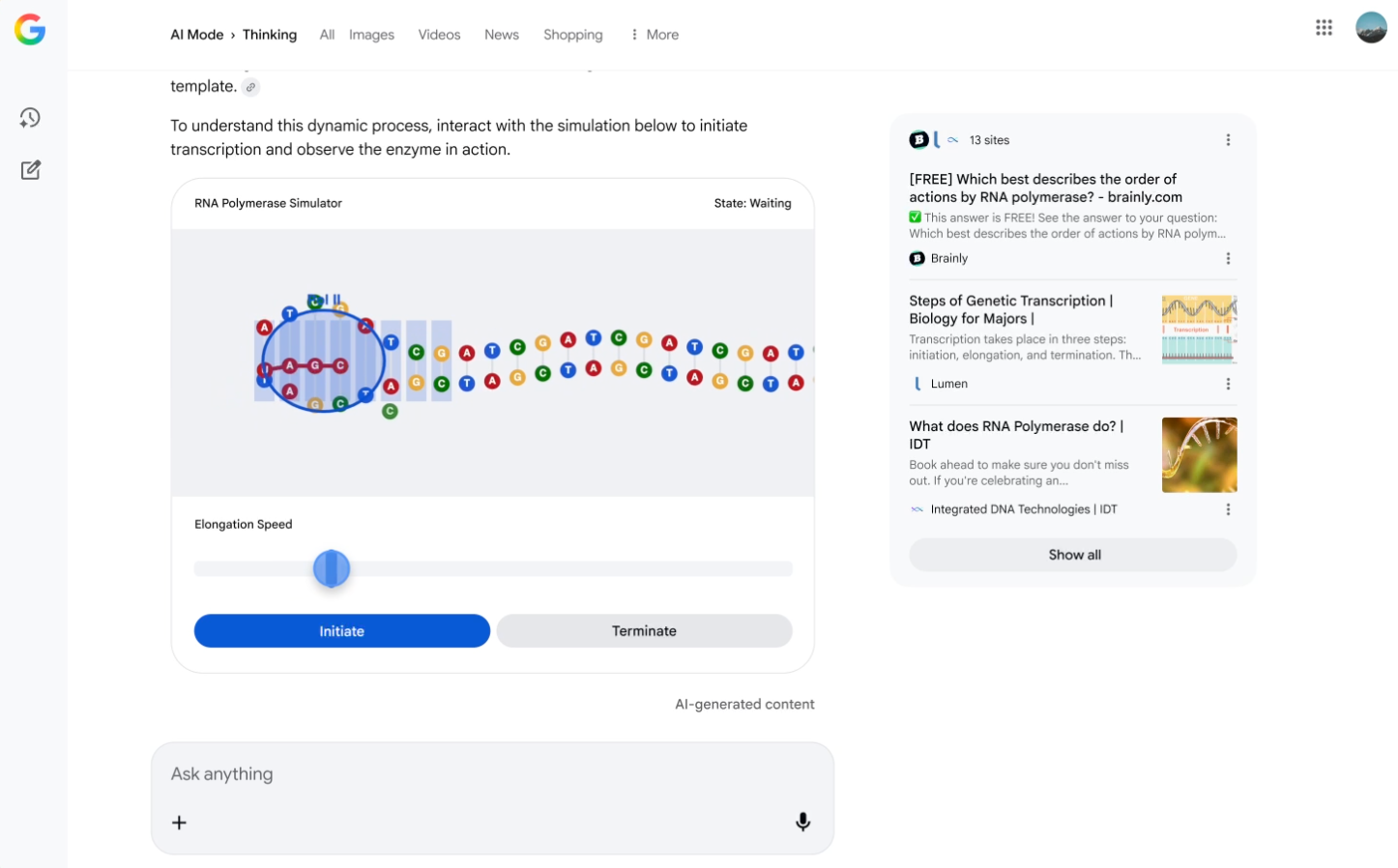
(Using Google AI Search: 'Explain how RNA polymerase works. What are the stages of transcription? How does transcription differ between prokaryotic and eukaryotic cells?')
Each search customizes an app, dynamically presenting results in a more vivid and intuitive manner, and enabling interaction. Of course, not all searches necessitate such elaborate results; AI intelligently determines the appropriate format based on user needs.
A True Revolution. For decades, the internet's foundational logic has revolved around 'web pages carrying information,' with Google facilitating the discovery of these pages by 'accelerating information flow.' Now, Google believes the intermediary layer of web pages is superfluous because AI can either aggregate information from third-party web pages or provide more suitable interactive interfaces, fundamentally altering how information is disseminated.
Once, the internet was characterized by its open 'interconnectedness': HTTP connected, HTML expressed, and browsers accessed. But in the AI era, Gemini assumes control over everything, with web pages becoming mere raw materials for its generated results, largely irrelevant to users.
Websites Degrade into Databases, Primarily for AI Consumption
This time, Google also introduced Agent Gemini Spark for individual users, integrating it into search. Search becomes more 'lobster-like,' with Spark continuously running in the background, monitoring specific information as requested. For example, a Leikeji editor might instruct the search Agent to keep tabs on AI news from companies like OpenAI, Anthropic, Grok, Perplexity, and X, receiving email alerts for major breaking stories.
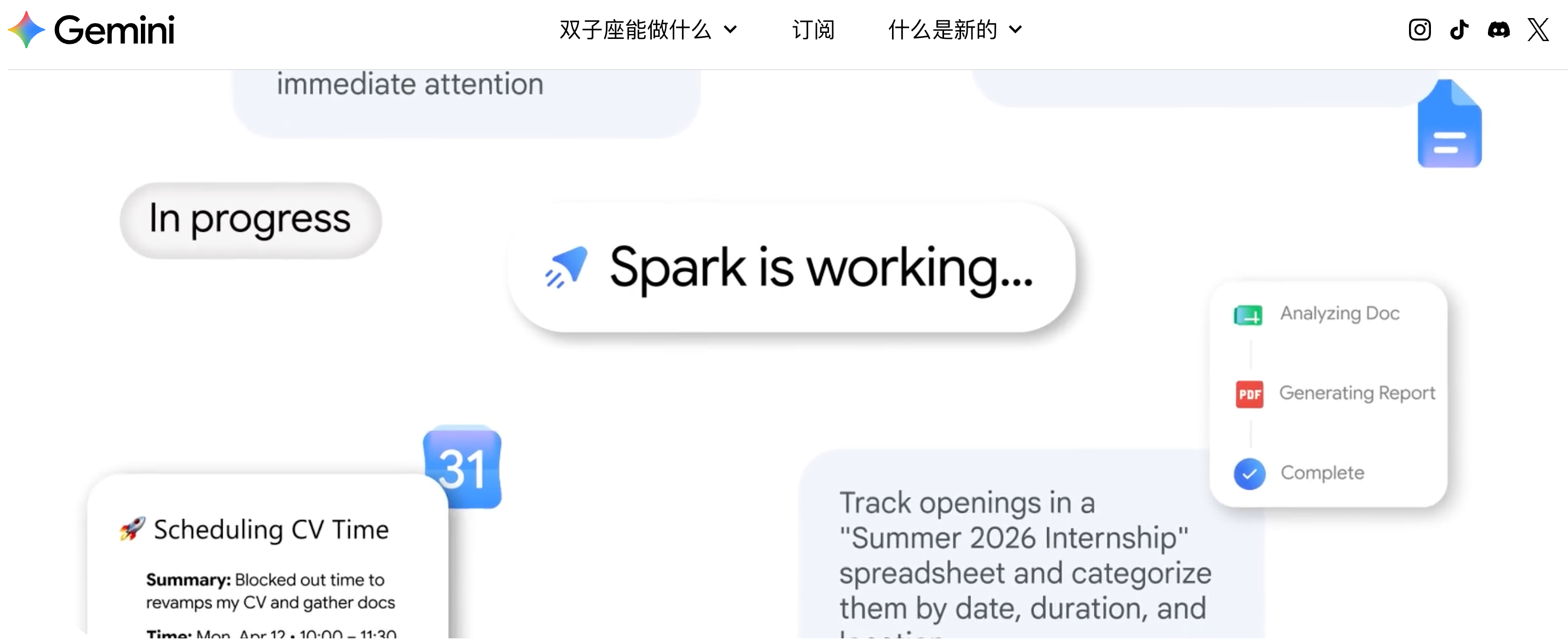
(Image Source: Google)
Gemini Spark operates on Google Cloud, supporting multi-device collaboration, allowing users to assign tasks on their phones and receive results on their computers. It not only seamlessly integrates with Google components (Google Docs, Google Calendar, Gmail, etc.) but will also connect with external apps via the MCP protocol in the future, enabling more comprehensive task delegation. It will also be integrated into Android Halo, Google Books, Chrome, and AI glasses.
Web pages are now created with Spark and similar agents in mind; even apps must develop skills to interface with them, actively feeding content to AI, while users are presented with only the final answers, rarely concerning themselves with the information's origin.
This scenario evokes memories of the famous 2010 article by Wired magazine editor-in-chief Chris Anderson (father of the Long Tail theory), titled 'The Web Is Dead, Long Live the Internet.' He argued that the Web was on its deathbed, but the internet would endure. At the time, the mobile internet was on the rise, and users were transitioning from accessing the internet via browsers to using apps, with app ecosystems engulfing the open Web, creating isolated information silos.
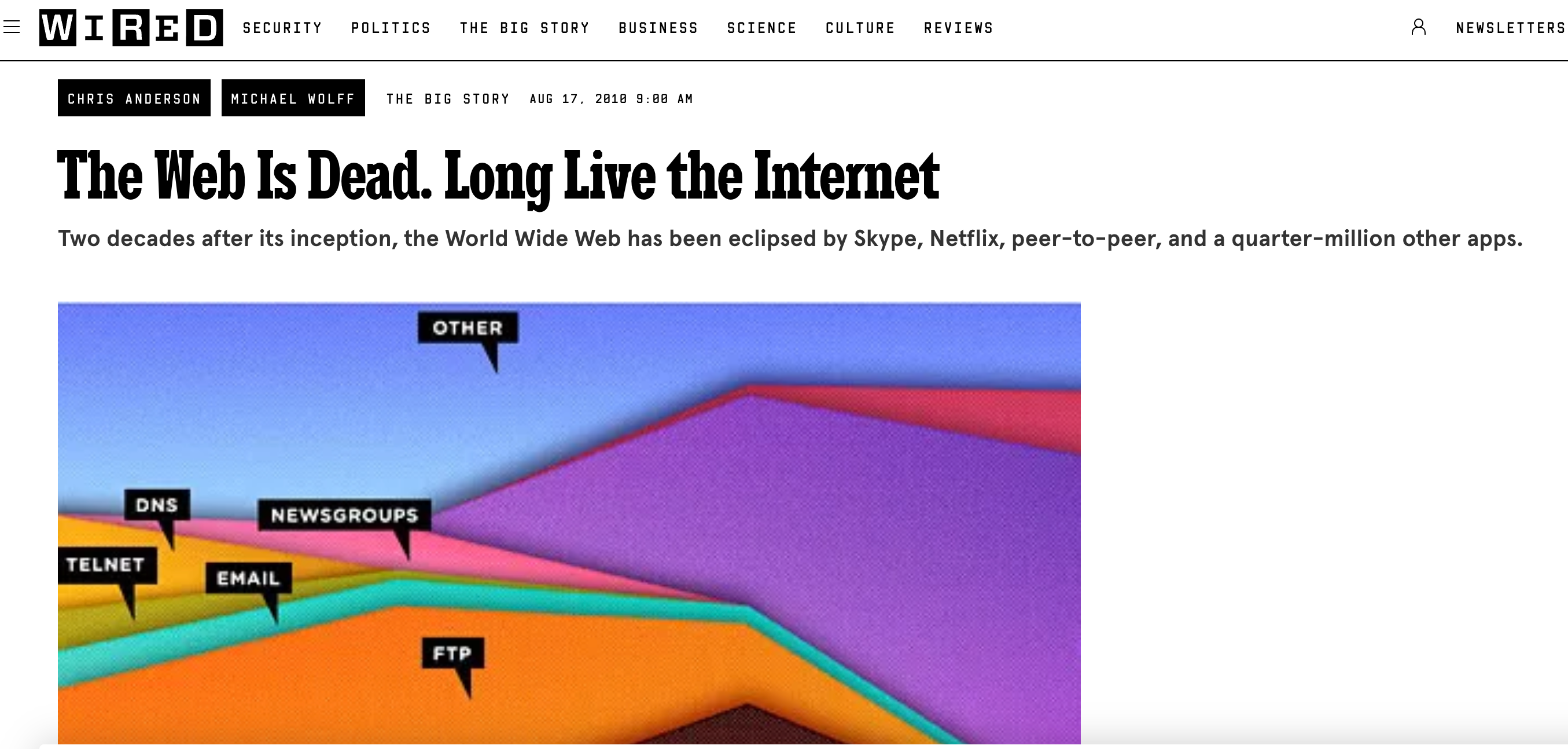
(Image Source: Wired)
Following the mobile internet boom, browsers were marginalized, and companies like Sogou, Cheetah Mobile, and Firefox exited the stage. User time was consumed by apps, and many young people today are oblivious to what a URL is—they simply open Douyin, Xiaohongshu, WeChat, or Taobao.
However, the shift from PC to mobile was essentially an 'entry point migration'; web pages still existed, just concealed behind apps—in fact, this article is hosted on a web page, but you don't need to know the 'URL.'
Google's current move is different; it's attempting to eliminate the very act of 'clicking.' Back then, Chris Anderson remarked in his article: 'We certainly love the open, free Web, but we're gradually abandoning it for simpler, trendier, more comfortable services.' Sixteen years later, that service has materialized: Agents, simple and user-friendly.
The Web will be completely obsolete. In the past, websites relied on Google for traffic distribution, and Google needed website content, giving rise to the discipline of SEO. But AI no longer provides links; it delivers answers and completes tasks. The results users obtain from AI searches are sufficiently accurate; if not, they can ask follow-ups, eliminating the need to click on web pages for verification. Even for verification, users are more inclined to cross-check with other Agents.
Thus, SEO gradually becomes obsolete, and GEO (Generative Engine Optimization) takes center stage. Brands no longer strive to 'rank high on web pages' but to 'become the answer,' finding ways to inundate AI with their content to secure a prominent position and become the sole answer to relevant questions. If achieved through misinformation, it's AI poisoning; if through legitimate means, it's GEO. One strategy for GEO is to flood websites with content to feed AI. GEO may become the last remaining value proposition of websites. Most website traffic will originate from AI and Agents, with Agents deciding whether to cite and how to aggregate.
Gemini Can't Take Over Everything; Apps Still Have a Promising Future
This time, Google introduced Android Halo mode to bolster agents, which will integrate Spark and become even more Agent-like in the future. Meanwhile, true AI phones represented by Doubao Mobile will also become Agent-centric. Will Agents gain control over all information and services on mobile, engulfing apps?
No.
Websites are being phased out because their core value lies in 'displaying information.' During the Web era, the most prosperous industries were search, portals, forums, blogs, and browser games. In recent years, the WEB ecosystem has sharply contracted into an 'internet information ecosystem,' and its quality has declined exponentially in the past two years due to AIGC content pollution.
However, the truly complex, challenging, and valuable aspects of the internet are service systems, all carried by apps. The most profitable sectors—e-commerce, payments, social media, logistics, short videos, local services, and mobile games—require sophisticated capability systems, not just simple information display, which Agents are unlikely to replace in the short term, at best only integrating with them.
Moreover, apps are fighting back by incorporating more AI-driven features. Amazon has explicitly blocked AI scraping, including by Gemini, realizing that once AI crawls product information, review systems, and pricing structures, users may not need to open Amazon anymore. Even if users rely on Amazon's fulfillment system, the platform would still need to pay a 'toll' to AI.
The same trend is evident in China. Alibaba's 'All in AI' strategy encompasses not only the AI technology infrastructure built with hundreds of billions invested in Alibaba Cloud, the Zhenwu AI chip, the Qwen foundational model, the Bailian inference platform, and AI applications like Qianwen and Kuake but also a thriving consumer service network—Taobao, Taobao Deals, Fliggy, Taopiaopiao, Hema, Gaode, Cainiao, and the external Alipay. These may seem like just apps, but they correspond to complex physical-world services and capability systems. With SKUs, logistics, payments, finance, membership, offline instant delivery, and merchant fulfillment, plus massive consumer behavior data, Qianwen can swiftly integrate Alibaba's ecosystem into a unified entry point, forming an end-to-end service closed loop.
No matter how powerful Gemini becomes, it cannot automatically generate human relationships, payment systems, supply chains, content copyrights, financial capabilities, or offline fulfillment systems—these are the barriers for Meta, Amazon, Alibaba, and Tencent.
But Google's upgrades are still noteworthy: as the greatest beneficiary of the open internet, Google has resolutely and unhesitatingly done one thing: killed links. The old king of the internet, who built its dominance by distributing blue links, has overturned its own foundation. It knows this will impact website traffic systems and search ad business models but must act: rather than being eliminated by OpenAI, Perplexity, Anthropic, and others, it's better to 'die' once itself—if done well, AI will herald a rebirth.
In his 2010 article 'The Web Is Dead, Long Live the Internet,' Chris Anderson said, 'The internet is immortal': the World Wide Web is just one manifestation of the internet, while the connection, openness, and intelligence embodied by the internet itself are integrating invisibly into the underlying fabric of human society. Now, it seems he was at least one-third correct: intelligence is indeed ubiquitous.
AI, AI Search, Google, Gemini, Internet
Source: Leikeji
Images in this article are from the 123RF licensed image library.
-
![]()
In the Next Decade of Joint Ventures, Honda Should Move Away from 'Stubbornness'
-
![]()
Operating Profit Plummets by 57%! What Caused Tesla’s Profitability to Decline in Q2?
-
![]()
Starting at 12,999 Yuan! Samsung’s Pioneering Wide Foldable Phone Unveiled: Sleek, Lightweight, and Ushering in a New Era for Android Foldables
-
![]()
Seven Bankruptcies Fail to Topple It! Aston Martin Raises £550 Million to Keep Afloat
-
![]()
Weichai's 'Triple Leap': From Diesel Engine Manufacturer to a 400 Billion Yuan Powerhouse
-
![]()
Tesla’s Financial Acumen Outshines Even Huawei’s
-
![]()
ChinaJoy 2026 Preview Roundup: AI Smartphones, AI PCs, and Robots Take Center Stage, Far Beyond Gaming!
-
Insta360 Faces Domestic NPE Lawsuit: Hunted Abroad, Ambushed at Home?