Distinct Paths in the 5G Private Network Market: Expansion by Manufacturing Giants and Withdrawal of Cloud Computing Giants
 04/10 2026
 473
473
Siemens Advances 5G Private Networks into the U.S., Accelerating Global Industry Reshuffle
Recently, industrial giant Siemens announced a further expansion of its private 5G business footprint. Building on its existing coverage across multiple European countries, it has officially included Canada as its first North American stop, with plans to enter the U.S. market by the summer of 2026. Siemens claims that enterprise-controlled private 5G infrastructure has become a 'core pillar of AI-driven industrial automation.' This move is not an isolated case. Almost simultaneously, Nokia secured a key order in Canadian mining, while the UK government introduced six European private 5G experts through its Open Radio Access Network (RAN) initiative. The global 5G private network sector has been driven by diverse players from the outset. After several years of practice, some players have exited the market, while others continue to invest, leveraging AI advancements to drive deep integration of 5G private networks into industrial strategies and supply chain restructuring.
Industrial Giants' 'Dimensional Reduction' Entry and Global Expansion
Siemens' foray into the U.S. 5G private network market epitomizes its transformation from a leading global industrial user to a system supplier. This path reflects a fundamental logic in the development of the 5G private network industry: deep demand understanding fosters scenario-specific solutions.
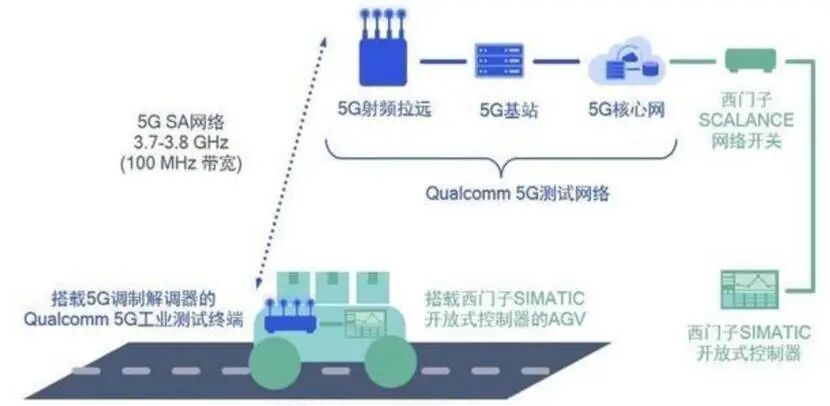
As early as 2019, during the initial phase of 5G commercialization, Siemens collaborated with Qualcomm in Germany to deploy a 5G Standalone (SA) test network based on the 3.7-3.8GHz private spectrum for automated guided vehicles (AGVs) in an automotive testing center. At that time, its role was that of a demand-side pioneer and experimenter. By 2023, Siemens had launched its full suite of industrial-grade 5G private network systems, covering all components of the core network and Radio Access Network (CU/DU/RU), running on its proprietary industrial computers. The company touts its 5G private network solution as 'OT-grade, compact, and user-friendly,' designed specifically for harsh industrial environments. Siemens has thus completed its transition from a demand-side player to a combined demand-and-supply-side entity.
Today, Siemens' private 5G network systems are sold in more than ten countries and are poised to enter the U.S. market. Leveraging its strengths in industrial automation and deep understanding of industrial scenarios, Siemens provides end-to-end solutions 'built by industry, for industry.' This includes not only hardware but also native support for industrial protocols, seamless integration with its automation software, and industrial-grade cybersecurity safeguards. Axel Lorenz, CEO of Siemens Process Automation, stated, 'The industrial world deserves a 5G solution that speaks its language.'
Siemens' case reveals a key trend: vertical industry leaders are leveraging their industry knowledge and customer channels to strongly enter the communications equipment market, becoming 'industry-level suppliers' that cannot be overlooked in the 5G private network ecosystem. This represents a bottom-up industrial transformation initiated by the demand side, differing from traditional telecom equipment vendors or operators.
Diverse Competition from the Outset, but Market Fragmentation is Now Evident
Since the early days of 5G commercialization, private networks have been a focal point of contention. Unlike the 5G public network ecosystem, which is dominated by traditional telecom equipment vendors and operators, the private network sector has from the outset formed a diversified landscape:
1. Telecom sector, including operators and traditional equipment vendors (Nokia, Ericsson, Huawei, ZTE). Leveraging public network operational experience, full-suite technologies, and spectrum resources, they offer a complete range of services from virtual private networks (network slicing) to standalone private networks.
2. Cloud service and internet giants, represented by AWS, Microsoft Azure, and Google Cloud. They utilize cloud computing, edge computing, and software-defined capabilities to offer pre-integrated, rapidly deployable 'turnkey' managed services like 'AWS Private 5G,' significantly lowering the technical and operational barriers to private network deployment, emphasizing convenience and flexibility.
3. Vertical industry giants, typified by Siemens. Starting from their own pain points, they create highly tailored solutions for their industries (e.g., manufacturing) and leverage existing OT equipment sales channels to promote deep IT/OT/CT integration among similar enterprises.
4. Open RAN and specialized suppliers, such as Accelleran, Benetel, and IS-Wireless—a group of small and medium-sized professional companies focusing on private 5G RAN or core networks. They aim to secure a foothold in the supply chain diversification wave through open interfaces and standardized testing platforms.
In terms of technological pathways, the development of 5G private networks has been heavily influenced by local spectrum policies, leading to two distinct paths: standalone and virtual private networks. Standalone private networks involve regulatory agencies allocating dedicated spectrum bands to enterprises (e.g., 3.7-3.8GHz in Germany, 4.6-4.9GHz in Japan), enabling enterprises to build fully physically isolated networks. This path ensures the highest level of control, security, and performance certainty, making it highly favored by large industrial enterprises. For example, Germany has issued hundreds of private network licenses, with active users including Audi, BASF, and Bosch. Virtual private networks, exemplified by current practices in China, offer advantages in rapid deployment, broad coverage, and leveraging the existing network scale effects of operators.
Market data confirms growth. SNS Telecom & IT estimates that the compound annual growth rate (CAGR) of global dedicated LTE/5G network infrastructure spending will be around 18% from 2023 to 2026, exceeding $6.4 billion by 2026, with 40% invested in standalone 5G private networks. IoT Analytics data shows that the growth rate of IoT connections based on 5G private networks (65.4% CAGR) far exceeds that of public networks, with an estimated 13% share of total 5G IoT connections by 2030.
Despite market growth, 5G private network suppliers are showing signs of fragmentation, particularly as cloud service providers begin to quietly exit the 5G private network service arena. In May 2025, AWS confirmed the discontinuation of its 5G private network service, launched in 2021. The company cited spectrum resource limitations and reliance on third-party hardware as obstacles to service development, noting that customers were shifting to more suitable alternatives. Microsoft Azure also announced in early 2025 that its 5G private network core service would be discontinued on September 30, 2025, advising customers to migrate to Microsoft partner solutions before that date to avoid service interruptions.
The reasons are twofold: on one hand, 5G private networks have not met initial market size expectations; on the other hand, AI has become the core focus, significantly diverting resources from 5G-related initiatives, leading cloud service providers to exit this field.
Nevertheless, the value of 5G private networks remains irreplaceable. In recent years, 5G private network applications have shifted from 'peripheral' to 'core' areas, with initial value becoming evident. Early deployments were common in ports, stadiums, and office parks. Today, applications are penetrating the core production processes of industrial manufacturing. BMW's global first AI factory in Debrecen, Hungary, relies on a 5G hybrid network to support real-time communication among nearly a thousand robots and an AI quality platform (AIQX). Nokia's private network deployment at the Côté Gold mine in Canada enables remote control of autonomous trucks and drills, enhancing safety and efficiency. These cases demonstrate that 5G private networks are beginning to unlock irreplaceable value in supporting mobility (AGVs/AMRs), low-latency control (machine coordination), massive connectivity (sensor networks), and integration with AI edge computing. Surveys indicate that private networks can deliver efficiency gains or cost savings ranging from 20% to 90% in manufacturing, mining, and other sectors.
Looking ahead, the integration of 5G private networks and AI is emerging as a value multiplier. Whether it's Siemens positioning private 5G as a 'pillar of AI-driven manufacturing,' BMW's AI factory practices, or Verizon's collaboration with NVIDIA emphasizing '5G private networks + AI edge computing for real-time AI applications,' all point to the same direction: the high-reliability, low-latency, and large-bandwidth connections provided by 5G private networks serve as the 'digital arteries' for real-time collection and transmission of massive industrial data and edge inference feedback of AI models. The combination of private networks and AI will enable advanced applications such as real-time quality control, predictive maintenance, and adaptive production scheduling, truly driving intelligent upgrades. Siemens' advance into the U.S. 5G private network market represents not just a company's market expansion but also a manifestation of the global 5G private network industry entering a new phase of deep competition and integration.
-
![]()
AI Giants Start Borrowing to Fuel Computing Power Race
-
ByteDance Initiates Largest B2B Structural Adjustment, This Time It's Truly Different
-
![]()
Let's Talk About Kingsoft Office's Mid-Year Outlook and the True Strength of Its AI-Powered Office Solutions
-
Despite 150 Million Users, Struggles Persist: AIShige Faces Tough Competition from Seedance and Kling in AI Video Monetization
-
![]()
Ensuring Safe Gear Shifting in the Automotive Industry: Transitioning from 'Product Oversight' to 'Full-Chain Governance'
-
![]()
Net Profit Soars to $133.7 Billion! Azure Revenue Tops $100 Billion, with AI Fueling Microsoft's Growth
-
![]()
Before 6G Hits the Market, the U.S. Forges a 'Rules Alliance': What Challenges Await Chinese IoT Enterprises?
-
![]()
Intelligent Driving's 'Little Blue Light' Faces Ban: Night Glare and Cut-in Risks Prompt Official Action