Can the Token Packages from the Three Major Operators Be Trusted?
 05/20 2026
 495
495

Tokens are emerging as a pivotal innovation for operators, aiming to reduce their reliance on traditional data traffic revenue.
Amidst the soaring demand for AI inference and Token consumption, the three major telecom operators have nearly simultaneously rolled out Token packages for both individual and enterprise customers. Their goal is to make computing power as easily accessible as subscribing to a data plan—ready to use, straight out of the box.
China Telecom has taken the lead, being the most proactive and representative in this regard. Its entry-level Token package for individual and family customers is priced at just 9.9 yuan per month, offering a substantial 10 million Tokens (enough to generate approximately 2,000 to 5,000 10-page research reports or 30,000 to 50,000 short video scripts). For developers and enterprise users, the lowest package is 39.9 yuan per month, providing 15 million Tokens.
In contrast to China Telecom's unified pricing strategy, China Mobile and China Unicom have adopted a more localized approach, with pricing varying by province and no unified computing power packages established at the group level yet. For instance, several provincial branches of China Mobile, including those in Guangdong, Jiangsu, and Beijing, began trialing Token packages in April. Similarly, China Unicom initially launched Token packages through its Shanghai and Hubei branches.
The impact of these operator initiatives remains uncertain, but they have already sparked significant activity in the capital markets. China Telecom's stock price has surged for two consecutive days following the Token package announcement, with China Mobile and China Unicom also experiencing notable gains.
01
Is 9.9 Yuan for 10 Million Tokens Overpriced?
The launch of Token packages by operators has garnered considerable attention from the media and social networks, yet the operators themselves seem somewhat unprepared.
For example, while China Mobile's App allows for the direct purchase of Token packages, Numerical Intelligence Frontline encountered difficulties in finding an entry point to experience the service after subscribing via the App. When contacting the 10086 customer service hotline, the representative remained silent for an extended period, seemingly unaware of the product.
A China Mobile employee informed Numerical Intelligence Frontline that the group had issued a notice encouraging employees to experience the service and that the customer service department was in the process of developing service process norms related to computing power, although specific scripts had not yet reached the frontline staff. The group had also issued guidance but had not set specific performance indicators.
The employee revealed that operators have been exploring a transition to the higher-value Token economy. Initially, they planned to launch a "crayfish package," which quickly evolved into selling Tokens within two months, and now into Tokens plus services. "Things keep changing, and we're adjusting accordingly," the employee said. Currently, not only users but also many frontline service personnel lack a clear understanding, making the promotion process costly in terms of explanation.
However, among the numerous discussions about operators transitioning to selling Tokens, pricing has emerged as the most criticized aspect by users.
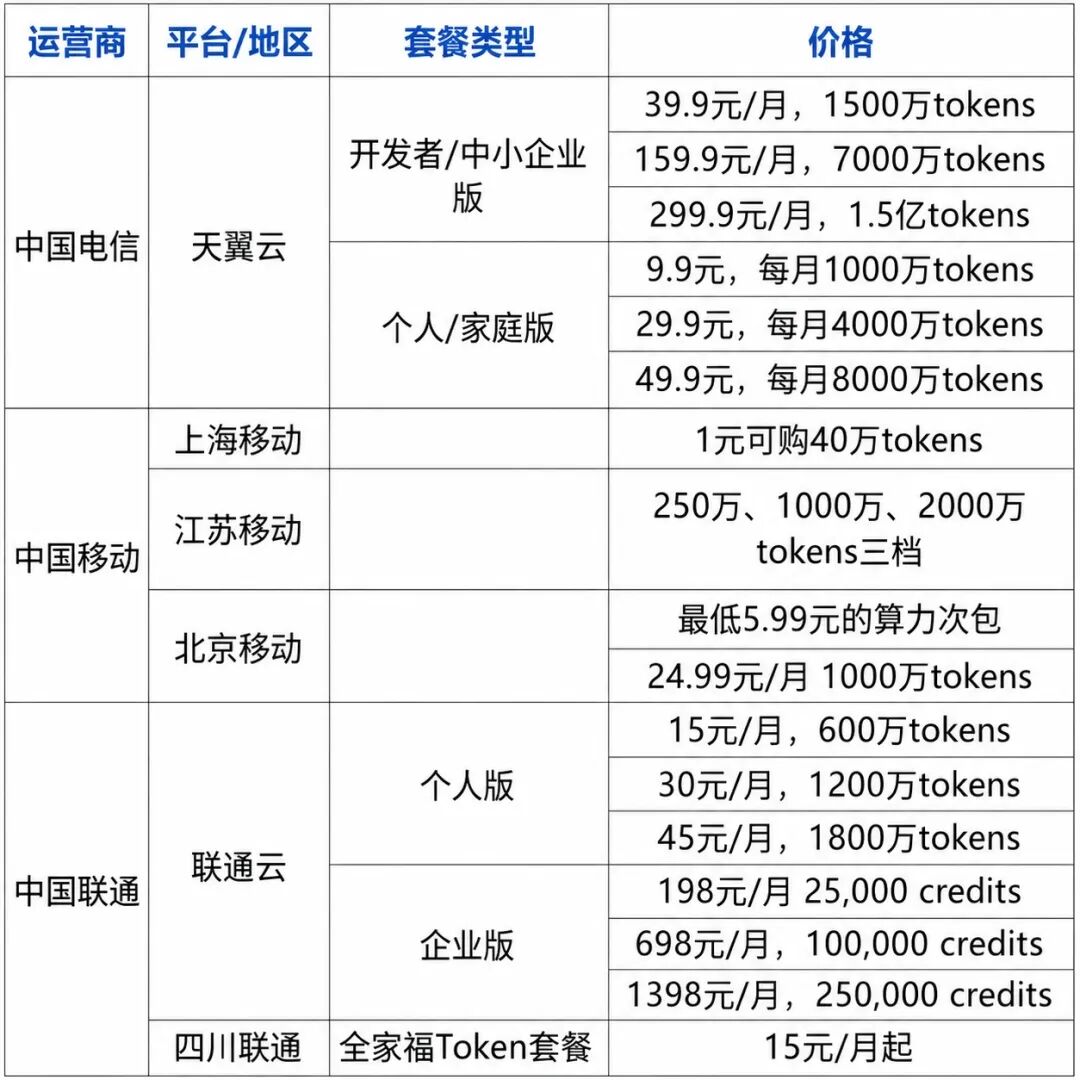
Many users have pointed out that operators' Token prices are higher than those offered by many model vendors for API calls. For instance, Beijing Mobile's Token package, priced at 24.99 yuan per month, includes a quota of 10 million Tokens. Shanghai Telecom's Token package, offering access to over 30 mainstream large models, costs 1 yuan for 250,000 Tokens, with the price per million Tokens reaching 4 yuan.
Moreover, the provincial branches of operators have significant pricing discretion, leading to varied pricing strategies for Token packages across regions, which has caused confusion among consumers.
Operators' Token prices are inevitably compared to those of cloud and model vendors. Take DeepSeek, which offers some of the most competitively priced options: DeepSeek-V4-Flash costs 0.02 yuan per million Tokens for input cache hits, and DeepSeek-V4-Pro costs 0.025 yuan, while cache misses cost 3 yuan per million Tokens.
However, operators do not differentiate between input and output Tokens or implement cache hit/miss pricing, which is a common approach in the industry for Token plans.
In fact, on paper, operators' Token package prices are not significantly different from those offered by internet cloud vendors. For example, China Telecom's lowest monthly fee is 9.9 yuan (10 million Tokens), while Tencent Cloud's lowest monthly fee is 39 yuan, including 35 million Tokens. However, cloud and model vendors generally charge by request count rather than Tokens, which indirectly complicates the comparison.
It's worth noting that current operator Token packages for consumers primarily cater to "crayfish farming" needs, as evident in their usage methods. For example, China Telecom offers multiple access methods: customers with local hardware terminals (e.g., Mac Mini) can set their API key for Token consumption across various local "crayfish" applications, while those without can bind directly via cloud computers or cloud phones.
Under some provincial packages, for intelligent agents like "crayfish" that require extensive workflow calls, deep usage can result in daily Token consumption in the tens of millions, posing a significant expense for users.
"Adjustments are ongoing, as pricing for computing power varies across channels. A unified pricing plan will follow, similar to how data plans were initially high and gradually lowered," a China Mobile representative told Numerical Intelligence Frontline. Some regional Token packages have been in place for over a month, and internal assessments confirm that pricing is relatively high—perhaps too high.
The representative revealed that operators will refine Token packages, such as offering specialized model Token bundles and general-purpose model Token bundles, and even exploring industry-specific Token bundles for finance, healthcare, and education.
02
What Are the Operators' Strategies?
As national teams and infrastructure builders, operators face significant pressure to transform their businesses. On one hand, user growth has plateaued, and revenue growth has stalled; on the other, user ARPU (average revenue per user) has declined annually. For example, China Mobile's mobile ARPU was 46.8 yuan in 2025, down from 49.3 yuan in 2023. China Telecom saw a similar decline, from 46.2 yuan to 45.1 yuan.
Meanwhile, according to the National Data Bureau, as of March 2026, China's daily token call volume exceeded 140 trillion, growing over 1,000-fold from early 2024, indicating accelerating AI application demand.
For operators seeking transformation, shifting from traditional communication and data pipeline services to intelligent services like Tokens and computing power is a well-known strategy. Tokens are becoming a core breakthrough for operators to reduce reliance on data traffic. In 2025, China Mobile's computing power service revenue grew by 11.1%, with communications, computing power, and intelligent services identified as the company's three growth engines.
China Telecom also stated, "Token services will be China Telecom's future business focus," offering differentiated services and pricing for general-purpose, professional, and customized Tokens.
An industry insider told Numerical Intelligence Frontline that a more direct motive for operators to launch Token packages is their structural computing power redundancy, with idle low-end general-purpose computing power and difficulty digesting domestic ordinary cards. The primary goal is to activate existing resources and monetize them.
However, the insider noted that operators' overall computing power construction has not slowed; they are merely shifting from blind expansion to precise deployment of high-end intelligent computing while strictly controlling inefficient capacity.
The biggest challenge for operators is their weak model capabilities. Selling Tokens is not entirely analogous to operators selling data traffic. Traffic and networks are franchised, with operators investing in base stations that other enterprises cannot replicate. However, Tokens essentially represent computing power plus models, and nearly all cloud vendors offer MaaS (Model as a Service) with corresponding Token package plans.
This means Tokens will not just be a competition among major operators but will face competition from cloud vendors, model vendors, and other open-market players.
Indeed, the three major operators have launched self-developed foundation models, such as China Mobile's JiuTian model, China Telecom's XingChen model, and China Unicom's YuanJing model. However, operators' large models cannot directly compete with market models in overall strength, instead emphasizing domestic computing power support to meet some government and enterprise customers' needs.
From current experiences, even operators' Token packages do not yet invoke their proprietary models. China Mobile uses MiniMax, while China Telecom uses Zhipu GLM and DeepSeek, and not the latest models (e.g., DeepSeek V3.2).
In fact, operators have been strengthening their talent pools and betting on new businesses. China Telecom, seen as a steady yet bold operator, has broken state-owned enterprise salary mechanisms in recent years to hire top talent.
Moreover, compared to cloud vendors, operators are not without advantages.
Operators have built extensive computing power networks and can access the most favorable power resources locally, enabling them to leverage scale advantages to reduce Token costs. China Galaxy Securities noted that operators, with their national backbone network resources, rich computing power node layouts, and "cloud-network integration" capabilities, play a key role in connecting dispersed computing power and breaking geographical barriers.
Telecom industry analyst Yang Guang believes that some price-sensitive but latency-tolerant small and medium-sized enterprises may find this attractive. Additionally, operators are building their model marketplaces, which can allocate different models based on task urgency through model routing, such as offloading latency-insensitive tasks to western data centers for computation.
Second, operators have built numerous data centers with domestic computing power, aligning with their narrative of "domestic chips, domestic clouds, and domestic models" and "bundling Token operations with network security, computing security, and data security," Yang Guang told Numerical Intelligence Frontline. While C-end consumers may not feel this strongly, it is in high demand in the government and enterprise market.
In fact, operators are gradually shifting from a pure Token-selling model to Tokens plus services, which involves packaging network billing and security services alongside Tokens.
Furthermore, operators have a nationwide business network and a vast service system that penetrates deeply, giving their business touchpoints an advantage over other vendors.
"Account managers interact with these units daily, and some clients may have demand for such packages," an operator representative said, describing a potential scenario where account managers selling broadband to merchants could also offer a Token package for the client's store cameras.
Operators also have a natural advantage: seamless integration between mobile numbers and Token users, eliminating the need for separate registration and enabling direct Token purchases using phone credits, greatly facilitating Token consumption.
"There will be short-term stimulation, as some users are always willing to try new things," Yang Guang said. However, whether operators can grow their Token business remains to be seen. "Willingness to try is still a good thing."
-
![]()
AI Giants Start Borrowing to Fuel Computing Power Race
-
ByteDance Initiates Largest B2B Structural Adjustment, This Time It's Truly Different
-
![]()
Let's Talk About Kingsoft Office's Mid-Year Outlook and the True Strength of Its AI-Powered Office Solutions
-
Despite 150 Million Users, Struggles Persist: AIShige Faces Tough Competition from Seedance and Kling in AI Video Monetization
-
![]()
Ensuring Safe Gear Shifting in the Automotive Industry: Transitioning from 'Product Oversight' to 'Full-Chain Governance'
-
![]()
Net Profit Soars to $133.7 Billion! Azure Revenue Tops $100 Billion, with AI Fueling Microsoft's Growth
-
![]()
Before 6G Hits the Market, the U.S. Forges a 'Rules Alliance': What Challenges Await Chinese IoT Enterprises?
-
![]()
Intelligent Driving's 'Little Blue Light' Faces Ban: Night Glare and Cut-in Risks Prompt Official Action