Tencent Secures a Crucial Victory in AI Office Arena, While Baidu Continues to Struggle
 08/10 2026
 328
328
Source: Shenlan Finance
The AI office sector is emerging as a new front in the AI competition among leading companies. Within just two weeks, ByteDance, Alibaba, Tencent, and Baidu have all made significant strides in the AI office domain, marking a clear transition from "internal rivalry" to "unified brand" approaches. Tencent has merged QClaw and WorkBuddy under a single management framework; Alibaba has consolidated its three Agent offerings—QoderWork, Wukong, and MuleRun—under the "Qianwen Office" banner; ByteDance has embarked on the integration of Feishu and Doubao; and Baidu has fused its internal office AI agent, dodo, with its Baidu Dazi team. If we view these developments as the dividing line between the first and second halves of the AI office competition, Tencent has already surged ahead in terms of scale, with ByteDance and Alibaba in close pursuit, and Baidu trailing behind. Nevertheless, the second half of the competition remains rife with uncertainties. After "consolidating their forces," these major players are poised to engage in an even more intense battle. After all, the AI office represents a "super gateway" that none of them can afford to overlook.
1. Tencent Turns the Tide
A few months ago, Tencent was still perceived as "playing catch-up" in the AI race.
Even Ma Huateng admitted at a shareholder meeting that they thought they had secured a spot on the ship, only to discover it was taking on water, leaving them standing anxiously, unable to find a seat.
Now, with the first half of the AI office competition concluded, Tencent has not only secured a seat at the table but is also sitting comfortably in the prime position.
According to the latest report by Analysys, as of June this year, among the 17 mainstream desktop AI-native office agents in China, Tencent's AI office product, WorkBuddy, claimed the top spot with 20.97 million monthly visits, outpacing the combined total of the second and third-ranked products. Furthermore, Tencent's Q1 2026 financial report revealed that WorkBuddy's active user retention rate exceeded 60%, and its paid user retention rate surpassed 80%.
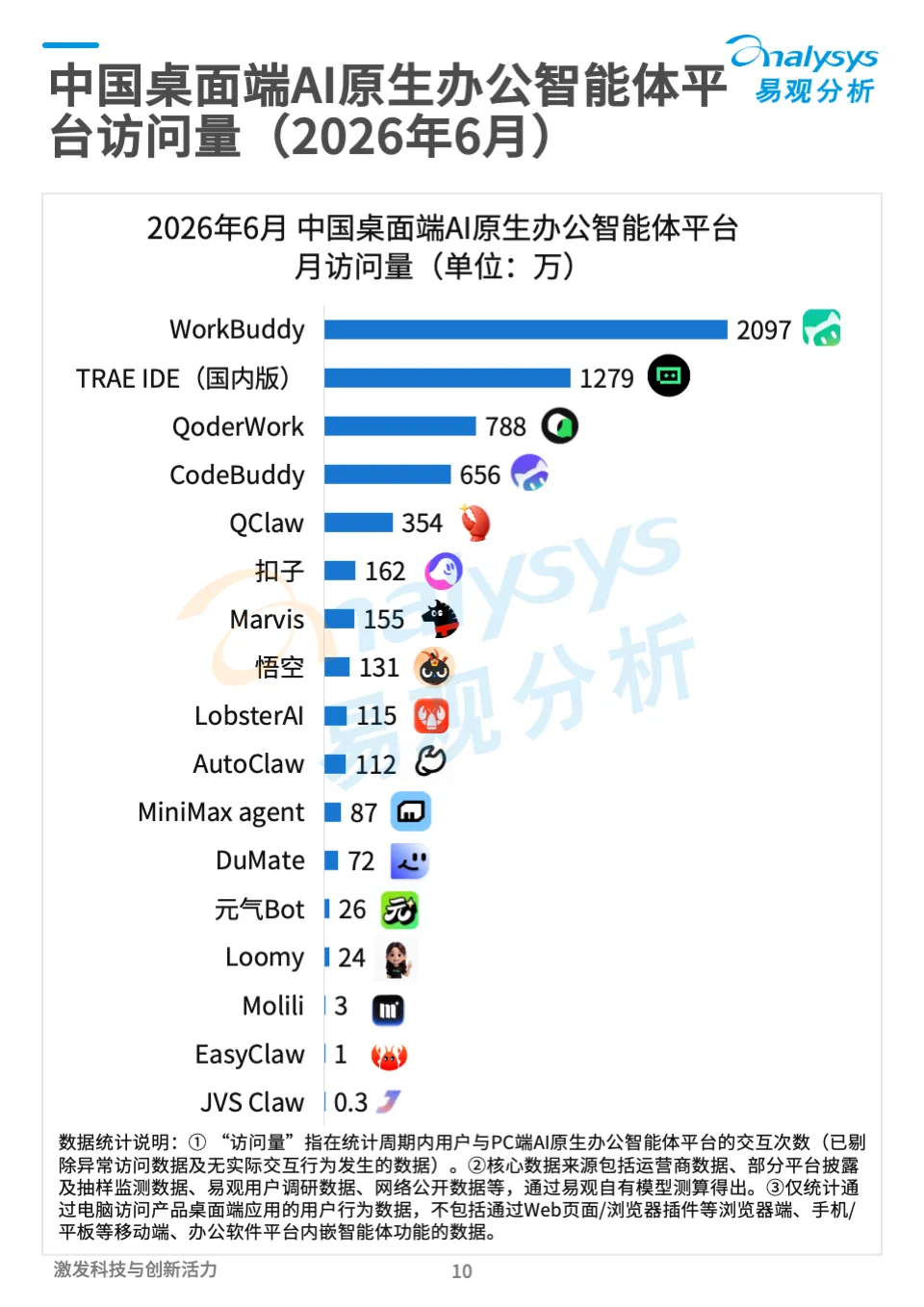
Image Source: Analysys
In terms of real-world impact, WorkBuddy is poised to become another C-end sensation from Tencent, following in the footsteps of QQ and WeChat, breaking out of the tech bubble and entering the mainstream consciousness.
What's even more remarkable is that WorkBuddy was developed by a small, nimble 10-person team within Tencent.
According to LatePost, when Claude Cowork from the U.S. AI company Anthropic was launched in mid-January, product manager Wang Shengjie and three colleagues crafted a similar product, WorkBuddy, over a single weekend. That very night, WorkBuddy was rolled out for internal testing across the company. In the subsequent nearly two months, thousands of non-technical employees used it daily. When the "shrimp-raising" craze swept in, the well-prepared WorkBuddy went live ahead of schedule.
While WorkBuddy is currently leading in monthly visits in the first half of the AI office competition, its advantage stems more from clever user experience design than from absolute technological superiority.
From the outset, Tencent was committed to creating a simple, user-friendly product. Thus, WorkBuddy's interface features only a single chat window—users articulate their needs, and the system executes them. The model's strengths, the Agent's capabilities, and the underlying MCP remain concealed behind the conversation.
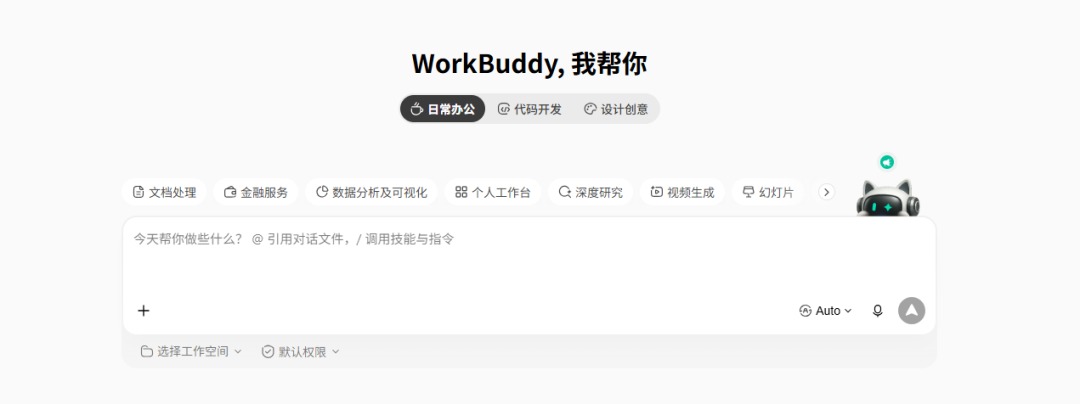
Meanwhile, WorkBuddy translates developer jargon into more familiar workplace terminology, transforming "Skills" into "abilities," "MCP" into "connectors," and "Agent" into "experts." This low-barrier design clearly resonates more with office workers.
As Tencent continues to allocate resources to WorkBuddy, the product has experienced rapid growth, enabling Tencent to finally turn the tide in the new round of competition for AI entrances.
2. ByteDance and Alibaba in Close Pursuit, While Baidu Lags Behind
Tencent has taken the lead in terms of scale, but it cannot yet claim to have established an insurmountable lead.
According to LatePost, a Tencent insider believes that WorkBuddy is currently only half a step ahead of its rivals. ByteDance poses a significant threat as a pursuer because "ByteDance has the financial resources and strong organizational capabilities to pivot swiftly at any moment."
Tencent's caution regarding ByteDance is well-founded. On the aforementioned list of desktop AI-native office agents, as of June this year, ByteDance's AI office product, TRAEIDE (domestic version), ranked second with 12.79 million monthly visits.
Alibaba's QoderWork secured the third spot with 7.88 million monthly visits.
In terms of monthly visits, ByteDance's TRAEIDE and Alibaba's QoderWork still trail WorkBuddy by a significant margin. However, in the long run, ByteDance and Alibaba possess their unique "weapons"—Feishu and DingTalk, respectively.
For agents to execute tasks effectively, they require context, which is likely the most valuable asset that Feishu and DingTalk have accumulated over the years. Although WeChat Work has maintained a stable position in the previous round of office application competition, for many clients, its role is more focused on external connections, with approvals, documents, and business systems still housed elsewhere. In other words, in terms of organizational context data, WeChat Work has not amassed as much as Feishu and DingTalk.
Recently, ByteDance has merged its Feishu product team with its Doubao product team to form a new Doubao product team, adding an extra layer of intrigue to the second half of the AI office competition.
Another notable phenomenon is that in many media reports on this AI office frenzy, Tencent, Alibaba, and ByteDance are frequently compared, while Baidu seems to have "faded into the background."
In reality, Baidu's AI office platform, Baidu Dazi (Dumate), was launched around the same time as WorkBuddy and QoderWork. However, on the latest AI office rankings, Baidu Dazi only ranked twelfth with 720,000 monthly visits, just one-thirtieth of WorkBuddy's.
It can be said that in the first half of the AI office competition, Baidu has temporarily fallen behind. However, in the long run, Baidu's long-standing capabilities in chips, cloud, models, data, engineering, and industry implementation are sufficient to support the continuous evolution of Baidu Dazi.
What Baidu Dazi urgently needs is a more compelling narrative to attract users.
3. Conclusion
After ChatGPT ignited the AI large model competition, for an extended period, C-end applications were seen as the most enticing super gateway. Even during this year's Spring Festival, major companies were still heavily investing in this sector.
However, despite substantial spending, a viable business model has yet to materialize, leaving major companies feeling anxious.
In contrast, B-end AI office applications represent a more accessible super gateway. There are successful cases to draw inspiration from in terms of both technology and business logic: Anthropic's Claude Code generated $1 billion in revenue in just half a year; OpenClaw became so popular that it sparked a nationwide "shrimp-raising craze."
AI office has also brought major companies back to the same starting line. Tencent has taken an early lead with its user experience, ByteDance is poised to make a move with its models and scenarios, Alibaba is defending its B-end foundation, and Baidu needs a product narrative overhaul to rejoin the competition. As the strategies are set, the more intense second half of the competition is just beginning.
In the end, victory will hinge not just on visit numbers but, more crucially, on paid conversion rates.
*Disclaimer: The views expressed in this article are solely those of the author. The market is fraught with risks, and investment should be approached with caution. Under no circumstances does the information or opinions expressed in this article constitute investment advice to anyone.
The Shenlan Finance New Media Cluster originated from the Shenlan Finance Journalist Community and boasts a 16-year history. It is a renowned financial new media outlet in China, with accounts focusing on China's most valuable companies, cutting-edge industry developments, and emerging regional economies. It provides valuable content for investors, corporate executives, and the middle class. Welcome to follow us.
-
![]()
The Ruthless B-Side of AliExpress's Global Expansion
-
![]()
BYD's Mass Production of Photovoltaic Sunroofs: A New Opportunity for PV?
-
New Business Models in the Era of AI Agents: A2A
-
![]()
Kejinming's IPO: Diminished Fundraising, Slashed Working Capital Project, Sluggish Growth of Core Products, and a Cooling North American Market
-
![]()
Tencent Secures a Crucial Victory in AI Office Arena, While Baidu Continues to Struggle
-
![]()
DeepSeek Raises Prices, Alibaba Takes a Cut: Will Major Clients Stay or Leave?
-
![]()
After Persistent Declines, Is This Joint Venture Automaker Considering an Exit? Here’s the Official Word
-
![]()
DeepSeek Raises Prices, Alibaba Takes a Cut: Will Big Clients Pay Up or Walk Away?