Focusing on Data and Delivery, Kingsoft Office Leads the Enterprise AI Race
 08/26 2026
 435
435
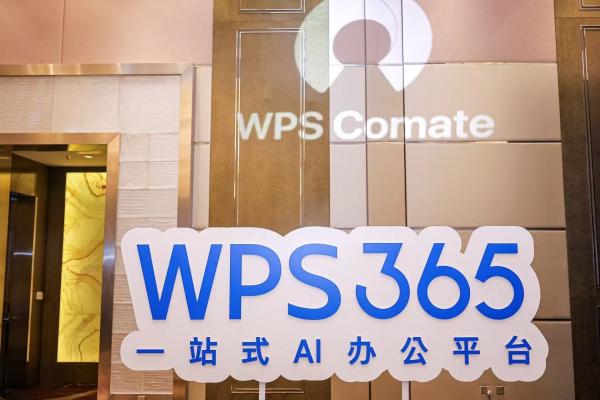
A crucial step forward from traditional office software to an 'organizational-level AI office agent.'
The summer of 2026 has seen an unprecedented intensity in the AI office sector.
First, Tencent's WorkBuddy emerged as a dark horse in the industry. Then, ByteDance suddenly announced a major organizational restructuring, merging its Feishu product team into Doubao and integrating its GTM system into Volcano Engine, aiming squarely at the enterprise AI office sector.
Just four days after ByteDance's restructuring, Alibaba announced the public beta of its enterprise AI office product, Qianwen Office, which was comprehensively integrated from three internal Alibaba products: QoderWork, MuleRun, and Wukong.
It is evident that on the AI office track, the moves by these internet giants are increasingly urgent, and competition is intensifying.
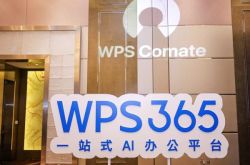
While these giants are busy merging product lines and vying for entry points, Kingsoft Office is taking the fight directly into organizational workflows. On August 21, the 'WPS Comate AI Agent Empowerment Plan for 100 Cities' was launched in Beijing, in collaboration with local SASACs, big data bureaus, and economic and information bureaus. The initiative offers specialized training for enterprise digitalization and AI business leaders, aiming to transition organizational-level AI from flagship customers to large-scale replication.
'This AI Impact (AI impact) is unprecedented in its intensity. Kingsoft Office has only two choices: either die or undergo a painful transformation into an AI-driven company,' said Zhang Qingyuan, CEO of Kingsoft Office.

Zhang Qingyuan, CEO of Kingsoft Office
Beneath the surface of intensifying competition, a more fundamental question is emerging: When everyone is racing in AI, what enterprises truly need is not just a smarter model but a product suite that can genuinely deliver results.
'In the future, AI large models will be as readily available as basic cloud services, with performance gaps in the 'single-digit percentages.' Domestic models are also performing well and catching up rapidly,' Zhang Qingyuan judged.
Therefore, in his view, the root cause of difficulties in enterprise AI adoption lies not in the lack of model intelligence but in the absence of unified management.
Thus, Kingsoft Office's bet in this fiercely competitive market is clear:
When the era of model equality arrives, the key to success will be who can build a complete office ecosystem from individuals to enterprises, from generation to delivery, based on a deep understanding of work contexts.
To this end, Kingsoft Office has added the organizational-level AI agent, WPS Comate, to WPS 365, delivering the industry's first 'Enterprise Brain' and a 'Three-Two-One' implementation framework to address the pain points of enterprise AI adoption.
Through a unified product architecture, it enables AI to learn enterprise documents, understand business data, operate business systems, and precipitate (accumulate) and reuse organizational capabilities, truly delivering results while meeting enterprises' needs for AI resource and security management.
So, as ByteDance merges Feishu into Doubao and Alibaba consolidates three agent lines into Qianwen Office, the giants are all trying to answer the same question: In the AI era, what kind of office software do enterprises truly need?
Clearly, Kingsoft Office's answer differs somewhat from these giants.
When 'intelligence' is no longer scarce, what becomes valuable?
Over the past year, a subtle change has occurred in Kingsoft Office's internal use of large models:
In 2025, Kingsoft Office primarily used foreign large model products for development. However, by June this year, all internally developed models had switched to domestic large models.
'When selecting models today, our primary considerations are cost-effectiveness, service stability, and Token supply,' Zhang Qingyuan said.
The key reason behind this change is that the scarcity of underlying models is diminishing. SOTA rankings change almost weekly—one model may be the strongest this week but could be surpassed the next.
Zhang Qingyuan offered a vivid metaphor: 'A large model is like a provincial top scorer who has completed undergraduate, master's, and doctoral programs at Tsinghua University. However, every time you ask him to do something, you have to explain a pile of background information, making the experience terrible.'
This 'background' in enterprise scenarios includes how to calculate travel expenses, where the red lines are in contract reviews, and what cost components make up a project. These enterprise-specific knowledge areas are precisely the weakest links for general-purpose large models.
Wang Dong, Vice President of Kingsoft Office, put it bluntly: 'Large models are smart but don't understand your business.'
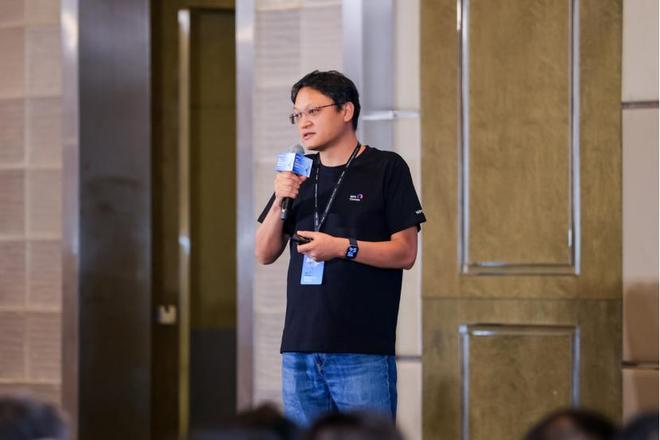
Wang Dong, Vice President of Kingsoft Office
This means that as models become increasingly equal, what is truly scarce is enterprise-specific contextual engineering and high-quality data.
Zhang Qingyuan judged this directly: 'Large model technology will eventually move toward equality. When the capabilities of basic models are no longer scarce resources, what will truly determine product competitiveness is the depth of understanding of user contexts and the office data assets accumulated in real-world scenarios.'
Yang Zeyuan from CITIC Securities compared mainstream large models to 'general practitioners with doctoral degrees'—possessing general knowledge and complex problem-solving abilities but lacking industry-specific operational data and business experience. Addressing concerns about whether 'model vendors will replace vertical application enterprises,' he gave a negative judgment: Enterprise core operational data and job-specific operational experience are private assets that will not be uploaded to general-purpose large model platforms. From legal, ethical, commercial cooperation, and industrial practical perspectives, underlying large model vendors cannot replace vertical industry application vendors. 'Vertical software vendors like Kingsoft Office are the core carriers for large-scale AI implementation,' he said. State-owned enterprises and leading private enterprises are particularly concerned about data security in the AI era.
In other words, whoever helps enterprises retain data sovereignty while transforming data into AI-understandable knowledge may hold the competitive moat.
Facing enterprise AI implementation scenarios, Kingsoft Office's approach is not to rush to switch to stronger models but to first lay a solid 'foundation' for enterprises, corresponding to the 'Three Connections, Two Controls' implementation framework: connecting knowledge, data, and capabilities, and controlling data security and costs.
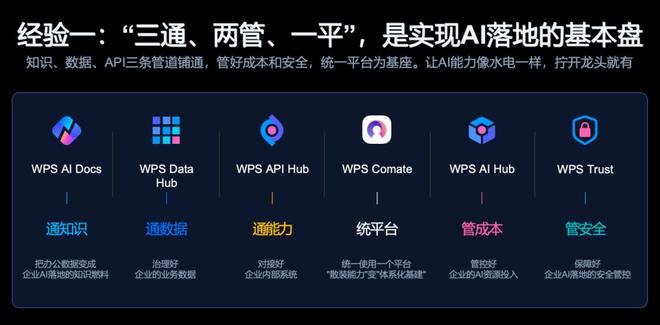
Wang Dong offered a metaphor: Data is undoubtedly the fuel for AI implementation, like gasoline for an engine, driving the growth of the entire system.
So, how exactly does Kingsoft Office do it?
Connecting knowledge relies on AI Docs. Over the past two years, Kingsoft Office has consolidated all documents, PPTs, spreadsheets, chats, and meetings scattered across office components into AI Docs, forming an enterprise-level intelligent knowledge base that transforms documents into 'knowledge fuel' understandable by AI. Dozens of enterprises have already participated in co-construction.
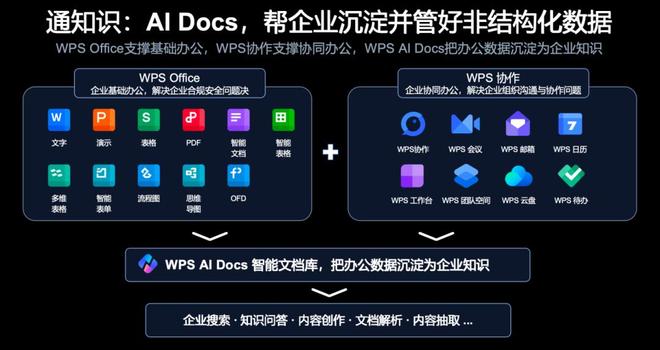
For example, in the scenario of legal teams reviewing contracts, Kingsoft Office began building an Enterprise Brain two years ago. Given the vast number of historical contract emails, extracting all these emails for AI analysis, automatically refining review rules, and feeding them back yielded immediate results.
Connecting data relies on Data Hub.
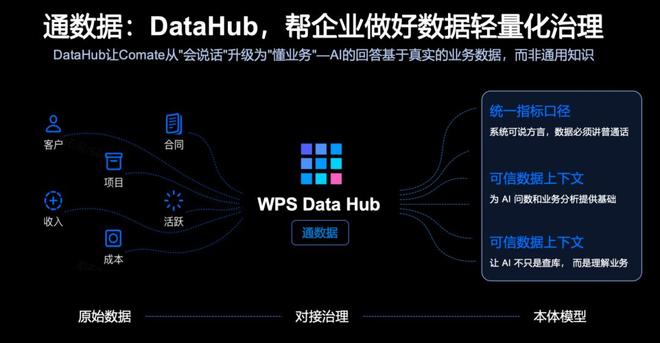
For enterprises, a more troublesome issue is that cost and performance metrics vary across departments—sales view costs as travel, solutions, and delivery, while R&D views them as man-hours and R&D investment, with no unified units for AI calculation.
DataHub does not move enterprise data or rebuild enterprise data warehouses. Instead, it connects and understands enterprise data by constructing an AI-oriented data ontology layer and semantic consumption layer.
After data and enterprise knowledge are unified, it is even more crucial to connect the interfaces of various internal systems, enabling AI to truly circulate within enterprise operations. This relies on API Hub.
Generally, enterprises often have numerous information systems left over from decades of digitalization efforts, with ERP, OA, and CRM interfaces and authentication methods varying widely. API Hub uniformly connects ERP, OA, CRM, and other business systems, upgrading AI from 'answering questions' to 'executing tasks.' Without this step, AI would remain just a smart chatbot rather than a truly productive tool.
Above the 'Three Connections' are the 'Two Controls': cost control and security control. AI Hub manages Token resources by person, role, and task dimensions; Trust provides a multi-dimensional security system encompassing identity and permissions, data classification and grading, terminal environment trustworthiness, and AI behavior auditing.
It is evident that as models become increasingly equal, what is truly scarce and valuable is enterprise-specific contexts and high-quality private domain data. A core aspect of this is that Kingsoft Office enables AI to truly execute tasks, allowing the Enterprise Brain to grow organically within enterprise business processes.
Connecting full-process business systems: An enterprise needs only one AI office platform
With a solid foundation laid, new questions arise.
Wang Dong discovered a common phenomenon when visiting clients: Department A builds a system using low-code agent tools, Department B uses an open-source solution, and Department C uses something else entirely.
Permissions, data, and interfaces are repeatedly connected, leading to redundant construction. Worse still, when a task requires coordination across Departments A, B, and C, the incompatible tools prevent seamless execution, locking excellent practices within small teams and relying on 'file transfers' for communication.
AI products are too numerous and fragmented, with no interoperability.
Therefore, for enterprise AI implementation, the most critical aspect is having a unified AI platform. 'An enterprise needs only one AI office platform,' Wang Dong said.
Kingsoft Office's solution is to solidify the 'One Platform' in the 'Three-Two-One' framework—an independent and unified organizational-level AI entry point that encompasses all capabilities. Previously, Kingsoft Office's unified entry point was WPS 365, which has now been upgraded and independentized as WPS Comate.
How exactly does WPS Comate work?
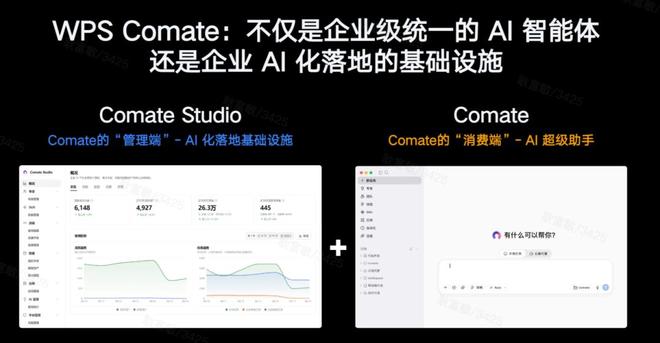
Beneath the entry point, capabilities must first be connected, which is where the aforementioned API Hub comes in. Building on this foundation, Comate develops three key elements to make the entry point truly 'usable and user-friendly':
First is the Skill Hub, where employees can encapsulate proven scenarios into Skills and share them with their team or the entire company with one click.
Wang Dong shared a personal experience: Previously, meeting clients required sales to write lengthy briefings. Later, a senior pre-sales specialist gave him an Excel file that, upon entering the client's name, automatically compiled information from enterprise dashboards, CRMs, and work orders, generating a 6-7 page document on the first try, clearly outlining the solution, delivery, and potential bottlenecks.
The second element is the expert system, which encapsulates veteran employees into agents. By infusing the system with the experience and knowledge of senior employees, it trains expert agents with multiple capabilities, assistants, and workflows.
For example, Comate incorporates experience Skills distilled from senior legal, financial, and business experts, enabling automatic contract reviews that annotate different risk levels (R1, R2, R3) and generate complete review reports, consolidating the work of legal, financial, and business departments into one.
A young engineer visiting a client site can input an unfamiliar error log, and the system can diagnose the next steps.
The third element is a creative tool, App Engine, which allows users to create lightweight applications with a single sentence and deploy them within the enterprise (internally within the enterprise) with one click, enabling rapid idea implementation.
With a unified AI platform, organizational efficiency improvements have become tangible.
For example, one of Kingsoft Office's airport clients implemented 12 business scenarios in less than a month; rural commercial bank frontline staff collaborated with engineers to quickly build four agents to handle temporary tasks like agricultural loan statistics during busy seasons; and a super-large manufacturing factory consolidated process rules previously fragmented across three plant areas, achieving 5%-6% savings just by sharing experiences like 'how to paint more cost-effectively.'
In response, Wang Dong stated: 'WPS Comate is not a chatbot but an AI office partner that deeply connects organizational data, invokes built-in skills, summons domain expert digital employees, and delivers end-to-end results.'
From an industry perspective, why has the entry point become a matter of life and death for enterprises in the AI era?
He Tianfeng, an investor who has long followed Kingsoft Office, put it succinctly: The greatest threat is not competitors but users completing documents directly within others' agents, such as saying a few words in Doubao or another AI agent to get the job done. Once user habits form, it is extremely difficult to win them back, just as when lightweight documents seized a window of opportunity and data never flowed back.
This is not alarmist. He Tianfeng further pointed out: 'This may be another race for office software entry points. Success could lead to a new level of improvement; failure could result in the collapse of the user base.'
Clearly, for Kingsoft Office, this is a tough battle that must be fought in the ToB (enterprise) market.
The AI Office Race: Competing Not on Entry Points but on AI Delivery Results
Standing at the 2026 milestone, competition in the enterprise AI office sector has reached a white-hot stage.
Tencent, ByteDance, and Alibaba are all making significant moves, with their paths in the AI office sector beginning to diverge but also reflecting a collective shift in the second half of 2026: the 'horse racing' era is ending, and the 'super workstation' battle is about to begin.
Tencent merged QClaw into WorkBuddy; Alibaba integrated QoderWork, Wukong, and MuleRun, upgrading to Qianwen Office; and ByteDance advanced the deep integration of Feishu × Doubao, renaming TRAE SOLO to TRAE Work.
Compared to these three giants, Kimi, an AI large model company under Yuezhiyemian (Moonshot AI), did not forcefully create an enterprise collaboration entry point or desktop agent. Instead, it leveraged long contexts and end-to-end Office output capabilities to deeply address the most challenging pain point in office work: document delivery.
What Kimi actually sells is the productization of model capabilities, rather than a platform ecosystem, which is more suitable for C-end users. But as He Tianfeng said, once an entry point truly occupies users' minds, it will form a genuine barrier.
In front of these industry leaders, Kingsoft Office's advantage does not lie in model capabilities or entry point traffic. It neither independently develops foundational large models nor competes for desktop entry points. Instead, it firmly positions itself at the last step of office delivery, transforming AI-generated content into truly editable, traceable, and enterprise business flow-integrated native Office files.
Therefore, Zhang Qingyuan believes that WPS was not an office entry point in the past and will not be one in the future; users' work begins with WeChat or OA. The key to Kingsoft Office's competition does not lie in vying for enterprise office entry points but in providing a complete work closed loop (closed loop), meaning that after a leader assigns a task in a chat software, users can complete the entire process from understanding the task, retrieving information, generating documents, to collaborative revisions within the WPS ecosystem, reducing the pain of repeatedly switching between different applications.
After all, after the democratization of large models, what truly matters is who understands users better and whose data is more robust. This is the underlying logic of Kingsoft Office, which does not bet on the model layer but on the engineering layer and scenario layer:
Model Layer: Access to multiple third-party large models (including competitors of Tencent, ByteDance, and Kimi)
Engineering Layer: Thirty years of accumulated document kernels, layout engines, and rendering validation
Scenario Layer: Thirty-eight years of accumulated real-world office scenario experience
When model capabilities converge, the ability to transform AI-generated content into 'continuously editable native Office outcomes' becomes a scarce resource. This is Kingsoft Office's most irreplaceable advantage in the AI office sector.
Over the next 12 months, the key point to watch for Kingsoft Office is whether WPS365 can truly enable 'organizational intelligence enhancement' in large enterprises—this is the decisive factor in its transition from an 'office software' to an 'AI office platform.'
Zhang Qingyuan's words reveal the essence of this competition: 'AI is our only and most important opportunity in the coming years. If we succeed, we will achieve better results; if we fail, we will certainly be out of the game.'
Overall, the competition in the enterprise AI office sector is becoming increasingly fierce.
Amidst the chaos where Microsoft, DingTalk, Feishu, and Doubao each occupy their own territories, Kingsoft Office's answer to the enterprise brain at least points out a path that does not require starting from scratch and keeps data sovereignty within the enterprise itself.
Whether this path can succeed, 2026-2027 will be a critical testing period.
For the entire industry, Kingsoft Office's choice also provides a thought-provoking example: In the AI era, companies that do not develop models may still become the ones who understand models best; companies that do not chase trends may still thrive after the hype fades.
After all, when 'intelligence' is democratized, what truly holds value is never intelligence itself but the engineering capabilities that enable intelligence to take root.
-
AI-Related Business Revenue Surpasses 60% for the First Time, iSoftStone's 'Full-Stack Intelligence' Strategy Enters Harvest Phase
-
Some Investors Reap 100-Fold Returns While Others Suffer Losses Right at Entry: Zhipu's Market Value Plummets by Over HK$500 Billion—Has the Valuation Logic for AI Large Models Transformed?
-
![]()
Focusing on Data and Delivery, Kingsoft Office Leads the Enterprise AI Race
-
![]()
Goldman Sachs Executive Sounds Alarm: Overreliance on AI Could Diminish Human Reasoning Skills
-
![]()
The Allure of 'Acquisition Spree': Li Shufu's Left Turn, Xu Jiayin's Right
-
![]()
Strategic Transformation Yields Results: Phoenix Optics Reports 10.9% YoY Rise in Core Net Profit for H1 2026
-
![]()
Three Key Growth Trajectories Synergize! Crystal-Optech Reports 3.478 Billion Yuan in Revenue for H1 2026
-
![]()
Semi-Annual Report Sparks XPENG Motors Buzz