Insta360: Navigating Through National Subsidy Controversies, Patent Litigation, and the Compliance Risks of Rapid Growth
 07/03 2026
 379
379
Compliance is not merely a superficial requirement; it is the bedrock upon which a company's reputation and stability are built. When this foundation is shaky, the higher a company aims to reach, the greater the risks it faces.
Author/Linghu Zhu
Produced by/Xinzhai Business Review
On the SSE E-Interaction platform, a question lingers unanswered for days.
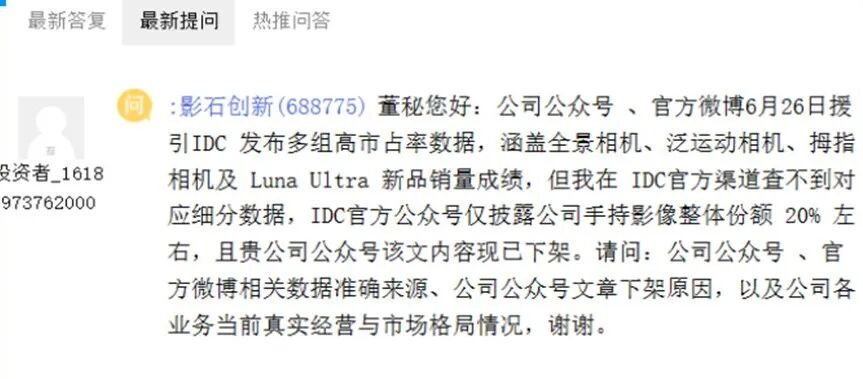
In late June, an investor directly inquired on E-Interaction: The IDC market data cited in your official WeChat account cannot be verified through IDC's official channels. What's the explanation? Why was the article removed?
As of now, the company has not issued a public response.
What initially appears to be a routine investor query has unexpectedly unraveled three interconnected issues: the silent removal of promotional data without explanation, a sudden 72-hour shift in national subsidy pricing strategies, and DJI's cross-border patent lawsuit seeking a permanent injunction over six patents.
Remarkably, all these events transpired in the same month that marked Insta360's first anniversary of listing and the expiration of the lock-up period for 227 million shares. Leading up to and following this milestone, the stock price plummeted from a September peak of RMB 377 to below RMB 150—reaching a record low of RMB 148.79 on June 16, further dipping to RMB 144.99 on June 17, and closing at RMB 131.85 on June 26, with brief touches of RMB 130 in subsequent days. The confluence of a lock-up expiration flood and a sharp stock price decline has heightened market anxiety.
While these three issues may seem unrelated at first glance, against the backdrop of lock-up pressure and a collapsing stock price, they collectively raise a critical question: What compliance challenges is a company listed on the STAR Market just one year ago grappling with?
I. Questionable Data Sources: High-Profile Promotion, Quiet Deletion
On June 26, Insta360 released a set of promotional content on its official WeChat account and Weibo, citing IDC data to claim high market share in multiple segments, including panoramic cameras, action cameras, and thumb cameras, and disclosed sales figures for the Luna Ultra.
The promotion was extensive—featuring multiple data points across various segments, accompanied by rich visuals, presenting an image of "full-scale dominance."
However, investors soon discovered discrepancies upon checking IDC's official channels—finding no corresponding data.
IDC's official WeChat account had previously disclosed only that Insta360 held an approximate 20% overall share in the handheld imaging sector. The segmented data cited in Insta360's promotion had no traceable source in IDC's public channels.
Investors' doubts were direct: Where did these segmented data points originate? Were they derived from unreleased custom IDC reports? Or were they Insta360's own interpretations of IDC data? If custom reports, could authorization or sources be provided?
More intriguingly, the article on Insta360's official WeChat account was later taken down.
High-profile release, quiet deletion, with no public explanation in between.
Yet the promotion didn't disappear entirely. While the WeChat article was removed, related content continued to circulate on Insta360's official Weibo and founder Liu Jingkang's personal Weibo. On one hand, official channels quietly deleted content; on the other, Weibo kept spreading it—this "half-deleted" operation is perplexing.
The core contradiction lies in the numbers themselves.
In Insta360's cited IDC data, the company's Q1 2026 action camera sales were marked at RMB 2.536 billion. However, Insta360's own Q1 report showed total company revenue of RMB 2.481 billion.
Sales in one segment exceeding total company revenue—a financial impossibility.
Delving deeper: Insta360's business isn't limited to action cameras; it also includes panoramic drones, non-consumer products, and various accessories, accounting for about 20% of revenue. This suggests that actual revenue from action cameras is likely around RMB 2 billion—aligning with data from Qianyan Research.
But the promoted figure was RMB 2.536 billion—nearly 40% higher than actual data. A segment's "sales" not only surpassing total company revenue but also far exceeding reasonable limits for the segment itself.
This isn't just a "questionable data source" issue. When a figure directly contradicts the company's own financial report by nearly 40%, the problem escalates from "unclear origin" to "whether the data itself can withstand scrutiny."
In late June, investors formally requested clarification on the IDC data's source and the article's removal on the SSE E-Interaction platform.
As of now, no public response has been forthcoming.
The company cited third-party data for promotion, that data directly contradicted its own financial report, it then removed the WeChat article while Weibo content remained, and it didn't respond to formal investor inquiries.
These facts, when linked together, point beyond data source issues—they raise questions about information disclosure compliance. Can a listed company use data contradicting its own financial reports for public promotion, delete content without explanation when questioned, and remain silent after formal inquiries? This isn't nitpicking; it's about meeting basic disclosure requirements.
This isn't an excessive demand; it's the bottom line.
II. National Subsidy Controversy: Who’s Footing the Bill for the RMB 3,999 Price Tag?
On June 10, Insta360 launched the new Luna Ultra, priced at RMB 3,999.
But RMB 3,999 isn't the full story. According to multiple verifications, the product's registered price in the national subsidy catalog was RMB 4,729—RMB 730 higher than the consumer-facing price.
Where did the RMB 730 go?
Online channels make it clear: E-commerce pages label it as "government subsidy," with RMB 3,999 including a ~15% national subsidy reduction. In other words, part of the product's online price is covered by policy subsidies.
Offline channels operate differently. Physical stores also sell at RMB 3,999 but without national subsidies—according to insiders, this relies on "brand concessions," with Insta360 covering the difference itself.
This creates an interesting phenomenon: Same product, same price, two paths—one through policy channels, one through brand support.
On June 22, something even more intriguing happened. Insta360 completely removed the national subsidy portal from e-commerce pages, replacing "government subsidy" labels with brand coupons.
Within 72 hours, the pricing logic shifted from "government subsidy" to "brand coupon."
On June 23, insiders told media: The product qualifies for national subsidies, and the brand covers the difference itself, denying any fraud. But note—this wasn't the company's official statement.
Here, three unanswered mysteries emerge:
First, the contradiction between labeling and funding. If offline sales rely on brand concessions, why did online channels previously label them as "government subsidies"? When consumers see "government subsidy," is it policy savings or brand marketing using policy terms? Who is the real funder behind the labels?
Second, subsidy catalogs and channel funding sources. The product's registered price is RMB 4,729, with consumers paying RMB 3,999. The RMB 730 difference is covered by national subsidies online and brand concessions offline. Which channel claims the national subsidy funds? Which catalog disburses them? Does Insta360 have a fully compliant pathway for national subsidy policy application?
Third, the motive for the 72-hour emergency adjustment. If everything was compliant, why suddenly remove the national subsidy portal? Changing from "government subsidy" to "brand coupon"—was this proactive compliance correction or passive response to doubts? After the adjustment, did consumers who previously bought through national subsidy channels lose their eligibility?
Three questions, no official company responses yet.
No conclusions—but for a STAR Market-listed company, this "label-shift-silence" chain in national subsidy policy usage warrants scrutiny.
III. Patent Litigation: 6 Patents + Permanent Injunction—The Compliance Test Arrives
On June 10, the same day Insta360 launched Luna Ultra, DJI filed a patent lawsuit against it in the U.S.
The complaint involves six patents and requests a permanent injunction—if granted, related products could be banned from the U.S. market.
This isn't an ordinary commercial dispute. A permanent injunction is the harshest remedy in patent litigation; if ordered, it structurally impacts the defendant's market access and product lines.
On June 12, Insta360 swiftly countersued DJI over five patents. The back-and-forth seems evenly matched, but size disparities loom: DJI's 2024 revenue exceeded RMB 30 billion with thousands of patents; Insta360's 2025 revenue was RMB 9.741 billion with relatively limited patent reserves.
This isn't a symmetrical battle.
We won't debate here whose technology is stronger or whose strategy is better—that's for another discussion. Let's focus on compliance:
A STAR Market company facing transnational patent litigation with a permanent injunction request on its core product line is a real compliance risk event. It suggests potential weaknesses in the company's patent strategy and uncertainty in overseas market access.
Insta360's countersuit is active defense, but with 5 vs. 6 patents and limited vs. thousands of reserves—how long can the countersuit hold, how broad can its coverage be? These answers directly affect investors' assessment of compliance risks.
Yet as of now, Insta360's public disclosures about this lawsuit remain extremely limited. Information investors can glean from announcements is far from enough to evaluate the true scope of this patent battle.
Compliance obligations for STAR Market companies aren't just about lawful operation; they also include keeping investors fully informed, especially when compliance risks shift from "possibility" to "actual event."
IV. Compliance Risks Behind Rapid Expansion
Three threads, three areas, but pointing to the same underlying logic.
IDC data directly contradicts financial reports yet is promoted aggressively—WeChat quietly deletes content, Weibo keeps spreading it, E-Interaction inquiries go unanswered.
National subsidy pricing shifts abruptly within 72 hours—from "government subsidy" labels to "brand coupons," with no official explanation, leaving three unanswered mysteries.
DJI's 6-patent + permanent injunction transnational lawsuit—compliance risks shift from possibility to reality, yet investors struggle to access sufficient public information.
The common feature of these three events: Fast actions, slow explanations, almost no responses.
Now consider financial figures: In 2025, Insta360's revenue hit RMB 9.741 billion, up 74.76% YoY; net profit was RMB 964 million, down 6.62% YoY. Revenue surged, profits collapsed. Q1 2026 was steeper—revenue RMB 2.481 billion, up 83% YoY; net profit plunged 52%, with net margin at just 1.3%.
Revenue races ahead, profits collapse—this financial structure means the company is exchanging scale for enormous costs. When scale expansion far outpaces profit accumulation, whether compliance systems can keep pace becomes a real question.
Now consider lock-ups and stock price. Insta360 listed on the STAR Market on June 11, 2025, at RMB 47.27. On June 11, 2026, 227 million shares (56.5% of total shares) were unlocked. Before and after, the stock price tumbled from last September's high of RMB 377: closing at RMB 131.85 on June 26—less than 3x the IPO price. Block trades surged, and market anxiety is palpable.
Data contradictions vs. financial reports, shifting national subsidy pricing, patent litigation—all three occurred in the same month, compounded by revenue surge without profit growth, lock-up flood, and stock price collapse. It's hard not to wonder: When revenue races but profits collapse, when 227 million shares unlock as the stock price falls to one-third of IPO, has compliance been pushed to the sidelines? In the rush, is aggressive growth a strategic choice or the price of opportunism?
No conclusions—but for a STAR Market-listed company with simultaneous doubts over data authenticity, national subsidy policy usage, and patent risk response, choosing silence after formal investor inquiries warrants attention and scrutiny.
Compliance is not a decorative element; it is the foundation.
When the foundation is shaky, the taller a company aims to reach, the greater the risks it faces.
© Long-term data support for this account comes from Tianyancha
-
![]()
China’s AI Industry: A Unified Pivot Towards Monetization?
-
![]()
New Progress! Infineon Completes Acquisition of ams OSRAM's Non-Optical Sensor Business
-
![]()
35 Million Bet on an Optical Future! Tengjing Technology Makes a Move in AR
-
![]()
Why World Models Get Stuck on Construction Roads in Autonomous Driving Applications
-
Alibaba Initiates Cultural Transformation: Is Jack Ma Making a Strategic Comeback?
-
Tianfeng Heads to Hong Kong for IPO with RMB 3.8 Billion in Funds: Xingyu's Cross-Border Foray into Embodied AI Faces Uncertain Future
-
![]()
Mengshi Auto’s High-End Aspirations Dashed: Huawei Partnership Fails to Revive Sales, New Model’s Entry Price Dips Below 300,000 Yuan
-
A Single-Day 40% Plunge! AI-Themed New Listings: The Cruelest 'Slashes' for Retail Investors in Hong Kong Stocks