Low-Cost Data Cards Vanish Overnight! Three Major Operators Unite in Action—Is the Price War Over?
 08/03 2026
 416
416
Are Low-Cost Data Cards a Thing of the Past?
Recently, discussions surrounding data cards have surged, and the reason is straightforward—they seem to be disappearing.
Initially, some netizens abruptly shared an 'internal notice,' revealing that the three major operators would officially halt the application process for SIM cards through third-party online channels, such as the internet, starting August 1st. Only official apps, websites, and other designated online channels would remain operational.
Upon hearing this news, many netizens were taken aback: 'Are data cards becoming obsolete? What will I do if I run out of data?' For those who already possess a card, there's no need for concern. As long as you don't actively modify your plan, you can continue using it with the same fees and data allowance.
However, for those who haven't secured a card yet, this news spells trouble. Many initially hoped it was just a hoax, especially since no official announcements had been made by the three major operators. Moreover, platforms like Douyin were still promoting data cards, and some official media outlets inquired with the operators, only to receive replies stating, 'No notification has been received yet.'
Yet, by August 1st, it became evident that the rumors were true. If you search for data cards on platforms like Douyin now, you'll only find options from China Broadcast Network, while those from China Mobile, China Telecom, and China Unicom have disappeared without a trace.
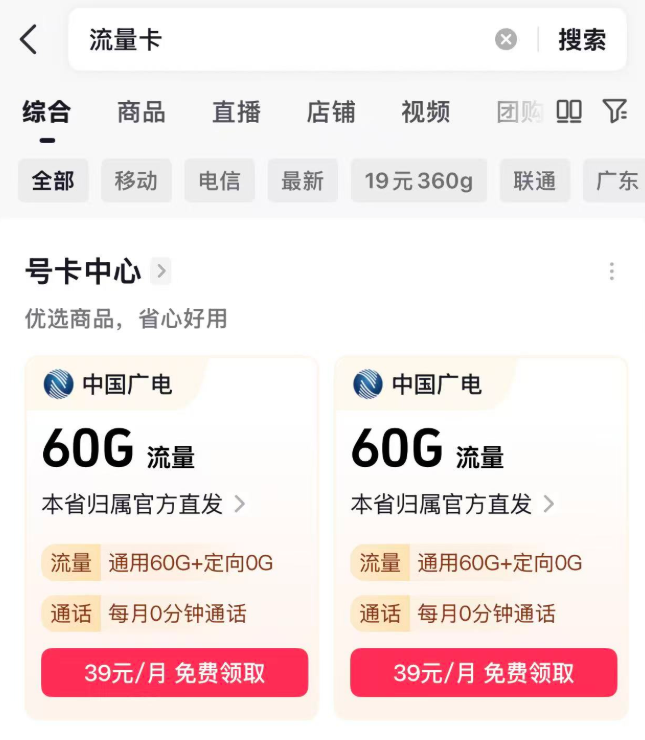
Image Source: Leitech
On the same day, the three major operators also issued an announcement titled 'Announcement on Regulating the Application Process for SIM Card Services through Internet Channels,' effectively declaring the 'complete collapse' of data cards sold through third-party channels. Although the operators haven't entirely closed online channels for obtaining SIM cards, they now only offer services through official websites and apps, with very limited plan options available.
Naturally, netizens reacted with outrage. Some rushed to stock up on cards before the shutdown, managing to snag a few (though it's important to note that reselling SIM cards is illegal). However, more netizens were curious: Why were data cards, once so prevalent on the internet, suddenly shut down overnight? Leitech will provide a clear answer in this article.
Rumors Denied One Day, Data Cards Gone the Next
Data cards have long been known for their affordability and generous data allowances. Official plans might offer a few dozen GB of data for fifty or sixty yuan, but livestreams could offer deals like '19 yuan for 300GB.' When calculated per yuan of available data, the difference exceeds 15 times.
Why such a significant gap within the same operator? First, you need to understand a fundamental principle: Discounts don't appear out of thin air.
If you've ever purchased a data card advertised on Douyin or Bilibili, you've likely noticed that they're usually shipped from remote cities. Moreover, when you call a friend using such a card, the caller ID will display that city. I recall a friend who got one and called home, only to have the call mistaken for a spam call and hung up on.
In reality, many internet data cards were initially designed by local branches of operators to swiftly acquire new users. Therefore, these cards are often subsidized by local operators, who concentrate plan resources on data by reducing other benefits like calling minutes to attract users.
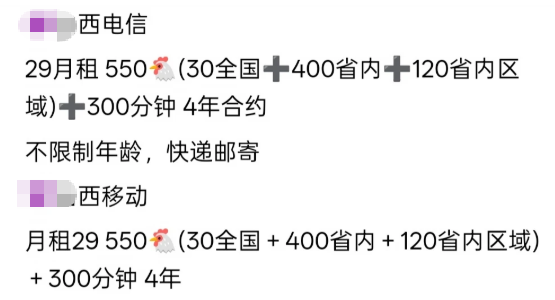
Image Source: Xiaohongshu
However, while they're advertised as '19 yuan for xxxGB,' the actual plan price is often higher, but operators reduce it through limited-time discounts and subsidies. Generally, the 19 yuan monthly fee isn't permanent; it's usually a promotional price for six months to a year, after which it reverts to 39 yuan or higher.
Of course, some SIM card sellers may mislead users, claiming that discounts can be renewed before they expire or that they can help obtain a new card to continue the discount period. After all, most phones now have dual SIM slots, so for many people, one card is for calling acquaintances, and the other is purely for internet access, making it easy to switch.
Moreover, many data cards consist of general data + app-specific data. For example, those sold on Douyin often offer Douyin-specific data, which can only be used when browsing Douyin. This app-specific data is also subsidized by Douyin, making it a cost-effective way for operators to attract users.
It's through the cooperation and joint subsidies of local operators and content providers that these data cards can offer large data allowances at low prices. However, this also leads to a problem: The more they sell, the more they potentially lose.
Behind the Cheap Plans: The Three Major Operators Engage in a Loss-Making Price War
For local operators, subsidizing data card fees is essentially about pre-empting the market (seizing market share) and acquiring new users. Therefore, these discounted plans often come with conditions, such as requiring two years of use before cancellation, while the SIM card's discounted plan only lasts a year, after which it charges 59 yuan.
Through such fee combinations, they can recover the subsidized costs from the first year in the second year. If users continue using the service afterward, it's pure profit. However, as mentioned earlier, some agents lure users into placing orders by claiming they can 'assist in switching cards to continue enjoying discounts' after the promotional period ends. There's naturally room for manipulation here, such as simply disappearing.
If you've ever come across content creators selling data cards on platforms like Bilibili, you'll notice that these accounts are mostly new. After you place an order through an ad link and use it for a year, when you try to go back to them for a new card, you'll find the account has been deleted, and the seller has vanished.
At this point, even if you contact platform customer service, they can't offer any help because SIM cards don't have 'after-sales' support, and most e-commerce platforms don't delay payment settlements for a year. So, these merchants make money by 'quickly setting up accounts—selling cards—disappearing,' while also scamming another batch of users.
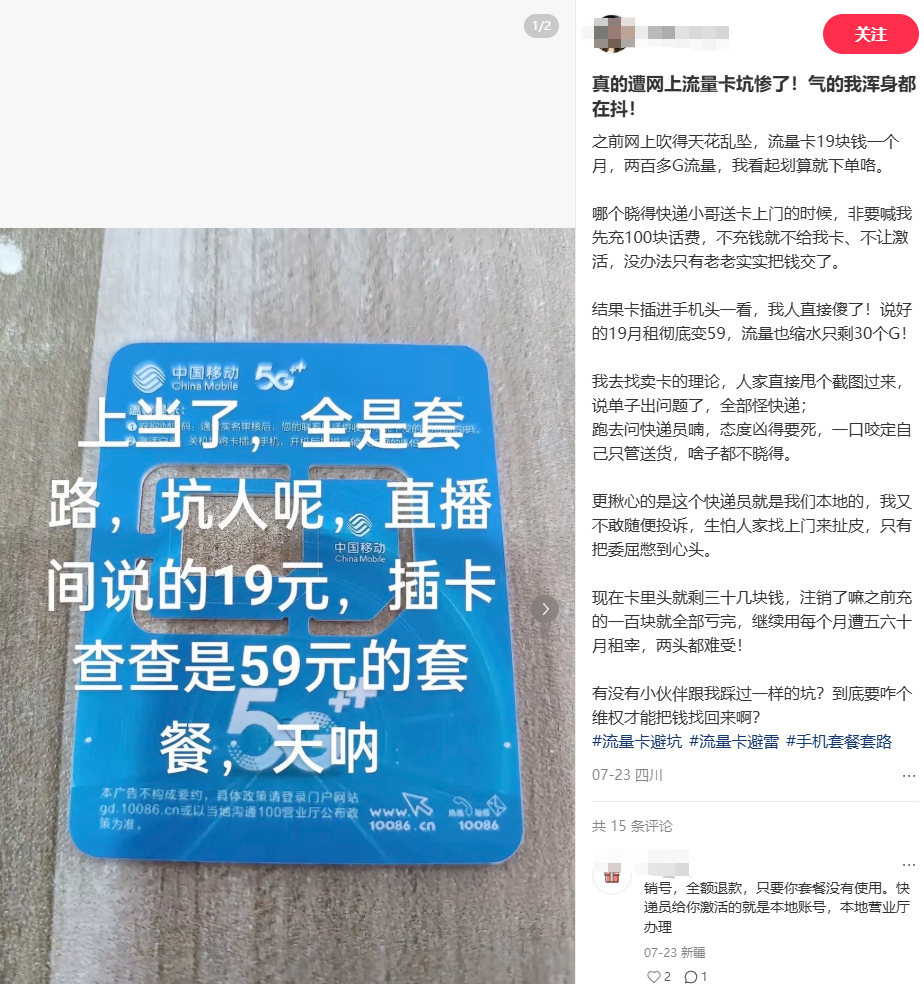
Image Source: Xiaohongshu
In fact, such agents are also a headache for operators because when users can't find the sellers, they naturally turn to operator customer service. Facing these inexplicable complaints, handling them means a pure loss; not handling them risks users complaining to the Ministry of Industry and Information Technology, affecting evaluations. So, operators are also in a dilemma.
What's even more troublesome for operators is that these discounted SIM cards, initially targeted at specific cities or counties, are being sold nationwide through online platforms. Although operators appear as a single entity, they're actually divided into provincial, municipal, district, and county levels, each with KPIs for user growth.
For some operators under heavy business pressure, selling SIM cards is all that matters, regardless of where they end up. However, for operators in other regions, this is a problem. Because data consumption increases operational costs, the KPIs are attributed to the operator where the SIM card is registered, but the costs are borne by the operator where the data is actually used.
Initially, when there weren't many data cards, it was manageable. But as sales increased, local operators in these provinces and cities naturally complained. Moreover, the three major operators kept lowering data card fees to compete for users and raised channel commissions, further driving up channel promotion costs. In the end, the three major operators realized they had acquired many users but also lost a lot of money.
Additionally, some merchants indeed scammed user information under the guise of online SIM card applications, compounding the issue of operational costs exceeding customer acquisition benefits. So, the three major operators decided to take the plunge and shut down this channel entirely.
To be honest, a few years ago, operators might have continued subsidizing even at a loss. However, with mobile network and smartphone penetration nearing saturation, there aren't many 'new users' left to acquire in the market, while channel fees have visibly skyrocketed.
When losses far outweigh gains, the three major operators naturally won't continue subsidizing.
User Demand Persists, and Low-Cost Plans Will Eventually Return
The popularity of data cards ultimately stems from the fact that official plans are too expensive. Take China Telecom as an example: a 39 yuan plan offers 5GB of general data and only 30GB of app-specific data, which runs out quickly when streaming videos, forcing users to buy additional data packs.
To be honest, if this issue isn't resolved and users are forced to buy regular plan cards, it will only breed more user resentment and potentially give rise to a gray market, which isn't something operators want to see. Furthermore, competition among the three major operators won't disappear. Once one operator can't hold back and lowers fees, it's likely to drag the other two into another price war.
Image Source: Leitech
Not to mention, there's also China Broadcast Network lurking in the shadows. As the newest operator, its need to acquire customers is the highest. After the three major operators suspend data card sales, China Broadcast Network has an opportunity to meet this demand. However, whether it can retain users ultimately depends on its capabilities, as poor signal quality will render cheap data useless.
Moreover, with the development of applications like AI, cloud gaming, and mobile office work, users' data demands are increasing. Current regular plans simply can't meet these growing needs. So, I speculate that operators may further optimize plan fees or bypass intermediaries like agents to launch new data cards officially.
So, for those who need data cards but missed the last opportunity, why not wait a bit longer or visit a business hall and ask the staff directly? You're likely to find plans more favorable than those on official apps. Additionally, September brings the back-to-school season, one of the most important marketing nodes for operators. They may also launch new plans this month, so keep an eye out.
-
Financing and IPO: Is Ant Group a Financial Giant or a Pioneer in Cutting-Edge Tech?
-
![]()
Revenue Soars Twofold in Three Years! Optical Firm Reignites Bid for Hong Kong Stock Exchange Listing
-
![]()
Jiangsu LEAD Microelectronics Successfully Hands Over Its Inaugural 12-Inch Wafer-Level Optical Magnetron Sputtering System!
-
![]()
Domestic Computing Power Hits Breakthrough: Super Nodes as the Pivotal Force
-
![]()
Tongze Kangwei Secures IPO Registration on GEM: Broadband Terminal Equipment Provider Set for Imminent Share Issuance
-
![]()
Transforming Car Manufacturing into a 'Smartphone Launch' Frenzy: 5 Tips to Avoid Pitfalls When Purchasing a New Car
-
![]()
The Three-Way Battle Among AI Office Software: A Decade of War Among BAT
-
![]()
The Three-Way Battle Among AI Office Software: A Decade-Long War Among BAT