Harbor Weekly Review | Dreame’s 200,000-Yuan Smartphone: A Symbolic Gesture Lacking Substance
 08/24 2026
 495
495
Li Lei, Harbor Business Insights
After the departure of its smartphone division head, Dreame has finally unveiled some “encouraging news”: the sale of a smartphone priced at 200,000 yuan.
However, this news is far from positive. While it may signify a notable move for Dreame’s smartphone endeavors, it hardly constitutes a significant leap for the broader smartphone industry.
A smartphone lavishly adorned with gold and diamonds cannot, in reality, become a mainstream global product based solely on such embellishments.
Recently, the head of Dreame’s smartphone division announced on social media that the 001 AURORA smartphone had been delivered, with full payment of $30,000 (approximately 202,300 yuan) received. This includes a $10,000 deposit and a remaining balance of $21,184. The phone is marketed as the “highest-priced flagship smartphone in Chinese history.”
It is reported that the phone’s back panel is crafted from 24K solid gold and features custom-cut rare gemstones. Additionally, it bears an exclusive signature from founder Yu Hao and comes with a commemorative certificate marked “No.001.”
In early August, market reports indicated that Yu Lei, the leader of Dreame’s Eclix smartphone ecosystem brand, planned to resign from Dreame, though his internal Feishu account remained active.
Yu Lei officially joined MOVA, a subsidiary of Dreame, in March 2026 as the head of smartphone and AI hardware businesses, but his tenure lasted less than six months.
Public records reveal that Yu Lei joined Gionee Group in 2015 as Global Vice President, overseeing marketing and channel sales until his departure in 2018. He later served as Chief Operating Officer at BrainCo, contributing to the company’s commercialization and its rise as one of the “Hangzhou Six Little Dragons.” Yu Lei also founded the smartphone brand FreeYond, targeting overseas markets with a direct-to-consumer (DTC) model.
Just two months ago, the Eclix team announced a deep collaboration with a leading domestic large model company, planning to release its first-generation AI smartphone in September 2026, with a market launch scheduled before the “Double 11” shopping festival. The product is positioned as high-end, with a price tag exceeding 5,000 yuan.
According to Yu Lei, Eclix will operate as a Dreame ecosystem brand, distinct from MOVA, with a team of about 60 people expected to expand to around 300 by the end of 2026. Meanwhile, the Eclix team is open to external financing, with the AI smartphone project engaging with multiple investors.
After just six months, the parting of ways between Dreame and the seasoned Yu Lei raises further doubts about Dreame’s ambitious plans.
It is widely believed that Dreame embarked on a comprehensive restructuring in June, announcing a strategic pivot to focus on four core areas: smart home, outdoor living, smart mobility, and embodied AI, while integrating, merging, or transforming other businesses. Some business units (BUs) without actual operations or personnel will be dissolved directly. Previously market-focused businesses like automobiles and smartphones will transition into industrial research institutes, primarily focusing on technological R&D and industry-academia-research collaboration.
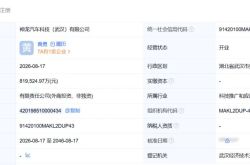
In fact, in May, Chen Longdong, head of Dreame’s automotive business, had already resigned. Later, Dreame’s subsidiary, Stellar Future (Suzhou) Automotive Technology Co., Ltd., issued a statement clarifying that Chen Longdong joined Dreame’s original Stellar Future BU in June 2025 as its head, a role inconsistent with the online rumors of “Dreame Auto CEO” or “Dreame executive.”
From automotive to smartphone businesses, Dreame’s setbacks have become increasingly evident.
A brief recap of the bold claims made by Dreame’s founder, Yu Hao: to compete with Apple and Samsung for global market share and ultimately become the world’s number one.
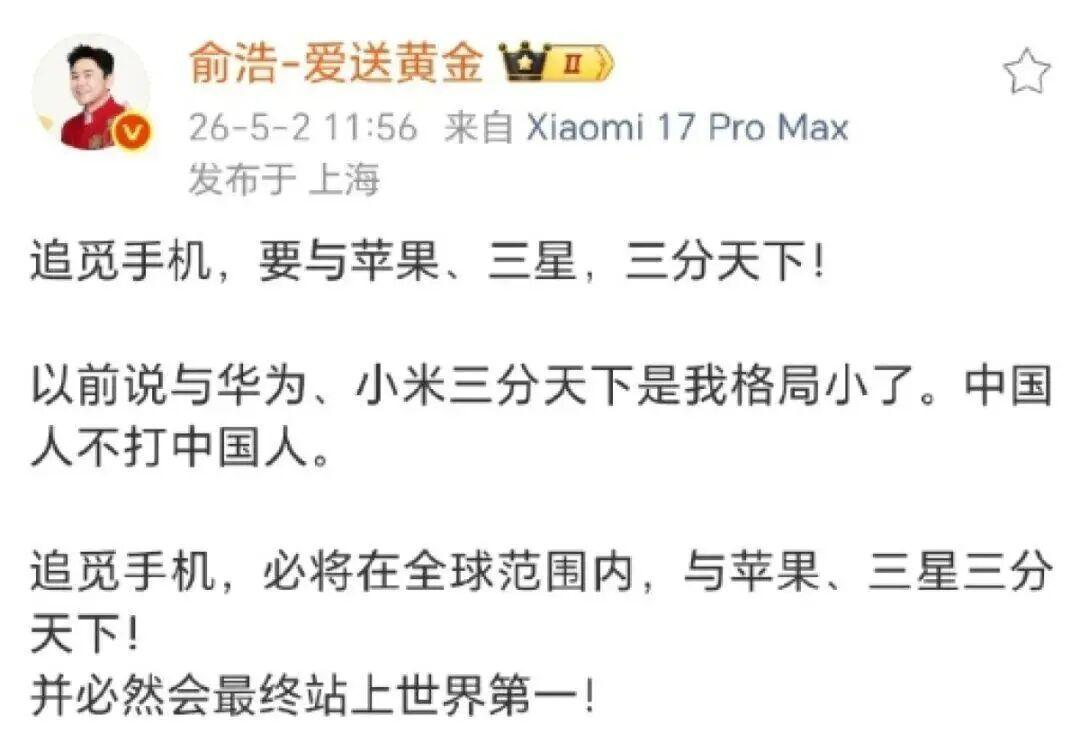
Prior to this, Dreame also announced that its overall R&D investment in the smartphone business was expected to reach 10 billion yuan, with smartphones and automobiles being the two most resource-intensive sectors.
Why is Dreame’s sale of a 200,000-yuan smartphone, claimed to be the most expensive in China or even the world, virtually meaningless?
Firstly, the hardware is falsely premium. Traditional high-end smartphones (e.g., Huawei Porsche Design/Mate RS, Samsung W series) derive their premium pricing from absolute technological barriers, such as proprietary chips, satellite communication, or foldable display technology. In contrast, Dreame’s smartphone, manufactured by ZTE Nubia (running MyOS), offers no fundamental breakthroughs in core user experience.
Physical material stacking is disguised as technological premium. Dreame’s “200,000-yuan price tag” essentially repackages an industrial product as a “gold and gemstone ornament.” It sells not the technological value of a smartphone but the physical value of gold and gemstones. Raising the price with gold bars and gemstones is a marketing “dimensionality reduction swap” that fails to address the smartphone’s technological moat as an electronic product.
By this logic, could embedding gold and gemstones into a bowl or cup justify a 200,000-yuan price tag?
Secondly, Dreame misreads the endgame of luxury smartphones, which is a “Vertu-style” false proposition.
The collapse of Vertu, the pioneer of luxury smartphones, has already proven that in the smartphone era, “the wealthy do not need to sacrifice basic user experience for prestige.” Luxury buyers may purchase high-end watches or jewelry, but smartphones are daily necessities highly dependent on ecosystems and frequent interaction.
Vertu initially relied on Nokia’s heyday, while Dreame’s brand heritage lies in household cleaning appliances like “robot vacuums and hair dryers.” Asking buyers to carry a gold smartphone weighing several hundred grams, emblazoned with a cleaning appliance brand logo and running a contract-manufactured system, fails to provide strong social status symbolism or the century-old cultural heritage required of luxury goods.
If consumers are unfamiliar with Vertu, they may recall the domestic brand 8848.
Thirdly, Dreame’s 200,000-yuan smartphone appears more as a form of self-consolation, a PR strategy, or performance art.
Yu Hao’s smartphone ambitions are beyond ordinary comprehension. Even Xiaomi, OPPO, VIVO, or the recently controversial Yu Chengdong would not dare to make such bold claims.
When conventional R&D cannot shake Apple or Huawei in the short term, generating online hype through “selling the first 200,000-yuan gold smartphone” is the fastest way to attract leveraged public attention. However, the negative side effects of this public opinion leverage are substantial. Can selling a few units truly establish core competitiveness or industry standing?
Can Dreame mass-produce its smartphones? Can it introduce even a single self-developed, irreplaceable technology in the fiercely competitive consumer smartphone market? Or, if Dreame positions itself as a luxury smartphone brand for a global elite minority, can it achieve the top-tier status of Hermès or Louis Vuitton?
These questions demand answers from Dreame. (Produced by Harbor Finance)
-
![]()
Wu Yongming: Have No Fear, Capex Will Yield Returns in Three Years
-
![]()
After Cursor and OpenRouter Were Acquired, Has the Wave of AI Mergers and Acquisitions Arrived?
-
![]()
Revenue of 11.6 Billion and Loss of 200 Million: Can iFLYTEK Overcome the AI Profitability Dilemma?
-
![]()
CHN Energy Teams Up with Chery, Further Strengthening Green Power Alliance Between Power Generation and Auto Companies
-
![]()
Insights from the Chengdu Motor Show: Overseas Brands Step Up Their Game
-
![]()
Chengdu Auto Show: Some Brands Opt Out, While Others Go All-In with 'Pavilion Dominance'
-
![]()
8.2 Billion Yuan Invested to Launch a New Entity: Dongfeng Peugeot Citroen Automobile Reboots After Years of Inactivity
-
![]()
Why Are Once-Prominent 'Honored Guests' Now Mostly Missing from the Chengdu Motor Show?