Eco-System Co-Construction: China's Auto Industry Advances into the Overseas Expansion 2.0 Era | Cover Story: System Upgrade for China's Auto Industry Overseas Expansion (Part I)
 03/05 2026
 689
689
Editor's Note
China's auto companies are entering a new phase of overseas expansion 2.0, with increasingly diversified overseas layouts. The approach is evolving from product exports to eco-system co-construction, initially establishing a relative technological competitive advantage based on electrification, intelligence, and covering the entire industrial chain. Some companies are beginning to show the potential of global brands, gradually demonstrating the comprehensive strength to reshape the global auto industry landscape. However, to adapt to the profound changes of overseas expansion 2.0, the global narrative capabilities and risk resistance of Chinese auto brands need to be reconstructed. Technological innovation remains the core driving force for Chinese companies to break the existing global auto industry landscape and gain a competitive edge in overseas expansion.
Focusing on auto overseas expansion, "Auto Review" presents this special “Cover Story” report. This feature consists of seven articles, with the first one being released today. Stay tuned.
From 'going global' to 'going local,' advancing into the overseas expansion 2.0 era. The overseas expansion model is being upgraded, requiring Chinese auto companies to co-construct an overseas expansion ecosystem. This requires both a scale-oriented and a value-oriented approach, as well as reconstructing global narrative capabilities, turning overseas operations into new growth poles for sales and profits.
On February 26, 2026, Stellantis Group released its full-year 2025 financial results. With this, the top 10 global automakers by sales volume in 2025 were finalized: Toyota Motor with 11.323 million units, Volkswagen Group with 8.984 million units, Hyundai Motor Group with 7.274 million units, General Motors with 6.182 million units, Stellantis Group with 5.484 million units, BYD with 4.602 million units, SAIC Group with 4.507 million units, Ford Motor with 4.395 million units, Geely Holding Group with 4.116 million units, and Honda Motor with 3.522 million units. Three Chinese automakers ranked in the top 10, with BYD in sixth place, SAIC Group in seventh, and Geely Holding Group in ninth. In 2025, BYD's overseas sales reached 1.054 million units (according to CAAM data), SAIC Group's were 1.071 million units (according to company data), and Geely Holding Group's were 606,000 units (according to CAAM data).
BYD, SAIC Group, and Geely Holding Group are key representatives among Chinese automakers. In recent years, the scale of Chinese auto companies expanding overseas has continuously expanded, showing a vigorous development trend. Chinese auto overseas expansion may usher in a new golden window period. Industry insiders believe that Chinese autos are entering the overseas expansion 2.0 era, reshaping the global auto industry landscape through diversified overseas expansion paths.
From Quantitative to Qualitative Change: The Evolution Logic Behind the Data
Recently, MG Motor's cumulative sales in the European market surpassed 1 million units, making it the first Chinese automaker to achieve this milestone in Europe. It is a typical representative of China's auto globalization development.
On February 11, 2026, the China Association of Automobile Manufacturers (CAAM) released January data: 681,000 vehicles were exported, up 44.9% year-on-year. Among them, 589,000 passenger vehicles were exported, up 48.9% year-on-year; 93,000 commercial vehicles were exported, up 23.6% year-on-year. 302,000 new energy vehicles were exported, doubling year-on-year; 380,000 traditional fuel vehicles were exported, up 18.8% year-on-year. Passenger and commercial vehicle exports achieved rapid year-on-year growth, with new energy vehicle exports maintaining high-speed year-on-year growth. Among the top 10 companies by whole vehicle export volume, Chery exported 119,000 units, BYD 100,000 units, SAIC 97,000 units, Geely 77,000 units, Tesla 51,000 units, Changan 44,000 units, Great Wall 40,000 units, Dongfeng 29,000 units, BAIC 26,000 units, and Sinotruk 18,000 units, with nine companies achieving positive export growth.
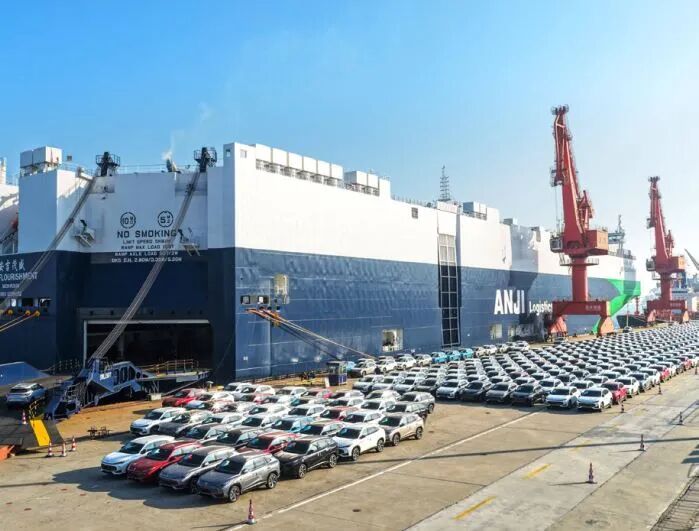
In 2025, according to CAAM data, auto production and sales reached 34.531 million and 34.40 million units, respectively, maintaining the top global position for 17 consecutive years. New energy vehicle production and sales reached 16.626 million and 16.49 million units, respectively, ranking first globally for 11 consecutive years. Auto exports reached 7.098 million units (including 2.615 million new energy vehicle exports), reaching a new export scale and becoming the world's largest auto exporter for three consecutive years. Chinese auto companies' 'going global' maintained a high-growth trend.
In fact, China is not only a major exporting country but also a major importing market. In 2025, China's import scale reached RMB 18.5 trillion, becoming the world's second-largest import market for 17 consecutive years. China's imports from over 130 countries and regions increased, becoming the main export destination for nearly 80 countries. Against the backdrop of globalization facing headwinds and the rise of unilateralism and protectionism, China actively promotes global open cooperation and win-win outcomes, becoming a banner for globalization development.
Behind these data lies a profound change in the connotation of overseas expansion. It has shifted from pure product exports to the export of the entire industrial chain, including products, technology, talent, and management. It has also shifted from passively adapting to overseas market rules to actively participating in global industry standard-setting. Meanwhile, the average export price has steadily increased. In the words of industry insiders, Chinese autos are transitioning from 'overseas expansion 1.0,' centered on whole vehicle trade, to 'overseas expansion 2.0,' characterized by eco-system construction.
This is also the result of the combined forces of national policy guidance and market drivers. For example, in February 2024, nine departments including the Ministry of Commerce jointly issued the Opinions on Supporting the Healthy Development of New Energy Vehicle Trade Cooperation, providing full-chain support for overseas expansion companies from early R&D to overseas operations. In September 2025, four departments including the Ministry of Commerce decided to implement export license management for battery electric passenger vehicles, ensuring export product quality from the source. These policies actively guide the industry towards sustainable development.
From the perspective of Chinese automakers' overseas layouts, a diversified trend has emerged. Europe remains one of the high-value core markets, while the 'Global South' markets have become a focus for overseas expansion. For example, SAIC Group's overseas sales reached 1.071 million units in 2025, with SAIC MG selling over 300,000 units in Europe, 70,000 units in India, and 29,000 units in Thailand. Currently, SAIC's overseas layout has formed one '300,000-unit' level (Europe) and five '50,000-unit' level (Americas, Middle East, Australasia, ASEAN, South Asia) overseas regional markets, with products and services covering over 170 countries and regions worldwide.
Notably, the roles of foreign/joint venture brands have also been actively transforming in recent years: shifting from a 'in China, for China' localization strategy to a 'in China, for the world' globalization strategy. In other words, foreign/joint venture brands are also beginning to value 'going global.' For example, in September 2025, FAW-Volkswagen held the off-line ceremony for its first batch of exported vehicles at its Changchun base, marking its first vehicle exports to overseas markets since its establishment. In 2025, China's foreign/joint venture brand passenger vehicle exports reached 1.045 million units, accounting for about 14.7% of total domestic auto exports. Three foreign/joint venture brands—Tesla, Yueda Kia, and Jiangling Ford—exported over 100,000 units each, with export volumes reaching 226,000, 173,000, and 115,000 units, respectively. These foreign/joint venture brands deeply participating in the Chinese market will reshape the global auto industry eco-system landscape alongside Chinese auto brands, leveraging the global brand influence and channel networks of multinational automakers to open up diversified paths for the globalization development of the Chinese auto industry.
We should recognize that the key driving force for the transition from quantitative to qualitative change in China's auto globalization development is that Chinese auto companies have seized the important strategic opportunities presented by the new round of technological revolution and industrial transformation represented by electrification and intelligent technologies. Chinese autos have become a convergent carrier for the new round of technological innovation in the auto industry. Citing the view of Zhang Yongwei, Chairman of the China EV100 Forum, the time difference and developmental gap formed at the product, technology, and industrial chain levels provide a rare window period for China's auto intelligent overseas expansion.
Changes in Overseas Expansion Models: From Pure Product Sales to Eco-System Co-Construction
The overseas expansion model of Chinese automakers has begun to quietly change, shifting from pure trade to eco-system co-construction, and from a single product supplier to an 'product-service-solution' eco-system provider. This is a qualitative upgrade in the overseas expansion model.
On January 30, 2026, at the High-End Seminar on Chinese Auto Brands' Overseas Expansion and the premiere of the 'Seeing Chinese Autos Go Global' special documentary, the documentary systematically showcased the charm of overseas expansion by five outstanding companies—FAW Hongqi, Changan Automobile, Chery Automobile, BYD, and BAIC Foton—covering both passenger and commercial vehicle markets. A company representative stated during the event, 'Chinese auto globalization is moving from 'quantitative expansion' to 'qualitative improvement,' upgrading from 'market entry' to 'value co-construction.'
Perhaps such scenarios will become commonplace in the future. On February 17, 2026, Dongfeng Import and Export Corporation, together with its Sri Lankan dealer, held the opening ceremony of a new Dongfeng showroom and a full lineup new vehicle launch event in Colombo, Sri Lanka. This is currently Dongfeng's largest commercial vehicle 4S store in Sri Lanka. Dongfeng's full lineup of commercial vehicles was unveiled, showcasing a product range from light to medium and heavy-duty commercial vehicles. New vehicle keys were handed over to industry major clients on-site, and a purchase order for 60 heavy trucks was signed with the dealer.
The eco-system for Chinese automakers' overseas expansion is being rapidly constructed. Overseas expansion 1.0 for Chinese automakers is 'going global,' while overseas expansion 2.0 is 'going local,' achieving localized R&D and production, industrial chain collaboration, and deep integration of service ecosystems. Currently, Chinese autos have formed a diversified layout of 'whole vehicle exports + KD parts exports + overseas base production + global supply of core components,' gradually transforming from product exports to technology exports and eco-system co-construction, and gradually building a comprehensive competitive advantage covering the entire industrial chain.
Deep Localization. This is not simply about selling products but redefining the relationship between products and users. This requires auto companies to not only localize manufacturing but also value localized R&D. The local R&D, local production, and local sales model is the basic path to integrate into local markets. Therefore, in recent years, Chinese companies have been establishing factories overseas through acquisitions or contract manufacturing, while also setting up R&D centers globally. Through localized R&D, production, and sales, reliance on whole vehicle exports can be reduced, trade barriers can be circumvented, and true integration into local industrial ecosystems can be achieved.
At the premiere of the aforementioned overseas expansion documentary, Wei Wenqing, Executive Deputy Secretary-General of the China Association of Automobile Manufacturers, pointed out that China's auto industry has begun to establish overseas large-scale production capacity layouts. Currently, Chinese companies have acquired, built, or are building over 23 deep CKD and above overseas whole vehicle manufacturing factories. Among China's top 100 auto parts companies, 82% have production bases overseas, spread across more than 50 countries globally.
At the premiere event, a representative from Chery Automobile stated that technological innovation is the driving force for the new voyage, quality is the cornerstone for building a global brand, and localization is the key to high-quality overseas expansion. Under the global development philosophy of 'In somewhere, For somewhere, Be somewhere,' Chery Automobile insists on promoting product integration, industrial integration, and cultural integration according to 'local recipes and local tastes,' contributing to local economic and social development.
Industrial Chain Collaborative Overseas Expansion. Currently, China has formed a complete industrial system covering materials, components, whole vehicles, and manufacturing equipment. This 'cluster effect' is reshaping the global auto industry competitive landscape, highlighting the relative competitive advantages of Chinese auto industry companies. For example, battery companies like CATL and Sunwoda have established production bases in Europe, the Americas, and Southeast Asia, entering the supply chains of international brands like BMW and Volkswagen. Tech companies like Huawei and Momenta provide intelligent driving solutions for global automakers, collaborating with multiple international brands. Strengthening industrial chain collaboration also involves joint overseas capacity layout by whole vehicle companies and core component companies, co-constructing and sharing industrial ecosystems, and enhancing overall resilience.
Service Ecosystem Overseas Expansion. Chinese automakers are building a service system around users' full lifecycle product needs, constructing a complete ecosystem of 'sales + after-sales + charging + intelligent services.' This will change overseas consumers' perception of Chinese auto brands, shifting from 'affordable' Chinese cars to 'enjoyable' Chinese cars.
The form of Chinese companies' overseas expansion is transforming from product exports to systematic and ecological overseas expansion, requiring companies to deepen institutional and mechanism reforms in their overseas operations, adapt to the needs of globalization development, and turn overseas operations into new growth poles for sales and profits.
Growth Pains: The Need to Build a Healthy Overseas Expansion Ecosystem Foundation
At the same time, opportunities and challenges coexist on the path of Chinese auto overseas expansion. Diverse market regulations and standards, cultural differences, etc., pose higher requirements for the sustainable development of Chinese auto overseas expansion.
At the 2025 China Automotive Industry Development (TEDA) International Forum, industry insiders identified some core challenges currently faced by overseas expansion: first, trade protectionism. For example, according to Japanese media reports, major Japanese automakers have all pointed out that the impact of U.S. tariff policies far exceeds expectations. Second, cross-border data flows. Data sovereignty is increasingly becoming a focus of contention among countries. About 146 countries worldwide have introduced over 190 data security-related laws and regulations. Third, intellectual property disputes. Fourth, regulatory requirements for power battery recycling. Fifth, technical barrier system certifications. Sixth, severe shortage of shipping capacity. Seventh, value misconceptions in brand perception. Eighth, the use of policy tools for export credit insurance.
Currently, global markets remain highly differentiated, with traditional fuel vehicles still dominant in some regions and electrified markets being accepted to varying degrees in others. Therefore, adopting diversified technological routes by Chinese automakers can also be an important measure to address global market differentiation.
The issue of internal competition extending externally cannot be ignored. The 'cutthroat' competition in the domestic auto market was once extremely fierce and gradually extended to some overseas markets, leading to significant cost and profit pressures for Chinese auto industry companies. Therefore, the national level has introduced a series of measures to address 'cutthroat' competition, and the China Association of Automobile Manufacturers has also issued a series of initiatives to the industry to gradually eliminate this significant hidden danger to the sustainable development of the Chinese auto industry.
To break the deadlock, we must trace the source. Adhering to long-termism and a win-win coexistence philosophy is the basic foundation for building a healthy overseas expansion ecosystem. The auto industry is a long-term industry. Maintaining sustained competitive advantages involves not only speed and scale but also systematized capabilities and a sense of responsibility cultivated over the long term. These are the lasting driving forces for the steady advancement of China's auto global business development. Therefore, in the context of overseas expansion 2.0, Chinese auto companies must not only have a scale-oriented but also a value-oriented approach, and reconstruct global narrative capabilities while adapting to the auto industry's transformation and upgrading.",
Globalization is a long-term systematic project, where enterprises play a primary role, the government plays a guiding role, and industry organizations play a bridging role, working together to build a sustainable development system for Chinese automobile companies going global.
Note: This article was first published in the 'Cover Story' column of the March 2026 issue of Auto Review magazine. Please stay tuned.
Image: Sourced from the Internet
Article: Auto Review
Layout: Auto Review
-
![]()
The Unstoppable Rise of 'Optical Progress and Copper Decline': Sunny Optical’s Strategic Vision for the Next Decade
-
![]()
AI + Going Global in the Second Half: No Intermission for Robot Vacuum Cleaners
-
![]()
The Suffering Endured in E-commerce, Walmart Doesn't Want to Repeat in AI
-
![]()
What Does the Doubling of New Energy Vehicle Exports Mean?
-
![]()
Ghosn: 'Only I Can Save Nissan'
-
![]()
Volkswagen Lays Off 100,000 Employees, The Elephant Sits Down
-
![]()
Expanding Production Capacity! Yutong Optics Acquires Approximately 1.5 Hectares of Industrial Land in Chang'an, Dongguan
-
![]()
Why Is Nokia Making a Comeback in the AI Era?