Momenta's Ambitions for 'Physical AI' Must Overcome the Challenge of 'Momenta Quotient'
 04/29 2026
 608
608
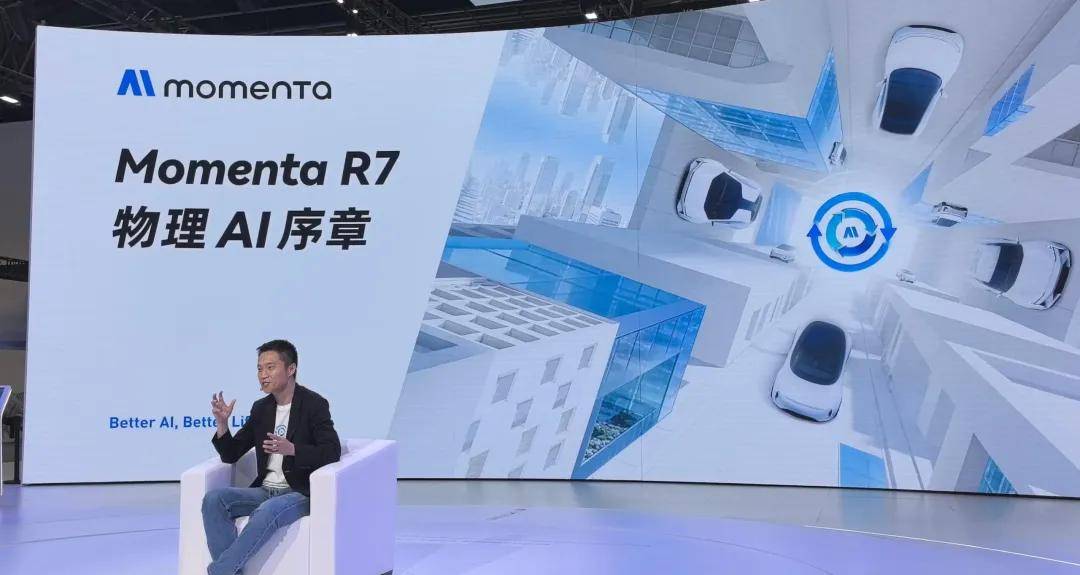
At the 2026 Beijing Auto Show, the air still carried the scent of new car leather, but the underlying tone had changed.
Amidst the chaotic technical symposium, Momenta CEO Cao Xudong made a 'doomsday-like' prediction: In the realm of intelligent driving, only 2-3 suppliers in China and 3-4 globally will quickly emerge victorious, leading to a rapid convergence of the industry landscape.
As a solution provider with over 200 cumulative fixed point (designated) cooperation models, more than 70 delivered mass-produced models, and over 800,000 installations of intelligent driving assistance solutions, Cao Xudong is confident that Momenta will capture one-third of the global intelligent driving market. At the Beijing Auto Show, he boldly stated that autonomous driving is the prologue to Physical AI, and Momenta aspires to be a platform player in this space.
Behind the grand narrative of 'Physical AI,' an awkward dilemma persists for Momenta: At auto launches by GAC, SAIC, Mercedes-Benz, and others, Momenta is merely a small line of text on a PPT slide, with its 'Momenta Quotient' remaining a taboo topic for automakers.
01 The 'Shadow Champion' in the First Tier: Strong in Algorithms, Weak in Mindshare
Over the past two years, various intelligent driving evaluation bloggers and professional institutions have tested nearly every mainstream model on the market, producing numerous intelligent driving rankings.
A paradoxical phenomenon has emerged: In unofficial or semi-official intelligent driving competitions, models equipped with Momenta's solutions frequently appear in the first tier, even outperforming Huawei ADS and Tesla FSD in certain complex urban NOA tests with their dynamic anthropomorphic performance. However, in consumers' perceptions, the top-ranked models are rarely associated with the 'intelligent driving' label.
A direct example is the second China Intelligent Driving Assistance Competition in Ningbo, initiated by D1EV. The test process was dubbed 'hell mode': The route was fully concealed before the event, with 29 kilometers hiding eight test points, including narrow community roads, blind spot U-turns, artificial obstacles, and even a deliberately tricky question like 'identifying transparent cling film.'
When the final rankings appeared on the screen, the entire automotive circle erupted. The top-ranked model was not AITO, Li Auto, XPENG, or Avatr, but the Buick Envision L7.
Some denounced it as a 'fake ranking,' while others attempted technical explanations: The Buick Envision L7 was equipped with Momenta's R6 Flywheel Large Model, trained on 4 billion kilometers of real-world data, giving it a clear advantage in complex scenarios. For instance, when facing chaotic traffic during a left turn at a roundabout, its 'perception-decision-execution' closed-loop reaction speed was 0.3 seconds faster than traditional solutions...
This ranking ignited public debate but also exposed Momenta's problem.
First, there is the 'social isolation' of technical jargon. Terms like reinforcement learning reward functions, feedback loops, and flywheel large models may amuse seasoned engineers but are akin to 'academic gibberish' for ordinary users. What we want is 'to avoid erratic e-bikes like a seasoned driver,' not to ask AI about 'end-to-end one-stage architectures.'
Second, there is the 'identity crisis' of flagship models. The IM L6, while impressive in intelligent driving, has always focused its promotion on the 'Lingxi Chassis' and 'vehicle intelligence hub'; BYD and Yangwang have adopted solutions deeply co-developed with Momenta, but all the exposure and accolades go to 'Eyes of the Gods.'
Momenta is like a top chef cooking in high-end restaurants, but its name never appears on the menu. This disconnect between being 'strong in rankings but weak in mindshare' has left Momenta in the predicament of a 'shadow champion.'
According to Cao Xudong's narrative logic, the intelligent driving market is about to enter a knockout phase, with only two or three suppliers surviving. The question is—how will automakers choose? Will they opt for technically superior parameters or solutions that drive sales? The answer is self-evident.
At least for now, explaining Momenta's leading capabilities often requires a lengthy explanation starting with the background of the founding team and backed by a list of technical terms. In contrast, Huawei ADS needs only one sentence—'Our intelligent driving is Huawei's'—to instill a sense of 'greater safety' in users.
02 The 'Soul Theory' Persists, and the 'Momenta Quotient' is Deliberately Diluted by Automakers
Momenta's inability to establish a 'brand benchmark' is fundamentally due to choosing the hardest and loneliest path: becoming the underlying operating system for global OEMs.
In the automotive industry, which emphasizes 'brand sovereignty,' automakers' attitudes toward dominant suppliers are extremely complex—akin to a 'secret affair' mixed with dependence, wariness, and anxiety. They want suppliers' technology to fill their intelligence gaps but fear being overshadowed or, worse, 'losing their soul.'
The fig leaf of 'co-research' is the first barrier preventing the 'Momenta Quotient' from becoming visible.
Take SAIC as an example. As Momenta's most important cornerstone partner, multiple models from IM and Volkswagen are equipped with Momenta's intelligent driving solutions, yet the supplier's presence is consistently downplayed in promotion. For instance, IM names its intelligent driving system 'IMAD.'
In the automotive industry, such practices have become an unspoken rule: Money can be given, data can be exchanged, but brand premium cannot be shared. Automakers need to prove to capital markets and consumers that they possess 'full-stack self-research' capabilities, leading to the deliberate dilution of the 'Momenta Quotient.'
This dilution is even more blatant in the face of global giants like BBA and Toyota.
While Huawei ADS accelerates its penetration into the fuel-powered vehicle (fuel vehicle) market through collaborations like the Audi Q5L, Momenta has been 'knocking on doors' at Mercedes-Benz and BMW's R&D centers for years.
These established luxury brands choose Momenta for its global mass production capabilities and low-cost adaptation solutions. In their eyes, intelligent driving is merely a feature on the configurator. Mercedes-Benz's promotion pages will mention ' Excellent safety assistance ' (exceptional safety assistance) but never 'Powered by Momenta.'
In contrast, Huawei ADS breaks the curse not just with technology but also with the traffic (traffic) and brand endorsement it brings to automakers. Partners like Seres and BAIC are willing to 'surrender their souls' for 'survival rights' because users buy AITO or Genesis for the 'Huawei factor.'
By 2026, Huawei ADS's market expansion has accelerated: At a launch event themed 'Integrating Intelligence into Every Vehicle,' Huawei ADS adopted an almost 'saturation attack' posture, collaborating with GAC to create the Qijing, with Dongfeng to launch the Yijing, and with SAIC-GM-Wuling to introduce the Huajing.
Notably, the Huajing largely signifies that Huawei ADS's autonomous driving and intelligent cockpit solutions will no longer be confined to the mid-to-high-end market above 200,000 yuan but are likely to penetrate the 150,000 yuan market in 2026—the current price range dominated by Horizon Robotics and Momenta.
As a pure technology platform, Momenta currently lacks strong bargaining power to 'drive sales.'
If automakers perceive your technology as merely a convenience—something that, if promoted alongside their brand, would dilute their own value—the outcome of the game theory (game) is clear: becoming the 'thermal underwear' of the intelligent driving field—essential, life-saving, and invisible under the spotlight.
The upside is that even as 'thermal underwear,' Momenta's data volume can grow exponentially, solidifying its technical foundation. The risk is that if the 'Momenta Quotient' fails to become a hard currency that users actively seek, like 'Intel Inside,' it remains vulnerable to replacement by automakers at any time.
03 The 'Specialized Storyteller': When Elitism Clashes with Traffic Logic
In the second half of the intelligent driving industry, the thickness of algorithms matters, but the breadth of 'persona' often determines victory.
Harmony Intelligent Mobility has Yu Chengdong, who excels at turning dry technology into super IPs like 'far ahead' and 'changing the world'; XPENG Motors has He Xiaopeng, who embodies the stubborn image of a 'tech geek who never compromises'; Li Auto has Li Xiang, who precisely targets family users' safety concerns with a product manager's empathy...
Momenta's founding team, by contrast, is a typical 'tech elite faction.'
Cao Xudong, often active in top academic forums and R&D centers, is known for his minimalist, pragmatic, and calm style—which may be perceived as 'boring' in the consumer electronics-driven automotive market.
Reviewing Cao's public speeches over the past two years, he still attempts to 'logically deduce' his way to winning over audiences: discussing the R7's reinforcement learning world model, algorithm convergence speed, and diminishing marginal costs. These topics are impeccable academically but a 'disaster' in mass communication.
However, Cao is clearly trying to break out of the elite context and seek resonance with a broader audience.
During the Beijing Auto Show, he not only predicted the rapid convergence of the industry landscape but even shouted slogans like 'hoping to write the legend of the Eastern Silicon Valley with all Chinese AI companies.'
The dissonance lies in the fact that it feels like using the rigor of 'linear algebra' to promote a 'trendy restaurant.' The so-called 'bold statements' often fall flat due to their lack of concrete, relatable emotional connections.
To some extent, Cao might consider emulating Qianli Technology's Yin Qi—focusing on his technical strengths while leaving the stage to more expressive figures like 'Zhao Ming.' In a single launch event, Zhao Ming used phrases like 'defeating Tesla' and 'becoming a top intelligent driving player in three years' to give Qianli Intelligent Driving a significant boost in visibility.
Keep in mind that Qianli Technology's intelligent driving revenue in 2025 was just 350 million yuan, accounting for less than 4% of total revenue. As a newly validated intelligent driving enterprise, even with Geely Group as its majority shareholder, it would struggle to make waves in the industry.
Qianli Intelligent Driving's rise to prominence and its ambition to challenge 8 million vehicle installations in three years confirm a shift in the underlying logic of intelligent driving: It is no longer just a Tier 1 supplier for automakers, nor does it enjoy the comfort zone of the Bosch era. Those who lag are not just left behind—they are eliminated.
The pride of tech elites often lies in believing that 'a good product speaks for itself,' but in the 2026 intelligent driving arena, a good product that cannot speak will likely drown in the noise. In today's heavily filtered information environment, failing to capture users' attention within 3 seconds is a failed marketing effort.
For Momenta, increasing its 'Momenta Quotient' in the automotive market requires not only iterating model parameters in the lab but also 'befriending' consumers under the spotlight. After all, in the final battle of convergence, only remembered brands possess survival and bargaining rights.
04 Epilogue
In a converging landscape, there is no middle ground—either define the rules or exit quietly.
For Momenta, 800,000 vehicle installations are both a source of confidence and a warning: It must stop being a supporting actor in sales pitches and strive to become the protagonist that owners pay for. With Huawei ADS already infiltrating the luxury fuel vehicle segment and moving toward lower-tier markets, the window for Momenta to prove its 'Momenta Quotient' is closing.
Between disappearing heroes and visible pillars lies not just algorithms but also user word of mouth (reputation) and cognition (perception).
-
![]()
Expert Interpretation of New Policy Combination: Activating the Trillion-Dollar Automotive Aftermarket
-
![]()
Doubao Goes 'Professional', Volcano Rolls the Snowball
-
AI: No Sign of a Bubble!
-
![]()
NVIDIA-Backed AI Unicorn Secures $1.5 Billion Funding: Revenue Soars 2000%
-
![]()
Doubao Pro is Here: How Can Seed 2.1 Be Integrated into Real Processes?
-
"PCB Juice" Sees Four Consecutive Declines: Even Computing Power Material Suppliers Can't Lift This "Old Stock"
-
![]()
Potential 'Seismic Shift' in the U.S. TV Industry: Competition Shifts from Hardware Sales to Traffic Entry Points
-
![]()
Audi A6L's Defense in the Luxury C-Class Market: Following Huawei's Smart Driving Integration, Is Large-Battery HEV the Next Move?