Audi's 2026 Q1 Performance: Declining Financials, Yet Easing Capital Market Worries?
 05/21 2026
 460
460
Introduction
When offering discounts to sustain sales proves ineffective, why not try the opposite approach?
At the close of last month, Audi led the way in announcing its financial results for the first quarter of 2026.
To be candid, if we liken periodic financial reports to a report card for an automotive brand, Audi's Q1 2026 performance is far from stellar. Not only did revenue decrease, but sales also took a hit. Particularly in the Chinese market, the 12% year-on-year sales decline appears to mock its persistent “profit-for-market-share” strategy in recent years.
However, if we delve deeper than the surface data, we find that capital markets are actually reassured by this seemingly “failing” report card.
Why? Because as blind “price-for-volume” strategies reach their limits, Audi has finally learned to “cut losses to survive.”
Let's get straight to the point and summarize Audi's true situation in Q1: proactively reducing speed in a storm. Although the ship slows down, its course finally stabilizes.
This article will explore how Audi, amid the global new energy vehicle reshuffling and U.S.-Europe tariff disputes, charts new courses in these treacherous waters.
01 “Frugality,” Though Passive, Proves Effective
Judging by the overall figures, Audi had a challenging three months.
Revenue stood at €14.178 billion, down 8.1% year-on-year; global sales reached 364,900 vehicles, a 6.1% decrease. Yet amid these negatives, two key metrics drew industry attention: the operating profit margin surged from 3.5% to 4.2%, while net cash flow soared from a negative €61 million last year to a positive €883 million.
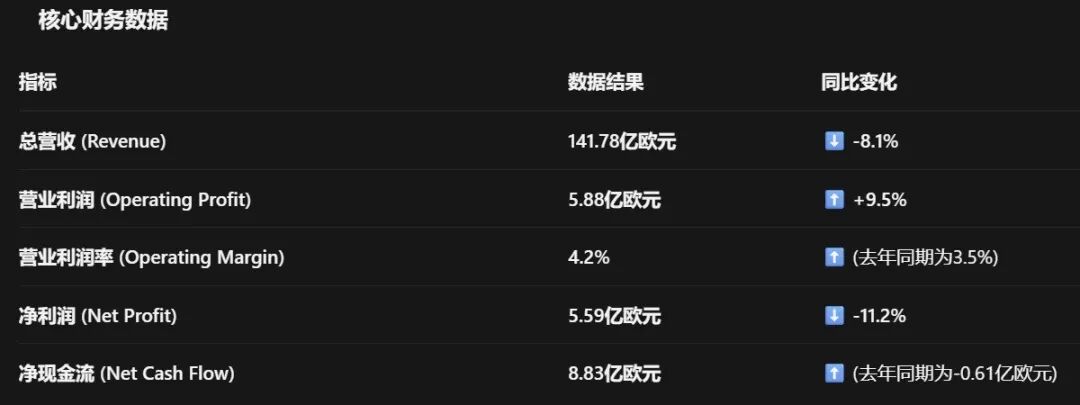
What kind of magic is this? The answer lies in extreme cost control and efficiency improvements.
Under the leadership of CFO Jürgen Rittersberger, Audi's theme this quarter has been meticulous cost-cutting based on rational and rigorous financial logic. As Rittersberger put it: “The stable sales markets and predictable conditions of the past no longer exist. The pace of global environmental change has accelerated significantly, with a clear impact on our business. The results clearly show that urgent action is needed. Therefore, we are optimizing our cost structure and implementing efficiency measures.”
Even in the face of sharp profit declines in China and U.S. tariff headwinds, Audi avoided frantic discounting to clear inventories. Instead, it addressed gaps from rising raw material costs and new model depreciation through industrial performance optimization at the operational level.
Avoiding blind internal competition and preserving cash flow became Audi's top priorities. While this may sound defensive, in today's brutal auto market, holding €883 million in cash means securing ammunition for the next product battle. Improving per-unit profitability matters far more than vanity sales numbers.
02 Audi “Finally” Advances to Hybrid Stage
On the new energy transition front, Audi's current stance is somewhat... elusive.
Originally, Audi planned to forge ahead in the battery electric vehicle (BEV) sector. Yet Q1 reality shows: BEV deliveries around 42,000 units, slightly down year-on-year. In stark contrast, plug-in hybrid electric vehicle (PHEV) deliveries exceeded 30,000 units. While PHEV sales may seem unremarkable, compared to 11,500 units in Q1 2025, that's nearly 160% growth!
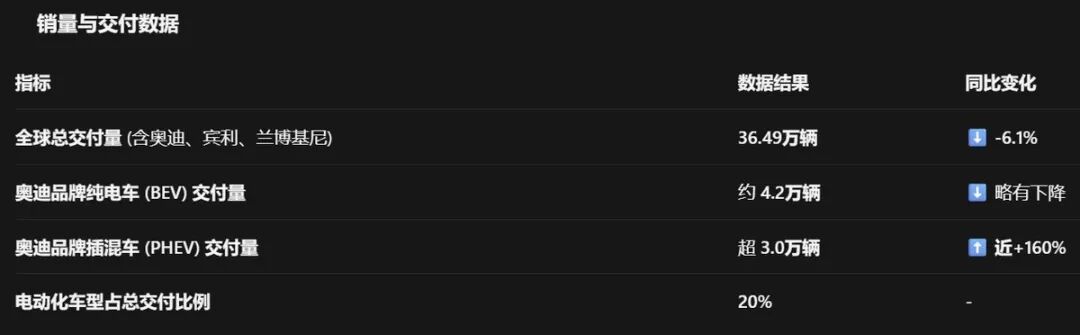
These numbers hold real-world significance. They reveal a simple truth: during transitions, consumers are more honest than automakers.
Clearly, despite Europe's early push for vehicle electrification and North America's Tesla-led vanguard, both regions have only just reached China's stage from five years ago—owners gradually accept new energy vehicles but immediately confront range anxiety and inadequate charging infrastructure.
For now, U.S. and European users vote with their wallets, choosing the most pragmatic PHEV models. Audi keenly captured this signal, avoiding KPI-driven pushes for BEVs and instead letting PHEVs become firefighters for profit and sales.
However, this doesn't mean Audi abandons its BEV roadmap. At best, it's another case of “actions speak louder than words.” Current PHEV products essentially serve as transitions for tomorrow's BEVs while buying time.
Last August, the Q6L e-tron, built on the premium PPE BEV platform, launched, while the A6L e-tron began deliveries in April. Meeting market expectations with PHEVs while advancing core BEV products proves a clever and rational choice.
03 Leveraging Local Strengths in China, Grappling with Tariffs in North America
If financial reports resemble world maps, Audi's Q1 performance across continents resembles a microcosm of geopolitical drama.
In China, Audi faces a whirlwind of “dimensionality reduction” attacks.
Overseas luxury brands, particularly Germany's Big Three (BBA), once built “brand power” over a century that domestic brands found insurmountable. Yet in the new energy-smart era, refrigerators, TVs, sofas, plus intelligent human-machine interaction and capable driving assistance systems, allowed domestic “9-series” products to shake BBA's foundations within two to three years, aggressively eroding market share.
Especially after 2025, with domestic brands' reputations solidified, direct competition became unwise. Thus, Audi made a strategically significant decision: leverage local strengths.
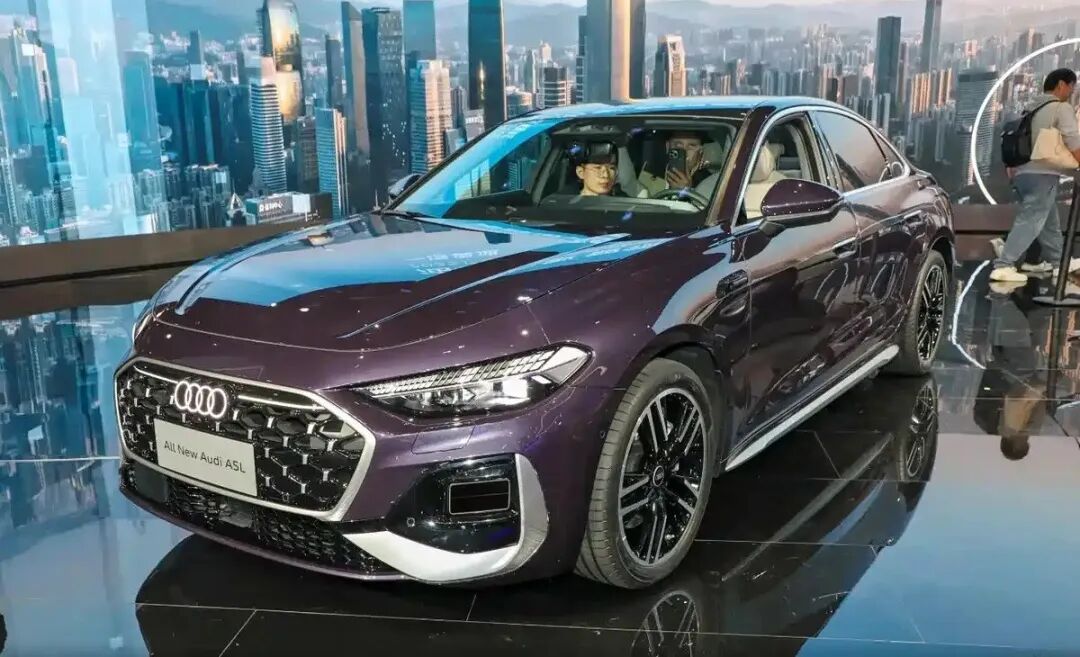
Figure: Can fuel cars be smart? The answer now exists.
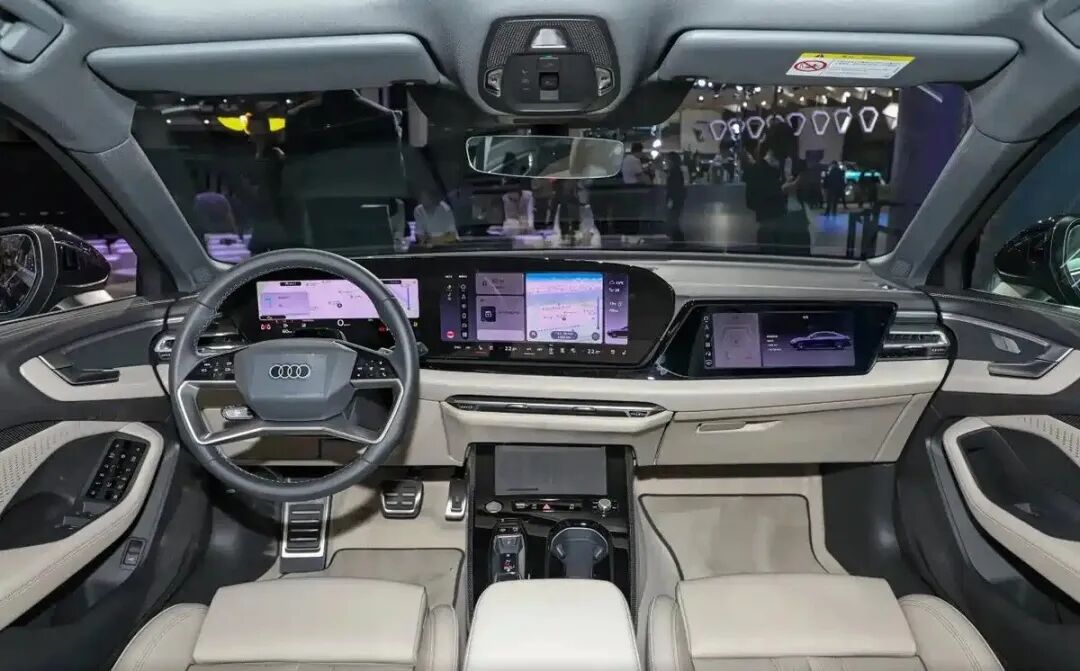
Late in smart technology adoption? Partner with the strongest local players. Audi not only integrated Huawei's ADS 3.0 intelligent driving system into its PPE platform BEV flagships but also applied it to mainstream fuel models facing generational shifts, breaking the myth that “fuel cars can't achieve high-level intelligent driving.” Through collaborations with Momenta and other local tech firms, it accelerated high-level driving assistance deployment.
Acknowledging competitors' strengths and forming alliances marks Audi's first step to regroup in China.
North America remains Audi's biggest pain point in Q1.
Affected by U.S. tariff adjustments and EV subsidy cancellations, Audi's deliveries in North America (excluding Mexico) plummeted 27%. This cliff-like decline forced Audi's strategy: “Local for Local” (produce locally, sell locally).
To circumvent high tariffs, Audi is accelerating its global production network restructuring.
For example, shifting some capacity to Mexico's San José Chiapa plant and considering further expanding North American localization ratios. This reflects not just Audi's predicament but a collective strategic shift among BBA brands facing deglobalization trends.
In contrast, Europe offered Audi some relief, stabilizing with nearly 6% growth. Particularly in Germany, BEV deliveries surged 41%. Yet this stability is temporary. As Chinese new energy automakers accelerate overseas expansion, Europe's “comfort zone” will soon face brutal price wars.
04 Epilogue: A Century-Old Giant's Clarity and Struggle
Audi's Q1 2026 reveals a century-old brand shedding arrogance, learning humility, yet retaining powerful assets.
Instead of spinning attractive narratives like some new forces, Audi chose the most straightforward but practical methods—cutting ineffective internal competition, prioritizing cash repatriation, betting on PHEV transitions, and allying with local intelligent driving firms—to survive this prolonged industry winter.
Has the BBA era truly ended? It's too early to conclude, but change is both necessary and urgent. As Audi CEO Gernot Döllner stated: “In a world where customer needs vary by region, the ‘world car’ business model increasingly fails. Market-specific solutions and models become essential. The courage to pursue new partners and develop novel branding approaches is no longer optional but a prerequisite for competitive advantage.”
This old giant is clumsily but diligently adapting its stance. As external variables stabilize in the remaining year, Audi's non-China global operations should regain stability.
In China, success hinges on whether owners will continue valuing its fuel-era “luxury” legacy once Huawei intelligent driving-equipped generational products fully launch.
Editor-in-Charge: Shi Jie Editor: He Zengrong
-
![]()
Audi's 2026 Q1 Performance: Declining Financials, Yet Easing Capital Market Worries?
-
Is the 'Price War' Drawing to a Close? Several New Energy Vehicle Firms Stealthily Hike Prices
-
![]()
Hainan Offers Up to 8 Million Yuan in Rewards for AI-Powered Solo Entrepreneurs—How Can You Seize This Opportunity?
-
![]()
Is Tesla Set to Launch Supervised FSD in China?
-
![]()
The Reference Frame of AI Has Changed After Google I/O
-
![]()
A Monumental Global Shift Unfolds: The Strategic Moves of BYD, Geely, and Chery
-
![]()
Toyota's Fiscal Year 2026: The Top Earner Warns of Tough Times Ahead
-
![]()
Google’s New AI ‘Paywall’ Put to the Test: ‘Freeloaders’ Get a Pass, but Their Experience Falls Short